When I started off having an interest in DJing I went around to a a friend’s house whose older brother was into audio engineering. As well as having one of the first set of Technics 1200s I had ever seen he had a Revox B77 tape recorder. He used to record tracks on to the tape reels and then splice the tape to make tracks longer by extending breaks, or extend the breakdown or vocal hook of a track into staccato repetitions; which sounded like Max Headroom-esque stutters of vocal hook or ‘machine gun’ drum breaks.
Splicing tape took patience, practice and a modicum of skill to achieve. At the time however it was the Revox B77 tape machine itself that I fell in love with. These machines were made in Switzerland and felt like they were hewn from aluminum. Even the buttons were solid, giving positive feedback through a satisfying clunk when pushed and the VU meters glowed with a warm light and needles danced as the sound levels went up and down. As interfaces went, the analogue controls of the tape machine have yet to be beaten by anything that Apple has come up with. All of this belied the complex engineering that happened inside.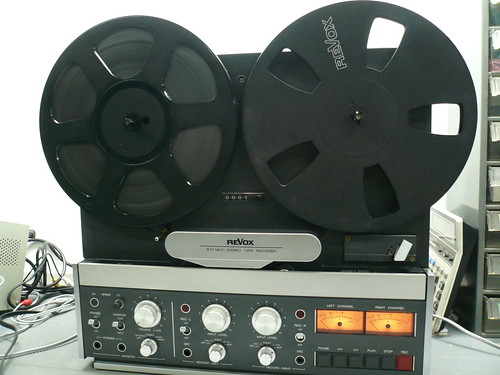
All of this engineering expertise turned out machines that were about the best recorded sound that money could buy. Many artists today record digitally, transfer on to an analogue tape machine like the B77 and then master back to digital for CD manufacture and iTunes reproduction because of the way analogue treats sound.
Revox was a consumer facing brand of Swiss professional audio manufacturer Studer (now part of Harman International) and much of that professional engineering went into the Revox products. The Revox tape machines were professional ‘wolves’ in consumer electronics ‘sheep’s’ branding.
The B77 series of machines came out in 1979 and sported full logic controls (which made things smoother) and direct drive motors (which meant that everything got up to speed faster), but otherwise improved on the A77 of the late 1960s. The machine used 10 1/2 tape spools to make its recordings on with a tape throughput of 15 inches per second on most models which was the professional master recording standard and one could vary the speed up to over 20 inches per second if you wanted to – this operated a bit like pitch control on a Technics SL-1200 turntable.
The B77 series came in a number of guises:
- The LS ran at low speeds for radio stations and call centres that needed to log everything that happened
- The basic model which ran only at consumer speeds
- The HS which ran at professional tape recording speeds
- The PR99 (Mk I, II and III) which were designed to be more edit friendly and had less knob controls which could get in the way of the manual tape splicing process
All of this engineering came at a cost and the Revox B77 weighed a proverbial ton (actually closer to 20Kg for the machine itself plus whatever you carted it around in, like a studio rack or a flight case)
Quarter inch tape recording isn’t dead, the tape is still made around the world by Quantegy, RMGI, ATR Magnetics and Jai Electronic Industries. Otari Inc still makes an analogue studio master machine and Denon still sells a similar machine for broadcast purposes in Asia.
In addition, high end studios still use multi-track digital reel-to-reel machines when you want to record to 48 tracks as the time code technology and audio encoding technology used in them is superior to more modern computer-based solutions. More related content can be found here.