Month: October 2015

  • Louis Vuitton Series 3 exhibition, 180 Strand, London

    Having been involved in a number of events over the past couple of years where creative digital work intersected with experiential marketing I was keen to look at Louis Vuitton Series 3 exhibition before it closed.

    Burberry tends to get the plaudits for digital experiences in the luxury sector and they do a lot of interesting work. Louis Vuitton’s initiatives like an online service that allows ladies to personalise their bag a la Nike ID.

    I found it interesting that Louis Vuitton’s approach seems to have been guided by exclusivity not being the same as accessibility. There was a wealth of helpful staff, you were positively encouraged to take your own pictures – again unusual for a luxury brand, many prefer to give you content that upholds their standards.

    A few touches that I really liked at the Louis Vuitton Series 3 exhibition

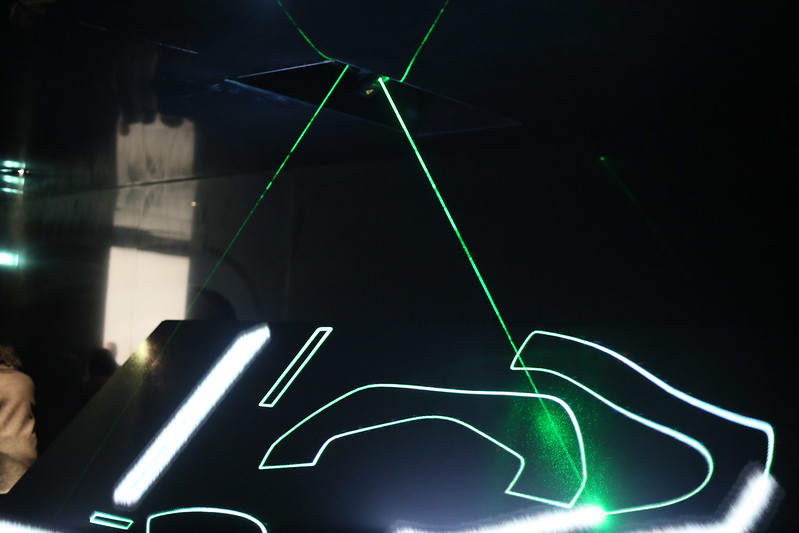
    #LVSeries3 Louis Vuitton Series 3 exhibition, 180 Strand, LondonLV logo motion graphics at the start of the exhibition, no real surprise right? What the designers did was remove the polarisers from the LCD screens so that the screens are apparently blank. The polariser is laid out in vertical strips at different distances and widths from the screen. This gives a kind of lenticular effect when you walk past it. This modern logo morphs through matrix-like digital noise and on to the more traditional LV design.
    #LVSeries3 Louis Vuitton Series 3 exhibition, 180 Strand, London
    It seems absurdly simple, but the idea of using projecting mapping techniques on a flat LED screen to emphasise how Louis Vuitton products are cut from a common material before being assembled was clever. Just because you have projection mapping technology at your finger tips means that one often looks for complex shapes like building fronts rather than a flat panel.
    #LVSeries3 Louis Vuitton Series 3 exhibition, 180 Strand, London
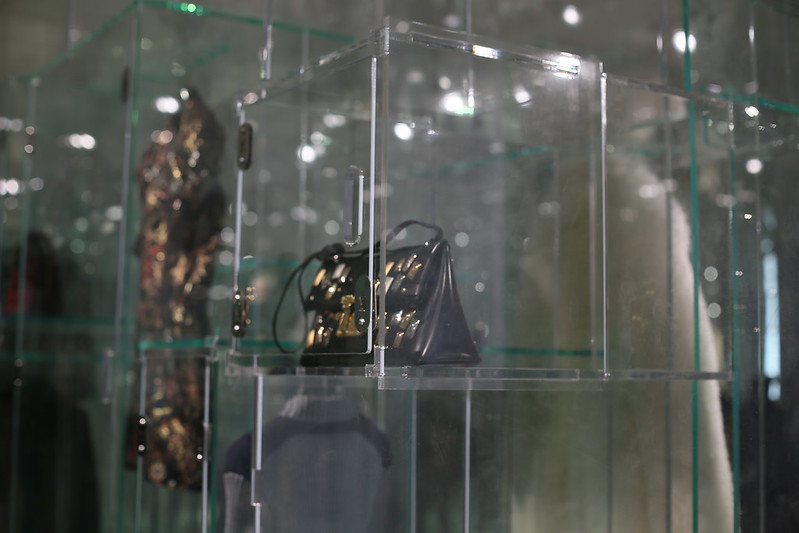
    The glass bins got the balance right between protecting the product so that it doesn’t look grubby from being over-handled, whilst still making it accessible and tactile rather than a museum experience.

  • Asian FMCG + more things

    Asian FMCG gain ground on global brands in their home market | Kantar World Panel – MNCs losing out to own local Asian FMCG brands. Local Asian FMCG brands are more nimble and are closer to the customer. There is also a changing attitude to (western) MNCs – as consumer’s nationalistic sentiments in markets like China and India start to manifest itself in their shopping basket. More FMCG (fast moving consumer goods) related content here.

    Alibaba just offered $3.6 billion to take over the YouTube of China | Quartz – it makes sense. Tencent has been challenging Alibaba in other areas and already has the QQ video platform. QQ however isn’t as big in terms of views as YouKu / Tudou. The most obvious opportunities around YouKu/Tudou for Alibaba are selling online media a la Amazon and (QQ Video in China) and social commerce with life video a la the Home Shopping Network – but done by influencers on their own channels

    China’s big media challenge | Marketing Interactive – twice as many touch points required compared to just five years ago. A huge decline in media effectiveness

    W+K Shanghai Gets Inspirational in New Tiffany’s Campaign | AdWeek – focus on confidence rather than status in a series of documentary type videos (paywall)

    Getting LEAN with Digital Ad UX | IAB – Light Encrypted Ad choice supported Non invasive ads

    Twitter now shows advertisers which ads perform better | VentureBeat – smart move by Twitter

    TeliaSonera accused of making €1.8bn in corrupt payments | TotalTelecom – some interesting reading

    China’s middle class has overtaken the US’s to become the world’s largest | Quartz – pure numbers

    China’s `Big Three’ e-commerce platforms extend lead | Kantar China – interesting how JD comes out top in the benchmarking

    Facebook Goes On Privacy Offensive in Europe | WSJ – (paywall)

    Aspirationals: Who are they and why they matter to marketers | Marketing Interactive – positive about outlook so more likely to consume?

  • AT and T & more things

    Contact AT and T’s CEO, hear back from his lawyer – LA Times – this sounds like a PR train wreck for AT and T. AT and T aren’t having their needs served by the lawyer’s conduct

    China—not online porn—is why Playboy is dumping nude photographs | Quartz – its all about licensed clothing and other products

    The world’s most popular app will soon be where you do your shopping, too | Quartz – geofenced Facebook ads anyone?

    I, Cringely Dell buys EMC and gets the corporate cloud for free – I, Cringely – on the money analysis by Bob Cringely

    IoT Net Gets Boost in Europe | EE Times – how will this affect Qualcomm et al?

    PC Sales Plummet in Q3 | EE Times – interesting decoupling between OS upgrade and hardware upgrade on the Windows eco-system

    Andy Rubin: AI Is The Future Of Computing, Mobility | EE Times – driven by data from IoT etc – there will be a need for machine learning analysis

    Laser surveys light up open data | Creating a better place – UK Environment Agency data, would probably be also handy for anyone with cruise missiles

    Luxury brand Marc Jacobs abandons Tsim Sha Tsui – mainland purchase down and high rents I guess. More luxury related posts here

    SMARTPHONES: Price Wars Topple Huawei, ZTE Supplier – Bottom line: The bankruptcy of a major component supplier to ZTE and Huawei is the latest sign of stress in the overheated smartphone sector

    Bankruptcies in China pose challenge for foreign creditors | SCMP – quite handy primer (paywall)

    DEXTER – Yahoo! Pipes worthy successor

    Twitter’s Next Hail Mary, Project Lightning, Has Arrived | Re/code – I think the key targets on this are Google News, Flipboard and Apple’s News functionality

    Google’s Search Boss Talks Surviving and Thriving in an App World (Full Video) – Amit Singhal says Google will not only survive the transition to mobile apps, but will thrive in it

  • Shop OS versus mobile OS

    I decided to write this post to reflect on the very different visions of digital retailing that consumers are currently experiencing. I’ve labelled these two visions mobile OS and Shop OS respectively.

    The Mobile OS
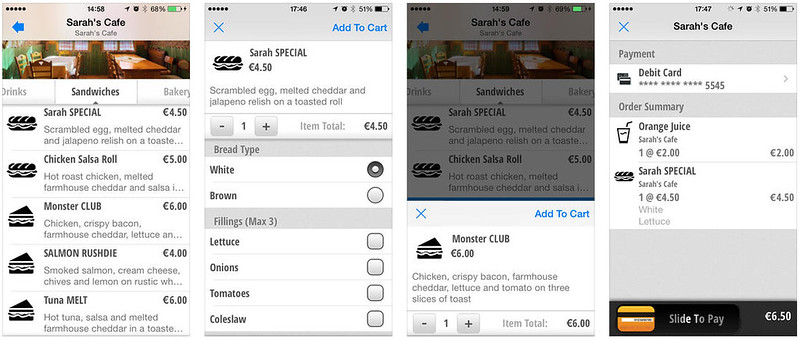
    Qkr!I went to Wagamama with some colleagues from Racepoint where we were encouraged to all download Qkr!. Qkr! is an application that was developed by MasterCard rather than the restaurant, it isn’t exclusive to Wagamama either. MasterCard has built the application with a view to building a wide eco-system merchants. It is notable that the application is actually card issuer agnostic, so I was able to set up an account with a Visa card. Wagamama bribed us with free desserts to download the application, so they clearly have some skin in the game. We downloaded it, set up our account with at least one mode of payment, our email address and a password. One of us became the host and gave us all a number which was our common bill. We could order straight from the app and food was supposed to arrive. When we wanted to pay we selected our items and paid our share of the bill. A couple of us only had cash, so they paid a friend and the friend paid on the app. If I am absolutely honest with you, it was a lot of work for casual dining and but for everyone around the table working in technology marketing (and so having a modicum of curiosity about things app-related) – it probably wouldn’t have had us all on board. Now that we have the app on our phone, I could see Qkr! hoping that we use it regularly and likely try and steer us to its merchant network though notifications and special offers. From Wagamama’s point-of-view it saves them from building, testing and maintaining a bespoke application. There are also presumably productivity benefits from reducing the order taking staff required. Qkr! didn’t prevent Wagamama from making mistakes with our order and we ended up one chocolate cake down. Contrast this with the approach that McDonalds have rolled out in their new (to me) Cambridge Circus branch. The area between the counter and the entrance is dominated by a series of vertical kiosks. Digital McDonalds
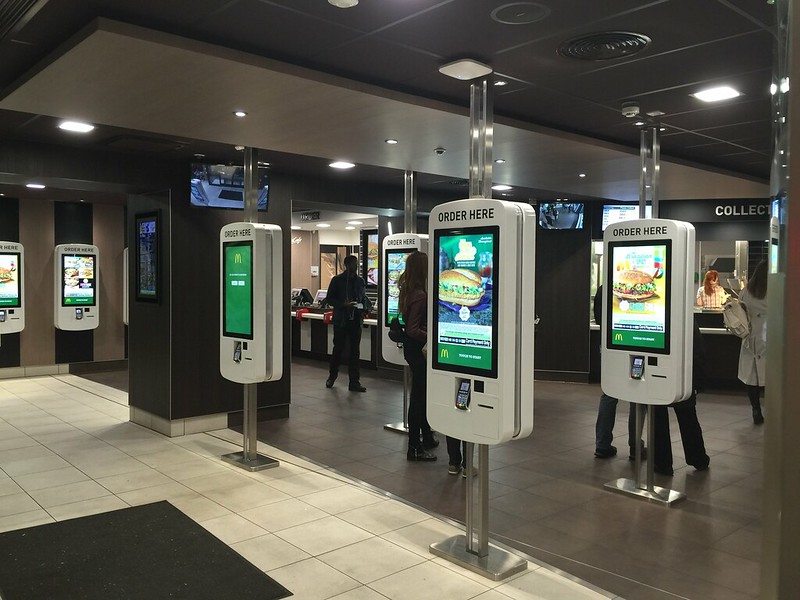
    These kiosks contain an identical touch screen interface
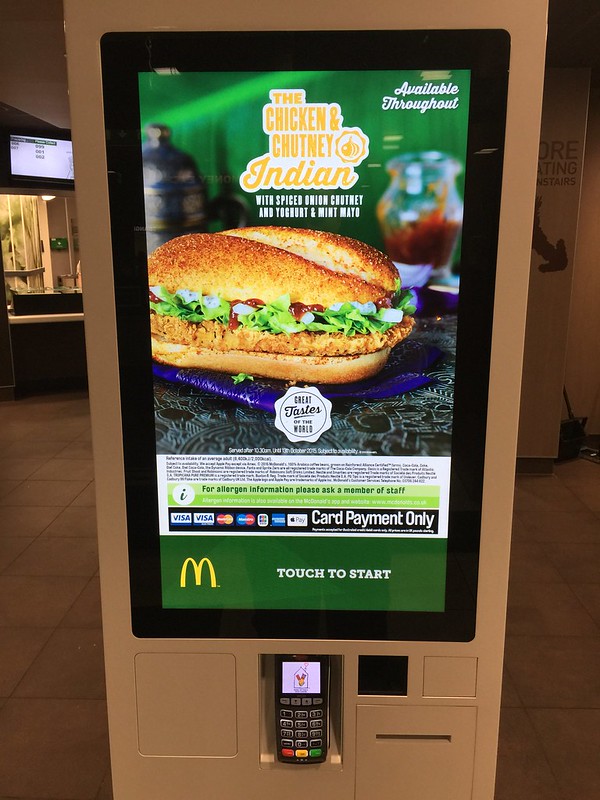
    Digital McDonalds

    With a basic card reader on the bottom, there is no Apple Pay or NFC facilities, just a chip and PIN reader. The touch screen menu takes you through a smartphone app like experience, if smartphones came with 27 inch screens. Once payment was successfully received, you then received a deli counter style receipt Digital McDonalds
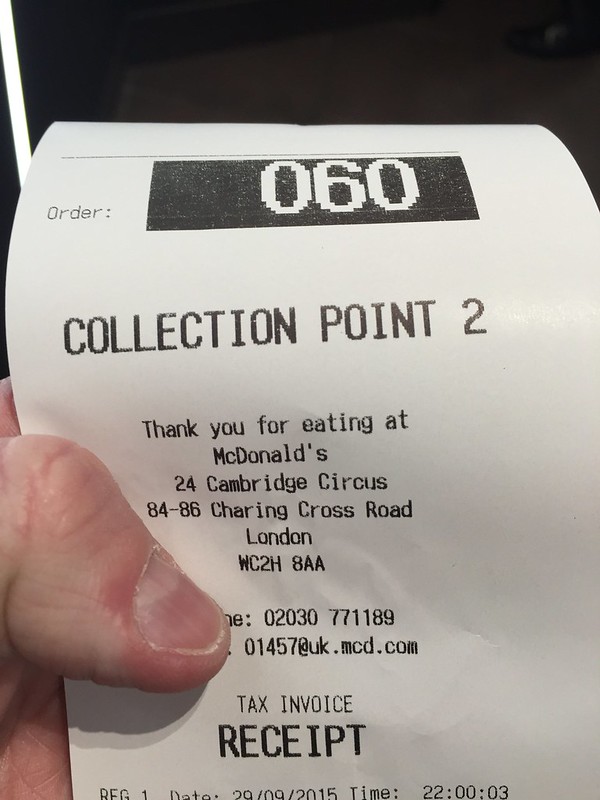
    And collected from a counter when your number appeared on the screen
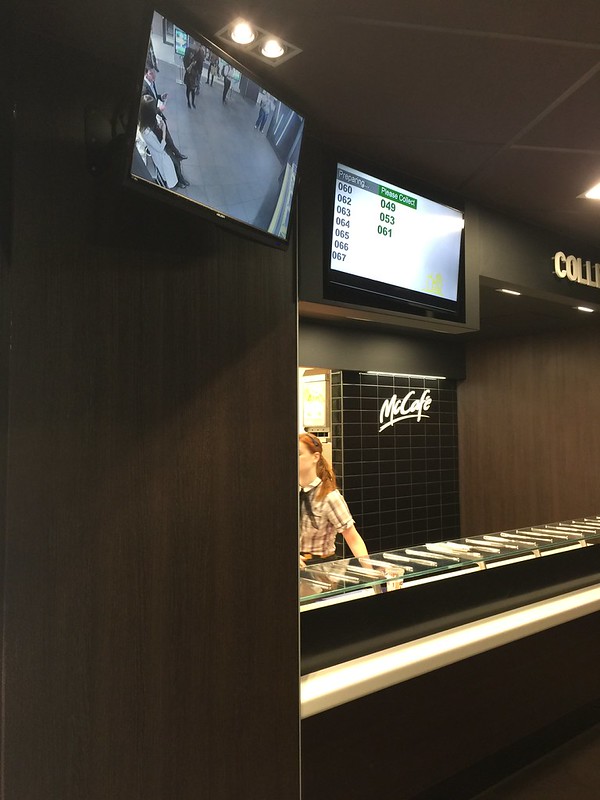
    Digital McDonalds

    This is all designed to reduce consumer interaction and improve efficiency in the restaurant, if there was any way to cheapen the McDonalds’ experience making you queue like an Argos seems like the ideal way to go. The logical progression for this would be to move back to the Automat format (presumably this time using some sort of algorithm to optimise production. automat
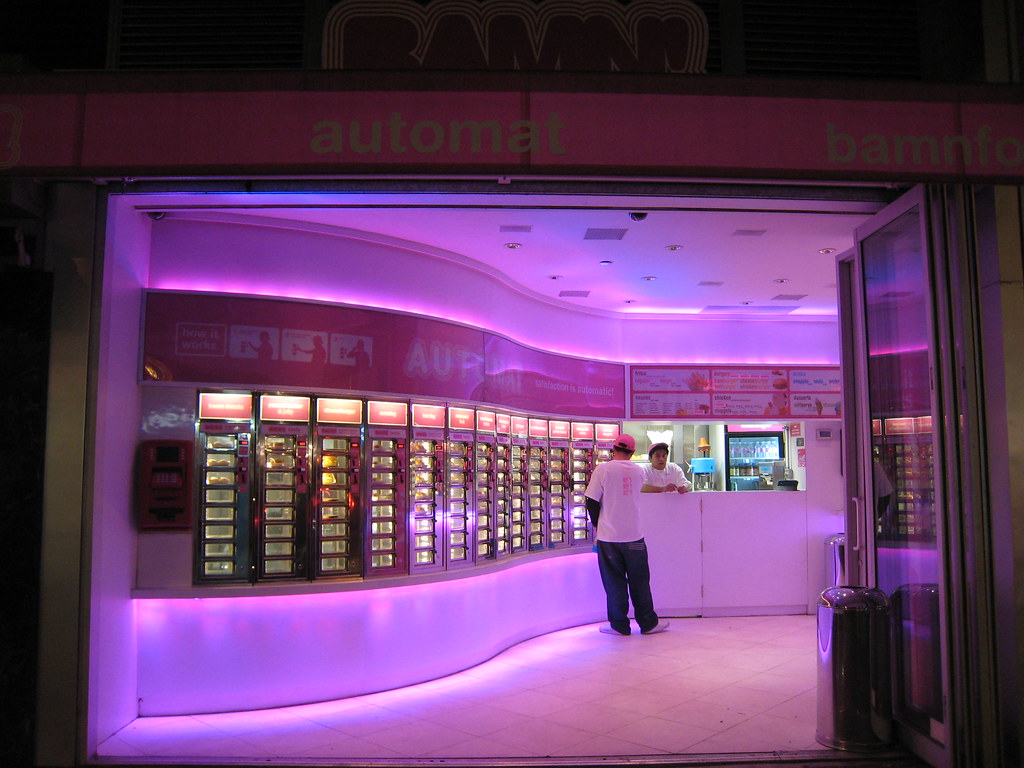
    The irony of it all is that the rise of fast food restaurants like McDonalds killed off the Automat as a trend in North America and many Automats were converted into Burger King franchises.

    Both Wagamama and McDonalds may have had some efficiency gains but lost out in terms of brand experience, they moved a bit further towards commoditised casual dining and fast food respectively – which goes against the brand equity that they have striven hard to build over decades.

    Shop OS offers some advantages over Mobile OS, you can standardise on the hardware to reduce coding and testing requirements. It is ideal for tourists who may not want to roam on foreign mobile networks, nor be able to navigate free wi-fi offerings. The flip side is that there isn’t the same opportunity to capture customer data and behaviour, the notification screen on the smartphone is a key place for brands to intercept the customer using geofencing.

  • Microsoft Windows event

    I’ve been in-and-out of meetings that prevented me from reflecting fully on the Microsoft Windows 10 event of October 7, 2015. Microsoft put a lot of content out there which is worthwhile picking through. I have put these items in the order that they occur to me rather than an order of importance.
    Windows 10 : Everything You Need To Know About

    Microsoft Windows 10 is designed to run on a wide range of devices, a by-product of this is that the PC on your desk maybe a phone connected to a screen and keyboard. Now this may not work for all applications, but it could be enough for browser-based needs. It also means that bring-your-own-device could move beyond having your email on your phone.

    The Surface Pro 4

    Whilst Microsoft has undergone a regime change since the launch of the original Surface, somethings haven’t changed. I think that the Surface Pro 4 represents a continued effort to decapitate the Microsoft PC eco-system. The targets in the frame are devices like:

    • Lenovo La Vie Z
    • Lenovo Yoga 3 Pro
    • H-P Spectre 13x 360
    • Dell XPS 13

    All of these devices broadly fit into the 13 ultra notebook format that Apple plays in, but I think that the goal is to maximise Microsoft’s revenue share of the Windows eco-system. The hardware design hasn’t done the wider Microsoft brand any harm at all.

    New Lumia devices

    The 950 and 950XL put Microsoft in the game, at least from a hardware perspective with the Android eco-system, comparing favourably on hardware specifications with the likes of Huawei, LG and Samsung. What I found more interesting is the allusion in Microsoft’s own commentary of the event that the phones would face a gradual rollout in markets and Microsoft wouldn’t be rolling it out to all markets in Europe.  Don’t necessarily expect to see these handsets being rolled out in multi-national companies without an extensive availability and support network.

    Whilst mobile network providers would like a third eco-system to reduce the power of Android and iPhone, there doesn’t seem to have been universal carrier acceptance of the devices. This maybe partly due to the tighter integration of Skype in the Windows 10 OS?

    Xbox on Windows 10

    Xbox need to bring more customers on board and having backwards compatibility with Xbox 360 games provides a more cost effective gaming experience thanks to eBay and other used console game exchanges. It also does beg the question about possible non-gaming or even enterprise use that could be made of the new Xbox (beyond running Linux on them).

    Rolling out an OS so universal as Windows 10 is an interesting move. It presents some risks:

    • Compromised user experience due to different user contexts (gaming, business desktop computing, consumer PC usage, tablet experiences). A touch orientated interface on a laptop is sub-optimal for content creators who can touch type for example
    • Bloat due to the ‘Swiss Army knife’ requirements catering at a core level for different form factors and displays

    More information
    The Secret of iOS 7 | I, Cringely
    Final 2014 prediction: the end of the PC as we knew it | I, Cringely
    Thoughts on Microsoft Surface | renaissance chambara
    Skype in Windows 10 Preview: Built into Windows 10 so you can do more with friends across devices | Big Blog (Skype owned blog)
    Windows 10 Devices: a new chapter | Microsoft News