What is CNY 2024
CNY 2024 or the Chinese new year is celebrated across east and south east Asia as it marks the new year according to the lunar calendar. It is as important an advertising spot as Christmas in the UK or the Super Bowl advertising slots in America.
This Saturday marks the new year. This year is the year of the dragon, it is a time for family and for cementing relationships through gift giving. Packaging and promotions will lean heavily on red, gold or yellow colours signifying good luck and general positive vibes.
The packaging can often be very ornate as this example by Shanghai design agency The Orangeblowfish for client Chow Sang Sang shows.
In many small businesses red or Christmas decorations are often left up and enhance the lunar new year decorations. Corporate florists will bring in miniature orange trees that are also a symbol of the season. (Pro-tip, don’t try one of the fruit).
Given it’s such an important time in the marketing calendar, you see some of the most creative campaigns conducted in the region. Here’s a sampling of this year’s advertisements broken down by country.
China
China’s ‘Galapagos Syndrome‘ social platforms mean that it’s really hard for me to share campaigns with you here. In addition, many of the main advertising agencies no longer seem to share their work on more accessible platforms in the west any more. Each year it becomes harder to write a post like this. It’s almost like they’re ashamed of it.
Amushi
Food brand Amushi worked with Leo Burnett on an advert that conveys the main elements of new year celebrations. You need to watch it on Campaign Asia.
Apple
Apple has done some really interesting Chinese new year films documenting different aspects of Chinese new year and this focuses on the trials of childhood and the magic of new year. The protagonist is ‘Little Garlic’, a young girl with special shape-shifting powers.
Coca-Cola
By January 2nd, Coca-Cola already had year of the dragon cans for sale in Beijing. They created a mini-film around a family gathering, but its on WeChat. Contact me if you would like me to share it in-app with you.
Lululemon
I am guessing that Lululemon’s campaign was planned to be running across Mandarin-speaking markets as well as appealing to Asian Americans. The theme of spring is an analogue for the new year, but it is a celebration of traditional Chinese culture rather than lunar new year traditions per se. Michelle Yeoh is Malaysian but has global recognition amongst Asian cinema fans and her Hollywood appearances.
The problem is that Lululemon has fallen foul of Asian Americans and this ad might have its media spend pulled outside Asia? If it happens it would be a shame, as this is the most ‘high concept’, artistic and cinematic of the ads that I have watched so far.
Nike
Nike in partnership with Wieden + Kennedy Shanghai have been turning out high quality Chinese New Year adverts for a number of years now and this year was no exception. It took me so long to get a copy of it, that it almost missed going into this post.
If you have been in a rush to do your Christmas shopping you can empathise with the struggle of getting ready for lunar new year and the vignettes are really nicely done.
Prada
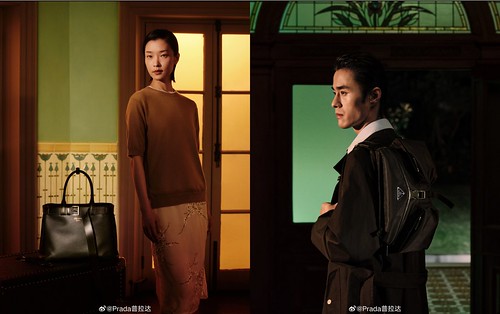
Prada did a photo shoot which is shared on Sina Weibo microblogging platform. The photographs were designed to emulate the classic mid-century elegance of Wong Ka wai’s film In The Mood For Love. This also ties into the popularity of Wong Ka wai’s recent mainland Chinese TV series Blossom set in Shanghai during the early 1990s that is similarly visually rich.
Hong Kong
Hong Kong usually doesn’t have a rich source of lunar new year video advertising. You will see print and poster ads though as sales promotions are the main driver of marketing activities.
Coca-Cola
Coca-Cola Hong Kong went with really short takes, a celebration, fireworks, a branded giveaway and dragon-branded cans make it feel as if the creative was literally dialled in. Where’s the magic that’s integral to the brand?
Watsons
Hong Kong’s ubiquitous pharmacy and beauty care retailer has a brief ad promoting their new year sales promotions and the potential to win a Mofusand co-branded ‘Jenga’-style game – which would be ideal when you have young family members over for CNY 2024.
Their associated web page has promotional price offers containing 688 which its considered to be lucky.

Macau
Macau government tourist board
I am not even going to try and explain what you are about to see. It’s special. But once you watch it, it can’t be unseen. I will leave it at that.
Malaysia
Astro
Astro is a Malaysian satellite TV and OTT broadcaster. As is common with other media businesses in Hong Kong and Singapore they rolled out a song to celebrate Chinese new year. This video showcases their varied broadcast talent.
Cetaphil
Cetaphil is a range of skincare products from Galderma. Chinese new year means looking your best, including new clothes. This combined with gifting is why the holiday makes so much sense for Cetaphil.
Coca-Cola
Coca-Cola made use of high profile 3D OOH spaces such as this one in Malaysia with a very traditional dragon motive. It’s nicely executed and fits into the magic of the brand.
Eu San Yang
Eu San Yang is a traditional Chinese medicine retailer originally from Malaysia, that now has branches in Hong Kong, Macau and Singapore. It’s advert talks about relationships particularly assumptions like ‘I thought’ or ‘I took for granted’. Click the link, as they aren’t allowing embedding. It touches on the tension between tradition and modernity that is generational and is quite meta in the way it references lunar new year adverts as a popular trope in the dialogue between father and son.
Loong Kee
Malaysian dried meat brand Loong Kee put together a music video featuring ethnic Chinese influencers and celebrities.
Mr DIY
Mr DIY is kind of like Homebase or Wilkinsons but with an extended product range. Their film has a Christmas Carol type transformation to it. I’ll leave it at that for you to enjoy.
This comedy clip explains the universal insight above really well.
Pepsi: Finish The Unfinished
Pepsi’s campaign is built around the insight that during new year meals and celebrations there are lots of partly finished cans of drinks left around. The idea of finishing something is an important part of Chinese new year, echoed in the series of Hong Kong family entertainment films released for the new year called ‘Alls Well That Ends Well‘. The original film was released in 1992 featuring Maggie Cheung, Leslie Cheung and Stephen Chow – and spawned seven sequels. The advertisement connects with a gold cup giveaway that is also tied into this the theme of ‘finish the unfinished’.
Petronas
Malaysian government-owned energy company Petronas promotes its corporate brand with a short film that riffs on the harmony of Chinese new year. They were careful to cast talent from the countries three main ethic groups: Malays, Chinese and South Asians.
Tune Talk
Malaysian mobile provider Tune Talk focuses on filial piety and the high level of change that’s signified by the Dragon in the horoscope. At first when I saw the ad I thought that it would be warning about online scams, but the story is much more straight forward. It’s fun and high energy, just what you need for lunar new year.
Watsons CNY 2024 campaign – Enter The Dragons
Watsons is part of AS Watson, the retail arm of CK Hutchison Holdings and the owner of Superdrug. They have their own branded pharmacy stores with a large range of beauty products throughout China, Dubai, Indonesia, Hong Kong, Macau, the Philippines, Qatar, Saudi Arabia, Thailand, Ukraine, Vietnam and Malaysia as you can see.
Yee Lee
Yee Lee is a Malaysian manufacturing and packaging company – imagine an analogue of Unilever and Tetrapak. Their products include food, bottled water, oral care, household cleaners, and industrial products. It also manufactures corrugated cartons and aerosol cans for a wide range of customers. The music video is notable for its use of rap lyrics. Also, notice how the cast is older than Loong Kee’s music video.
Yeo’s
Yeo’s is a local FMCG brand with a range of products including drinks, teas, instant noodles, canned food sauces and dairy products. Every household has some Yeo’s products in the pantry or the fridge. This advert neatly captures the stress and joys of new year celebrations.
Singapore
Mediacorp
Mediacorp is a Singapore government-owned commercial media company that would be analogous to the BBC in terms of the media footprint, and Channel 5 in the way it takes advertising. Chinese new year songs are a thing, with new ones launched each year. Mediacorp’s song is also an advertisement for its talent and the company’s OTT service – kind of equivalent to BBC Sounds and iPlayer.
SingTel
Singapore’s dominant telecoms provider SingTel have a reputation for delivering high quality Chinese New Year ads and this year was no exception. This time the ad focuses not only on reunion, but also remembering those people who we can no longer enjoy CNY 2024 with Mr DIY’s campaign we see greater than expected evolution of a senior citizen.
Taiwan
7-Eleven
Convenience store 7-Eleven created a 30-second spot to promote its range of Chinese new year products.
Here are the examples that I found in previous years:
The sales pitch
I work alongside Craft Associates and together have helped a number of clients including Oxford Nanopore Technologies on their successful China GTM approach and SK-II on their content strategy for Hong Kong. I have also worked with the team to help advise Chinese enterprises on going international over the years in the consumer technology space.
Whether you want to advertise to a Chinese audience, or advertise a breakfast cereal to people in Wolverhampton, you can contact us here.
More on what I have done to date here.