Much has been made this week on the Murdoch’s appearing at a parliamentary inquiry into hackgate: a scandal involving phone hacking and other nefarious practices by the media in order to get stories. What is less getting less to no real discussion is what hackgate says about the UK audience. News International is a business, if the content didn’t sell, they wouldn’t create more of it.
Content that would formerly only air in blackmail cases would appear on the Sunday breakfast table and consumers lapped up the lives of public figures. I am no fan of News Corporation’s media outlets but I feel very uncomfortable about the four-minute hate that is going on at the moment. Lots of people are enjoying the details about the how, but nobody seems to be asking about the why of the whole episode.
Like the war on drugs, the problem isn’t only one of supply, but one of latent and actual demand that will be supplied one way or the other. Whilst there are middle-class people who believe that cocaine is an ideal final course at a dinner party you will have drug cartels. Whilst you have consumers who have a prurient interest in other people’s lives there will be publications that are willing to push the envelope in news-gathering.
Why aren’t questions being asked about the thirst of UK consumers for the kind of stories that hackgate revealed. An examination of society as well as media ethics is called for.
Why did it take the murder of a child (Milly Dowling) to suddenly make the media gathering behaviour move from naughty to wrong in the general public’s eyes? More media related commentary can be found here.
My friend Tomoko was in London the other week and it was interesting seeing what excited her about London, as Tomoko’s London is very different from my own.
Firstly ‘knowing London’ means knowing central and Northwest London rather than central and East London. Shoreditch, Clerkenwell and Soho aren’t attractive; St Johns Wood and Mayfair are – big learning curve for me here, as I have assiduously avoided anything west of Soho during my 13 or so years in London.
Whilst we may think that London has everything to offer with contemporary clubs like Cargo and the East Village, it was Whisky Mist that Tomoko went to. With a clientele drawn from or aspiring to be in a P.G. Wodehouse adaption styled by Jack Wills; that you would only find me in under duress, but was what she wanted to do. Tradition and the class system trappings is a huge selling point for the UK – in terms of experience it beats Cool Britannia of modern UK life into a cocked hat. We had a drink and a catch-up late one evening in the Rockcliff Bar in The Trafalgar Hotel which I felt was a reasonable compromise.
One thing that she was surprised at was how early in general London closes its bars and restaurants on a week-day; its not as swinging as the reputation would have others believe and certainly not up to the standard of Tokyo, Seoul, Shanghai or Singapore.
Fifteen or twenty years ago, the UK had a reputation as the worst cooks in Europe. Tomoko’s trip was as much about being a gastronomic journey. She learned how to prepare a proper English afternoon tea (the rest of the world thinks that we don’t go to Pret-a-Manger and Starbucks apparently) and we had a taster menu lunch at Gordon Ramsay’s Maze restaurant (more on this in another post).
There was an interesting take on shopping:
Mitsukoshi for convenience – not having to fight your way through Mayfair, along Regent Street or up Oxford Street to Selfridges
Jermyn Street for male family presents; Covent Garden antiques market for souvenirs and bringing presnts to female family presents
Old and New Bond Street were of interest for window shopping
Which makes me think that a lot of central London retail space is looking seriously over-priced and that high footfall – long the measure of a desirable retail space can be as lethal for a shop as a branch of the Sue Ryder charity opening up next door.
All of this made think about what what my current home city means to people around the world. I have met people within my industry where having worked in London agency life carried a lot of kudos, the popularity of modern dance music elsewhere in the world was spearheaded by the middle-aged UK DJs who were involved in the late 80s acid house scene. Modern design with a twist of irreverence from James Dyson and Paul Smith to Jonathan Ives at Apple are the product of a forward-looking country. But that doesn’t seem to have translated into a brand identity for London that is less Daniel Craig and more David Niven.
Asian countries like Korea, Japan and China have managed to forge identities that are modern, yet are complementary to the centuries of culture and history that they have. On the other had, Egypt (at least as a tourist destination) is all about the ancient Egyptian society that flourished and declined 2,000 years ago. I would prefer to see London being able to balance a modern identity with a nod to the history rather than be trapped by it. Perhaps the best place to start would be through the creative destruction of the Central London built environment.
Google has finally left the Chinese market for search, so I thought I would try the alternative, hence an unscientific assessment of Baidu. My trial is unscientific in nature and not particularly rigorous. I did what most consumers would have done and searched for myself.
I was quite open-minded about this, on the one hand Google has been killing the search market in Europe, nothing can touch it in the EU and they have made moderately successful forays into other sectors as well. I also know that Google is not all conquering. In fact the wheels start to come off the Google search wagon when you venture into areas with non-Roman languages such as Russian, Korean, Japanese and Chinese.
On the other hand, Robin Li over at Baidu is no slouch. Baidu is famous for is huge index and its continued appetite to crawl content whenever and wherever it can find it.
Baidu like its Korean counterpart Naver has also managed a successful social search product running a question-and-answer service like a better version of Yahoo! Answers – largely free of spam and a more middle-class range of participants provide highly relevant quality content.
It is also blatantly obvious that Baidu doesn’t care whether it attracts a potential English-speaking audience as the entire site apart from investor relations is in Chinese.
I was expecting some divergence between Google and Baidu search engine results pages for a number of reasons. Google crawls an estimated 15 per cent of the total web, and Baidu is likely to crawl a slightly larger amount. That means that their search indexes are likely to be slightly different. Secondly, both will have started with slightly different algorithms and these will change over time with a experience of what users want. Finally, the results are usually ‘flavoured’ according to local market preferences such as language and local content.
I was a bit surprised at the level of divergence between Google and Baidu, which was great than I had seen between Google and Yahoo! in the past.
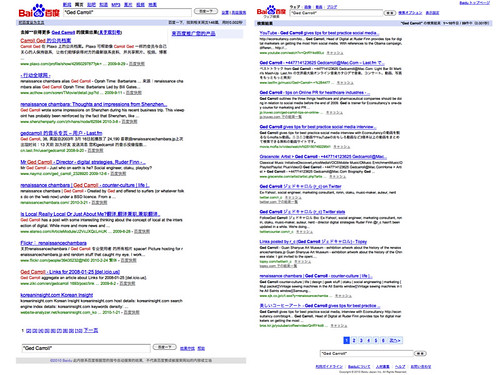
First of all flavouring. A comparison between the Japanese and Chinese versions of Baidu show a high degree of variance between the two versions of the Baidu search engine.
Part of the reason for the difference may be due to Chinese regulations around permitted services, for instance an educational video of me by Econsultancy on YouTube is the top result on the Japanese site and a couple of twitter related hits come in at six and seven. The Japanese site skews much more toward video services than the Chinese site which picked up profile services Plaxo and Naymz.
Interestingly, the Chinese site picked up the re-direct URI for my blog (renaissancechambara.com), whereas neither the Japanese or the Chinese versions picked up my proper domain (renaissancechambara.jp) at all. Even when I clicked a few pages down.
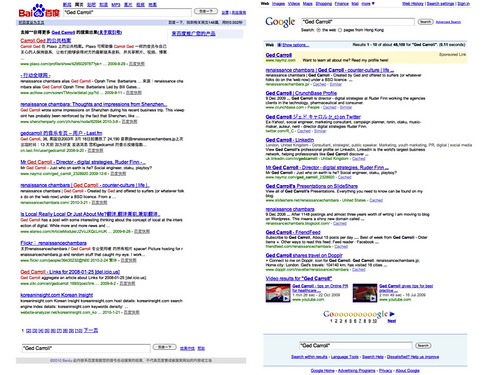
Plotting Baidu China against Google Hong Kong produced an interesting diversity of the results.
Their one point of correlation, my profile on Naymz. Again part of this may be because of my presence on services that don’t do business in China for instance YouTube and Twitter. Google rightly puts more weight and a consequently higher ranking on my Crunchbase and LinkedIn profiles than Plaxo which appears a couple of pages down on Google.
Baidu obviously puts much more emphasis on a historic redirect URI I have for my blog than the ‘real’ one and doesn’t seem to crawl the site in any great depth. I am guessing that this is because of its largely English language content.
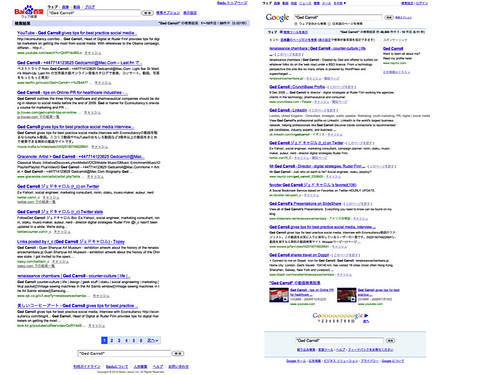
In Japan, the Baidu | Google comparison told a similar story. The Google flavouring between Hong Kong and Japanese versions wasn’t that great only showing differences at position five and lower on the page. Baidu Japan managed to pick up my last.fm profile and twitter profile, but didn’t pick up my blog or any professional information on the first page.
In conclusion, my unscientific assessment of Baidu has shown provides a great search experience for consumers. But I am uncertain how valuable it would be for people in a professional context, for instance researching foreigners with whom they may be doing business or finding foreign presentations. I can understand why Chinese scientific audiences would be concerned by the departure of Google.
I also suspect that optimising content to make it searchable on Baidu is different to the process that I would go through for Google or Yahoo!, but that would merit far more investigation before I could blog with any confidence about it. More Baidu related posts here.
When people ask me about social media: teach them how to do <insert an activity> on <insert the name of a service de jour> and I say sure I can teach you that (for a fee). Much of the value comes from being curious, this is as much about the way think and look at things as anything else. The second is trying to learn from history, which is why I was curious about the likes of Geocities. You can pick up skills as you go along, once you know what you want to do.
Historic interest and Geocities
However, services come and go, but the conversation remains. A classic case-in-point is GeoCities. Yahoo! has non-announced that it is shuttering this pioneering social network at the end of the year. GeoCities was founded in the mid-1990s and grew rapidly (ok so this was the dial-up era and the page building tools on it were the then equivalent of cutting edge-bandwidth hogging web 2.0 tools).
The site was organised into neighbourhoods of common interest: Silicon Valley for technology for example where ‘birds of a feather’ could ‘flock together’. The page creation tools were broadly comparable to MySpace profiles: people foisted poor aesthetics, bad web design and golden labrador digital photographs on an early online audience.
From a standing start in the middle of 1995, two years later they were the fifth most trafficked property on the web and a million-plus registered users (or Homesteaders as GeoCities called these web pioneers).
In college, I found lots of great content on GeoCities and cited some of the homesteaders pages as references in my essays and degree course work.
Yahoo! acquired the company for 2.87 billion USD in early 1999, this was cited as his ‘first rocket ship ride‘ by veteran VC Fred Wilson. There are obvious parallels to Facebook in this meteoric growth.
When I worked at Yahoo!, the disastrous terms of service debacle at GeoCities post-acquisition change in the terms of service where ‘the company owned all rights and content, including media such as pictures’ were held up as a lesson that we should learn from. Whilst Yahoo! quickly reversed this decision there was an exodus of homesteaders. It was an expensive mistake that we were loath to repeat when working with newer services like flickr. Again this sounds like some of the debacles that Facebook has faced. Indeed Facebook’s current terms of service includes rights on the user content that is far greater than in the current Yahoo! terms of service, here is the relevant section from Facebook’s Terms of Use:
… an irrevocable, perpetual, non-exclusive, transferable, fully paid, worldwide license (with the right to sublicense) to use, copy, publicly perform, publicly display, reformat, translate, excerpt (in whole or in part) and distribute such User Content for any purpose, commercial, advertising, or otherwise, on or in connection with the Site or the promotion thereof, to prepare derivative works of, or incorporate into other works, such User Content, and to grant and authorize sublicenses of the foregoing.
GeoCities like Facebook with its Beacon service had a scandal on its hands over user privacy. The FTC found that GeoCities had engaged in deceptive acts and practices in contravention in their privacy act. Subsequently, a consent order was entered into which prohibited GeoCities from misrepresenting the purpose for which it collects and/or uses personal identifying information from consumers.
Time moved on and GeoCities became a key part spam email acting as a redirect page for online pharmacies and replica watch sellers alongside more conventional GeoCities user pages. Over the past years the site traffic for GeoCities dropped faster than shareholder value at Yahoo!. The lesson here is that the Twitter or Facebook or today, can be the GeoCities of tomorrow. In fact, only five of the top 15 web service of a decade ago still have a similar kind of profile today.
If we look beyond web services to world history we can all think about eras and empires that have past, yet thinking (from the likes of Niccolò Machiavelli, Sun Tzu | 孙子, Miyamoto Musashi | 宮本 武蔵 and Carl Von Clausewitz) is as relevant today as it was when they created it centuries or millenia ago. In the grand scheme of things being open and understanding the concepts of conversation are more important than the latest tools. Whilst I still get excited about the ‘new Twitter’, I still like to keep things in perspective. I have cross-posted this at my employer’s blog. More content on ideas can be fund here.
Communities Dominate Brands: Average Blyk campaign 100K messages, average segment only 8K youth – digging into Blyk stats – so much in this. Blyk took a model that had been popular in Africa and India – funding data, messaging and voice services with advertising and took it to the next level: a mobile carrier paid for by advertising. Blyk targeted young people and had offices in Finland, the Netherlands, the United Kingdom and in India. The Blyk model doesn’t add up in the face of modern carrier practices bundling services in post-paid and pre-paid services.
The Civil Heretic – Freeman Dyson – NYTimes.com – interesting the reaction that views beyond the orthodoxy of the global warming codex gets from a liberal estanblishment who should know better
Macne Nana – for a anime version of the girly T-Pain sound
Luxury
Dapper and pissed off – Slate Magazine – interesting article about how important appearance and dressing is in Nigerian culture. The right look and an up to date cell phone make all the difference apparently
Nobody does potholes like KFC – pure ambient advertising genius until there’s a class action suit from some hick who was distracted by Colonel Sanders message on the road and rear-ends his neighbour’s pick-up truck