Security is protection from, or resilience against, potential harm (or other unwanted coercive change) caused by others, by restraining the freedom of others to act. Beneficiaries (technically referents) of security may be of persons and social groups, objects and institutions, ecosystems or any other entity or phenomenon vulnerable to unwanted change. Security mostly refers to protection from hostile forces, but it has a wide range of other senses: for example, as the absence of harm (e.g. freedom from want); as the presence of an essential good (e.g. food security); as resilience against potential damage or harm (e.g. secure foundations); as secrecy (e.g. a secure telephone line); as containment (e.g. a secure room or cell); and as a state of mind (e.g. emotional security).
Back when I started writing this blog, hacking was something that was done against ‘the man’, usually as a political statement. Now breaches are part of organised crime’s day to day operations. The Chinese government so thoroughly hacked Nortel that all its intellectual property was stolen along with commercial secrets like bids and client lists. The result was the firm went bankrupt. Russian ransomware shuts down hospitals across Ireland. North Korean government sanctioned hackers robbed 50 million dollars from the central bank of Bangladesh and laundered it in association with Chinese organised crime.
Now it has spilled into the real world with Chinese covert actions, Russian contractors in the developing world and hybrid warfare being waged across central Europe and the middle east.
If you’re of a certain age, you might think that Suncity is related to Sun City in South Africa. Both are in the gambling resort businesses but I don’t think that either are connected. Sun City is part of a pan-African hotel and resort group headquartered in South Africa.
You might even remember remember the Artists against Apartheid song.
Suncity was associated with gambling junkets to Macau. The company is associated with Alvin Chau. Prior being sentenced to prison for 18 years, Chau was known as a philandering casino tycoon with a Malaysian-American mistress Mandy Lieu (劉碧麗).
Suncity Holdings was a Hong Kong listed investment company with:
Resort business in the Philippines
Hotels and gaming businesses in Russia
Consultancy for running hotels and resorts
Travel Agency and air chartering services
Property development
Shopping mall management
After Chau’s arrest, Suncity cut ties and shut down gambling rooms associated with Chau. Suncity then changed its name to LET.
The FT alleges that Suncity is also connected with online sports gambling, with services aimed at mainland Chinese. This is illegal in China.
The most shocking part of the FT’s video is The Gaming Commission (TGC) admitting that they didn’t want to disclose information as it would undermine trust in the ability of TGC to do its due diligence properly.
Australia’s daigou days done? | WARC – tightening regulatory standards and alternative employment are cited as two key factors by Asia News Network. I would also add increased national pride gau chao has changed the game for Chinese domestic brands
How Coach is using “expressive” luxury to connect with Gen Z | WARC – Heritage brands find themselves at a crossroads between preserving their historical roots and resonating with younger demographics. Tapping into influencer partnerships and cause-related initiatives are two ways to strengthen consumer engagement while simultaneously retaining a brand’s established culture.
Can Tokyo Fashion Week get back on track? | Vogue Business – The Japanese event is rebuilding momentum and simmering with fresh and unique talent, but hopes for international success are hobbled by insularity and pandemic lockdown aftereffects
Great manufacturing video showing 100% sports sunglasses being made. Interesting that they choose not to manufacture in China. 100% came out of the motocross scene in the US, back in the 1980s.
How dollar stores (especially Dollar General) have quietly conquered America. The documentary talks about how they’ve reduced their base costs and can work in sparse or very low income communities. If nothing else, this reminds of you of the scale in America’s mid-West.
Enquire Within tends to appear in book collections for people of a certain age, or, where the book collector has inherited part of their collection. Spending time on the family farm in Ireland during my childhood, I used to see a copy of an early 20th century vintage sit next to a dog-eared copy of Old Moore’s Almanac (not to be mistaken for a separate UK publication: Old Moore’s Almanack), Old Moore’s was used for deciding what to plant in the garden besides potatoes.
During the bank holiday weekend, staying with my parents, emergency works on a water main managed to take out the broadband and electricity along their road. I went back though my Dad’s boxes of books and leafed through my parents copy of Enquire Within. My Dad thinks he had received the copy as a gift from a the owner of a second hand book store in Birkenhead market right after he had moved into the first house that my parents had bought. But he can’t be certain. Given that the outer gloss paper wrap around the hardback inner cover uses a font that looks similar to Eurostile and the price is in decimal – I guess it’s from the early to mid-1970s.
Enquire Within could be thought of as a primer for everyday life. Topics included how to play a variety of card games, basic first aid, the basics on taxation and education with the addresses of the UK government departments responsible. There was a travel section with a few paragraphs on every western European country, which had been written by the Financial Times travel correspondent. The gardening section went into much more depth explaining what a hardy annual and hardy perennial were, alongside the correct way to build a compost heap, how to dig drills and prune roses.
At the back there is an exhaustive list of children’s names together with their meanings.
Enquire Within and the origins of the web
What I didn’t find out until later on was that Tim Berners-Lee was partly inspired to create a predecessor to what would become the world wide web by a Victorian vintage copy of Enquire Within that was in his parents house when he was growing up. The system was called ENQUIRE and seemed to be similar conceptually to HyperCard or a Wiki. The World Wide Web came out of Berners-Lee’s efforts to integrate disparate systems including ENQUIRE together to facilitate better collaboration between CERN research projects.
This video on money laundering is as much of interest for the phenomenon of quality documentaries on YouTube as it is for recycling known truths about HSBC.
The Forrester Wave™: Commerce Search And Product Discovery, Q3 2023, Surfaces The Challenges Of AI Unchecked – Don’t let buzzwords distract you from what your customers — and your business — need. Vendors often use their own terminology, especially in a market that hasn’t had a Forrester Wave evaluation in place already. One will talk about how extremely relevant their results are, while another will scoff at “relevancy” as outdated methodology. You’ll hear semantic, vector, hybrid, ML, AI, and all sorts of branded names for products and functions
Security
The Cheap Radio Hack That Disrupted Poland’s Railway System | WIRED – the ability to send the command has been described in Polish radio and train forums and on YouTube for years. “Everybody could do this. Even teenagers trolling. The frequencies are known. The tones are known. The equipment is cheap. – This reminds me of the blue boxes used for phone phreaking decades ago.
Adobe’s AI diversity auditor | Patent Drop – is seeking to patent a system for “diversity auditing” using computer vision. Essentially, this system uses facial detection and image classification to break down photos of employees and slot them into categories based on certain physical traits and characteristics. Adobe’s system looks through several images and detects faces in each one, then classifies each face based on a predicted “sensitive attribute” relating to “protected classes of individuals,” such as race, age or gender. For example, Adobe noted, this system may classify images from a company’s website, then compare its predictions to a “comparison population.”
Technology
Mexico’s Microchip Advantage | Foreign Affairs – there are significant hurdles to making Mexico a bigger player in supply chains for chips and advanced technologies. The country lacks its Asian rivals’ existing networks of high-technology firms. Until now, investments in the sphere have been sparse. To change this situation, Mexican political and business leaders need a clearer strategy for attracting semiconductor investment. The dividends, both for Mexican industry and for U.S. supply chain security, could be significant. Today’s large-scale shift away from China-focused assembly operations offers a once-in-a-generation opportunity to create a more fully integrated North American semiconductor and electronics supply chain. Despite the United States’ major involvement in many segments of the chip industry, there is at present hardly any semiconductor packaging or assembly in the country and very little anywhere else in the Western Hemisphere. The United States maintains a leading role in R&D-intensive segments of the semiconductor industry, including chip design and manufacturing equipment. The CHIPS Act is intended to increase the amount of chip fabrication in the United States. Yet neither the United States nor any country in the Western Hemisphere plays a major role in the final stages of the chip manufacturing process—assembly, testing, and packaging (ATP)—in which semiconductors are tested and assembled into sophisticated packages. The Western Hemisphere also does relatively little assembly of advanced electronic systems that require a lot of chips, such as consumer electronics.
It says something about the time that we live in that digital abortion clinics is a normal phrase and that publications like Wired have to have rank the clinics on patient data security. Disclaimer: I lean pro-choice in my beliefs as I don’t have to make the kind of choices that many women have to. Secondly, the second order consequences of high risk procedures done the black market create new moral and ethical dilemmas.
Dystopian vibes
Matt M – Ghost In The Shell Stand Alone Complex
Five years ago, if you had said digital abortion clinics to me it would have brought to mind the darker recesses of the cyberpunk realms created in novels by William Gibson or Neal Stephenson’s Snow Crash, or the Ghost In The Shell series of manga and anime created by Shirow Masamune.
The reality is more banal and horrifying all at the same time.
How we got here
Legal and regulatory environment
Family planning clinics that provide terminations have been under regulatory attack since the US Supreme Court ruling on Roe vs. Wade gave American women access to abortion in 1973. Roe vs Wade was challenged repeatedly in court and upheld in rulings given afterwards. Some of these rulings narrowed the definition of what procedures could be conducted and when they could be conducted. In June 2022, the US Supreme Court overturned Roe vs Wade with its finding on Dobbs vs Jackson Women’s Health Organisation. Abortion was no longer considered a constitutional right, which then meant pregnancy terminations became governed by a myriad of state laws both for, and against abortions.
Some states went as far as to provide a legal shelter for their medical staff against legal measures out of state.
Pharmaceuticals
Historically, medicinal herbs and drugs used to induce an abortion risked causing kidney and liver damage. But we now have drugs available that can provide a much safer alternative. It’s these drugs that the digital abortion clinics rely on. The two most common are:
Misoprostol was developed in 1973. It’s used to induce abortions, but also has other uses including the prevention and treatment of both stomach ulcers and some forms of postpartum bleeding. It can also be used to induce labour during pregnancy.
Mifepristone developed in 1980, is typically used to induce abortions in conjunction with Misoprostol. It is also used on its own to treat high blood sugar levels in patients who also have hypercortisolism.
Femtech
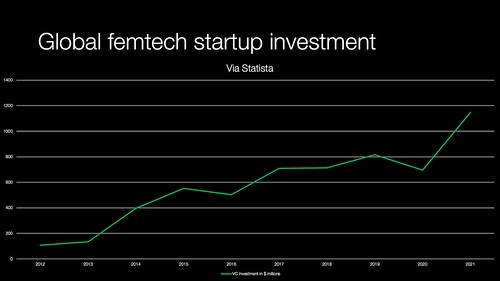
Femtech as a term has only been around since 2016, but investment in the area of women’s health related technology has been growing over a decade. A few things were driving this. The personal nature of smartphones as a device. The explosion in software tools that allowed you to write apps and the availability of wireless technology stacks that hardware easier to connect. Finally, countries like the US started working on data privacy standards in the health space which were very important.
2016 saw Nurx get funding for it to provide in-app ordering for birth control pills. So prescribing abortion inducing medications is a logical next step, in order to give women full control of their reproductive capabilities.
Telehealth
COVID-19 accelerated the normalisation of digitally mediated health services including telehealth consultations and digital abortion services are now exception. If a woman chooses to have an abortion, it’s a big decision and the popular apps covered by Wired seemed to have a wide variance of user experience / provision of care.
These clinics operate in different ways—some provide live video visits with doctors and nurse practitioners, while others offer asynchronous counseling—but many have experienced a record number of patient orders (and increased VC funding) over the past year.
Poli K. (August 21, 2023) The Most Popular Digital Abortion Clinics, Ranked by Data Privacy. United States: Wired magazine
Security issues
Those software tools that allowed apps to be written easily often included API calls that enable privacy infringing tracking. For instance, a byproduct of the software tools used to make LGBTQI dating app Grindr’s locative nature risked exposing precise location data of gay men. Which is of concern in more socially conservative environments. Women using some digital abortion clinics face similar challenges.
In US states, where the politicians thought that Margaret Atwood’s The Handmaid’s Tale was a how-to guide, rather than a societal warning; prosecutions in abortion related cases are using mobile data and search history.
Wired worked with the University of Texas privacy lab to grade the post popular digital abortion clinics on the degree of risk they posed to their patients.
The results were concerning and these problems can’t be mitigated through the use of a VPN or in-app settings.
Third-party data app sharing and data collection were used by the likes of Palantir to aid targeting people of interest in the global war on terror (G-WAT in security circles), and could be used in a similar way against women, if the state government were so inclined.
The Wired article that inspired this post here. More health-related content here.
I wish gatekeeping was a thing back in 2005 and 2006 when I was working on the international launch of Yahoo! Answers. The problem that we had was getting people to contribute answers to questions. Gatekeeping and the exhortation to not gate keep is about sharing knowledge and opinions freely – an in real life version of what we saw in early social publishing. Ironically gatekeeping stands in sharp contrast to oversharing as a social faux pas. The kind of knowledge that concerns about gatekeeping is particularly opposed to is opinion based knowledge or NORA.
Now ‘your jam’ is no longer your jam, but instead offered up to be other people’s jam instead. Your individuality ready to be cloned at a moments notice. Will everything descend to being ‘basic’ or mainstream? Does it disincentivise possessing good taste?
What the Internet’s Use of ‘Gatekeeping’ Says About Power – The rise of “Don’t gatekeep” has reframed keeping things to yourself as a selfish act. But not everything is for everyone! And sometimes the act of sharing does more harm than good. I’m thinking of how Anthony Bourdain felt conflicted about sending droves of tourists to mom-and-pop restaurants. I’m thinking of gentrification and what happens when certain neighborhoods are positioned as hidden gems.
Study Times op-ed shoots down new policy options | Pekingology – translation from an article from the Study Times. Comments on infrastructure are particularly instructive in terms of the view point that they reflect: To debunk views such as “infrastructure overcapacity is wasteful,” “promoting infrastructure equates to taking the old path that’s inconsistent with high-quality development,” and “limited space,” it’s crucial to fully understand the role of infrastructure investment from a holistic perspective of national economic development. Infrastructure investment doesn’t only interact with the expansion of aggregate demand to stabilize economic operations, but also enhances macroeconomic efficiency, improves people’s living standards, and robustly supports high-quality development. Overall, there’s no issue of excessive infrastructure. On the contrary, there are areas that hinder the efficiency of the national economy and the improvement of people’s living standards. China’s per capita infrastructure capital stock only accounts for 20% to 30% of the developed countries, and public facility investments per rural resident are only about a fifth of an urban dweller, indicating potential for investment
McDonald’s Hong Kong and Kevin Poon “Coach McNugget Art World” Exhibition | Hypebeast – via Ian at Deft. This was to celebrate 40 years of the McNugget. McDonald’s have always done some smart cultural marketing work in Hong Kong (such as an McDonalds Big Mac themed issue of Milk magazine). Hong Kong seems like a natural home for these things, I remember activating a Coke Zero x Neighborhood collab while there.) But it isn’t only a Hong Kong thing, McDonalds has done some strong cultural marketing internationally as well: from the Cactus Jack happy meal to a bounty programme for rappers that namedropped McDonalds on their mixtape over the years. As my friend Ian observed this is at odds with their current UK positioning ‘ McDonalds is the perfect place for estranged parents to meet their kids for awkward conversations’. The implication in that McDonalds restaurants are a lower rent third space (than Starbucks or Costa) positioning. I have welcomed their value-priced coffee and breakfasts at the end of an all-nighter on a pitch or a long drive. But the UK’s the third space aspect loses all the joy that McDonalds manages to imbue in their children experiences – the treat, the birthday party, the expectation of picking up a much wanted toy in a happy meal. The child to adult disconnect in the experience is something cultural marketing like this can help bridge if done in the UK.
Hong Kong’s corporate lawyers test boundaries as Beijing’s influence grows | Financial Times – legal practitioners, including corporate lawyers, are concerned the broadening scope of a sweeping national security law could jeopardise the independence of the city’s legal system, a legacy of British administration, as Beijing tightens its grip. “There is general concern . . . that people are not fully understanding where the boundaries lie,” said a senior corporate lawyer with a global firm who has worked in Hong Kong for more than two decades
Daring Fireball: ‘Changes to U.K. Surveillance Regime May Violate International Law’ – As I see it, the most likely outcome is that the U.K. passes the law, thinking that the grave concerns conveyed to them by the messaging services are overblown. That the platform providers are saying they can’t comply but they really just mean they don’t want to comply because it’s just difficult, not impossible. And when it becomes law, the platforms will hand it off to the nerds, the nerds will nerd harder, and boom, the platforms will fall into compliance with this law. That’s what they think will happen. What will actually happen, I believe, is that E2EE messaging platforms like WhatsApp (overwhelmingly popular in the U.K.), Signal, and iMessage will stop working and be pulled from app stores in the U.K., full stop. The U.K. seems to think it’s a bluff; I don’t
Singapore
Money Laundering Bust Puts Foreign Wealth in Singapore on Notice | Asia Sentinel – if that occurred at the behest of the China then we’re likely to see flight overseas from Singapore. It’s also interesting that these raids have come soon after China arrested a Shanghai immigration consultant to get hold of their database of UHNWI overseas (predominantly in the US). They second question I had would be why Singapore would cooperate with China on this?
Software
Now is the time for grimoires – by Ethan Mollick – With the rise of a new form of AI, the Large Language Model, organizations continue to think that whoever controls the data is going to win. But at least in the near future, I not only think they are wrong, but also that this approach blinds them to the most useful thing that they (and all of us), can be doing in this AI-haunted moment: creating grimoires, spellbooks full of prompts that encode expertise. The largest Large Language Models, like GPT-4, already have trained on tons of data. They “know” many things, which is why they beat Stanford Medical School students when evaluating new medical cases and Harvard students at essay writing, despite their tendency to hallucinate wrong answers. It may well be that more data is indeed widely useful — companies are training their own LLMs, and going through substantial effort to fine-tune existing models on their data based on this assumption — but we don’t actually know that, yet. In the meantime, there is something that is clearly important, and that is the prompts of experts.
Trybals is a YouTube channel that features people from the less developed parts of Pakistan and asks their reactions about different aspects of the modern world. It’s an interesting bit of anthropology. In this episode the panel gets to try a VR experience.
What prompted me to write about Geico advertising was a stream of news from marketing services companies about the state of technology company advertising. At the time of writing Stagwell are just the latest marketing services firm after S4, IPG, Omnicom and WPP have pinned declining profits on a reduction in technology company advertising spend. Then this story broke about Geico advertising: Insurer Geico made more money after benching its famous gecko | Quartz – and my first reaction was that the wrong lessons might be taken away from this.
Geico advertising – a primer
Geico îs an unfamiliar name to most people outside of the US. If you’ve read American magazines chances are there was a print ad or two in there with their iconic Gecko spokesperson. It’s a similar case on American television.
Geico advertising and their Gecko are as familiar to Americans as the meerkats of Comparethemarket.com are to your average Brits.
The truth about technology marketers vs. Geico advertising
Having worked with technology brands on and off for the past three decades, I have enough experience to know that generally, they aren’t great marketing organisations.
Coinbase’s Super Bowl ad drove traffic to a site that fell over.
Geico reinforced brand equity in the insurance space and pointed out their 24-hour claims hotline (I imagine that this isn’t an exclusive feature, but you wouldn’t know it from the advert).
Growth mindset ≠ marketing mindset
As organisations, they have a growth mindset, but not a marketing mindset. Before the internet, this meant a powerful field sales force organisation and marketing meant a bit of branding / design work coupled with case studies for the sales people. With the internet came constant iterative ‘growth hacking’ on digital channels, that mirrors agile software development rather than the best practices of marketing science.
There is a good reason why organisations like the Ehrenberg-Bass Institute for Marketing Science are supported by FMCG manufacturers, luxury goods makers, media companies, marketing services firms and pharmaceutical companies, BUT has no technology company sponsors.
The reasons are cultural in nature:
Engineering – if I haven’t heard of it or invented it then it’s not valid and you’re just a suit. At best great product is the marketing – and that’s great if you have a clearly differentiated great product which is self evident. The engineering mindset is also why they trust adtech and marketing automation services which outsource your marketing communications approach to a black box
Sales – marketing is just support. Which is the reason why my early clients (like old school Silicon Valley royalty LSI Logic) promoted long serving secretaries and administration staff into marketing roles
Even if they had a marketer who knew about Ehrenberg-Bass they wouldn’t be able to get in buy-in from the wider organisation to participate and they’d likely be fighting other dumpster fires elsewhere
Secondly, their laser focus on data affects their outlook. To paraphrase the comedian Bill Hicks: they know the price of everything, but the value of nothing. Because they are only looking at short term data. Great marketing and advertising also has long term effects that both screws with the short term marketing data focus.
Marketing and growth hacking are considered synonymous. It would seem ridiculous for me to to claim in any large marketing orientated organisation that sales and marketing are synonymous. The differences and complementary aspects of both would be well known. Yet in technology companies, this isn’t the case.
By contrast Geico as a brand is an organisation who understood marketing. You make your car or house insurance decision at best once a year (though there is friction in making a change).
The technology sector approach would be for Geico to bid on search ads and aggregators to acquire customers and then do direct mail or email when it comes to renewal times. But Geico advertising does something different. Geico advertising builds mental framework, so that Geico means car insurance and will be one of the brands that you consider.
This achieves a few things:
You are less likely to move away from Geico, you may not love them, but searching for an alternative might be too much of a hassle.
You may be reassured that you have chosen ‘the’ car insurance
It helps new customers get over the ‘which car insurance company to choose’ decision
It helps with upsell on the products due to the reassurance of the brand
Technology companies deal with these problems in a slightly different way:
Certification of engineering staff. If you are Microsoft certified or Cisco certified, you are less likely to use open source software or Juniper Networks products respectively. It would be against your self interest and the investment in terms of time and money that you have made in your self development
Contractual lock-in – self explanatory
Technology lock-in. You can put your data or programming code into a particular system, but its much harder and more expensive to move on to another system
Owning the entire technology stack. This is the approach that Adobe Systems have taken, gradually acquiring over the years the entire marketing, workflow and creative systems used by ad agencies, media agencies and their clients
So why was Geico advertising spend cut?
This is the crux of my point about how the wrong lessons might be taken away from the Geico advertising spend cut, with no ‘apparent’ impact.
There are a number of good reasons why Geico made the cut in advertising spend:
There was a cut in insurance sector advertising overall, so that Geico maintained or even grew its relative share of voice while spending less. This should see it emerge with improved economic performance over time. Procter and Gamble became the behemoth it now is by INCREASING advertising during the great depression of the 1920s. So the idea of relative share of voice and its relationship to market share is older than I am. Further more research by the IPA has found that holding or increasing relative share of voice during a downturn has a positive impact for business performance over a five year period
Geico may have managed to make some efficiency gains, this is most likely to occur in brand activating activities
There is also a bad reason: saving money in the short term. Kraft Heinz cut marketing to the bone under the guise of zero based budgeting (ZBB) – which made a mockery of ZBB as a concept. Kraft Heinz shares massively underperformed and were down 60% in the last 5 years, compared to the S&P 500 having gone up 69%. If Geico is following this route then it bodes ill for the long term performance of the business.
Without us knowing the real reasons and focusing on the short term measure, it reinforces a growth hacking mindset.
Hard times mean no sustainability premium in North America | WARC | The Feed – every single economic recession this comes around and marketers are surprised. Time to pay attention to what the longitudinal research data says. I really like the work that Gallup have done on macro trends and the American consumer, in particular their work on attitudes to the environment.
‘Pokémon Sleep’ Review: Sleep-Tracking Game Made Me Into Snorlax – gamifying sleep. Pokemon Sleep has surged to 3.2M global downloads and an estimated $130k in daily revenue according to SensorTower data. The app ranked in the top 5 in the U.S. Games charts. It’s even more popular in Japan (the home of Pokemon), where it’s number 1 across the App Store categories
Using attention to scale creative excellence at Mars | WARC – Sales, distinctive assets, and attention to advertising are the go-to metrics to guide marketing decisions at Mars. Mars use Attention as a pre-testing tool, to inform creative choices in digital and also proxy in TV. Mars believe that an execution with a better attention score will travel across media channels better and will be a safer bet for you when you need to make a choice. Measuring Attention is a key element in helping us improve the creative hit rate. Advertisers should question how they measure consumer responses and focus on measures of real consumer behavior.