Security is protection from, or resilience against, potential harm (or other unwanted coercive change) caused by others, by restraining the freedom of others to act. Beneficiaries (technically referents) of security may be of persons and social groups, objects and institutions, ecosystems or any other entity or phenomenon vulnerable to unwanted change. Security mostly refers to protection from hostile forces, but it has a wide range of other senses: for example, as the absence of harm (e.g. freedom from want); as the presence of an essential good (e.g. food security); as resilience against potential damage or harm (e.g. secure foundations); as secrecy (e.g. a secure telephone line); as containment (e.g. a secure room or cell); and as a state of mind (e.g. emotional security).
Back when I started writing this blog, hacking was something that was done against ‘the man’, usually as a political statement. Now breaches are part of organised crime’s day to day operations. The Chinese government so thoroughly hacked Nortel that all its intellectual property was stolen along with commercial secrets like bids and client lists. The result was the firm went bankrupt. Russian ransomware shuts down hospitals across Ireland. North Korean government sanctioned hackers robbed 50 million dollars from the central bank of Bangladesh and laundered it in association with Chinese organised crime.
Now it has spilled into the real world with Chinese covert actions, Russian contractors in the developing world and hybrid warfare being waged across central Europe and the middle east.
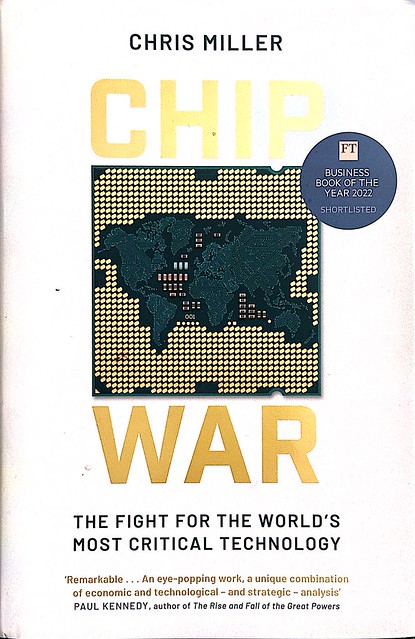
It has taken me far too long to finish Chip War and write this review, so apologies in advance. Chip War was one of the FT’s best business books of 2022. In reality it’s a book about history, that happens to feature businesses.
The lens shaping everything else that I have written here
I am a sucker for books on the history of technology and Chip War was right in my wheelhouse. It complemented, rather than overlapped some of my existing favourite technology history books like Bob Cringely’s Accidental Empires, John Markoff’s What The Dormouse Said or most of Michael Malone and Steven Levy’s output to date.
The author
The author Chris Miller wasn’t a familiar name to me. Unlike Cringely, Markoff, Malone or Levy; Miller is an academic rather than a former journalist. Miller currently teaches international history at Tufts University. Chip War wasn’t his first book, his previous ones have focused on Soviet and Russian history. As a technology sector outsider, Miller’s Chip War has a very different tone my other favourite books from the genre.
It also allowed Miller to view the history of semiconductors in terms of a global perspective, that I hadn’t previously seen done.
On to Chip War itself
Other reviewers have used words like ‘outstanding’ and ‘epic’ to describe the book – which while being a reasonable guide to overall quality and length of read aren’t really all that helpful. It took me six months to read as a casual book. This is partly down to a hectic work schedule and that its a long book. I suspect that some readers when they reviewed the book seem to have thought ‘long’ as difficult to read. It’s actually 351 pages ignoring acknowledgements and the footnotes at the back of the book. Being an academic Miller worked hard to source everything in Chip War.
The book starts in the post-war period as the defence industry moves from being focused on hammering steel to developing smarter systems using semiconductors. That road takes the book past Texas Instruments and the early Silicon Valley of Bob Noyce and other members of the treacherous eight.
The book also zooms out to cover the Soviet Union’s failed efforts to replicate Silicon Valley as well as domestic industrial espionage and the start of globalisation which begat the current industry.
The Japanese challenge is covered in depth as is the rise of Korea including challenges that the industry faced in the early 2000s. The rise of Taiwan and its use of semiconductors as a hedge against invasion from the mainland. European tool maker ASML gets its own section, which is a case study in how to make a virtue of necessity. Finally it covers the technology conflict with China. Bring this up to date circa 2022.
If you are student of Silicon Valley history, then Chip War is unique in the way it puts everything in context. There were some completely new parts to me such as the political role that Sony founder Akio Morita played in advocating for a robust Japanese semiconductor industry as part of reasserting Japanese importance internationally.
You can get hold of Chip War here. More book reviews here.
The politics of Prada challenged what I knew about the luxury brand. I knew that Prada started off as a handbag company that then pivoted into apparel. I also realised that some Prada items probably borrowed from military clothing design and fabric technology, such as Prada’s iconic black Pocono fabric backpacks.
This is pretty common across Italian design with Stone Island CP Company being prime examples. If you would have asked me about the politics of Prada, I would have expected it to be part of the wider anarcho-far left hatred of all prestige brands.
I didn’t realise that Miuccia Prada’s clothing designs reflected her own left wing, pro-feminist politics. The connections of Prada with yachting has less to do with the politics of Prada and more to do with the passion of her husband and business partner Patrizio Bertelli.
One forgets how politics in Italy, had elements of the far left with the Communist Party and the Red Brigades pitted against reactionary right including the Propaganda Due (P2) masonic lodge and the Bologna central station bombing on August 2, 1980. The politics of Prada is by its nature Italian. More related content here.
Aimé Leon Dore x DJ Stretch Armstrong
Aimé Leon Dore got Stretch Armstrong in for a set playing sublime vintage soul 45s.
Scott Galloway on the intersection of economics and technology
Professor Scott Galloway on the intersection of economics, social trends, consumer trends and technology.
Iran-Contra affair
The Iran-Contra affair was how the president Reagan administration, specifically ‘rogue’ elements within it like Oliver North and John Poindexter, came to swap heavy weaponry with the terrorist sponsoring government of Iran in exchange for the release of American hostages, and how money from these deals came to be diverted to a secret and illegal war in Central America.
Sean Munger provided one of the best accounts of it that I have seen outside of the Congressional report.
The most Hong Kong thing I saw all week
HKIB News – a cable and online TV news channel featured a news story about the first trip of local bus company KMB’s electric double decker bus. At the bus stop was a mix of young and middle aged (mostly) male business enthusiasts. In Hong Kong, bus enthusiasts is much more mainstream in the UK. There are shops that sell die-cast scale models of buses in different liveries, so you can get an exact period-correct bus. Bus enthusiasm and the continued popularity of radio controlled car builds as mainstream hobbies were two distinctive aspects of Hong Kong culture for me.
Much of this is down to the limited size of Hong Kong and the public transport infrastructure. Generations of small children have enjoyed some of their happiest memories starting and ending with a bus trip. Buses are the first line of public transport. Hong Kong, (and Singapore) have a good number of young men and women for which it is the dream career. Which is remarkable given that these are part of the developed world and have a good education system.
Instead in the UK, you have a job that pays minimum wage that no one dreams doing.
The two stand out films of the summer are Barbie and Oppenheimer . Oppenheimer is a biopic of scientist and Manhattan Project lead J. Robert Oppenheimer, based on the book American Prometheus: The Triumph and Tragedy of J. Robert Oppenheimer. Oppenheimer went on to lead the projects Los Alamos lab. Los Alamos National Laboratory has gone on to do scientific research on defence projects as well as health related projects. Casting of Cillian Murphy provides a good physical resemblance of Robert Oppenheimer.
J. Robert Oppenheimer biopic
Oppenheimer is a complex film with the story told in the form of flashbacks. It also tries to reinterpret Oppenheimer for the present day, with a sense of guilt that Oppenheimer never personally expressed. But Oppenheimer had been concerned about the nuclear arms race and weapons proliferation. He opposed the subsequent development of the hydrogen bomb. These positions along with his friendships with communist party members in the US, led to him losing his security clearance in 1954.
J. Robert Oppenheimer via the US Department of Energy
Barbie
Barbie looks to bring to life Mattel’s toy characters Barbie and Ken. Barbie was introduced in 1959 as a copy of a German fashion doll line. The fashion doll line came out of a cartoon strip in the Bild tabloid newspaper. Mattel went on to buy the German originator and shut it down. But by this time the German doll moulds were bought or copied by manufacturers in Hong Kong and Spain.
1990s vintage Barbie
The Barbie movie addresses head on the cultural and design legacy of Barbie alongside present-day culture wars
Barbie starts off in a matriarchal fantasy world; Ken is represented as a boy toy
Eventually Barbie and Ken end up in the real world. Barbie meet her owner who accuses her of setting unrealistic beauty standards
Ken learns about the male patriarchy, which means a battle of the sexes ensues when they both return to toyland
Barbeheimer
Both Barbie and Oppenheimer were released in the cinema at the same time going head-to-head with Mission Impossible: Dead Reckoning Part One. This led to cinema goers taking advantage and buying a ticket to see each film one after the other. The practice of watching Barbie and Oppenheimer as a double-bill became so common it was given its own name Barbenheimer, when then became a thing in the news, on podcasts and social media. It has been credited with listing the business performance of cinemas, while sit on the edge of a recession. In fact in the UK, for some of the weekend, both Picturehouse cinemas and Vue cinemas websites were having trouble handling customer traffic.
Google Tests A.I. Tool That Is Able to Write News Articles – The New York Times – One of the three people familiar with the product said that Google believed it could serve as a kind of personal assistant for journalists, automating some tasks to free up time for others, and that the company saw it as responsible technology that could help steer the publishing industry away from the pitfalls of generative A.I.
I was taken back to to memories of Skeleton Records in Birkenhead during the early 1990s due to a Taylor Swift album mispress. As a young record buyer I used frequent secondhand record shops to pick up promo copies of records. A rock orientated shop would often not realise what they had, this was before widespread internet access.
The gaunt middle-aged shop assistant was sat behind the counter looking at a picture disc of Fish – State of Mind on picture disc. Fish had recently left then popular rock band Marillion and State of Mind was a single from his first solo album Vigil in a Wilderness of Mirrors.
Apparently one of his customers worked as an assistant shop manager, realised what they had and ‘lost’ the record before the distributor came to collect all the copies of the mispress. The reason why the distributor would want to collect the records? Because they played Madonna’s Cherish instead. The shop assistant said to no one in particular, that will be worth something one day. He wasn’t wrong, I have seen prices quoted as high as 650 dollars paid – if the right Madonna or Marillion completist collector actually finds a copy for sale.
Taylor Swift Speak Now Concert at Heinz Field by Ronald Woan
A similar thing happened to Taylor Swift fans this week, who ordered her latest album and ended up with Taylor Swift artwork, but songs from the early 1990s electronica compilation Happy Lands volume 1 playing instead.
This mispress became know as the ‘cursed version’ presumably because of its dark electronic sounds featuring Cabaret Voltaire and others. They might be able to take heart when they realise the such mispresses have become collectors items in the past with an appreciating value.
Back when I was a child, the oil refinery was a cathedral to industry rather than a climate crime scene and working in the oil industry was a cut above working in other industries.
3D printing industry gripped by intrigue, litigation and churn | Financial Times – 3D printing or additive manufacturing is currently used for small batch manufacturing by the likes of GE, Rheinmetall, Airbus and Lockheed Martin. You had a similar set up with CNC milling (including multi-axis machines) and multitasking machines which were confined to manufacturing ‘cells’ until Apple went out and bought thousands of them and had them running in parallel on Foxconn lines manufacturing iPhone chassis’. Additive manufacturing needs its ‘iPhone moment’ to cross the chasm to mainstream use. That is reliant on an innovative client rather than supplier innovation and the current players like Stratasys aren’t in a position to drive this next stage of innovation, but their customers might be.
Letter Statement March2023 | DAIR – Tl;dr: The harms from so-called AI are real and present and follow from the acts of people and corporations deploying automated systems. Regulatory efforts should focus on transparency, accountability and preventing exploitative labor practices.
A number of things have happened that made me think about the idea of the British discount. A fund manager came out and said that UK equities were cheap compared to their counterparts listed on other stock markets and would likely remain so for a long time.
Genuine sale bargains?
There are a number of reasons why these companies may trade at a British discount:
The London Stock Exchanges doesn’t have a reputation for high growth businesses in the same way that the New York Stock Exchange or NASDAQ does. Instead it has a preponderance of mining companies and similar firms
UK pension funds are discouraged from purchasing stocks
The UK doesn’t foster the kind of businesses that growth investors would want to invest in
British banks don’t particularly want to invest in British businesses beyond property portfolios
Management demonstrate short-termism in their investment approach, as does the banking system
There isn’t a culture of retail share ownership
The UK economy has numerous structural challenges, some of them self inflicted
The British discount goes beyond the stock market, but instead the very nature of the UK itself.
Indebted government
Government debt is ballooning and will continue to do so, yet productivity is stubbornly low meaning the bonds will be ever harder to pay off. Finally as the Liz Truss debacle showed even leadership shows the British discount.
The state Britain has been in
The ideas and concepts the British discount aren’t even new – most of them came from ideas in Will Hutton’s The State We’re In originally published in 1995.
The fund manager can be confident in the British discount to be long-lasting as he knows that neither the Labour Party or their Conservative Party counterparts had managed to address existing structural economic issues. Instead they managed to create new ones.
The Trajectory of China’s Industrial Policies – IGCC – Barry Naughton, Siwen Xiao, and Yaosheng Xu argue that most of the changes in Chinese industrial policy since the mid-2000s can be thought of as being part of a trajectory that seeks to build a policy/planning mechanism, and that shifts the ultimate objective of technology and industry policies from economics to security.
Saudi Arabia’s Barn’s Coffee plans 25 outlets in Malaysia – Malaysia’s Premier Fine Foods plans to establish 25 outlets in Kuala Lumpur as its hub and expand operations to other Southeast Asian countries, including Brunei, Cambodia, Indonesia, Laos, Myanmar, the Philippines, Singapore, Thailand and Vietnam, in its aim to have 300 outlets in the next 10 years – interesting franchise coming out of Saudi Arabia
Street Style in Tokyo: “Harajuku Is Like a Fashion Gallery With a Free Entrance” | Vogue – “In present-day Harajuku, there are probably more foreigners walking around than there are Japanese people. They used to be watchers of Harajuku fashion, but now they are players; it’s a new movement in the neighborhood. In this story, there are many Chinese and Korean individuals who seem to enjoy and carry forward the Harajuku fashion of the 1990s and 2000s, rather than simply copying it
Full article: ChatGPT, AI Advertising, and Advertising Research and Education – leading scholars and industry thinkers in our field and neighboring disciplines are actively examining and engaging in debates on AI technologies and their applications to advertising practices and effects. However, we have not imagined such powerful AI technologies as ChatGPT emerging and spreading in the general public so quickly. According to industry estimates, ChatGPT reached 100 million monthly users in the first two months after launch, which makes it the fastest-growing technology application in history, but web traffic has since peaked. ChatGPT and other generative AI technologies in this new phase of AI advancement are expected to completely transform the advertising business and research. More research is urgently needed to gain an understanding of the short- and long-term impacts of this new generation of transformative AI technologies on advertising across the micro, meso, and macro levels
Influence 100: In-House PR Budgets Slashed | Provoke Media – This year, our Influence 100 cohort control a combined spend of $3.7 billion, a drop of more than $1bn on last year’s figure of $4.8 billion and far below 2020’s dip to $4.2 billion, after being at $4.8 billion in 2019. The drop is largely down to a significant dip in the number of our Influence 100 managing top-end budgets. Last year the number who managed budgets of more than $100m was 25% (compared to 27% in 2021), while this year it is down to 17%. The number of CMOs and CCOs managing between $75 and $100m also dropped, from 12.5% last year to 10% (although this is on a par with 11% in 2021), and the next budget bracket, $50-$75m, also saw a drop from 17.5% to 13%, one percentage point lower than 2021. The proportion of communications leaders managing budgets of between $25m and $50m remained the same as last year, at 10%, and the only budget bracket that saw an increase was at the lower end, $10m-$25m, which shot up from 12.5% to 30% – unsurprising given the dip in advertising spend
Materials
Machine learning based design optimisation was used to create additive manufactured brackets for NASA instruments. They feel organic in nature, presumably because they the result of millions of virtual trials, rather like generations of biological evolution.