It is hard for anyone who can’t remember back to the original PlayStation, but back in the 1980s and the 1990s Sony was a technology company that held the kind of stature that Apple currently holds in consumer minds. Trinitron had the kind of gravitas that Apple’s iPhone or Samsung’s Galaxy have now.
In fact, Sony used to do a fair bit of industrial and product design for Apple. The initial Apple PowerBook range was designed by Sony and the 3 1/2 floppy disk that was the hallmark of the original Mac was down to Sony engineers who collaborated with the Apple team to get the product ready in time. Steve Jobs self-imposed uniform of black mock-turtleneck jumpers and Levi 501s was inspired by a conversation he had with Akio Morita about the use of corporate uniforms inside Sony Japan which created corporate cohesion. (Sony had implemented these, because workers in post-war Japan struggled to afford clothes). Jobs cited Sony, alongside Cuisinart and Braun as companies that he would like to emulate in terms of product design.
Part of Sony’s pre-eminent position was down to their amazing electronic, electrical and mechanical engineering chops combined with great product design and an attention to detail which churned out a succession of small high-performance products including high-end personal tape cassette players (the Walkman), personal compact disc players (the Discman) and camcorders (Video8 and Hi-8).
Often consumers couldn’t afford the high-end designs so the mid-and-low range products that they bought had the Sony quality and design ‘halo’ around these products.
The second thing that supported Sony was the high quality of their televisions. This was due partly to the industrial design that Sony perfected – particularly in their portable television sets.
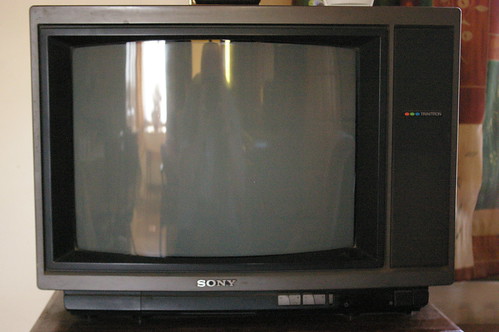
The deal closer was Sony’s display technology called Trinitron.
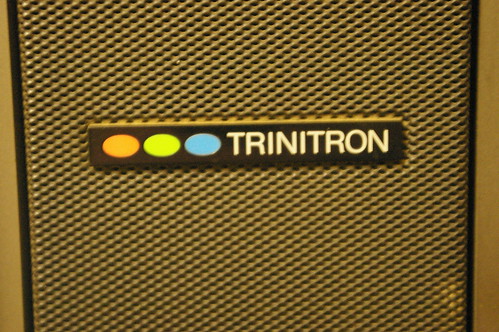
Trinitron signified the technology that Sony had inside its screen, and the logo became a mark of quality. The story of Trinitron goes back the mid-1960s, Sony had bet the farm on a great display technology called Chromatron which it had licenced from a small American company. The problem with Chromatron was that it was really hard to make the displays commercially, Sony was getting about three good displays for every 1,000 they made on their production line. The televisions that the displays went into cost twice as much to make as Sony could sell them for. By 1966, Sony was facing financial ruin.
So they took a look around at the other technologies pioneered by the likes of GE and RCA to try and work out how they could come up with a unique patentable product. In double quick time, Sony came up with a display with an electron gun at the back of the cathode ray tube with three electrodes (for the red, green and blue composite colours), permanent magnets to focus the electron stream and an aperture grill made up of tiny wires hung vertically connected by one or two tungsten stabilising wire going horizontally across them.
This gave Trinitron displays a bright, high contrast, high-colour display with no gaps between the colour phosphor dots on the screen. I still use a Trinitron set to watch DVDs because it provides a superior colour and contrast to more modern LCD screens. Modern LCDs have to use a lot of power; up to 1,000 watts to try and match the contrast of the Trinitron set. In 1996 Sony’s patents ran out and technological change with copycat designs from Mitsubishi and ViewSonic; followed by LCD displays eroded Sony’s advantage in the market. Prior to bowing out of the market Sony made its WEGA sets which feature the best consumer Trinitron screens to date – and can be picked up on eBay for a song. In 2008, Sony stopped selling Trinitron televisions in the developed word (though WEGA sets continued to be sold in China).
It still has a production line in Singapore making Trinitron displays for professional use, in particular video monitors. Sony’s television business is now bleeding cash as it no longer has a best-of-breed display technology advantage and so consumers will no longer pay a premium price because it’s a Sony. A Sony BRAVIA LCD television is a Sharp or Samsung panel display with Sony electronics and packaging.
Efforts to commercialise OLED displays have so far proven to be unsuccessful so far; though Sony does offer a Trimaster branded version of these for high-end video monitoring. Presumably the Trimaster brand is allusion to the gold standard that Trinitron provided. More Sony related content here.