Finance is a really odd section for me to have. I don’t come from a finance background, I have no interest in fin-tech. Yet it makes its appearance here on this blog.
When thinking about this category, I decided to reflect on why its here. It’s usually where curated content sits, rather than my own ideas.
The reality of life in the west is that everything has become financialised. As I write this as people think about web 3.0, they are thinking about payment systems first and working about utility later. This implies that the open web we know won’t be part of the metaverse in terms of ideas or ethos.
Instead of economic growth consumer spending depends on different ways of creating credit. Its no accident that delayed payments finance company Klarna is the biggest thing in European e-commerce at the time of writing this page.
Back when I started writing we were heading into the financial crisis of 2008, the knock on effects of that could still be felt a dozen years later and was a contributing factor to Brexit and Trump victories. The ‘occupy’ movement was catalysed by the financial crisis and then turned into something else. For instance it became a pro-democracy movement in Hong Kong.
We had the implosion of financial brands like Lehman Brothers and the Royal Bank of Scotland. This created a lack of trust in business, the media and the government. We are still seeing that play out today, from cryptocurrency to conspiracy theories and a lack of trust by the public in experts.
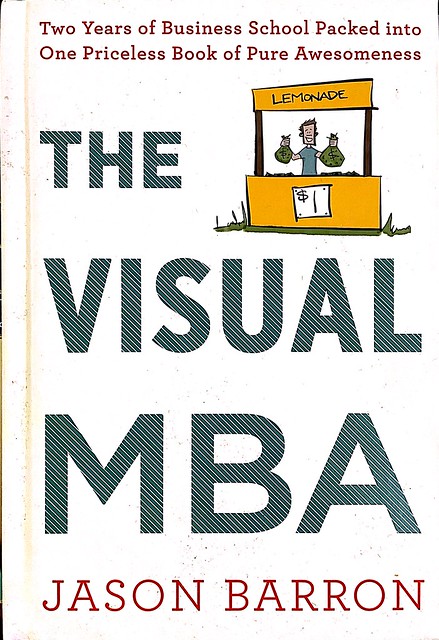
Jason Barron’s book The Visual MBA looks to distill down business principles into more easily understandable formats. The Visual MBA has been translated into a number of European languages since it was published in 2019, which is a good indicator of the book’s utility. So I thought I would take the time to reviewThe Visual MBA and see how I got on with it and whether it lives up to its premise.
Areas covered in The Visual MBA
The content of The Visual MBA is broken down into a number of areas including:
Leadership
Corporate financial reporting
Entrepreneurship (management and financial focus)
Management accounting
Business finance
Marketing
Operations management
HR
Strategy
Ethics
Decision making
Startups
The book itself is a robust hardback book that would be fine in a daypack lugged around campus. As with any book there are things that could be put in and taken away. My impression of the content is that would be useful to someone studying business at A’level or in the first year of an undergraduate degree. I personally found the marketing section frustrating. Part of the reason for this is that the depth of the subject was barely scratched. Readers were not prompted to even ask the right kind of questions.
There was nothing that would spur you to read more and read widely. I suspect that this would be the case with the other areas covered by the book as well. It creates the false confidence that would appeal to a surface player. I think that is dangerous for readers and the businesses that they work for.
Do I think the premise of the book works?
The book neatly summarises many of the key concepts that would be taught in a general business course and it explains the points in a simple manner. For instance the idea of balance sheets reminded me of the first semester in the first year of my marketing degree in terms of its explanations.
Where I am less sure of the book’s benefits was whether the illustrations would make me retain any better the content of the book? I will ignore the fact that for some pages the drawings weren’t illustrated but instead representations of the headlines in a hand drawn typography. I might the book beneficial if they were my diagrams that I was sketching in my notes. But I don’t think they have the same effect on a reader of the book.
In summary I would recommend that one buys the book as a simple guide to business studies or commerce rather than the visual aide memoire that the book seems to promise. If this sounds of interest to you you can get more information here.
Until watching this video on Heat I didn’t understand its link to Michael Mann’s earlier projects Crime Story and L.A. Takedown; which were basically attempts to make the same story for film. One of the reasons why Heat looks so realistic is that the film used a number of ex-special forces consultants including Steven Mitchel, who you might know better as Andy McNab. Heat is a legendary film for putting Al Pacino and Robert DeNiro in the same scene at the same time.
Heat has fantastic dialogue and is used by the US military for training purposes.
Beauty
Is the BBL bubble about to burst? – The Face – BBL is Brazil Butt Lift – the big butt is going the way of oversized breast enhancement surgery. It will have its place, but it won’t be so extreme
‘Prison Gothic’: Hong Kong road signs reborn as new font – Hong Kong Free Press HKFP – “Responding to the social movements and changes is a big incentive for the fonts’ development,” said Brian Kwok, associate professor at Hong Kong Polytechnic University’s design school. “In the past, symbols of Hong Kong local culture might be egg tarts, milk tea and the Lion Rock,” Kwok told AFP. “Now fonts have become a way for young people to explore their Hong Kong identity.”
Which means the only listings are likely to be old industry listings of state owned firms that foreign investors wouldn’t want to deal with anyway. The second one was: Alibaba scales back global expansion plan to rival Amazon | Financial Times – Alibaba.com’s US operation has failed to meet its initial targets, forcing the Chinese company to readjust its growth plans, according to three people familiar with the operations. The project has also been hit by dozens of staff departures from its New York office. The troubles at its US business-to-business arm come as Alibaba steps up its international push as its domestic operations continue to get hit by Beijing’s tech crackdown, slowing economy and rising competition. However, Alibaba.com has struggled to retain US sellers since its launch, in part down to the difficulty of competing with the prices of global merchants. “US manufacturers aren’t as competitive, the cost of everything is a lot higher including labour. The team do not have enough support internally, so they can’t get enough suppliers and sellers on board,” one current employee said – you could read this as the US is uncompetitive, or Alibaba only manages to sell on cost rather than value (quality, flexibility, after sales service don’t matter).
Aviation sector will be disrupted for years, Qatar Airways boss says | Financial Times – “Covid has damaged the supply chain of the industry . . . I think that it will last for a couple of years — it is not going to go away tomorrow,” Akbar Al Baker told the Financial Times in an interview. Labour shortages in Europe, delays in aircraft deliveries from manufacturers and a lack of spare parts had all affected Qatar Airways, he added. – and this is without the problems that airports have faced in baggage handling etc. If aircraft deliveries were really an issue, why did Qatar pick a fight with Airbus?
HSBC’s past may not help its future | Financial Times – There is no place in the new Hong Kong for a pre-eminent bank which is not institutionally subject to the Chinese government. As China turns inwards, it makes sense for the ruling party to want its own financiers in command of a smaller standalone lender that will be well-capitalised, regionally-focused and prepared to serve national objectives, not global shareholders. The installation of a Communist party committee at HSBC’s Chinese investment banking subsidiary, reported by the FT, is a prelude of what is to come: a slow, patient strategy of small steps designed to make inevitable a break-up already determined on high in Beijing. That is why Ping An has fired the first shot in the final battle over the colonial legacy of Hong Kong — a place China has always called “a problem left over from history”. – the smart play would be to cut the PRC and Hong Kong business off from the rest of the network. While China is the growth engine, it relies on the rest of the network for this profitable wealth management business. Secondly, what will happen with Standard Chartered?
Ideas
Reviving Progress in the UK – there is an issue with the capital injection required by the plans outlined. Would anyone trust the UK government that they would be able to execute in a competent manner on the ideas? I think that the UK is suffering from a crisis of competence as much as anything else.
Associated Press Aims to Drop the Term “Assault Rifle” from StylebookThe Firearm Blog – really interesting change towards more neutral language while the progressive media obsesses about the new SIG-Sauer MCX Spear which is similar in terms of lethal effect to the longer range rifles field during the first part of the cold war. These cold war era designs have been modernised and are available to gun owners across most of the US. The MCX Spear relies on a newer, harder to get ammunition. This ammunition is also harder to fill at home than existing formats like the earlier NATO 5.56mm and 7.62mmm rounds. Older weapons like the Heckler & Koch G3 are a bit heavier but offer a similar performance, yet you wouldn’t get this information from the progressive media. Regardless of your opinion on gun control, the facts matter.
Beijing detains high-flying Tsinghua semiconductor boss, report says | Financial Times – Zhao Weiguo, the former head of an expansive Chinese conglomerate with state backing and deep investments in the global technology sector, has been placed under investigation by officials in Beijing, according to local media. The 54-year-old, who led cash-strapped chipmaking giant Tsinghua Unigroup for a decade, has been out of contact after being taken from his home by authorities in mid-July, reported Caixin, a Chinese business publication.
Emirates statement on operations at London Heathrow – Emirates lays into London Heathrow’s airport chaos. The airport chaos has been labelled ‘airmageddon’, due to the restriction in numbers of passengers who can fly in and out of Heathrow in a given day of just 100,000 people. That’s 25,000 people a day lower than last year. While there is similar restrictions at Amsterdam’s Schiphol airport and a complete failure of their baggage system.
China
China’s Collapsing Global Image – China’s image abroad has declined significantly in the past four years, a sharp revearsal from the relative popularity it enjoyed in Africa, Asia, and Eastern Europe from the 1990s to the late 2010s. While previous Chinese regimes stressed humble non-intervention on the global stage, distributed generous infrastructure funding via the Belt and Road Initiative, and conducted massive soft power outreach programs through media and academia, many of these strategies have been reversed or rendered ineffective. As Council on Foreign Relations Senior Fellow for Southeast Asia Joshua Kurlantzick notes, “[there] are multiple reasons for China’s deteriorating global public image. China’s overall rising authoritarianism at home, its cover-up of the initial COVID-19 outbreak, and its brutal repression in Hong Kong and Xinjiang have hurt its perception among many foreign publics. China’s continued zero-COVID strategy has cut it off from much of the world, undermined people-to-people relations with other states, and cast some doubt on the Chinese model of development—even among some Chinese citizens.” – worthwhile contrasting with the following research, which implies a negative but more complex and nuanced situation – China seen as better than EU in completing African projects, survey finds | South China Morning Post – Poll of more than 1,000 policymakers on the continent puts priority on physical infrastructure, speedy results and non-interference in internal political affairs. European Union charts higher on quality of products or services delivered; good working conditions; creating jobs for Africans; upholding environmental standards
HSBC installs Communist party committee in Chinese investment bank | Financial Times – I don’t think that it would be beyond the realm of possibility seeing HSBC China and Hong Kong breaking off ARM China style under the auspices of Ping An and the Chinese government. Ping An is actually a cross holding: HSBC is the largest shareholder in Ping An and vice versa. The question is can they take the bulk of the HSBC Asia businesses with them like Singapore et al as well? This could happen based on company structure and western shareholders would be left with the equivalent of an empty husk
Hong Kong Law Reform Commission proposes 5 new offences to rein in cybercrime, with tougher penalties of up to life imprisonment | South China Morning Post – Will this proposed ordinance be available as a charge, with the prosecution claiming the criminal intent is an offence involving national security?” he asked. “Could all social media become a target? Given the wide criminalisation of speech in the context of national security and sedition charges is there a risk a charge under this ordinance will be added?” Davis said he was also worried the proposed amendment would be used to reverse the outcome of an earlier decision by the Court of Appeal in 2019 which limits the reach of an ordinance that prohibits “access to a computer with criminal or dishonest intent” to cover a person using their own tech devices.
Prior to reading The Power Law Mallaby wasn’t a familiar name to me. Looking into his background I could see why, Mallaby is a Washington Post columnist and specialises in international economics for the Council of Foreign Relations. A perfect CV for a policy wonk. His previous works have included a biography of Alan Greenspan, the World Bank and a book on hedge funds.
What the book doesn’t cover
The origins of modern venture capital in the pre-second world war era was through the family offices of people like the Wallenbergs and the Rockefellers. The Power Law only picks up the story post-war and has a distinct US bias in its storytelling.
Synopsis of The Power Law
George Doriot
Mallaby starts the story with Georges Frédéric Doriot and the American Research and Development Corporation (ARDC). What’s interesting Doriot is how he was different from today’s VCs with a focus on patriotism. Doriot is most famous for his funding of Digital Equipment Corporation (DEC), an enterprise computer company whose mini-computers facilitated the early internet and many business computer systems. At the time of DEC, the Boston area seriously rivalled the Bay Area as the technology centre.
Treacherous eight
As the book goes into the story of Arthur Rock and his relationship with the treacherous eight who left Bill Shockley’s lab, this is where many Silicon Valley histories start to coalesce with The Power Law. Mallaby adds a little more, such as the 600x return that both the eight and Rock enjoyed from their investment. At 96, Rock is still alive at the time of writing. He is more recently remembered for his involvement of firing of Steve Jobs from Apple in 1985, a good deal of this came down to his distaste for Jobs informal appearance.
Sandhill Road
Arthur Rock and former Doriot student Bill Draper benefited from being in the right place and at the right time. The US government looked to spur innovation as part of the cold war and the Bay Area was were much of this innovation would happen. Sequoia and Kleiner Perkins followed soon after, these names are now central to the Sandhill Road venture capital ecosystem, but in 1972 they were just starting off with businesses like Atari. Atari wasn’t started by experienced business professionals, but by a twenty something who thought meetings in the hot tub were a good idea. Atari marked a point in time when VCs had to become the adults in room, or as Mallaby put it ‘active investors’.
What I didn’t realise at the time was how early in Kleiner Perkin’s history was their engagement with biotech pioneer Genentech. I didn’t realise that Genentech was funded before Apple and was more a peer of Tandem Computers. Much of the early networking was based on a two-way door between established venture funded firms that were descendants of the treacherous eight and early venture capital firms that employed experienced executives as partners.
Apple was notable for two reasons. Firstly, venture capital firms operated for the first time rather like an insurance syndicate with several funding the business rather than one large investor. Secondly, the returns on Apple seems to have solidified the model and bought niche financing to a wider awareness beyond the geographic pockets of the technology industry. Where many books like Accidental Empires would use this as a jumping off point to tell the story of the PC industry. The Power Law instead talks about computer networking, this makes sense if one thinks of Metcalfe’s Law as the power law that matters the most in the internet age. The early east coast venture capital community were more cautious than their west coast counterparts, partly because the east coast technology corridor had less of a loose network of connections compared to the west coast. I think that the different business culture of the east coast also had an effect.
Connectors
Doerr connected Cypress Semiconductor and Sun Microsystems, two companies that Kleiner Perkins funded so that they would make the SPARC RISC microprocessor. You could put this as the starting point for the golden age of UNIX servers and workstations – which we can trace forward to today’s Mac range and modern Google servers.
Doerr had attempted other alliances before and in this way we see a different way how Metcalfe’s Law was the power law of the title. VCs has access to several nodes that they could connect together to try and build a technical vision. This is different to the idea we’re usually sold of the tech visionary / company founder a la the Google founders, Mark Zuckerberg or Steve Jobs.
Meanwhile Don Valentine of Sequoia Capital usurped the founders of Cisco Systems and brought in a new team to run the business bilking the founders out of much of their money. Part of this was down to one of the original Cisco founders being a woman.
Government money
The VC industry of the early 1990s capitalised on government money. Netscape was a remake of Mosiac which was the first graphic internet browser software developed in the NCSA software design group. This was part of the government-funded National Center for Supercomputing Applications (NCSA) at the University of Illinois. UUNET was a commercial ISP based on the back of the ARPANET email delivery system. As the dotcom boom took off it was the largest ISP and the fastest growing. UUNET eventually became part of MCI WorldCom and then Verizon, where UUNET remains a key part of the Verizon business offering. Both Netscape and UUNET were viewed at VC successes but as The Power Law shows, the reality was more complicated.
Irrational behaviour
I thought that the original dot.com boom was irrational behaviour, but I learned from the account of GO Computers a decade or so earlier that irrational behaviour is very much in the blood of venture capital, which explains how we had WeWork and Uber in the 2010s which is where The Power Law finishes its tale. The funny thing about the irrational behaviour is that both the dot com era and the 2010s Softbank appear to have been an accelerant with their late stage momentum approach to venture capital deals which blew valuations on businesses up far beyond what would be reasonably expected otherwise. Softbank gave birth to ‘growth equity’ as a business model that took in many existing and new VC businesses including Russian Israeli Yuri Milner and his DST Ventures business which invested in Facebook, Stripe and GroupOn.
Paul Graham and Peter Thiel
Paul Graham was a founder of an ad tech business who then moved over to investing and had a reputation for warning startup founders about the nature of VC funding. It fitted neatly into the ‘John Gaunt’ type narrative that played well with some of his peers like Peter Thiel. The impact of these people setting an ideological agenda of sorts for Silicon Valley founders, together with a plethora of other founders providing seed capital to businesses from Google onwards greatly impacted the freedom of VCs to operate using their previous models and left the industry open for the Softbanks of the world to inflate everything.
China off-note
The Power Law offers a largely truimphantist view of the role of VCs such as Sequoia Capital in China. However, this seems to ignore the impact of Chinese VC and angel investors. It also chooses to ignore the negative impact of Xi Jingping.
Conclusion
Mallaby illuminates part of Silicon Valley history that I wasn’t familiar with, in particular VCs strategic role in steering technological change during the 1990s. Time has somewhat outpaced the book. The rise of Xi Jingping and the change in attitude towards safety and innovation amongst young Chinese is likely to make the China section look overly optimistic. The end of easy money, at least for the time being will impact the VC industry globally and growth equity looks like a folly during the present time. But if you want to understand how things were The Power Law is the ideal book for you.