Category: innovation | 革新 | 독창성 | 改変

Innovation, alongside disruption are two of the most overused words in business at the moment. Like obscenity, many people have their own idea of what innovation is.

Judy Estrin wrote one of the best books about the subject and describes it in terms of hard and soft innovation.

  • Hard innovation is companies like Intel or Qualcomm at the cutting edge of computer science, materials science and physics
  • Soft innovation would be companies like Facebook or Yahoo!. Companies that might create new software but didn’t really add to the corpus of innovation

Silicon Valley has moved from hard to soft innovation as it moved away from actually making things. Santa Clara country no longer deserves its Silicon Valley appellation any more than it deserved the previous ‘garden of delights’ as the apricot orchards turned into factories, office campus buildings and suburbs. It’s probably no coincidence that that expertise has moved east to Taiwan due to globalisation.

It can also be more process orientated shaking up an industry. Years ago I worked at an agency at the time of writing is now called WE Worldwide. At the time the client base was predominantly in business technology, consumer technology and pharmaceutical clients.

The company was looking to build a dedicated presence in consumer marketing. One of the business executives brings along a new business opportunity. The company made fancy crisps (chips in the American parlance). They did so using a virtual model. Having private label manufacturers make to the snacks to their recipe and specification. This went down badly with one of the agency’s founders saying ‘I don’t see what’s innovative about that’. She’d worked exclusively in the IT space and thought any software widget was an innovation. She couldn’t appreciate how this start-ups approach challenged the likes of P&G or Kraft Foods.

  • AMD Live and the connected home ten years later

    A decade ago I worked on AMD Live. A hodgepodge of hardware and software that provided media access where ever and whenever you wanted it.  Here is a short video that we made at the time to bring it to life. The idea was that AMD would be able to sell higher specifications of PC components into the home to act as digital hub. They wanted to push their Opteron server processors into the home.

    An engineer came in and spent the best part of a day setting everything up throughout the house prior to shooting the film. At the time much of the streaming boxes didn’t work as promised so some of the screen images were put in post-production. There was a mix of cloud services and home hosted content. At the centre was a PC running Windows Multimedia Centre. There was a raft of third-party apps needed as well

    • Network management apps
    • Video and image compression apps
    • Instant messaging (that wasn’t MSN or Skype – no idea why it was in the bundle)
    • TV tuner software
    • A music jukebox application
    • Network management
    • An AMD GUI which provided a 3D carousel effect and integrated web browser

    It was all a bit of kludge.

    Digital content was well on its way. Streaming technology was well known but unstructured. RealNetworks had been going commercially since 1997, but the playback quality was dependent on Internet network connectivity, We only started to see widespread DSL adoption from 2003 onwards in the UK. By the first quarter of 2003, DSL was enabled at 1200 of the 5600 telephone exchanges across the UK.

    Apple’s QuickTime streaming server was open sourced back in 1999; so if anyone wanted to set up a streaming network they had the technology to do so.

    Digital audio content prior to 2003 had largely been ripped from optical media or downloaded online via FTP, Usenet or P2P networks. iTunes launched its music store in 2003.

    From a standing start in 2002; by 2004, 5 million devices with a HDMI connection had been sold. The built in copy protection had been developed by an Intel subsidiary and was adopted by all the big Japanese consumer electronics manufacturers.

    By 2005, Apple had started selling iTunes movies and TV programmes  alongside its music offering that allowed sharing of an account on up to 5 concurrent devices.

    Apple launched its MFi programme in January 2005, which begat a raft of speakers and stereos with iPod connectivity in the home and the car.

    Sonos released its speaker system including a wi-fi mesh network and AES network encryption. Flickr had a well documented API that allowed for a fully functioning photo album and picture streaming which was used in early web 2.0 mashups.

    AMD Live was on the back-foot from day one. From a high end perspective of audio streaming Sonos had it locked down. For everyone else moving an iPod from room to room had the same effect.  Mini-video servers could be configured from mini-PC boxes, but they were only for the technically skilled. Even the Mac Mini launched in 2005 didn’t make the process much easier. The key advantage is that it could use iTunes as a video source and a playing software.

    Back then because it was US centric in its view AMD Live completely ignored the rise of the smartphone as a music playback device.  By 2007, Nokia launched ‘Comes With Music‘ which put mobile streaming in play. Apple Music and Spotify have now made streaming effortless. Video playback now comes from devices the size of a thumb drive. New intermediate screens from tablets to smartphones changed viewing habits and the PC has become redundant as the home hub for all but the most enthusiastic AV aficionados.

  • Machine learning sublime influence

    Scott Galloway talks about the way brands are using AI (machine learning) and the examples are very much in the background.  Welcome to the sublime world of machine learning where the impact on the customer experience won’t be apparent. In many respects this is similar to how fuzzy logic became invisible as it was introduced in the late 1980s.

    The Japanese were particularly adept at putting an obscure form of mathematics to use. They made lifts that adapted to the traffic flows of people going in and out of a building and microwaves which knew how long to defrost whatever you put into it. Fuzzy logic compensated for blur in video camera movement in a similar manner to way smartphone manufacturers now use neural networks on images.

    The Japanese promoted fuzzy logic inside products to the home market, but generally backed off from promoting it abroad. The features just were and consumers accepted them over time. In a quote that is now eerily reminiscent of our time a spokesperson for the American Electronics Association’s Tokyo office said to the Washington Post

    “Some of the fuzzy concepts may be valid in the U.S.,”

    “The idea of better energy efficiency, or more precise heating and cooling, can be successful in the American market,”

    “But I don’t think most Americans want a vacuum cleaner that talks to you and says, ‘Hey, I sense that my dust bag will be full before we finish this room.’ “

    This was also the case with the use technology companies made of Bayes Theory. This was used by the likes of Autonomy and Microsoft Research.

    A second technique was rules, put simply IF then THAT. This kind of technology has been used to drive automated trading models and credit card approvals for decades. Pegasystems are one of the leaders in developing rules based processing. Rules based systems could even be built in an Excel macro and would still count as a form of machine learning. 

    Finally machine learning needs to think about a number of things with regards the models being used:

    • The importance of accuracy in the use case
    • The level of precision required and ways to indicate that precision means
    • The cost of generation versus other methods, this is very important in terms of computing power and energy consumption 

    More information
    The Future of Electronics Looks Fuzzy | Washington Post (December 23, 1990)

  • The Inevitable by Kevin Kelly

    I re-read Kevin Kelly’s What Technology Wants and then decided to revisit The Inevitable: Understanding the 12 Technological Forces That Will Shape Our Future. The books make sense as ideal companions for each other, despite some overlap in terms of proof points.

    On the face of it The Inevitable is a less ambitious book than What Technology Wants. And when I started reading the book I didn’t get the kind of electrifying feeling that a big idea can bring, like when I read What Technology Wants.
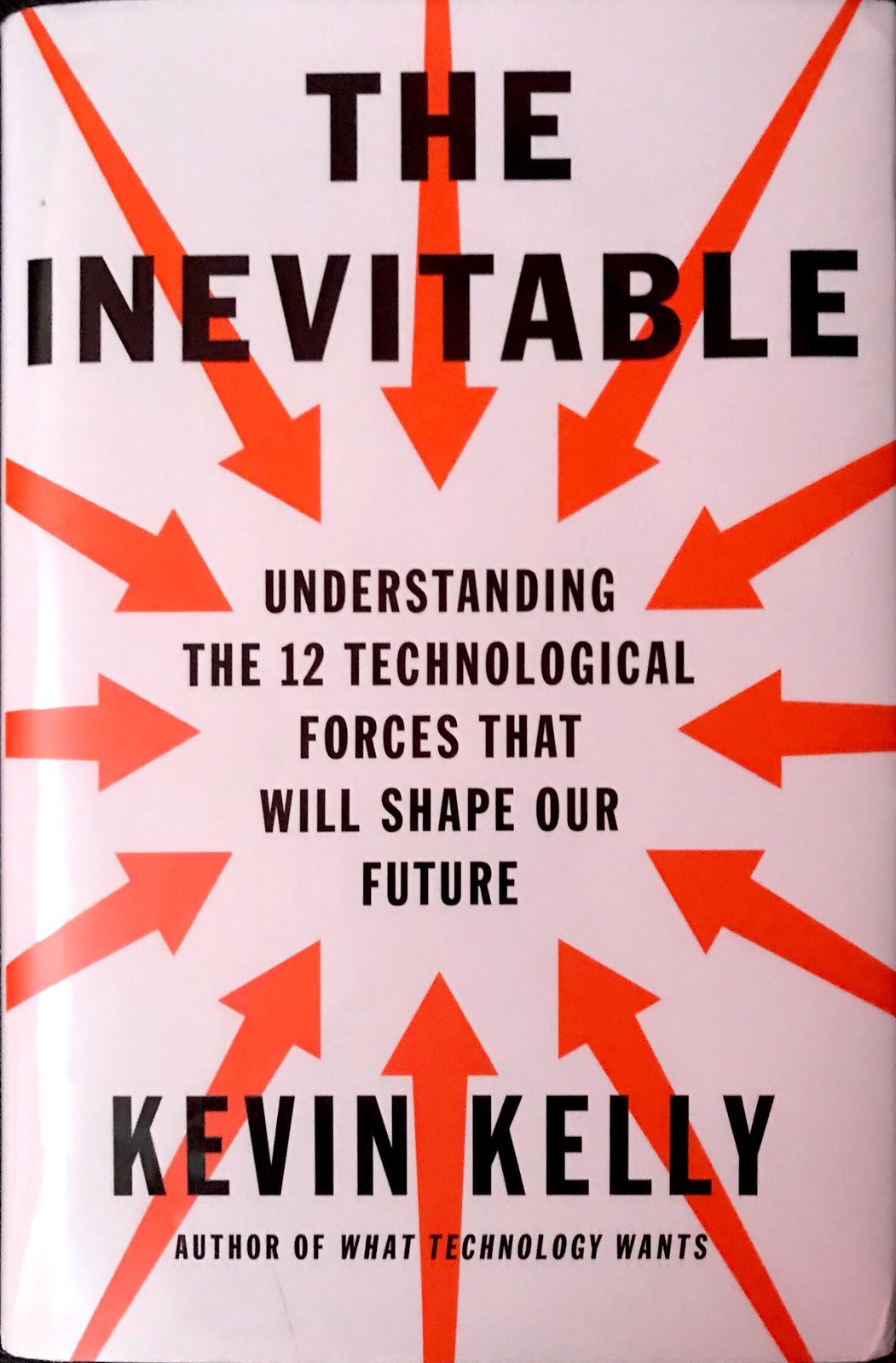
    The inevitable

    In the book Kevin Kelly touches on the kind of areas one would expect in  typical presentation given by an innovation team at an advertising agency. He is an unashamed techno-optimist, but the key difference in his thinking is two-fold:

    • Kelly pulls it together as a coherent idea rather than 12 slivers. He provides in-depth cogent arguments that bind the trends together
    • Kelly argues that transparency in governments will compensate for the erosion of privacy. While I understand where the idea has come from, I don’t agree with this particular viewpoint at least as it would manifest itself in the west. I certainly don’t think that would be the case in the East either. The Nazis use of IBM technology damn near destroyed the world as we know it. The level of trust between the government and the governed is in decline

    There is a clear line of progression in Kevin Kelly’s works from Out of Control written at the start of the modern internet age through to The Inevitable.  If you are interested in how technology is shaping our world buy What Technology Wants; if you are still hungry for more follow it up with The Inevitable: Understanding the 12 Technological Forces That Will Shape Our Future.

    More book reviews here.

  • Digital News Report + more stuff

    Digital News Report by Oxford’s Reuters Institute for the Study of Journalism latest findings discussed by Dr. Rasmus Kleiss Nielsen. This Digital News Report is based on a survey of more than 70,000 people across 36 countries.

    Economics

    The US gender wage gap is closing because women are making more and men are making less — Quartz – I wonder how this then fits into a feminist, social and larger economic agendas? Will there be a tension between all these? Is there a floor where aggregate male earnings will hit?

    FMCG

    P&G’s Pritchard Calls for Next Generation of Digital Ads | Special: Dmexco – AdAge – I kind of agree with him from a an overall sentiment point of view, but viewability is also a function of how much of the viewable area it fills? I realise that it would be hard to measure but it would be a function of ad size, scrolling speed and display size. In the real world think about the ads on the tube escalators.

    Innovation

    China May Own More Artificial Intelligence Patents Than US By Year-End – China Money Network – interesting speculation. I could understand it given that IBM is one of the largest filers of patents in the US and its machine learning efforts are overhyped

    Korea

    How Nike Sneakers Made a Billionaire of Park Yen-cha | BoF – interesting profile

    Legal

    WeWork accuses Chinese competitor UrWork of stealing its name and style: Shanghaiist – wait I thought WeWork’s style was stolen from the hipster catalogue?

    Media

    comScore Opens Global Access to Free Viewability Measurement – comScore, Inc – only for global advertisers, publishers, agencies and ad networks?

    P&G Asia brand director: ‘We were clickbaiters – and a giant duck still got more likes than we did’“I’ve been through generations of training in how to make a good Facebook ad, which has gone around 360 degrees and come back to the simple principles of marketing. We went through lots of complications in how to get clicks – we were clickbaiters. We honestly were. And yet that duck in Hong Kong Harbour got more likes than any of pure branded messaging, and we thought that’s maybe a good thing. But it’s not and it doesn’t help brands or businesses. It’s taken us time to get to where we are and the simplicity of those core marketing principles.”

    Security

    On the Equifax Data Breach – Schneier on Security – Surveillance capitalism fuels the Internet, and sometimes it seems that everyone is spying on you. You’re secretly tracked on pretty much every commercial website you visit. Facebook is the largest surveillance organization mankind has created; collecting data on you is its business model. I don’t have a Facebook account, but Facebook still keeps a surprisingly complete dossier on me and my associations — just in case I ever decide to join.

    I also don’t have a Gmail account, because I don’t want Google storing my e-mail. But my guess is that it has about half of my e-mail anyway, because so many people I correspond with have accounts. I can’t even avoid it by choosing not to write to gmail.com addresses, because I have no way of knowing if newperson@company.com is hosted at Gmail.

    Edward Snowden Interview: ‘There Is Still Hope’ – SPIEGEL ONLINE

  • FaceID

    @ WWDC

    Apple’s facial recognition aka FaceID has spurred a number of discussions about the privacy trade-offs in the iPhone X.

    Experts Weigh Pros, Cons of FaceID Authentication in iPhone X | Dark ReadingOne concern about FaceID is in its current implementation, only one face can be used per device, says Pepijn Bruienne, senior R&D engineer at Duo Security. TouchID lets users register up to five fingerprints. If a third party obtains a user’s fingerprint and reproduces it, and the user is aware, they could register a different unique fingerprint.

    Can Cops Force You to Unlock Your Phone With Your Face? | The Atlantic – Even if Face ID is advanced enough to keep pranksters out, many wondered Tuesday if it would actually make it easier for police to get in. Could officers force someone they’ve arrested to look into their phone to unlock it?

    How Secure Is The iPhone X’s FaceID? Here’s What We Know | Wired – Marc Rogers, a security researcher at Cloudflare who was one of the first to demonstrate spoofing a fake fingerprint to defeat TouchID. Rogers says he has no doubt that he—or at least someone—will crack FaceID. In an interview ahead of Apple’s FaceID announcement, Rogers suggested that 3-D printing a target victim’s head and showing it to their phone might be all it takes. “The moment someone can reproduce your face in a way that can be played back to the computer, you’ve got a problem,” Roger says. “I’d love to start by 3-D-printing my own head and seeing if I can use that to unlock it.” 

    Now lets talk about the Apple Watch, which I consider to present more serious issues.
     
    The Apple Watch 3 is interesting from a legislative point-of-view. The software SIM in the Apple Watch clones the number of your iPhone. The security services of the major powers generally don’t broadcast their capabilities. Politicians are generally untroubled by knowledge of what is possible. Giving politicians an inkling is likely to result in broad sweeping authoritarian power. 
    Imagine what will happen when Amber Rudd goes into parliament looking for real-time access to everyone’s phones. She now can point to the Apple Watch 3 as evidence that LTE and 3G connections can be cloned. What kind of legislation will her special advisers start cooking up then?

    Secondly, it will only be a matter of time before criminals either work out how to do it themselves, or co-opt mobile carrier staff. Two factor authentication that depends on SMS is already compromised. This allows it to be compromised and undetectable.

    The Apple Watch 3 may have royally screwed us all.