Category: branding | 品牌推廣 | 브랜드 마케팅 | ブランディング

The dictionary definition of branding is the promotion of a particular product or company by means of advertising and distinctive design.

I have covered many different things in branding including:

  • Genesis – the luxury Korean automotive brand
  • Life Bread – the iconic Hong Kong bread brand that would be equivalent of wonder loaf in the US
  • Virgil Abloh and the brand collaborations that he was involved in
  • Luxury streetwear brands
  • Burger King campaigns with Crispin Porter Bogusky
  • Dettol #washtocare and ‘back to work’ campaigns
  • Volkswagen ‘see the unseen’ campaign for its Taureg off road vehicle
  • SAS Airline – What is truly Scandinavian?
  • Brand advertising during Chinese New Year (across China, Hong Kong, Singapore and Malaysia)
  • Lovemarks as a perspective on branding
  • BMW NEXTGen event and Legend of Old McLanden campaign
  • Procter & Gamble’s Gillette toxic masculinity ads
  • Kraft Mother’s Day campaign
  • Kraft Heinz brand destruction
  • Porsche Design in the smartphone space
  • Ermenegildo Zegna
  • Nike’s work with Colin Kaepernick
  • Counterfeit brands on Instagram, Alibaba and Amazon
  • Gaytime Indonesian ice cream
  • Western Digital
  • Louis Vuitton collaboration with Supreme
  • Nokia
  • Nike Korea’s ‘Be Heard’ campaign
  • Mercedes SLS coupe campaign
  • Brand collaborations in Hong Kong
  • Beats headphones
  • Apple
  • Henrion Ludlow Schmidt’s considerations of branding
  • Cathay Pacific
  • Bosch
  • Mitt Romney’s failed presidential bid
  • Microsoft Surface launch
  • Oreo Korean campaign
  • Chain coffee shop brands and branding
  • Samsung’s corporate brand
  • North Face’s brand overeach in South Korea
  • Mr Pizza Korean pizza restaurant and delivery service brand
  • Amoy Hong Kong food brand
  • Chevrolet Corvette ‘roar’ campaign promoting a build your own car service
  • What does a great email look like?

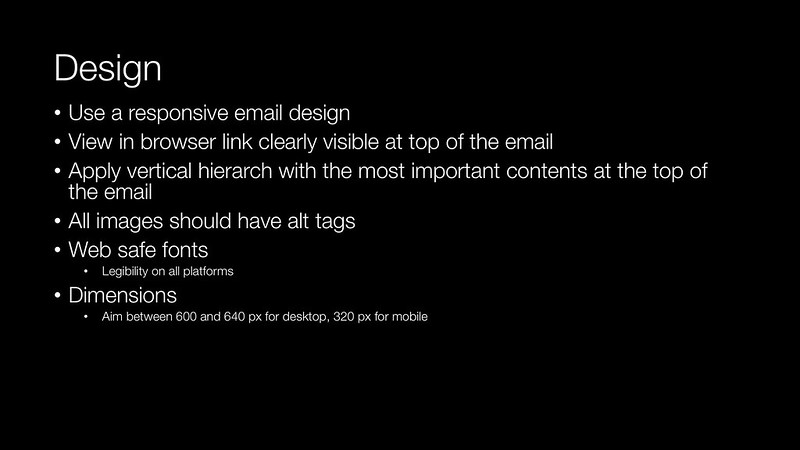
    I often end up with my head in the data and need to check myself to ensure that the basics are happening. This was a deck that I pulled together on what does a great email look like?

    Why email marketing? Because it still works and provides relatively good value in terms of marketing spend. We might be getting ever lower open rates over time in aggregate, but that means as marketers we need to be more focused on what makes a great email.

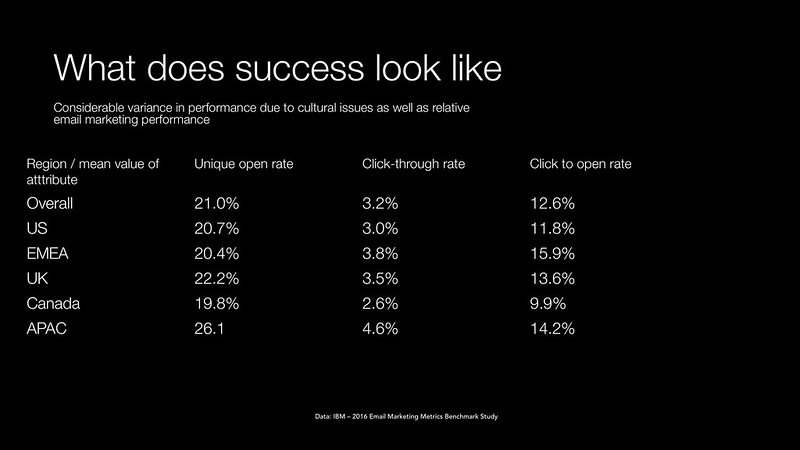
    So what does success look like, what constitutes great? If you work in digital marketing you probably have heuristics in the back of your mind based on an article you’ve read or how previous projects have turned out.  The reality is that it changes by country and by industrial sector.

    What does success look like

    There are some interesting variations, such as the US / Canada or UK / Canada click to open rates for email.

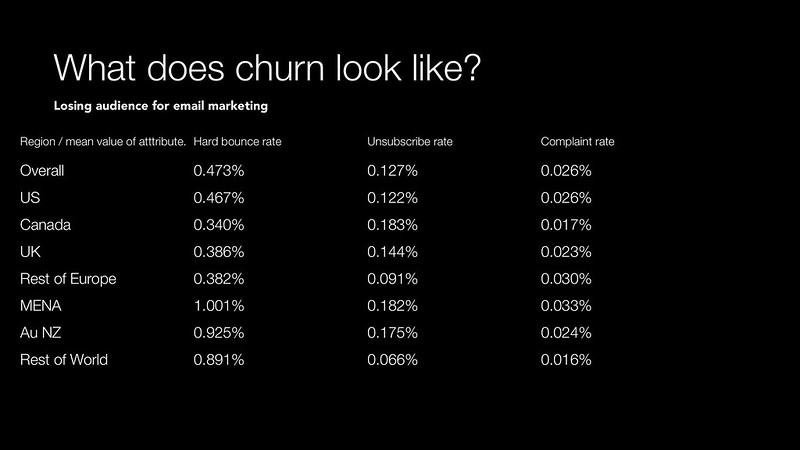
    What does churn look like

    Or the comparatively high of churn rate in the UK vis-a-vis the US and Canada.

    Getting to open

    There are a number of factors that can aid getting to open. Some of them will be hygiene when the General Data Protection Regulations kick in across the EU next year.

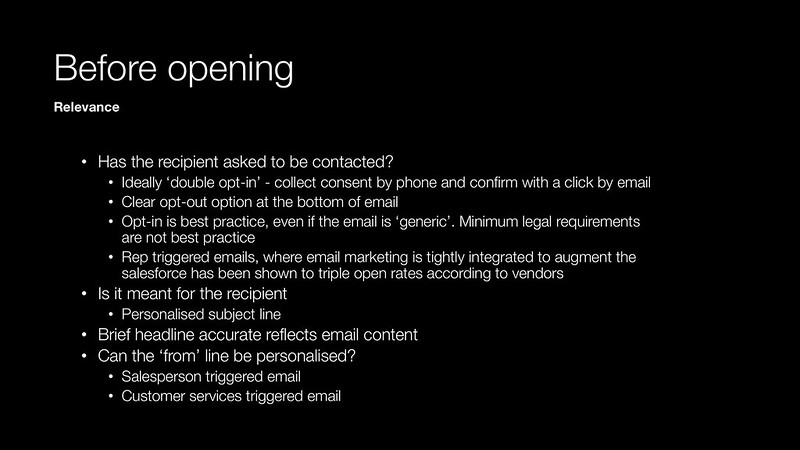
    Before opening

    A lot of the basics seem obvious, yet there is a lot of unpersonalised, unrequested, irrelevant mail is still sent out. For business-to-business relationships in particular having a phone and online double opt-in is desirable. For consumer marketing an online opt-in followed by a confirmation email and opt-in link.

    Before opening

    In some ways we have gone back to the early web. Lean download sizes for email are really important. There have been so many times I have been deleting marketing email on the tube, as the mobile device and spotty wifi can’t download the image heavy communication in a timely manner. For some reason clothing and shoe e-tailers are really bad on this.

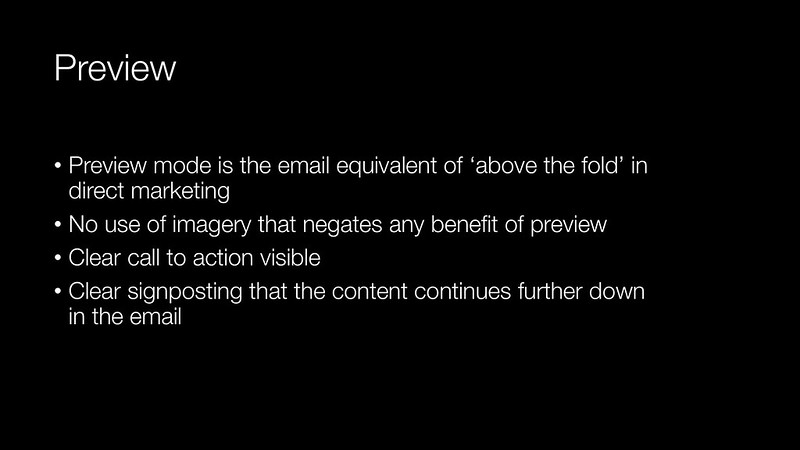
    Preview

    Back when I started in digital marketing, people laboured long-and-hard over crafting highly clickable message subject lines, but preview is as important now; especially in ‘three pane’ email clients like Outlook or Mail.app on Mac and iPad.

    Design

    Design is a key part of getting an email viewed. The design needs to be responsive because of the variation in possible device display sizes and the foibles between email clients, web email clients, web browsers and mail providers. Previously one would have worried about not being black listed (still important), plain text and HTML options. Business to business marketers used to get stressed over will the email work on Lotus Notes (historically no, unless it was in plain text).

    Inverted pyramid approach

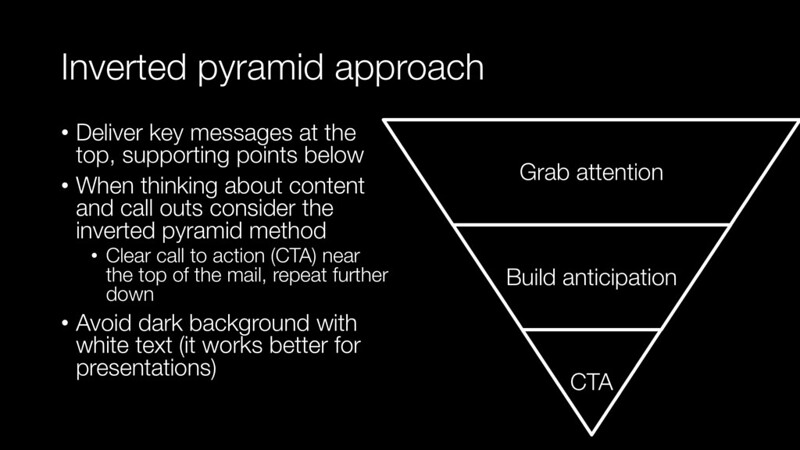
    When you are thinking about content and design layout the inverted pyramid approach is a good place to start from. With the call to action what kind of behavioural cues would work best? This is where A/B testing can be employed. Marketers aren’t great at intuitively picking these.

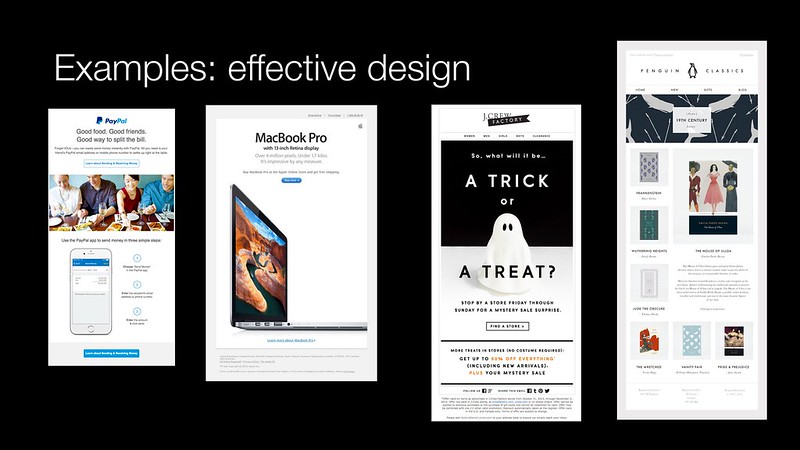
    Here are some examples of effective email design, notice the vertical alignment that makes them mobile friendly

    Effective design examples

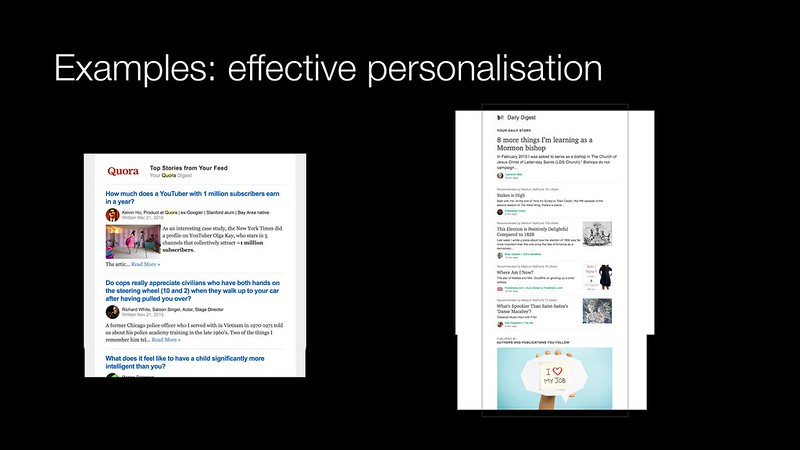
    And here are some examples of effective personalisation (in both these cases based on previous behaviour on-site).

    Effective personalisation examples

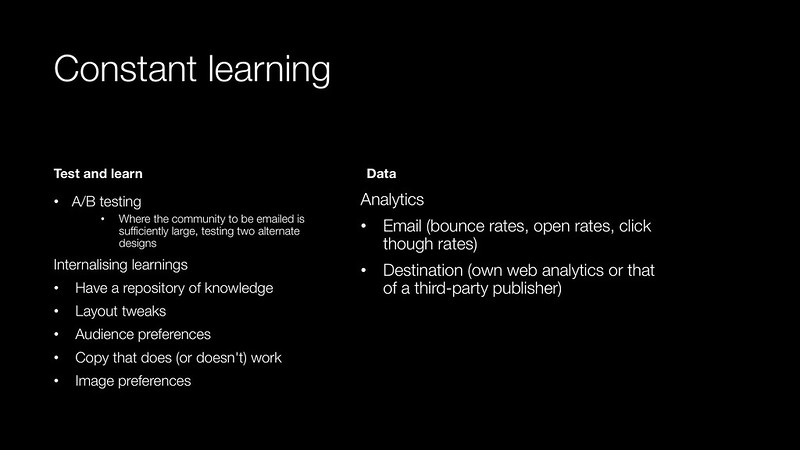
    The biggest mistake that organisations fail to do is internalise learnings from previous campaigns. This isn’t just about improving numbers over time but learning what has, and hasn’t worked. Often this knowledge will disappear when the marketer responsible moves on, or when the agency responsible has a similar change on their side.

    Constant learning

    Thanks for making this far, here are my details if you want to find out more.

    About me

    You can find this presentation on Slideshare.

  • eSports discussion

    The rise of eSports as a form of entertainment is a popular discussion area in both media and technology. Brandon Beck is the co-founder of Riot Games (best known for League of Legends) on the rise of eSports from a cultural and business perspectives.  His ideas what online gaming future looks like; are interesting, if a little self-serving.

    eSports takeouts:

    • Interesting that Riot are trying to give players a better base to build their careers. How will this affect teams over individual player talent?  How long is their professional life? When do they burn out? What does post-eSports athlete life look like?
    • They acknowledge that competitive gaming will have a long runway to adoption rather than the hockey stick models predicted by financiers in this area. Traditional sports management professionals see eSports as a new opportunity.
    • Professional athletes come out of second and third generation gamers and parents who pursued traditional sports at a competitive level
    •  The new nature of competitive gaming has an exclusively young audience. The vast majority of content is streaming. The audience is cable cutters, which implies that they didn’t have traditional sports as a substitute content
    • Player access and the Asian ‘idol’ phenomenon seems to be very similar with ‘around game’ content. There is an immediacy to it. There is also a grey zone between the athlete and online influencers, I could see a crossover
    • I found it concerning that it revolves so much around China, given the rule by law approach to things that the Communist Party of China takes. It would take nothing to crush competitive gaming in China. Comments on the negative social impact of gaming doesn’t bode well

    More on professional online gaming here and more on Riot Games here. It will be interesting to see how Riot Games continues to develop under the ownership of Chinese technology company Tencent.

  • Cinema in China + more news

    Cinema in China

    China’s total number of cinema screens now exceeds the US | Marketing Interactive – why Hollywood makes odd casting and big spectacle films. That also doesn’t mean that Hollywood is making the same revenue per screen either. Anecdotally, I heard of cinemas in China, running a ticket up as a local film and then crossing the cinema screen number off and changing it for a Marvel film. The customer gets to see the film that they want and the revenue goes to the local film instead. Hollywood already has a very limited access to the Chinese cinema market. The Communist Party of China is looking to grow domestic soft power, that means further limiting Hollywood’s access to cinema in China

    Business

    Macron wants limits on Chinese investments, takeovers in Europe’s strategic industries – smart move, there is a strong case for a ‘China reciprocity law’ forcing technology transfer to the EU and restricting investment in strategic industries

    It’s business, and it’s personal: How Amazon Web Services decides to enforce non-compete contracts – GeekWire – sounds like most non-compete clauses

    China

    China’s Biggest Gaming ‘Whales’ Are Werewolves — The Information – I was introduced to Werewolf in the early noughties by some of my geekier friends

    Consumer behaviour

    Americans won’t wait more than four minutes for a slightly less disgusting hamburger | Quartz – which funnily enough was the time that the McDonald’s restaurant I worked in for six weeks at the start of my working career aimed to surpass

    Design

    Owl Labs Meeting Owl – cute product design for… – I am reminded of the wood cut faces on the beneath the facias of old Nokia 5110 handsets

    Design in the Era of the Algorithm | Big Medium

    Economics

    The Political Kindling of the Grenfell Fire – The Atlantic – Britain has slipped to sixth in the economic rankings. Yet either position, fifth or sixth, is misleading: Broadly speaking, Britain is an economically average country, with one exceptionally rich region—London, which is reportedly home to more multimillionaires and billionaires than any other city in the world, and serves as the country’s economic engine. Of the EU’s 15 strongest economies, none rely as heavily on one area as the U.K. does: London’s per capita GDP is almost two and a half times Britain’s national average. But London’s enviable self-confidence, its robust financial services sector, and glittering facade, obscure the devastating inequality that plagues the U.K. While the city is Britain’s lone representative among the 10 richest regions in northern Europe, the country also includes a stunning nine of northern Europe’s 10 poorest regions. – One paragraph deflation of British hubris that underpins the likes of the Leave campaign and a great argument for London becoming a city state.

    The Car Was Repossessed, but the Debt Remains – The New York Times – For low-income Americans, the fallout could, in some ways, be worse than the mortgage crisis. With mortgages, people could turn in the keys to their house and walk away. But with auto debt, there is increasingly no exit. Repossession, rather than being the end, is just the beginning. “Low-income earners are shackled to this debt,” said Shanna Tallarico, a consumer lawyer with the New York Legal Assistance Group

    Finance

    Investors step in to play risky role of lender | WSJ City – at what point does this become similar to China’s shadow banking practices?

    FMCG

    Unstoppable at home, Ramdev’s Patanjali gets a reality check in Nepal | Quartz – Ramdev’s products have given the likes of Unilever a scare in India, interesting to see his brand has limits

    Ideas

    Targeting and the F3EAD Process | Havok Journal – interesting perspective with key focus of reducing time to insight and action

    Japan

    WATANABE KATSUMI: “GANGS OF KABUKICHO” | #ASX – amazing portrait images

    Why is Japanese customer service so amazing? Because in Japan it’s one strike and you’re out | SoraNews24

    Luxury

    Brands are learning millennials’ language for luxury: “organic,” “sustainable,” “ethical” — Quartz – oh god sounds awful. More related posts here

    Cathay Pacific still ranks among top five airlines in the world, with other Hong Kong carriers also taking home accolades | South China Morning Post – despite all the problems

    Marketing

    Harbin beer and Starcom join hands to push China’s e-Sports | Marketing Interactive

    P&G Malaysia goes on LINE to grow online following | Marketing Interactive – probably very big in Thailand for this as well

    Media

    WPP folds Neo@Ogilvy into Mindshare | Campaign Asia – interesting move to bring all paid media inside GroupM

    Group M downgrades UK ad growth forecast in part due to brand safety fears | Campaign LiveAdvertisers are increasingly taking a more measured view toward digital as they grapple with developing data strategies; setting more coherent objectives; attribution considerations; increased brand safety and accountability expectations and the appreciating trade-off between risk, price and performance

    Security

    Tim Cook was right to fight the FBI | TheNextWeb

    Software

    Inside Microsoft’s Artificial Intelligence Comeback | WIRED – interesting article on two levels. Firstly, Microsoft’s approach and direction on AI, secondly the classic approach to storytelling from a PR perspective. Not surprisingly they are focused on Facebook and Google

    Minecraft’s New 4K Textures Don’t Even Look Like Minecraft | Extreme Tech

    Technology

    Apple Culture After Ten Years of iPhone – Monday Note – The First Trillion Dollars is Always the Hardest

    Robots are doing the work of $326,000-a-year Goldman Sachs employees – Axios

    Wireless

    Roam like at home? Not so fast – POLITICO – interesting exceptions

    Sunrise preps 2G switch-off | total telecom – interesting move by the Swiss carrier. Greater focus on in-building and long distance performance of LTE

  • Brand blogs + more news

    Brand blogs

    Are Brand Blogs Worth the Effort? | The Daily | L2 – I am surprised at the findings on brand blogs especially in terms of best practices not being adhered to. Blogging is the platform which the marketing profession understands best, because it has been using it the longest, brand blogs are also one of the few platforms that the luxury brand can truly own. I think the research on brand blogs reflects that marketing functions aren’t learning organisation. More related content here.

    FMCG

    Starbucks is testing out ice cubes made of coffee | Quartz – makes total sense

    Media

    Rubicon Project’s Barrett: Tackle Transparency Or Ad Tech Could Face Regulation 05/18/2017 – stating the obvious, but interesting that this came out the same time that they are countersuing The Guardian

    Spotify’s Loss Widens Despite Big Jump in Revenue — The Information – investor sentiment seems to be more about hope rather than reality

    Online

    Introducing Similarity Search at Flickr | Yahoo Research – really cool image search

    Retailing

    Telegram now lets users buy things from chatbots in its messaging app | TechCrunch – very WeChat-esque

    Security

    How Google reinvented security and eliminated the need for firewalls | Network World – interesting read (reg wall)

    Theresa May to create new internet that would be controlled and regulated by government | The Independent – Facebook and Google should just block the UK and see how that goes down, otherwise the precedent it offers internationally is quite worrisome for them

    The Threat | Edge.org – interesting perspective on computer security research over time

    Software

    Huawei Loses Ex-Apple Designer Hired to Revamp Smartphone Software — The Information – usual aspects of challenge: distance from headquarters, Chinese language skills, desire for a big step change are all barriers

    What’s Happening with Me – Biz Stone – Medium – Biz Stone heads back to Twitter

    “MP3 is dead” missed the real, much better story – Marco.org

    China Hit Hard by Hacking Attack as Asia Assesses Damage | New York Times – not terribly surprised by this

  • Have we reached peak streetwear?

    At the end of January I wrote a blog post about the landmark luxe streetwear collection by Louis Vuitton and Supreme.

    I delved into the history of streetwear and the deep connection it shared with luxury brands. This linkage came from counterfeit products, brand and design language appropriation.

    This all came from a place of individuality and self expression of the wearer.

    obey

    I reposted it from my blog on to LinkedIn. I got a comment from a friend of mine which percolated some of the ideas I’d been thinking about. The comment crystalised some of my fears as a long-time streetwear aficionado.

    This is from Andy Jephson who works as a director for consumer brand agency Exposure:

    The roots of street and lux that you point to seem to be all about individuality and self expression and for me this is what many modern collabs are missing. To me they seem to be about ostentatious showmanship. I love a collaboration that sees partners sharing their expertise and craft to create something original. The current obsession with creating hype however is creating a badging culture that produces products that could have been made in one of the knock-off factories that you mention. Some collabs that just produce new colourways and hybrid styles can be amazing, reflecting the interests of their audience. But far too many seem gratuitous and are completely unobtainable for the brand fans on one side of the collaborative partnership.

    The streetwear business is mad money

    From Stüssy in 1980, streetwear has grown into a multi-billion dollar global industry. Streetwear sales are worth more than 75 billion dollars per year.

    By comparison the UK government spent about 44.1 billion on defence in 2016. Streetwear sales are more than three times the estimated market value of Snap Inc. Snap Inc., is the owner of Snapchat.

    Rise of Streetwear

    It is still about one third the size of the luxury industry. Streetwear accounts for the majority of menswear stocked in luxury department stores. Harvey Nichols claimed that 63% of the their contemporary menswear was streetwear. Many luxury brands off-the-peg men’s items blur the boundary between luxe and streetwear.

    The industry has spawned some technology start-ups acting as niche secondary markets including:

    • Kixify
    • K’LEKT
    • THRONE
    • StockX
    • SneakerDon
    • GOAT

    Large parts of the streetwear industry has become lazy and mercenary. You can see this in:

    • The attention to detail and quality of product isn’t what it used to be. I have vintage Stüssy pieces that are very well-made. I can’t say the same of many newer streetwear brands
    • Colour-ways just for the sake of it. I think Nike’s Jordan brand is a key offender. Because it has continually expands numbers of derivative designs and combinations. New Balance* have lost much of their mojo. Especially when you look at the product their Super Team 33 in Maine came up with over the years. The fish, fanzine or the element packs were both strong creative offerings. By comparison recent collections felt weak
    • The trivial nature of some of the collaborations. This week Supreme sold branded Metro Cards for the New York subway
    • Streetwear brands that sold out to fast moving consumer products. This diluted their own brand values. While working in Hong Kong, I did a Neighborhood Coke Zero collaboration. The idea which had some tie-in to local cycling culture and nightscape. Aape – the second-brand of BAPE did a deal wrapping Pepsi cans in the iconic camouflage

    Hong Kong brand Chocoolate did three questionable collaborations over the past 18 months:

    • Vitaminwater
    • Nissin (instant noodles)
    • Dreyer’s (ice cream)

    By comparison, Stüssy has a reputation in the industry for careful business management. The idea was to never become too big, too fast. The Sinatra family kept up quality and selective distribution seeing off Mossimo, FUBU and Triple Five Soul. Yes, they’ve done collaborations, but they were canny compared to newer brands:

    “The business has grown in a crazy way the past couple of years,” says Sinatra. “We reluctantly did over $50 million last year.”

    Reluctant because, according to Sinatra, the company is currently trying to cut back and stay small. “It was probably one of our biggest years ever — and it was an accident.”

    Sinatra characterises Stüssy’s third act as having a “brand-first, revenue second” philosophy, in order to avoid becoming “this big monstrosity that doesn’t stand for anything.”

    The Evolution of Streetwear. The newfound reality of Streetwear and its luxury-like management academic study uncovered careful brand custodianship.

    It’s not clothing; it’s an asset class

    Part of the bubble feel within the streetwear industry is due to customer behaviour. For many people, street wear is no longer a wardrobe staple. Instead it becomes an alternative investment instrument. Supreme items and tier zero Nike releases are resold for profit like a day trader on the stock market.

    Many of the start-ups supported by the community play to this ‘day trader’ archetype. It is only a matter of time for the likes of Bonham’s and Sotherby’s get in on the act.

    A key problem with the market is that trainers aren’t like a Swiss watch or a classic car. They become unusable in less than a decade as the soles degrade and adhesive breaks down.

    There is the apocryphal story of a Wall Street stock broker getting out before the great stock market crash. The indicator to pull his money out was a taxi driver or a shoe shine boy giving stock tips.

    Streetwear is at a similar stage with school-age teenagers dealing must-have items as a business. What would a reset look like in the streetwear industry? What would be the knock-on effect for the luxury sector?

    More information
    USA Streetwear Market Research Report 2015 | WeConnectFashion
    Louis Vuitton, Supreme and the tangled relationship between streetwear and luxury brands | renaissance chambara
    New Balance Super Team 33 – Elements Collection | High Snobriety
    New Balance ST33 – The Fanzine Collection | High Snobriety
    1400 Super Team 33 (ST33) trio | New Balance blog – the infamous fish pack
    How Stüssy Became a $50 Million Global Streetwear Brand Without Selling Out | BoF (Business of Fashion)
    The Evolution of Streetwear. The newfound reality of Streetwear and its luxury-like management by de Macedo & Machado, Universidade Católica Portuguesa (2015) – PDF

    * in the interest of full disclosure, New Balance is a former client.