Category: oprah time | 書評 | 서평 : 文芸批評

Welcome! I guess the first question that you have is why oprah time? Well in my last year of college I used to sit in the house that I shared with my landlord and write my essays whilst watching cable TV.

There I would be sipping tea, writing away and referencing from text books spread around me on the couch and coffee table. One of the programmes on the in the background was Oprah Winfrey. A lot of the show was just background noise. But I was fascinated by Oprah’s book club.

She’d give her take on a book, maybe interview the author. And then it would be blasted up the New York Times bestsellers list. This list appears weekly in the New York Times Book Review. Oprah’s book club was later emulated by other talk show hosts, notably the UK’s Richard Madeley and Judy Finegan.

On the high end you had Melvyn Bragg‘s South Bank Show when they profiled an author of the moment.

When I came to writing my own review of books that I’d read, I was was brought back to that time working on a sofa. Apple laptop in hand. It made sense to go with Oprah time.

You might also notice a link called bookshelf. This is a list of non-fiction books that I have kept. And the reasons why I have kept them.

If you’ve gone through my reviews and think that you’d like to send me a book to review. Feel free to contact me. Click this link, prove that you’re human and you will have my email address.

  • Bill and Dave by Michael Malone

    Bill and Dave were better known now by their surnames: Hewlett-Packard. It is familiar to consumers as a brand of printer, laptops and digital cameras sold in supermarkets up and down the country. Some may remember that they had a Watergate-type moment recently and a woman CEO who made a dogs dinner of things.

    I visited Boeblingen (near Stuttgart) – the European headquarters of Hewlett-Packard in the late 90s and left deeply unimpressed by a large but seemingly directionless technology behemoth. We were on the cusp of the internet, while they were talking about printing brochures on demand. While this was happening the best internet search engine at the time, Alta Vista, had been built by their long time rival Digital Equipment Corporation.

    Malone in his book Bill and Dave gave me a better appreciation of Hewlett-Packard. He brings into perspective how important Bill Hewlett and David Packard were to the technology sector and modern business practices.

    From a PR perspective, I found facinating the way Bill and David self-consciously built their own personal legends which helped support and extend the HP Way. The company’s culture was built, extended and modified in a deliberate, planned manner unparalleled in any other company. Their culture was what PR people would now call thought leadership – which feels very now given the start of interest around brand purpose.

    Bill and Dave wrote the book on corporate reputation without the help of big name agencies and invented the elements as they went along, combined with a wisdom worthy of Solomon. More book reviews here.

  • The Dream Machine by M Mitchel Waldrop

    Why did I read The Dream Machine? History is important. It inspires us and it informs us about the present and we can learn about it to shape the future. I was inspired to work in PR for the technology sector by Robert X Cringely’s book Accidential Empires: How the Boys of Silicon Valley Make Their Millions, Battle Foreign Competition, and Still Can’t Get a Date.

    Cringely inspired me with a tale of extraordinary people, strong personalities and a bit of youth rebellion. Cringely touched on the contribution of early pioneers like Doug Engelbert and Bob Metcalfe, but placed most of his emphasis on Larry Ellison, Steve Jobs and Bill Gates.

    John Markoff’s What the Dormouse Said: How the Sixties Counterculture Shaped the Personal Computer Industry covered the earlier generation of innovators in more depth, particularly Engelbart.

    The Dream Machine: J.C.R. Licklider and the Revolution That Made Computing Personal tells the story from the point-of-view of J C R Linklder, a polymath who was instrumental in putting in place a lot of the projects and infrastructure that was needed to make the necessary developments. Linklider was a psychologist by training who realised the power and potential of technology way before it was possible.

    Waldrop tells the story well, painting Licklider as a human being: a wonderful polymath, parent, researcher and a useless manager. He also paints the broader historical picture taking in ARPA, DEC, Xerox PARC, Al Gore and the Information Superhighway. More technology related posts here.

  • Nokia Smartphone Hacks

    O’Reilly are known for their technical books and they publish some of my favourite reference books: Flickr Hacks, Mac OS X – The Missing Manual and Learning Unix for Mac OS X Panther.

    At first I was skeptical, a book about hacking Nokia phones, what’s the point they’re so transitory as devices? I go through a new phone every 12 months or so.

    Nokia has released a plethora of OS’s for their phones: Series 40, Series 60 (of which we now have the 3rd edition), Series 90: which is what powered the 9X00 series communicators.

    To be fair most of the focus is on Series 60, the book provides advice on what hack doesn’t work with older Series 60 phones and highlights model exceptions.

    Nokia Smartphone Hacks at first seemed similar to other O’Reilly technical books, but as I worked through it over the past eight weeks in between work and travel I started to realise that Nokia Smartphone Hacks was different.

    The style and content of Nokia Smartphone Hacks has lots of useful content for the non-technically orientated users, this realisation slowly morphed into a realisation that Nokia Smartphone Hacks was in fact the manual that Nokia should ship with all their phones. It has a raft of helpful tips and links to really useful applications; many of them freeware and tips on how to get your phone to work with your Windows/Mac OS X/Linux box (delete as appropriate).

    Now some of the downsides:

    • The performance of a phone relies on a symbiotic relationship with the carriers network services (like port access), most the data in book usually relates to US carriers like Cingular / AT&T Wireless and T-Mobile USA
    • Size- its quite a weighty read but the content is really good

    More wireless related posts here.

  • jPod

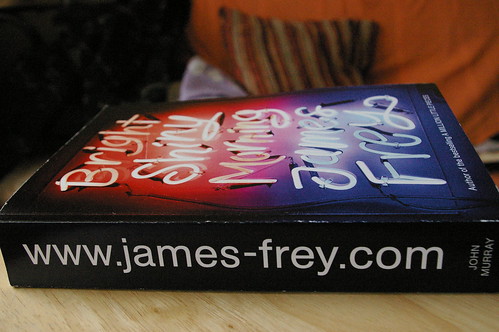
    It was a pleasure to read jPod. I like the writing of Douglas Coupland, he’s like a lightning rod for the zeitgeist for the knowledge economy. I’ve grown up and moved through my career with his works as a kind of literary soundtrack playing in the background. His writing moves from the monotony and empty-sadness of generation x in the 1990s through to the surreal humour of the present day.

    jPod is an updated world-view that builds upon Microserfs and Generation X. It is has a certain amount of recursion to these works and Douglas Coupland also appears in the book as a character. This recursion and self-referencing is fun for loyal readers and mirrors modern culture with its hipsters wearing ironic trucker caps, drain pipe jeans and Lynyrd Skynyrd t-shirts and listening to bad mash-ups of 1980s music radio fodder.

    The non-linear, multi-voice, collective approach in writing mirrors modern environments were online predominates. The only downside to this was that I was quite happy to put the book down and not revisit for a fair while because there wasn’t the same sense of suspense or urgency. The book took me four weeks to read, not because it was hard or inaccessible and I did enjoy it – I guess this drifting along is an analogue to the life that Coupland is trying represent.

    The fantastic dark humour of jPod mirrors a society facing world-war three in the Middle East, global warming and the meltdown of the relationship between employer and employee where not even greed can be trusted anymore.

    Deep down there however is the essential truth about the Kafta-esque nature of working in a knowledge economy company, particularly software or web services. The politics aren’t right, but they’re close enough.

    Go out and get it here. The author’s online presence is here. More book reviews here.

  • Airplane reading

    During my recent travels I needed some airplane reading materials, but didn’t want to go down the mindless thriller route a la Grisham, Dan Brown or Tom Clancy.

    I took a few books with me, two of which I will cover off in this post. It’s not how good you are, it’s how good you want to be by Paul Arden. The book distills the wisdom of a senior advertising man and provides inspiration that agency account leads can dip into to dig themselves out of the usual SNAFU account work or new business pitches that occcasionally come up.

    Unstuck by Keith Yamashita and Sandra Spataro provides guidance on getting past team issues. The cleverest part of the book is the personality test for your team at the beginning that helps you move through the problem. Like the Paul Arden book, Unstuck can be read from cover-to-cover the value is knowing that it is there to pull out of the drawer and use it as a prudent time to resolve team and project issues.

    Having them as airplane reading material gave me a good idea of what I could get out of them. Also they are small and slim, providing a lighter load for your carry-on luggage or slip into the main pocket of a fleece. More book reviews here.