According to the AMA – Marketing is the activity, set of institutions, and processes for creating, communicating, delivering, and exchanging offerings that have value for customers, clients, partners, and society at large. This has contained a wide range of content as a section over the years including
Super Bowl advertising
Spanx
Content marketing
Fake product reviews on Amazon
Fear of finding out
Genesis the Korean luxury car brand
Guo chao – Chinese national pride
Harmony Korine’s creative work for 7-Eleven
Advertising legend Bill Bernbach
Japanese consumer insights
Chinese New Year adverts from China, Hong Kong, Malaysia and Singapore
Doughnutism
Consumer Electronics Show (CES)
Influencer promotions
A media diary
Luxe streetwear
Consumerology by marketing behaviour expert Phil Graves
Payola
Dettol’s back to work advertising campaign
Eat Your Greens edited by Wiemer Snijders
Dove #washtocare advertising campaign
The fallacy of generations such as gen-z
Cultural marketing with Stüssy
How Brands Grow Part 2 by Jenni Romaniuk and Byron Sharp
Facebook’s misleading ad metrics
The role of salience in advertising
SAS – What is truly Scandinavian? advertising campaign
Brand winter
Treasure hunt as defined by NPD is the process of consumers bargain hunting
Lovemarks
How Louis Vuitton has re-engineered its business to handle the modern luxury consumer’s needs and tastes
Mastertape volume six by The Reflex was on heavy rotation for me over the past few weeks. Mastertape volume six is up to The Reflex’s usual high quality.
Valerie Plume’s ‘Undercover’ ad makes use of her CIA heritage in a political ad that breaks new ground. It feels like a high quality television trailer. Plume’s identity as a CIA officer was blown by the Bush regime in the run up to the Iraq war. Her husband who was a former diplomat expressed doubts over Saddam Hussein’s nuclear programme. State department official Richard Armitage, leaked her details to the New York Times. So Plume developed a career as an author and aspiring politician. There had been some controversy over anti-Semitic comments that have been attributed to her.
https://youtu.be/ICW-dGD1M18
Retail and food services at an architectural level often lack theatre and experience. Once you’ve looked past faux Edison bulbs and raw brick walls, there isn’t much difference between a WeWork office, a clothing boutique and a burger joint. So its nice to see innovation like this – a giant circular juice machine that turns discarded peels of squeezed oranges into 3D printed juice cups. The mix of form, function and theatre and kinetic sculpture is a winning one.
The baked goods market in china by Daxue consulting – baked goods sales in China are interesting because of their direct link with middle class consumer style consumption. Trying to get good bread in China isn’t easy, even in top tier cities, particularly if you are looking for . More on FMCG related content here
Keanu Reeves speaks Japanese to Cyberpunk 2077 fans at Tokyo Game Show【Video】 | SoraNews24 -Japan News- – can Keanu Reeves become even more legendary? Yes, because he’s Keanu Reeves. On a more serious note, it will be very hard for Cyberpunk 2077 to live up to the hype around the game. Even if it fails Cyberpunk 2077 has breathed new life into cyberpunk culture and sparked new interest into its canon of literature and film.
In terms of jurisdiction they have a reciprocal relationship with the FTC to enforce the law on campaigns that are being run out of the US that would affect the UK and vice versa. Geography can no longer be considered a defence.
In terms of compliance, there is an emphasis on brands needing to monitor influencer campaigns and enforce disclosure. The legal responsibility falls equally across brands, agencies and influencers. All three are obliged to go through content and retroactively apply the act if the content is likely to be resurfaced in the future. So you are less like to have to alter tweets and Facebook posts than say YouTube videos and blog posts.
In general they felt that brands (and their agencies) were too naive and trusting with regards influencers.
False and misleading claims at the corporate brand level (a hypothetical example would be gold mine claiming its a green sustainable company) aren’t something that they would deal with, but they acknowledged that this kind of incident would likely breach the law.
At the moment the Competition and Markets Authority is considering the role of platforms as agents of influence, but isn’t looking at items like Amazon’s recent algorithmic change.
Unsurprisingly the Competitions and Markets Authority have no desire to get involved in regulating political campaigns on social. The whole area is radioactive. Whilst there would be societal benefit, it would call into question the independence of the civil service and a host legal / constitutional issues.
Judging by the reaction of the audience, more of them were up to speed and complying with GDPR than The Consumer Protection from Unfair Trading Act – not for profits seemed shocked to find out that they weren’t exempt
Content crowdsourcing platform Tribe
Tribe talked about how Logitech used Instagramers to create photos for their paid media campaign to drive direct sales.
Ad creative was lasting a week and a half on Facebook (Facebook & Instagram) before ‘ad fatigue’ set in. From my own personal experience, traditional creative lasted appreciably longer. Tribe didn’t indicate whether they had an opinion on the cause of this premature ad fatigue. Factors that might be responsible include context collapse (lower usage, with less time per session on the platform by consumers) that has been afflicted the Facebook platform for a few years
Logitech internal division of labour on social influencer marketing campaigns
One of the perennial questions that is asked is where does PR stop and (digital) marketing teams start with regards social media influencers. Logitech’s approach was a common sense approach to this question. High follower number influencers were dealt with by the PR team just like members of the press or celebrities. Micro and nano influencers were co-opted by marketers as part of the process to drive sales. It makes sense, but it was the first time I had heard it broken down explicitly by a brand in public.
MSL research on the future of influencer marketing
They had wanted to explore both consumer and influencer attitudes to extrapolate insights; given the codependent nature of influencers on agencies and brands.
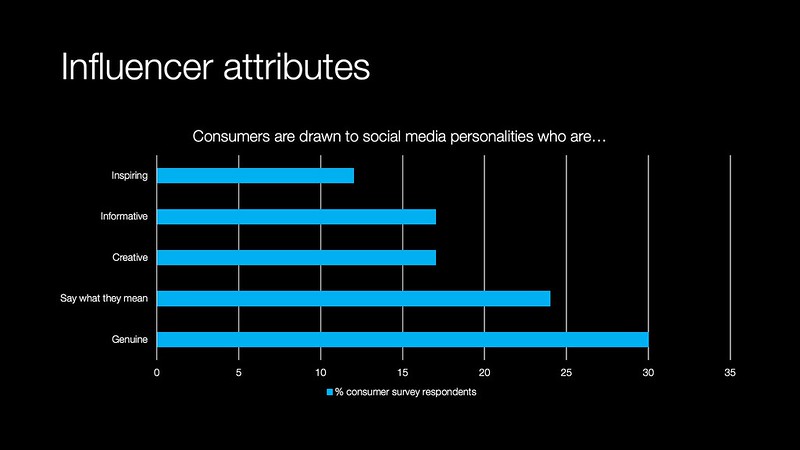
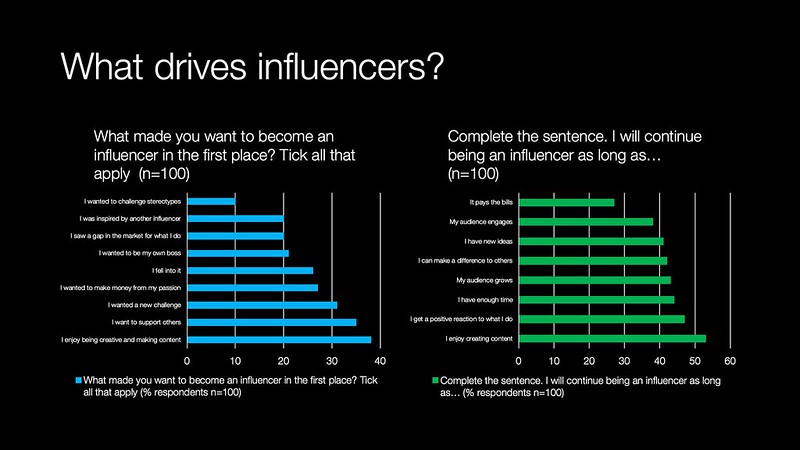
The research involved surveying 1,000 consumers and 100 influencers. So take the insights with a pinch of salt. The slides weren’t shared but I’ve reconstructed the data from photos I took at the event.
1,000 consumers were asked about their thoughts on the influencer landscape
100 influencers were asked on their views on brand partnerships
Influencers don’t like to be pigeonholed as influencers, according to consumers the title has become a dirty word
This conclusion is counter intuitive. The common wisdom is that:
Gen-y and gen-z are happy to ‘sell out’
Professional v-logger (YouTube, Twitch, TikTok etc) are desired professions in the same way that DJ, rock musician or celebrity were previously
Yet the influencers surveyed think that they are changing the world for the better. For instance some of them are dealing with fans who share their suicidal thoughts. But the label of ‘influencer’ was considered to have lost its currency.
Influencers that other influencers respect. People who have demonstrated resilience; they have gone through trials and tribulations and triumphed. Zoella and Lilly Singh were among the most popular cited.
Influencers feel that they are being treated like a channel and the process has got too transactional. Yet one of their key motivations to stay in their career as influencers is to pay the bills.
Panel discussion
If you’d have ran this event ten years ago. The panel discussion would still have been very similar. Measurement was considered very immature, but then the panel bifurcated. Measurement is much easier when you are using advertising and tracking through to a purchase. The discussion got muddled as paid and non-paid measurement strategies were discussed side-by-side without differentiation or explanation.
Social agency Goat made an interesting disclosure. They’ve worked with about 100,000 influencers and found that the vast majority did not work in delivering sales. But there are no data or heuristics about which influencer is likely to work, or the reasons why?
What was missing in influencer marketing discussion?
The main item that I felt the discussion missed was the role of social platform algorithms in creating social bubbles and reducing campaign reach. OgilvyOne’s paper on considering life after the demise of organic reach doesn’t seem to have factored into PR agencies (publicly expressed) thinking some five years after it has been published.
Secondly, I was surprised at the lack of progress. Whilst the platforms have changed over the past ten years. The issues don’t seem to have altered at all for communications agencies. Whilst some agencies like Edelman (and 90TEN where I am currently working) realise that a blended PESO* media mix is required – there was a large faction of earned media only practitioners in attendance. Ten years later, advertising and creative agencies have learned many of the techniques that PR agencies considered to be their domain in order to improve ‘talkability’.
This is out of step with clients requirements for two reasons:
Clients want to effectively measure their success and the tools available to paid media are more complete
As OgilvyOne proved in their research a number of years ago, we’re heading to a demise in organic reach
Brand marketing is in a resurgence after marketers had fetishised technology-based performance marketing for at least the last decade and a half. Influencer marketing may now be too important to be left to the the PR team…
*PESO (paid, earned, shared, owned) – different media types.
Looking back at the Snowden revelations – A Few Thoughts on Cryptographic Engineering – The brilliant thing about the Snowden leaks was that he didn’t tell us much of anything. He showed us. Most of the revelations came in the form of a Powerpoint slide deck, the misery of which somehow made it all more real. And despite all the revelation fatigue, the things he showed us were remarkable – this is such a good read. I suspect that the level of surprise expressed is mostly a US thing. I was disappointed, but not shocked by it all. Back in the day the NSA used to publish one of the best guides to ‘hardening’ macOS – documents that they no longer seem to host online. The Snowden revelations were nothing new. I grew up in Europe when:
GCHQ were tapping all of Ireland’s overseas telecoms and data traffic via the Capenhurst tower. Having lived in the neighbourhood of Capenhurst during the 1980s and 1990s, this was well known but only confirmed in the media in 1999
The ECHELON network was hoovering up microwave, fax, satellite and telephone calls
After Duncan Campbell’s lifetime of work, the Snowden revelations are part of a decades long pattern of behaviour. Admittedly the US’ rivals will be up to the same things and worse.
Luxury watch maker Patek Philippe and Leagas Delaney launch new Generations campaign – Marketing Communication News – the most interesting aspect of this to me is the way its looking to address a younger audience. Secondly, if you look at the background with the plants and rain its moved the look and feel to more tropical than their previous campaigns that were northern European in feel. (It was actually shot in Italy). Because? My guess, China. Younger rich people due to second generation wealth. Two children reflecting the recent law changes around family size in the country
Is the era of the $100+ graphing calculator coming to an end? | The Hustle – don’t feel too sorry for Texas Instruments: over a 20-year period, TI set out to manufacture demand by making its calculators mandated classroom tools. The company established partnerships with big textbook companies that integrated TI-specific exercises (complete with screenshots of buttons) into classroom curricula. It sought approval for standardized test use from administrators like the College Board. And every time a competing tech innovation came along, it lobbied to maintain its perch atop the parabola. According to Open Secrets and ProPublica data, Texas Instruments paid lobbyists to hound the Department of Education every year from 2005 to 2009 — right around the time when mobile technology and apps were becoming more of a threat. The company campaigned against devices with touchscreens, internet connection, and QWERTY keyboards” – hate the game, not the player etc. etc.
Parenting’s New Frontier: What Happens When Your 11-Year-Old Says No to a Smartphone? – Vogue – my son had decided three things about smartphones. 1. They’re infantilizing, a set of digital apron strings meant to attach you to your mother. (He was onto something there.) 2. They compromise a boy’s resourcefulness because kids come to rely on the GPS instead of learning Scout skills. 3. They make people trivial. This final observation bugs me the most, because he still expresses it whenever he sees me jabbing at my own device: “Texty texty! Emoji emoji!” And when I play my word games, he shouts, “GAMER!” That hurts. In short, my son says, he doesn’t want a phone because he wants to be free
Juul Sales Halted in China, Days After Launch – WSJ – this could be as much about IP as anything else that caused the Juul sales halted in China. The e-cigarette was invented by a Chinese engineer looking for a healthier option to cigarettes. Secondly tobacco is a monopoly in China run by a state owned enterprise that is a valuable source of government revenue. There are even tobacco sponsored universities. I am only mildly surprised that Juul sales halted hadn’t happened in the US, given that Juul is so popular with teens
Trend-bucking Maccas turns back to tradition | The Australian – the most interesting implication of McDonald’s selection of W+K is what it says about client conflict. W+K already has the North American account for KFC and has been producing spectacular work for the brand. McDonald’s made no request of W+K to drop KFC in order to work for it, with its North American chief marketing officer, Morgan Flatley, noting the potential client issue “doesn’t concern us”. “We wanted to make the decision around getting the best work that this business deserves,” she said. – it wouldn’t have been that long ago that a major client would tolerate that degree of client conflict
Frankfurt Motor Show: Winter Is Coming | EE Times – the moon shot of autonomous driving may one day lead to falling accident rates, but that the development costs — and liabilities of public testing — may destroy them on the way. Almost everyone has stepped back from the brink of a ludicrous business model. This begs the question about autonomous driving as a killer app for 5G
Standing out is the key brand challenge, so great brands play with their codes | Marketing Week – purpose-wank aside, removing every single letter from your packaging is actually a very smart and very effective move. Because when companies play with well-established codes like this and remove or alter their appearance, the impact on salience and brand image is significantly improved – great article by Mark Ritson, but requires decades of brand consistency to work well
Facebook warns about Apple iOS 13 privacy improvement – the blog post appears to be a way to get out in front of software changes made by Apple and Google that could unsettle Facebook users given the company’s poor reputation for privacy.
The new Microsoft To Do is here – pity the poor product manager who is trying to transfer Wunderlist which built up an amazingly loyal following
(Account) Planning is a role focused on bringing the consumer into creative thinking. This then impacts channel choice as well. It started in advertising agencies in the mid 1960s. At the time account managers were using information provided by researchers. The problem was the poor and untimely use of the information.
The solution was to put the researcher and account manager on an equal footing. UK ad agency Boase Massimi Pollitt (BMP) ‘invented planning. It was J Walter Thompson (JWT) that gave account planning its name later that year.
As is true with the story with many innovations, a similar process happened in Australia at the same time. Both were completely unconnected to each other.
The rise of planning as a discipline gave rise to a corresponding golden age in ad creative. BMP came up with the Cadbury’s Smash robots and the PG Tips chimps.
Jay Chiat of TBWA\Chiat\Day took note of the British experience and shipped it over to the US in 1982.
A couple of definitions
“The account planner is that member of the agency’s team who is the expert, through background, training, experience, and attitudes, at working with information and getting it used – not just marketing research but all the information available to help solve a client’s advertising problems.”
Stanley Pollitt
“Planners are involved and integrated in the creation of marketing strategy and ads. Their responsibility is to bring the consumer to the forefront of the process and to inspire the team to work with the consumer in mind. The planner has a point of view about the consumer and is not shy about expressing it.”
Fortini-Campbell
I think Pollitt has it closest to right from my personal perception of plannng as a practitioner.
Now it’s unthinkable that an agency of a certain size doesn’t use planners to help the creative process.
For smaller agencies, often the creative director tries to synthesise the planning function. Often there is reverse engineering of ‘planning’ to justify creative.
Communications agencies have tried adopting some of the practices of ad agencies. They have integrated planning functions into their businesses with varying degrees of success.
The tensions between account planning and public relations as a discipline
Whilst public relations has done a good job in terms of professional bodies. It has failed to come up with a solid definition of PR:
Managing Public Relations defined public relations as ‘the practice of managing the flow of information between an organization and its publics’.
Grunig, James E. and Hunt, Todd.
The UK’s PR practitioners professional body defined it as:
Public relations is about reputation – the result of what you do, what you say and what others say about you. Public relations is the discipline which looks after reputation, with the aim of earning understanding and support and influencing opinion and behaviour. It is the planned and sustained effort to establish and maintain goodwill and mutual understanding between an organisation and its publics.
Chartered Institute of Public Relations (CIPR)
These definitions are broad and deep. Broader and deeper than what companies ask agencies to do in most cases. The discipline has a conflicted identity at its core.
That has meant that the PR industry missed out on opportunities in search and social marketing. It also means that bringing planning to PR is like building on foundations of sand.
Secondly, there are agency practices. Real-world agency practices don’t look like the theory taught by PR academics. Often the strategy and planning process is not billed to clients, so you look to do ‘minimum viable planning’. This is done by generalists. These generalists learn by doing. Clients pay for activation only. It is a progressive client that spends resources on measuring campaigns. Optimisation is often hit-and-miss, because of the role of a planner and approach to data.
But it’s not all bad
That doesn’t mean that it can’t be done. Fishburn Hedges (now Fleishman-Hillard Fishburn) had a number of planners. Camilla Jenssen at Brands2Life is building an interesting team over there. I fell into the planning role at Ruder Finn because its what we needed. The agency didn’t really realise it at the time and currently do a similar role now at 90Ten.
In the decade or so that I’ve been planning we’ve seen PR agencies move to become communications agencies. I got to do cinema adverts, OOH and public transport campaigns. I got to do TV commercials that ran in in Latin America, the US and Southeast Asia.
In my current role we do paid media campaigns alongside earned media. The key difference is that we’re looking at behavioural change rather than selling a product or service – because we work in healthcare. Edelman spent a lot of money to build out a planning function. They have done amazing work in association with CAA (Creative Artists Agency).
So what does this mean for the agency?
PR agencies have repositioned themselves in the communications space. The PR name was too limiting from a commercial point-of-view. Programmes have become too ambitious to bodge the planning process. Agency management are being forced to resource planning properly. The task urgency culture of PR doesn’t die though.
I freelanced on a TV advertisng campaign to run in Southeast Asia. By the time I picked the campaign up, it had been worked on for six months in the Shanghai office. There had been three attempts coming up with a creative brief. Three sets of ad concepts were created, tested and rejected. So the challenge was thrown over to the London office. My job was to take another run at the creative brief to build a fourth set of ad concepts that would then go into testing. It went into a month of testing and then another six weeks for shoot.
This level of pre-launch focus and testing wouldn’t happen in a PR setting. The reason is because the creative is small compared to the media spend put behind the advert. But the opportunity cost in not having the creative right is large.
In the past with PR, you could create a catastrophe. A classic example would be Gerald Ratner’s after dinner speech at the IoD annual convention. Media coverage of this speech destroyed the Ratner brand he ended up pushed out of his own firm.
But the majority of the time, poor campaigns go nowhere. Press releases sat on newswires that no one ever sees and social media posts that no one engages with.
All this means that planning gets compressed timelines in communications agencies.
Data collection, analysis and synthesis has its challenges in communications agencies. You won’t have access to some of the sources you’d expect at a large ad agency. Sources like WARC, Contagious or Global Web Index. You can read more on data for comms agencies here.
The success of planning in communications is about melding two very disparate cultures. William Gibson’s ‘Blue Ant’ trilogy of books offer a vision of a possible way forward. In the book Gibson outlines the role of PR as having its finger in the zeitgeist. This has a clear analogue to the planning process.