Category: online | 線上 | 온라인으로 | オンライン

The online field has been one of the mainstays since I started writing online in 2003. My act of writing online was partly to understand online as a medium.

Online has changed in nature. It was first a destination and plane of travel. Early netizens saw it as virgin frontier territory, rather like the early American pioneers viewed the open vistas of the western United States. Or later travellers moving west into the newly developing cities and towns from San Francisco to Los Angeles.

America might now be fenced in and the land claimed, but there was a new boundless electronic frontier out there. As the frontier grew more people dialled up to log into it. Then there was the metaphor of web surfing. Surfing the internet as a phrase was popularised by computer programmer Mark McCahill. He saw it as a clear analogue to ‘channel surfing’ changing from station to station on a television set because nothing grabs your attention.

Web surfing tapped into the line of travel and 1990s cool. Surfing like all extreme sport at the time was cool. And the internet grabbed your attention.

Broadband access, wi-fi and mobile data changed the nature of things. It altered what was consumed and where it was consumed. The sitting room TV was connected to the internet to receive content from download and streaming services. Online radio, podcasts and playlists supplanted the transistor radio in the kitchen.

Multi-screening became a thing, tweeting along real time opinions to reality TV and live current affairs programmes. Online became a wrapper that at its worst envelopes us in a media miasma of shrill voices, vacuous content and disinformation.

  • Vladimir Putin + more news

    Vladimir Putin

    Why do diplomats use this alien WhatsApp emoji for Vladimir Putin? | Technology | The Guardian – its hardly diplomatic to carry on this in this way even if it is referring to Vladimir Putin. Secondly, I am pretty confident that Vladimir Putin and his team have a good insight into it. Finally I’d still want to be using Signal rather than giving Facebook indirect oversight of messaging. Given the ubiquity of WhatsApp, I would have thought that the security services that report into President Vladimir Putin would have found a way to crack WhatsApp

    China

    How did China’s Xi Jinping secure ‘core’ status in just four years? | South China Morning Post

    Culture

    This Cheesy, 1980s Promotional Video for a Northern Nightclub is UK Nightlife’s Finest Hour | Thump – OMG

    Economics

    Is the Gig Economy Cannibalizing or Creating Jobs? Here’s Some Early Evidence. – The Experts – WSJ – that the spreading gig economy (at least in the case of ride-sharing) is, in fact, substituting for some payroll employment, or at least depressing its growth.

    Independent work: Choice, necessity, and the gig economy | McKinsey & Company – good read

    Finance

    The Story of the Self Destruction of Deutsche Bank – SPIEGEL ONLINE – fascinating read

    China Prepares To Impose Curbs, “Capital Controls” On Bitcoin – inevitable to control capital outflows. Given China’s market maker status it could also weaponise bitcoin

    Gadgets

    VCR era ends due to lack of chips – and demand | Electronics EETimes – interesting analysis of the engineering that went into analogue video recorders

    Innovation

    Tim Cook on Apple’s strategy and Clayton Christensen’s “Jobs to be Done” theory – Business Insider – basically do the new products actually have use cases?

    Luxury

    Why the fashion world won’t let Amazon in 

    Media

    Tokyo Festival: Online Piracy on the Rise in Japan | Variety – problems with assessing traffic on Alexa as a sample. Also piracy has made up for problems getting Japanese content to market and even made markets for them

    Microsoft Keeps Dossiers on Journalists and Sent Us One By Accident | Gizmodo – reminds me of the Fred Vogel dossier sent a number of years ago, its not NSA level dirt unfortunately

    Online

    Google is returning to China? It never really left | Technology | The Guardian – There has been issues accessing dashboards though

    Merkel: murky internet giants distort perception of reality – The Local – “the algorithms must be made public, so that one can inform oneself as an interested citizen on questions like: what influences my behaviour on the internet and that of others?” 

    “These algorithms, when they are not transparent, can lead to to a distortion of our perception, they narrow our breadth of information.”

    Security

    Troy Hunt: The Red Cross Blood Service: Australia’s largest ever leak of personal data – just wow!

    Divorced by Apple in California | josh.com – which nukes Apple’s security measures if true

    Software

    The Wix Mobile App, a WordPress Joint | Matt Mullenweg – not terribly surprised by this. WordPress represents the old ethos of web 2.0, Wix represents the Uber or Facebook Hotel California mentality

    Technology

    Microsoft Is Looking Like the New Apple | MIT Technology Review – this isn’t the headline Apple want. Its kind of like the immediate aftermath of Windows 95. I think Apple’s interface design call is right but its marketing, product design and pricing is fucked. If they had put 32GB RAM in the machine, hadn’t upped the pricing and messed with the ports as badly this wouldn’t be a problem. It’s execution which is failing them

    Wireless

    LG mobile unit records possible worst quarterly loss ever at nearly $400 million – wow this is sad, I felt LG had done a good job with the phone and will discourage design innovation in the future

    Xiaomi Mi MIX Is An Edgeless Concept Phone That’s Actually Available For Purchase: Snapdragon 821, 6 GB RAM And More : TECH : Tech Times – big challenge to get back its crown in China from Huawei and Oppo. P9 or this? No contest to be honest with you the MIX wins hands down

  • Stone Island + more things

    Stone Island

    Arco Maher’s video lookbook for Stone Island via Dazed & Confused. With the book Maher and Stone Island are trying to draw a clear line between the Milan Paninaro sub-culture of the 1980s and urban British youth. There are clear parallels for Stone Island to draw on: conspicuous consumption, international orientation love of club related music. However the Paninaro look itself now has faded into staples of street style so is no longer distinct. Also Stone Island earned itself an unenviable reputation as the clothing of football casuals in the UK. A Stone Island top was enough to get you barred from many establishments.

    Halifax

    This Cheesy, 1980s Promotional Video for a Northern Nightclub is UK Nightlife’s Finest Hour | Thump – OMG was the first thing that sprung out of my mouth watching this. I spent a good deal of my university time in Halifax working part-time as a market research analyst. This early 1980s glamour is so faraway from what the town was when I was there. The video reminds of Fitzcarraldo; bringing culture and class to an otherwise inhospitable place for their endeavour.

    The Webbys

    The Webby Awards have a good Instagram account. This quote from Iain Tait stood out for me. Is it about agencies, the metaphysics of quality or both – you decide.


    A photo posted by The Webby Awards (@thewebbyawards) on

    BMW films

    BMW Films have returned, its a 13 minute feature film. Jon Bernthal plays the foil to Clive Owen in a role that is eerily similar to the look and feel of The Accountant. I wasn’t impressed with him on his outing as The Punisher on Daredevil, but if he keeps this up – he could work on the standalone series if Marvel gave it the go-ahead.

    Start up stock tracker

    The Startup Stock Tracker – WSJ.com – based on secondary market value (don’t expect an update every 15 minutes)

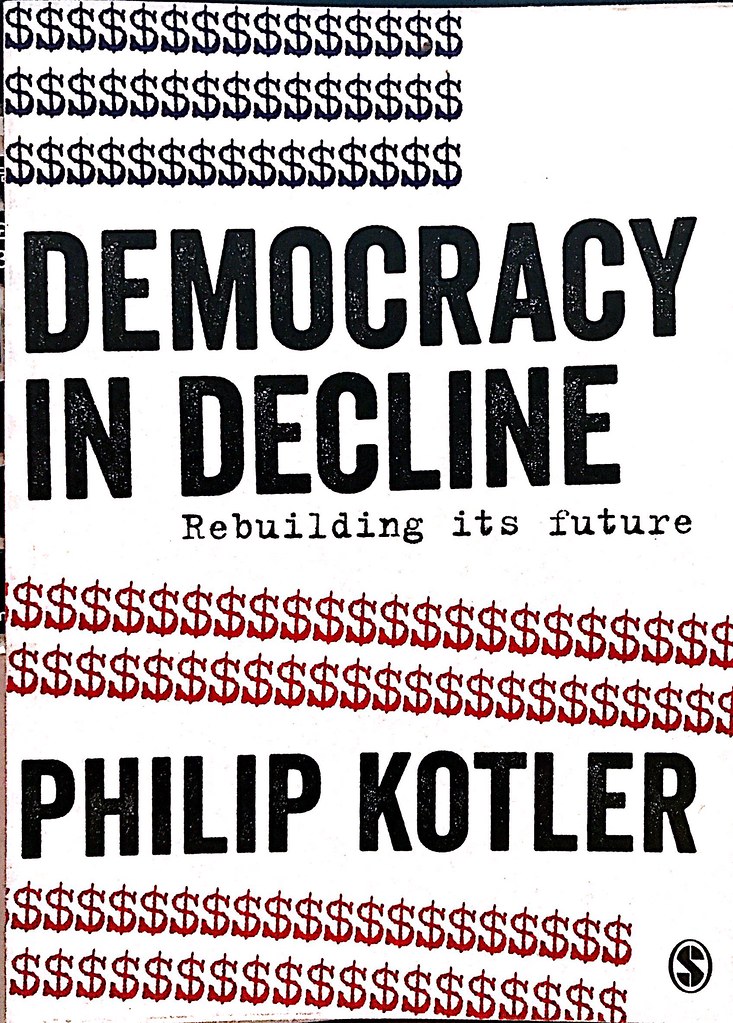
  • Democracy in Decline by Philip Kotler

    It was a curious experience for me to be reading Democracy in Decline. When I was in college Philip Kotler was a constant part of my life. His Principles of Marketing was a core text for my degree. It is a bit weird reading another book by Professor Kotler; especially one on such a dramatically different topic.
    Democracy in Decline
    In Democracy in Decline Kotler addresses what are commonly cited as weaknesses in the political system of the United States. He provides an easy to understand guide to the US political system.  Kotler then gets into what he identifies as the key points of failure in the American political system.

    1. Low voter literacy, turnout and engagement
    2. Shortage of highly qualified and visionary candidates
    3. Blind belief in American exceptionalism
    4. Growing public antipathy towards government
    5. Two-party gridlock preventing needed legislation
    6. Growing role of money in politics
    7. Gerrymandering empowering incumbents to get re-elected forever
    8. Caucuses and primaries leading candidates to adopt more extreme positions
    9. Continuous conflict between the President and Congress
    10. Continuous conflict between the federal and state governments
    11. The supreme court’s readiness to revise legislative actions
    12. The difficulty of passing new amendments
    13. The difficulty of developing a sound foreign policy
    14. Making government agencies more accountable

    Kotler’s viewpoint is unashamedly liberal and supportive of collegiate rivalry underpinned by compromise in politics. The White House he envisions is more like the Barlett administration in The West Wing or Star Trek’s United Federation of Planets rather than Hilary Clinton. The flaws he has identified are so big in scale that they would likely require a major re-engineering of American society. From the electoral system, the relationship between federal and state government, public policy and public service.

    That kind of re-engineering would require widespread societal approval. That wouldn’t happen in the riven, polarised society of America today. The books measures would be completely against the interests of the conservative movement.

    For the European reader, Kotler offers an interesting engaged analysis of the American condition, however there is little to no reflection on the commonalities of national populism in European politics. This book will only provide an understanding of the United States; and that’s ok.

    Kotler has a sub-header in the tile of the book ‘Rebuilding the future. In reality Kotler provides an effective diagnosis, but an not anything that points to an effective solution beyond hoping for the best.

  • Internet of hacking

    IoT should be considered the Internet of Hacking (IoH).

    Mirai – is a bot network that is powered by a range of devices including infected home routers and remote camera systems. It took over these systems by using their default passwords. The network of compromised machines is then targeted to overload a target network or service. Last week the Dyn DNS service was targeted which restricted access to lots of other services for users on the east coast of the US.

    DNS is like a telephone directory of internet destinations, if no one knows where to go it becomes a lot harder to get in touch.

    DDoSing

    Mirai didn’t spring miraculously out of thin air. It finds its history in passionate gamers who used distributed denial of service (DDoS) attacks to slow down or even kick opponents off online gaming platforms. Eventually the gaming companies got hip to it and went after the cheaters, not to be outdone the cheaters went after the gaming companies.

    Taking a service offline using DDoS became a source of extortion against online banking and e-commerce services. Attacks can be used as a form of ‘digital hit’ to take out opponents or critics like online security commentator Brian Krebs.

    Computing

    Moore’s Law meant that computing power has become so small and plentiful that it is surprising what we often have in the palms of our hands. The first Cisco router was built on the circuit board of a Sun Microsystems workstation. Home routers now are basically small computers running Linux. A CCTV camera box or a DVR are both basic PCs complete with hard drives.

    Back in 2007, BlackBerry co-founder Mike Lazaridis described the iPhone as

    “They’ve put a Mac in this thing…”

    The implication being that the power of a sophisticated PC was essentially in the palm of one’s hand. The downside of this is that your thermostat is dependent on a good broadband connection and Google based cloud services and your television can get malware in a similar manner to your PC.

    Security

    For a range of Chinese products that have been acknowledged as part of the botnet; the manufacturer acknowledged that they were secured with a default admin password. They fixed the problem in a later version of the firmware on the device. Resetting the default password is now part of the original device set-up the first time you use it.

    The current best advice for internet of things security is protecting the network with a firewall at the edge. The reality is that most home networks have a firewall on the connected PCs if you were lucky. The average consumer doesn’t have a dedicated security appliance on the edge of the home network.

    Modern enterprises no longer rely on only security at the edge, they have a ‘depth in defence’ approach that takes a layered approach to security.

    That would be a range of technology including:

    • At least one firewall at the edge
    • Intrusion detection software as part of a network management suite
    • A firewall on each device
    • Profile based permissions across the system (if you work in HR, you have access to the HR systems, but not customer records
    • Decoy honey post systems
    • All file systems encrypted by default so if data is stolen it still can’t be read

    Processes:

    • Updating software as soon as it becomes available
    • Hard passwords
    • Two-factor authentication

    Depth in defence is complex in nature, which makes it hard to pull off for the average family. IoT products are usually made to a price point. These are products as appliances, so it is hard for manufacturers to have a security eco-system. The likelihood of anti-virus and firewall software for light bulbs or thermostats is probably small to non-existent.

    The Shenzhen eco-system

    Shenzhen, just across the border from Hong Kong has been the centre of assembly for consumer electronics over the past 20 years. Although this is changing, for instance Apple devices are now assembled across China. Shenzhen has expanded into design, development and engineering. A key part of this process has been a unique open source development process. Specifications and designs are shared informally under legally ambiguous conditions – this shares development costs across manufacturers and allows for iterative improvements. This doesn’t seem to improve product security, quite the opposite, hence the internet of hacking. 

    There is a thriving maker community that allows for blurring between hobbyists and engineers. A hobbyists passion can quickly become a prototype and then into production . Shenzhen manufacturers can go to market so fast that they harvest ideas from Kickstarter and can have them in market before the idea has been funded on the crowdsourcing platform.

    All of these factors would seem to favour the ability to get good security technologies engineered directly into the products by sharing the load.

    China

    The European Union were reported to be looking at regulating security into the IoT eco-system, to try and prevent the internet of hacking, but in the past regulation hasn’t improved the security of related products such as DSL routers. Regulation is only likely to be effective if it is driven out of China. China does have a strong incentive to do this. But it is unlikely to do anything to help prevent the internet of hacking.

    The government has a strong design to increase the value of Chinese manufacturing beyond low value assembly and have local products seen as being high quality. President Xi has expressed frustration that the way Chinese manufacturing appears to be sophisticated, yet cannot make a good ballpoint pen.

    Insecurity in IoT products is rather like that pain point of poor quality pens. It is a win-win for both customers, the Chinese manufacturing sector and by extension the Party. More security related content can be found here.

    More Information

    WSJ City – Massive Internet Attack Stemmed From Game Tactics
    Your brilliant Kickstarter idea could be on sale in China before you’ve even finished funding it | Quartz
    Asus lawsuit puts entire industry on notice over shoddy router security | Ars Technica
    Europe to Push New Security Rules Amid IoT Mess — Krebs on Security
    Why can’t China make a good ballpoint pen? | Marketplace.org

  • Toothbrush test + more news

    Toothbrush test

    Google Canceled the Launch of a Robotic Arm After it Failed the ‘Toothbrush Test’ – Bloomberg – executives at Google parent Alphabet Inc. nixed the plan because it failed Chief Executive Officer Larry Page’s “toothbrush test,” a requirement that the company only ship products used daily by billions of people, according to people familiar with the situation. – Surely this would nix Google‘s enterprise products as well? The toothbrush test poses a serious problem to Alphabet. The business can no longer go after most business opportunities, due to the tyranny of large numbers involved in their earnings. Secondly, they may not get lucky twice, the only benefit of the toothbrush test is preventing the kind of problem that Yahoo! had with the Broadcast.com acquisition. The toothbrush test sounds like an innovation killer

    Consumer behaviour

    More millennials switch off social media | FT – qualitative rather than quantitative data

    Economics

    Pound sterling could be worth less than a dollar within three years, investor Jim Rogers warns | The Independent – You’ve got a lot of debt, you’ve got a serious balance of trade problem which shows no signs of being corrected. I don’t see anything to make sterling go up – not terribly surprising conclusion. The only alternative would be massive cuts outside the South East including rural subsidies and infrastructure spending. The state pension would likely have to be means tested and cut. It would also make sense to up taxation on capital gains and death duty

    Marketing

    One on One – Edelman – Six of the top 10 PR firms did not grow or went backwards in 2015. This should be PR’s time, given the complexity of the environment (nationalism, populism, fear of pace of innovation) and the explosion of media options… I contended that the management of PR agencies has not sufficiently recognized the opportunity on the marketing side of the business. The emphasis on continued increase in profit margins has pushed our sector toward public affairs, crisis management and corporate reputation… – in addition PR is letting its top talent walk out the door, pay is below par for other disciplines and needs to get general managers that won’t have a rotating door on the new types of talent that they want to get in

    Media

    The Man Who Stood Up To Facebook : All Tech Considered : NPR – which all goes back to where Facebook deviated from the web 2.0 credo and used it to its own advantage – for instance hollowing out Yahoo!’s user base

    Tag Heuer’s adventure seeking leads to a Red Bull TV sponsorship | Luxury Daily – interesting wrinkle on brand content where other brands come in and sponsor the brand content

    Some Thoughts on Reuters, NY Times, and Yahoo – Lawfare  – Benjamin Wittes flags that much of the Yahoo story is unclear, including legal arguments and the objective of the search, and further reporting from Motherboard and the Intercept

    Online

    Analysis: Trump ‘rigged’ vote claim may leave lasting damage | AP News – I don’t think that you can pin this solely on Trump when you have thinkers like marketing professor Philip Kotler has written a book on how the current framework is broken to ‘repair’ US democracy.

    The Latest Celebrity Diet? Cyberbullying – The New York Times – which is going to legitimise the tactics in the minds of many people out there as ‘normal behaviour’

    Bronte Capital: Measuring how bad Twitter is – needs to fire two thirds of its staff

    Security

    What Surveillance Will Look Like in the Future – The Atlantic – of course this depends on not having Note 7-esque battery problems

    Europe to Push New Security Rules Amid IoT Mess — Krebs on Security – it is the right thing to do, but will be hard to police and won’t stop shoddy security on products coming out of the Shenzhen, Dongguan, Goungzhou silicon triangle in the Pearl River delta

    Software

    The Telegraph overhauls mobile app to focus on speed – Digiday – interesting focus on immediacy, goes against the ‘abundance of bandwidth’ assumption many developers use

    WTF is a container? | TechCrunch – really nice primer

    Huawei has formed a strategic partnership to develop AI – Business Insider – but could you trust it? Interesting that this hasn’t caused upset in the US body politic

    Daring Fireball: Walt Mossberg: ‘Why Does Siri Seem So Dumb?’ – John Gruber’s take is really good. I won’t even get into the fact that Siri just doesn’t understand my BBC northern English accent and so I just don’t bother using it

    Baidu Launches A Medical Chatbot That Acts As A Physician’s Assistant | IPG Media Lab – interesting application, IBM Watson has aspired to go in this direction. Maximises the 8 minutes a patient has in a doctors surgery

    Web of no web

    Most Drivers Who Own Cars With Built-in GPS Systems Use Phones For Directions – Mostly Out of Frustration – explains why TomTom and Garmin are still going

    Building a Smart Home With Apple’s HomeKit | Wirecutter – shows how immature the smart house still is. That is if you’re not concerned about your IoS (internet of shit) devices being compromised and turned into a bot net for hire

    Wireless

    Verizon just raised a big warning flag for Yahoo – The Washington Post – hacks had a material effect on the business

    The exploding Note 7 is no surprise – leaked Samsung doc highlights toxic internal culture • The Register – the Note 7 seems to have shone a light on the Samsung business

    iPhone 7 vs Leica M9-P: A Side-by-Side Photo Comparison | PetaPixel – to me these show the limits of the smartphone rather than how great it is