Publicis Groupe announced two things in the past week that caught the attention of the industry:
- Withdrawing for 12 months from all promotional activity spend including the Cannes Lions awards
- A Groupe-wide 12-month digital transformation fronted by a personal assistant app
You can’t look at either in isolation, they are both linked together.
Why the withdrawal from promotional activities?
There are various speculative takes on this:
- Other groups doing better at Cannes Lions this year had caused them to ‘take their toys to go home and sulk’. I hadn’t looked at the Lion awards scores, but I wouldn’t think that this is the reason. Clients would react negatively to it. Clients have egos too
- Cannes Lions have gotten too expensive. Running events on the Côte d’Azur has never been cheap. The hotels can charge premium rates, due to demand being greater than supply. The GSMA World Congress moved to Barcelona in 2006 for this reason. Cannes can still run a good event and the infrastructure is ideal for advertisers. Other groups like WPP have pared back their spend but not cut it completely
- It’s designed to focus spend on the things that matter for the next 12 months. This was one reason articulated by Publicis. The spend involved isn’t going to make a significant difference. At least, not on a project of the scale outlined by Publicis
- It’s designed to focus staff on the things that matter over the next 12 months. I think that this is a key factor. Marcel is a software layer for a wider culture change the ‘Power of One’. Forcing the agencies to work together to provide a full deep offering for the client. This creates an internal market for services, skills and knowledge. There is no use having a development team if you can tap into Sapient. This also leads to a de-duplication of capability, increase in efficiency (% billable time). It also reduces duplication of knowledge creation – tap into it wherever it is. You would need to balance this against client confidentiality
- It’s a PR stunt. If handled well Publicis could gain a lot of positive coverage from this. It’s a classic example of what Sun Tzu called ‘The Void’. It’s also a bloody expensive PR stunt – so one would have to presume this is a collateral benefit. What happens if Sapient doesn’t match what’s in the concept video 12 months from now? If it does succeed then Publicis ends up with a solution would help market their business – business eating its own dog food, as advertisement
Let’s move on to Marcel itself
It’s hard to deconstruct a corporate video to get a firm idea what the underlying form might be. The truth is that the underlying form may not even exist yet as a product brief. It takes time to coalesce an offering from high concepts to prototyping these concepts with a sampling of users. From then on you go to mapping out the functional requirements of the product and build it in a series of short sprints. Once you have a minimum viable product and tested it, you may want to tweak your project direction further.
However, when you dig into it, Marcel isn’t only about an app, but re-engineering most of the IT infrastructure as well in order to support the machine learning capability. Marcel will find it harder to learn if the data is fragmented in drives with different permissions, online services or even offline.
Carla Serrano describes Marcel as:
A professional assistant that uses AI machine learning technology across our 80,000 people in 130 countries to connect, co-create and share in new and different ways.
This won’t be like Alexa Home managing your calendar and your Spotify playlist.
AI is put in there for audience members who wouldn’t know what machine learning is. A nice succinct definition below via TechTarget:
Machine learning is a type of artificial intelligence (AI) that provides computers with the ability to learn without being explicitly programmed. … The process of machine learning is similar to that of data mining.
Let’s tease out the functions
- Connect – could be anything from an intranet directory to a social network a la Facebook Work. The key element for success would be to get people to complete their profile and for the content to be validated. From personal experience, it is best if you get people to do this right at the point that you are on-boarding them. Getting a mass-push on employees doing this would be a campaign of attrition since there is always a client call to do, pitch to write or creative concept to develop. The information could be pulled across from HR systems, business planning, time-tracking / accounting systems and scraping LinkedIn profiles but all the data will be sub-optimal. How do you ensure consistent quality data on staff expertise? The key benefit of machine learning would be pulling information capacity and personnel career ambitions alongside mining the profiles. What I’ve talked about in this paragraph is a major undertaking of data integration in itself
I’ve ignored messaging as a function as most agencies use multiple channels for messaging including Slack, email, Skype/Lync or SMS. A messaging service might be built in, some of the interfaces could be ‘call-and-response’ chat bot style interactions.
- Co-create – Co-creation could just be building a virtual team through the connection functionality, if its a platform in its own right what would that mean? Google co-creation platforms and you get 14,900,000 results. There are lots of options, opinions and descriptions of how to implement a platform to do it. Publicis could use some of these commercial off-the-self platforms. Decisions would have to be made if the co-creation would facilitate synchronous or asynchronous co-creation. Where do you want to have it involved in the process? Discovery, strategy, creative briefing, ideation, concept development? Is bolting Box.net accounts, Basecamp or Jira co-creation and where would the co-creation process benefit from machine learning?
- Sharing – Back in the mid to lated 1990s knowledge management was a thing for technology marketers selling into enterprises. The idea was that a mix of data mining software (Autonomy or SAS Institute) would allow you to tap into the written knowledge across your company. Of course, it didn’t work out that well. Google tried a similar thing with its own Search Appliance hardware sold to enterprises. For a business like Publicis whose product is data, insights and ideas, the potential implications are huge
Based on Google’s Return on Information: Improving your ROI with Google Enterprise Search white paper here are some rough numbers that I came up with.
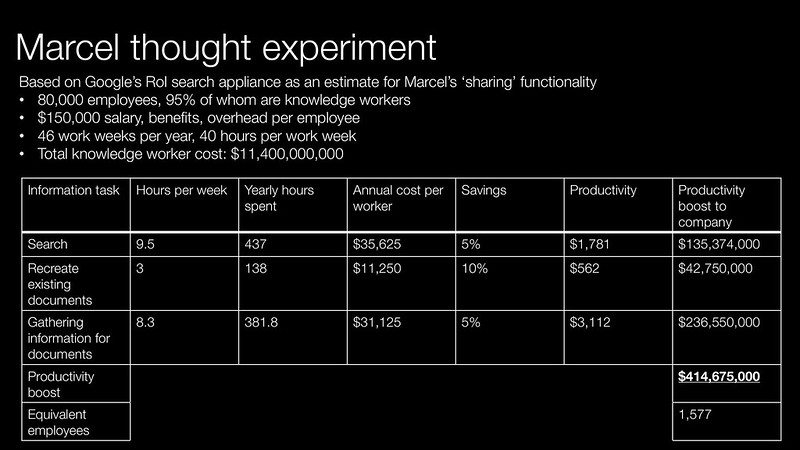
The notional productivity gain is worth well over $400,000,000 in additional billable time, or like having almost 1,600 additional staff at little additional cost. The key word in all this is ‘notional’.
So what’s the downside to the factors outlined in the top-level view of Marcel?
- Client confidentiality – imagine if you’re a client and you realise that your documentation within an agency can be searched for beyond the account team and could be used in ways that you don’t know about? This isn’t an unsurmountable problem, but it is something that I am sure Publicis would be thinking about
- Changing working habits and culture – the most valuable files will be spread across Dropbox-like services, in email exchanges, on file servers, personal computers (Mac and Windows), USB sticks and optical media. Software can look at unstructured data to try and make sense of it. But it needs access to the files first. As a manager how would you feel that you lose control over work assigned to your staff. How would you assess their work for their appraisals?
- A marathon of sprints – this a huge IT undertaking across hardware infrastructure, networks and access. That’s before you’ve considered software development. On its own it would weighty task – in reality it will be a large amount of iterative tasks, any number of whom could delay or damage Marcel
Understanding the context for Marcel
The second half of the video is concept film of how Marcel would work in practice. It was likely put together to give voice to functionality rather than also thinking about tone. I would not be surprised if this was reused from an internal presentation to showcase the vision of Marcel to key stakeholders. The film has tonality in it is a bit concerning, I suspect it’s unintentional. If Marcel works as promised we would be in new territory for corporate culture however.
Having watched it reinforced to me:
- The technical scale and ambition Marcel represents. It is a huge undertaking from a technical point-of-view
- Marcel is just the start of the hard work for Publicis.
How do you ensure a culture that continues to attract and retain the top talent as the organisation gets Marcel operational?
- What does it say to women (or men) who might want certain amount of work life balance due to family commitments or a desire to upskill?
- How would it handle organisational politics?
- Lesley might be requesting talent for his energy client but how would his demands be balanced against those of their line managers or other people in the business?
- How might it redefine the role that line managers play for colleagues?
The partial removal of client services as a gate keeper between Jamie the client and Publicis talent was interesting. It would make client services job to get their arms around all the business opportunities in the client much harder. It would also be more attractive to certain clients who would feel more in control of their account.
Themes in the film:
- Marcel is being used at night or in the twilight – usage massively extending the working day. Agencies aren’t really a 9 – 5 lifestyle at the best of times, but this video implies even less work-life balance as standard working practice. The introductory dialogue is shot at twilight and Alex the Asian American strategist, sits in an empty office at night time. Lesley is in the artificial time of an subway station and even the Arc de Triomphe dropped in is shot in twilight
- Marcel is mobile – and being used out-of-the office in most of the film. This implies that the work day has no boundaries. Does it imply that mobile devices are no longer for reacting to urgent emails, has the balance of work expectations changed to zero-downtime always on proactive working? How would an agency team be able to keep their thinking fresh over the medium and longer term?
- Marcel is desktop – Alex uses Marcel on a desktop computer and the web service provides a Statista like set of visualisations for data. The implication being a large amount of research source integration (social insights, market data, Kantar media data???). This would also affect third party licenses as information is pooled
- The dialogue implies a ‘Siri’-like experience on the mobile app, except that it understands what you’re saying. Marcel is far more articulate conversationalist than Siri, Google, Alexa or my banks interactive voice system. He’d probably score highly on Tinder due having a personality. I suspect most of this is a plot device for storytelling. Alex gives voice to his key strokes and Marcel is manifested as a search box rather like Bing using a desktop computer. Lesley the South African client service person is not talking to his phone as he moves up the escalator – he is literally giving voice to his thoughts. He sounds stressed.
- Jamie the client from a bank is an interesting vignette. She has direct access to Marcel as a client facing tool and it is suggesting Publicis contacts to her, normally you would expect a client services person to be that interface.
- Ines, the copy writer in Brazil has the most positive experience portrayed. Marcel understands her complex career aspirations and offers her opportunities to work on an Indian project. It looks as if she is doing this work at home, again reinforcing ambiguous message on work / life balance?
- All of the people are alone, Marcel is not shown being used in a normal office environment. Marcel becomes your team?
TL;DR
Marcel is the business equivalent of playing high stakes poker. If it is pulled off successfully it would put Publicis in an excellent position versus it’s competitors. However there is a lot that can go wrong from a technological and organisation perspective.
I don’t know how much of this can be realistically achieved in the 12 months that Publicis seems to have given itself? It strikes me that this is likely to be a transformation that would require much more time in order to fully match the vision outlined. From a cultural perspective the challenge of ‘break, build, bond’ hides the level of complexity and change going on.
The biggest risk is what happens if Publicis doesn’t meet the wider industry expectations of success with Marcel? How will that affect client perceptions of them, or their ability to hire talent? How would it affect Sapient’s standing as a technology company?
SaveSave
SaveSave
SaveSave
SaveSave
SaveSave
SaveSave
SaveSave

 is published by Penguin with a collection of essays from a range of technology thinkers including