Category: telecoms | 電信 | 통신 | テレコム

I thought about telecoms as a way to talk about communications networks that were not wireless. These networks could be traditional POTS (plain old telecoms systems), packet switched networks including ethernet or some hybrid of the two.

I started my agency career working during the dot com era. What was happening in the broader technology space was one wave of technology cresting, while another one rose.

In the cresting space was:

Enterprise software (supply chain software, financial systems, database software, middleware software tools).

NIC cards (network interface cards, a way of getting your computer to be able to communicate with an ethernet network. It was a little circuit board that connected on to the mother board and allowed.

Mainframe and  mini-computers. It was around about this time that company owned data centres peaked.

In the rising wave was:

Servers –

  1. Unix servers and workstation grade computers were what hosted the first generation of websites. Names that did particularly well were Sun Microsystems (now part of Oracle) and Silicon Graphics Inc. (SGI). Sun Microsystems ran everything from investment banking models to telecoms billing systems. It’s hardware and software made great web servers. SGI was facing a crisis in its core market of 3D modelling due to Moore’s Law, but its operating systems was still very powerful. They managed to get some work as servers because people had them around in creative agencies.
  2. You also had a new range of servers on the low end. A mix of new suppliers like Cobalt Networks and VA Linux, together with existing companies like Dell who were offering Linux and Windows web servers that were really repackaged local area network file servers.

Enterprise information management software. The web posted its own problems for content management and publishing and companies like Captiva and Open Text rushed in to plug the gap.

Traditional vendors like HP and IBM rushed into provide a mix of software and hardware based solutions including e-business by IBM, which morphed into ‘Smarter Planet’

Telecoms companies – two things happened.

  1. Phone services were deregulated opening up former state owned incumbents to competition in fixed line and mobile telephony
  2. Data services really started to take off. Multinational companies like Shell looked to have a global data network for routing their calls over, so in many respects they looked like their own telecoms company. Then those data networks started to become of interest to the nascent internet providers as well. Mobile data started to gain traction around about the time of the dot com bust

So it made sense that I started to think about telecoms in a wide but wired sense, as it even impacts wireless as a backhaul infrastructure. Whether this is wi-fi into your home router or a 5G wireless network connecting to a fibre optic core network.

  • Nokia 8110 & other things

    Nokia 8110

    A cheap facsimile of the classic Nokia 8110 managed to upstage the launch of of a range of premium Android phones at MWC.  Nostalgia is powerful, but I don’t think what’s going on here. I could see the Nokia 8110 as a weekend phone allowing consumers to wind down at the weekend and go cold turkey on the app economy.

    nokia8110traditionalblack3 png-257014-original

    I think that the Nokia 8110 shows that the model of a single form factor based on common reference designs is broken. Apple managed to elevate the build quality of all smartphones as contract manufacturers moved towards an armada of CNC machines and advanced manufacturing. But in the process, the common designs, common components and new baseline in product integrity has homogenised and commoditised Android handsets to such a decree that only scale and advertising budgets are differentiators. More related content here.

    Hong Kong cinematic sound tracks

    Amazing selection of music from the sound tracks of classic kung fu movies over at Shaolin Chamber 36.

    Roni Size

    Roni Size talks about the music that influenced him. There is a lot of old school breaks that would be familiar to the breakdancing scene in his list of influential works. He also talks about the seminal film Wild Style and its influential soundtrack.

    Frank Herbert

    Frank Herbert talks about creating the science fiction epic Dune. Dune is an amazing piece of work and hearing Herbert talk about the origins of Dune makes that work even more impressive if that was possible.

    Xinyuan Wang

    digitalethnography | Field Note Painting Booklet – done by Xinyuan Wang, a UCL social anthroplogist in a lower tier Chinese city. Ms Wang wrote a really good monograph on social media in industrial China. She captures a moment in time that is invaluable for marketers looking at China and trying to understand the mobile environment.
  • Facebook eroding & other news

    Facebook eroding

    The tweet about Facebook eroding is part of a greater issue of what Facebook is calling internally ‘context collapse‘. Facebook recognised the issue back in 2015. There are several likely reasons for Facebook eroding:

    • Negative network effects
    • Societal norming on social media content
    • Lack of trust in the facebook brand
    • People just don’t like Facebook as a platform that much

    Business

    After Anbang Takeover, China’s Deal Money, Already Ebbing, Could Slow Further – The New York Times

    Hello, mobile operators? This is your age of disruption calling | McKinsey & Company – lots of buzz words, diagnosis but not a glimpse of a way forward

    Edelman Revenue Up 2.1% In 2018 To $894m | Holmes Report – given that all the global PR groups have had exceptionally low growth or even declines

    How Douyin became China’s top short-video App in 500 days – WalktheChat

    Wireless

    Nokia on 5G at MWC, what struck me is the sales pitch was more like an enterprise software company like IBM or Oracle than a telecoms vendor. There is lots of tech in the networks but there isn’t a recognisable killer app. His warnings about 5G upgradeable products ring true though.

    Consumer behaviour

    Asian Boss do some really nice street interviews in different Asian cities and this one about Apple iPhones in Korea is particularly instructive. Samsung is seen as the default phone as they assemble phones (mostly for Asian markets) in Korea. Whereas in Europe all of the are made in China. When I lived in Hong Kong, both Samsung and LG emphasised that they made their phones in Korea with an implicit quality guarantee. 

    The iPhone seems to have won out on product design amongst younger people. but one shouldn’t ignore the desire to support the national brand. 

  • Operaatio Elop

    Nokia

    Operaatio Elop covers one of the most dramatic events in Finland since the Winter War. At the time of Nokia’s high point it accounted for over 25% of the Finnish economy. There has seldom been a fall so drastic as Nokia’s fall in the mobile phone market from leading player to disaster. With that fall came the humbling of an entire country.

    Given the scale of the fall and the size of Nokia as a brand around the world, I was surprised the the Operaatio Elop hadn’t been translated and published in different language editions. Instead it was up to numerous Finns to crowdsource a translation into English for free and provide it on an as is basis.

    Has Nokia’s fall had been so complete that it literally fell out of interest for non-Finns?

    What becomes apparent is that a story more nuanced than the press coverage would allow. Elop comes out of it a flawed tragic figure – a one-trick pony; rather than a skilful trojan horse.

    Nokia’s feature phone line up where surprisingly a hero of the piece contributing positively to the business for longer than I would have expected and slowing down the business collapse precipitated in the smartphone business.

    Nokia’s board of directors and former management come out of it much worse.

    Fatal flaws

    Nokia’s strengths had become its weakness.

    • Smartphone manufacturing processes weren’t ready for mass adoption
    • MeeGo had been unfairly assessed
    • It blew its marketing budget on a bet on the North American market, ignoring other countries
    • The marketing budget was spent too early and all at once. What resulted was an ineffective and inefficient marketing campaign. By my reckoning it was roughly $100 per phone sold during the launch of the Lumia range in the US
    • Poor quality Windows Phone software, small Windows Phone application ecosystem and cheap Android phones were key issues
    • Chip technology partner issues from its relationship with Qualcomm to Intel’s failure in 4G as it focused on WiMax rather than LTE

    The more pertinent question would be is there any circumstances where Nokia stood a chance of staying on top in the mobile phone marketplace? Operaatio Elop is a compelling but balanced read and I can’t recommend it highly enough. More book reviews here.

  • The forces of 5G + more things

    The next generation of wireless technology is ready for take-off – The forces of 5G – the forces of 5G will be felt more in the industrial space than cellular networks (paywall) More related content here.

    The top trends to watch in OOH | Marketing Interactive – digitalisation – dynamic contextual content, programmatic like placement

    Inside North Korea’s Hacker Army – Businessweek – Bloomberg – really interesting insights. It makes you wonder about freelancing sites

    Silicon Valley Has Developed a $300 Million Foot Fetish – Bloomberg – Bloomberg’s take on how startups are tapping into the streetwear luxury nexus. Jordans are starting to look pretty played out

    Books with Full-Text Online | MetPublications | The Metropolitan Museum of Art – amazing resource via our Matt

    Episode 337: The Secret Document that Transformed China : Planet Money : NPR – a great lunch time listen. The farmers who came up with the first commercial contract during the communist era of China that led the way for the Deng era of opening up

    Trivago Surpasses Billion-Euro Mark as Tech Investment and Advertising Pay Off – Finance.co.uk  – The company also stated that increased expenditures in advertising had helped to improve revenues. Schroemgens informed reported that advertising has been a help for the company learn more about their customers. “We do a lot of quite extreme tests because the more extreme we do it, the more information we get,” said Schroemgens, in reference to the near wall-to-wall advertising campaign of Trivago on the London underground that features “the Trivago girl”, actress Gabrielle Miller. – In a digital world mass media still works. Trivago is particularly interesting when you think about the amount of established online travel players

    Tom Scott talks about the ethics and perils of doctored videos due to face swapping. Porntube and Twitter have already outlawed it, but I think that we’re only at the beginning of the ethical morass that’s about to unfold

    Bloomberg: China May Legalize Gambling on Hainan Island | Jing Daily – problematic for Macau and more likely to attract luxury retail to Hainan island alongside the high rollers

    Why Amazon, Apple, Facebook, and Google Need to Be Disrupted – basically a summary by Scott Galloway of the argument in his book The Four

    Scandal-hit casino mogul Steve Wynn’s luck may be running out in Macau as well | South China Morning Postaccording to a gaming industry source, that Wynn may have failed to meet expectations the Macau government had that he could be a key driver of a culture shift which would see the city “transformed” from a purely gaming destination into a family oriented centre for mass market tourists

    Why mobile operators want your second SIM card slot | HKEJ Insight – Hong Kong is hyper-saturated. Apple missed out by not having a dual-SIM offering. The problem with a lot of non-Hong Kong carriers is they would be struggling to innovate on the service that they offer due to generous data packages

    Toyota’s China Crisis Is Misfire in Biggest Auto Market – Bloomberg – interesting debate around Toyota’s product range

  • The Master Switch by Tim Wu

    Untitled

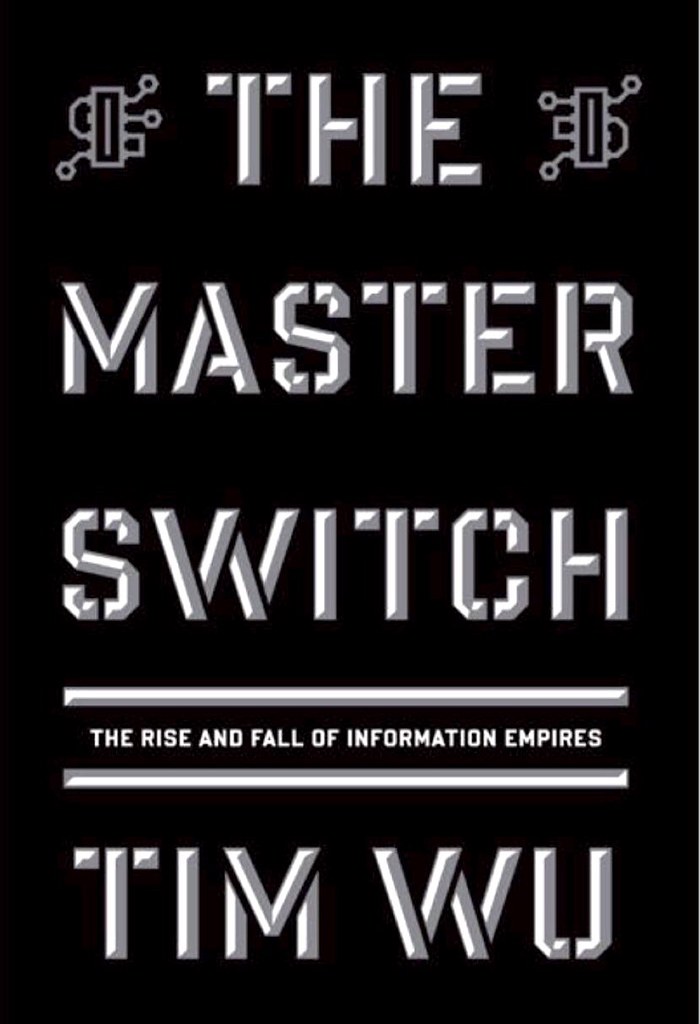
    The Master Switch author Tim Wu is an American lawyer, professor and expert  on internet matters. He is main claim to fame is coining the phrase ‘net neutrality’ back in 2003. He is well known as an advocate of the open internet.

    One needs to bear all this in mind when thinking about The Master Switch: The Rise and Fall of Information Empires. In it Wu posits a natural lifecycle for the rise and maturation of platform and media companies; which he called the ‘long cycle’.

    Wu uses the following companies as examples:

    • Western Union’s telegraph monopoly
    • Western Union-owned Associated Press’ relationship with the nascent newspaper industry
    • AT&T in telecoms
    • The early film industry and the rise of Hollywood studios
    • Apple’s history – though this point is less nuanced because Apple has cycled a number of times between open and closed systems – a nuance that Wu doesn’t fully pick up on

    In The Master Switch, he points about how these companies have moved from open systems to closed systems in order to maximise profits and resist change. Wu then uses these cycle to argue that a repeat of history was under way with the modern internet. In 2010 when the book was written; this would have ben the rise of Google, Facebook and Amazon.

    Ed Vaizey announced that ISPs should be free to abandon net neutrality in the UK and it was abandoned in the US when FCC chairman Ajit Pai was appointed by Donald Trump. More telecoms related content here.

    SaveSave

    SaveSave

    SaveSave