Blog

  • Google Facebook Amazon and Apple + more

    Lost Context: How Did We End Up Here? – NewCo Shift – how did Google  Facebook  Amazon and Apple get to a position similar to that of the gilded age giants?  What can be done to regulate Google Facebook Amazon and Apple?

    Online

    Facebook (FB) on Russian ads: Our platform doesn’t influence people; people influence people — Quartz – what’s the point of advertising then?

    Security

    Troy Hunt: Face ID, Touch ID, No ID, PINs and Pragmatic Security – most people are crap at information security. Reducing the friction of signing up and using authentication raises the overall security level of consumers

    WeChat confirms that it makes all private user data available to the Chinese government – Moneycontrol.com – not terribly surprising – this is China’s answer to PRISM. Your communications are unencrypted on WeChat so commercially confidential information is at risk from hackers and your local government regardless of whether Tencent hands your data over to the Chinese government

    Really interesting design experiment from Chinese university students. It is interesting that they use the ‘goldfish’ as the avatar of the AI. It also asks questions about how we relate to pets and whether augmentation like this would work.

    Very interesting student project from Shanghai Jiaotong University, has your pet fish serve as an avatar/front end for a smart device pic.twitter.com/tHDODQHArM

    — Naomi Wu (@RealSexyCyborg) September 22, 2017

    Software

    Business Standard-Bitcoin’s wild ride shows the truth: It is probably worth zero – likely worth nothing

    And I think dealing with the foibles of macOS 11 (developer beta) was a hassle

    Technology

    UK chip designer Imagination bought by Chinese firm – BBC News – but what about the need for a customer base? The MIPS architecture stuff is interesting and probably a bit of a concern for automotive etc

    AI Turns UI Designs Into Code – NVIDIA Developer News Center – interesting project where machine learning takes design mock-ups and turns them into working web apps with code

    Wireless

    Smartphones are dead. Long live smartphones! · Forrester – emphasis away from only ads to also think about experiences – big challenge is the zero growth in aggregate app usage
    SaveSave

  • Machine learning sublime influence

    Scott Galloway talks about the way brands are using AI (machine learning) and the examples are very much in the background.  Welcome to the sublime world of machine learning where the impact on the customer experience won’t be apparent. In many respects this is similar to how fuzzy logic became invisible as it was introduced in the late 1980s.

    The Japanese were particularly adept at putting an obscure form of mathematics to use. They made lifts that adapted to the traffic flows of people going in and out of a building and microwaves which knew how long to defrost whatever you put into it. Fuzzy logic compensated for blur in video camera movement in a similar manner to way smartphone manufacturers now use neural networks on images.

    The Japanese promoted fuzzy logic inside products to the home market, but generally backed off from promoting it abroad. The features just were and consumers accepted them over time. In a quote that is now eerily reminiscent of our time a spokesperson for the American Electronics Association’s Tokyo office said to the Washington Post

    “Some of the fuzzy concepts may be valid in the U.S.,”

    “The idea of better energy efficiency, or more precise heating and cooling, can be successful in the American market,”

    “But I don’t think most Americans want a vacuum cleaner that talks to you and says, ‘Hey, I sense that my dust bag will be full before we finish this room.’ “

    This was also the case with the use technology companies made of Bayes Theory. This was used by the likes of Autonomy and Microsoft Research.

    A second technique was rules, put simply IF then THAT. This kind of technology has been used to drive automated trading models and credit card approvals for decades. Pegasystems are one of the leaders in developing rules based processing. Rules based systems could even be built in an Excel macro and would still count as a form of machine learning. 

    Finally machine learning needs to think about a number of things with regards the models being used:

    • The importance of accuracy in the use case
    • The level of precision required and ways to indicate that precision means
    • The cost of generation versus other methods, this is very important in terms of computing power and energy consumption 

    More information
    The Future of Electronics Looks Fuzzy | Washington Post (December 23, 1990)

  • Connection planning has some problems

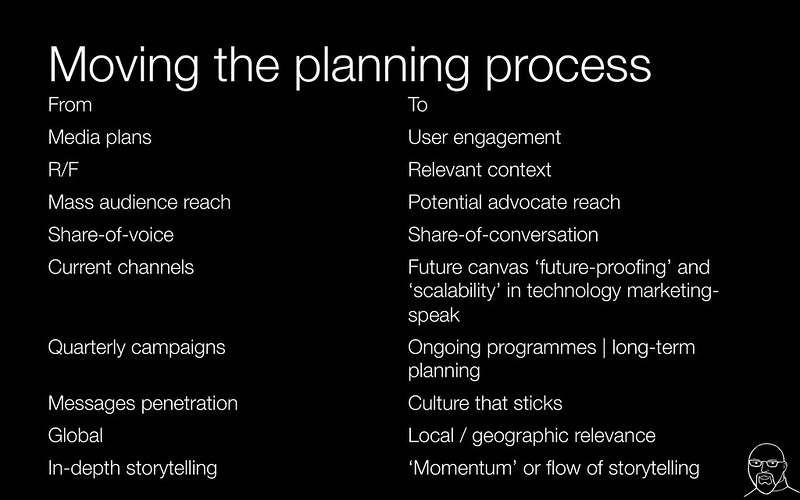
    A couple of years ago I did a presentation on connection planning and much of that thinking still has value. But some of the tenets of connection planning are now challenged by changes in marketing practice and strategy in the business to consumer space.

    Connection planning process

    The focus on user engagement has been affected by three things:

    • Social platforms have been moving their business model and interactions towards traditional brand advertising models. Social networks like Facebook and Twitter are structuring their algorithms and advertising closer towards the reach and repetition model of traditional broadcast advertising. TV advertising dollars are what social platforms are chasing, rather than going after Google
    • Consumer brands, particularly from publicly listed mature players are facing business pressures from the threat of private equity ownership that would look to sweat the assets at the expense of longer term brand performance.  No one is immune to this, not even Nestle that was thought to be protected due to Swiss regulations. This has led to a resurgence zero-based budgeting that is locked in focus on return on investment over a shorter time period. From a communications planning perspective there are no sacred cows, no guaranteed longer campaign story arcs or brand engagements as spend has to be justified from a clean slate each year
    • Most marketing spend tends to be around existing products, often in mature markets. New products run a high risk of failure. New products in new categories are generally the province of start-up graveyards – we remember the few successes rather than the legion of failures. Marketing thinking for mature brands in mature sectors (so most FMCG categories and established brands). This change has been driven by research financed by FMCG companies including Coca-Cola, Mars, Kraft and Kelloggs  at the Ehrensberg-Bass Institute for Marketing Science. Ehrensberg-Bass’ Byron Sharp book ‘How brands grow‘ is the talisman for these marketers and their agency side media planners

    The shorter focus of consumer marketers makes it much harder to build a brand culture that sticks like Red Bull has managed to do. Flow of storytelling becomes less important than reach and stream of repetition.

  • Narita airport + more news

    Narita Airport dumping squat toilets in restroom reform:The Asahi Shimbun – OMG makes Heathrow seem even more barbaric by comparison. Both Haneda airport and Narita airport are a pleasure to fly into. More Japan related content here

    Media

    Some thoughts on #SMWLDN – Matt Muir nails the ephemera that passes for thought leadership in social circles

    Technology

    There’s Blood In The Water In Silicon Valley | Buzzfeed – Tech is manifestly unready for this new era. They’ve been playing small-ball politics of regulation, and coasting on incredibly high approval ratings. But there are signs they feel the winds changing. You can usually detect a political figure’s problems from their overcompensation, and Zuckerberg’s Midwestern tour had all the hallmarks of a classic reaction to a specific political polling question: “Does he care about people like me?” The move was widely misinterpreted as some kind of beginning to Zuckerberg’s political career. But Zuckerberg is Facebook, and his image is his company’s. His mission was to fix the company’s image, and I’m just not sure this one is fixable.

    You can see the shape of how this plays out in a recent exchange between Mark Halperin and Rep. Adam Schiff, in which Halperin asked of Facebook: “Did they put profits ahead of patriotism in their conduct during the campaign?”

    Wall Street Journal Reports on SoftBank Offer for Uber….Yet No Other Press Outlet is Picking the Story Up | naked capitalism – at a lower than expected market value

    Web of no web

    As Amazon Pushes Forward With Robots, Workers Find New Roles – NYTimes.com – great example of what Kevin Kelly talked about in his book The Inevitable that we only preserve jobs by working with rather than against robots

    The Smart Watch Market is Headed for a Boom | Park Associates – not so sure about the rationale on this, I often forget to wear my smart watch for the same reasons that they give for fitness bands

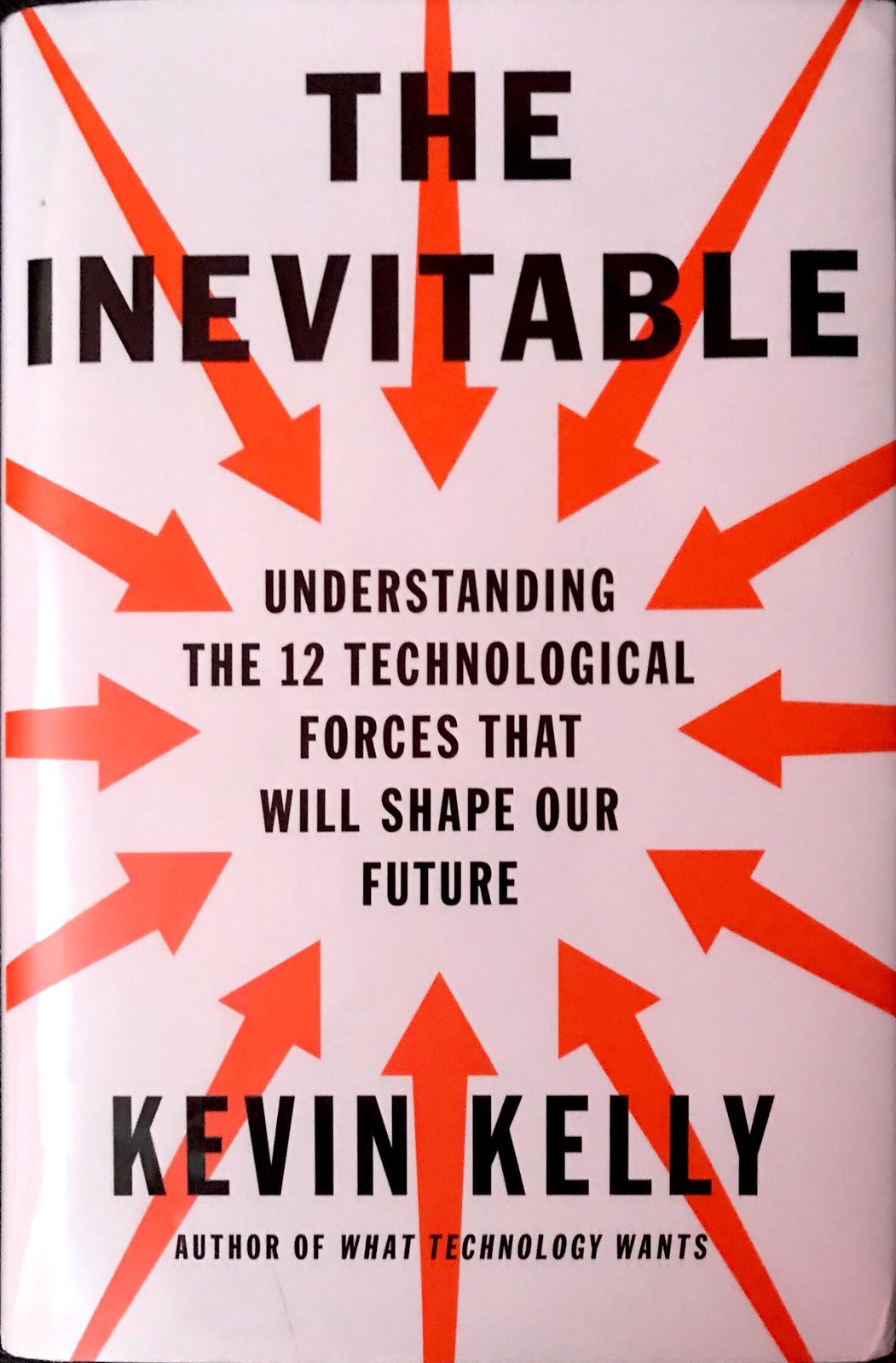
  • The Inevitable by Kevin Kelly

    I re-read Kevin Kelly’s What Technology Wants and then decided to revisit The Inevitable: Understanding the 12 Technological Forces That Will Shape Our Future. The books make sense as ideal companions for each other, despite some overlap in terms of proof points.

    On the face of it The Inevitable is a less ambitious book than What Technology Wants. And when I started reading the book I didn’t get the kind of electrifying feeling that a big idea can bring, like when I read What Technology Wants.
    The inevitable

    In the book Kevin Kelly touches on the kind of areas one would expect in  typical presentation given by an innovation team at an advertising agency. He is an unashamed techno-optimist, but the key difference in his thinking is two-fold:

    • Kelly pulls it together as a coherent idea rather than 12 slivers. He provides in-depth cogent arguments that bind the trends together
    • Kelly argues that transparency in governments will compensate for the erosion of privacy. While I understand where the idea has come from, I don’t agree with this particular viewpoint at least as it would manifest itself in the west. I certainly don’t think that would be the case in the East either. The Nazis use of IBM technology damn near destroyed the world as we know it. The level of trust between the government and the governed is in decline

    There is a clear line of progression in Kevin Kelly’s works from Out of Control written at the start of the modern internet age through to The Inevitable.  If you are interested in how technology is shaping our world buy What Technology Wants; if you are still hungry for more follow it up with The Inevitable: Understanding the 12 Technological Forces That Will Shape Our Future.

    More book reviews here.