Blog

  • 100 soundscapes + more things

    The 100 Soundscapes of Japan: A list of Japan’s greatest natural, cultural, and industrial sounds – this is the kind of project that the web was made of. It’s an inspired piece of work. Not to over-egg it but these 100 soundscapes are amazing. More Japan-related posts here.

    Burberry explores Mr. Burberry’s narrative via GQ films | Luxury Daily – its a smart time for Burberry to use this to work out a new brand positioning in the light of changing luxury market dynamics and its brand consolidation for Burberry Britain etc.

    I am a sucker for 1990s style CGI animation which seemed trippier and full of promise for an immersive cyber world that we would be able to one day jack into. This feels like it could be straight out of something like Lawn Runner Man or a vintage SIGGRAPH demo reel.

    This pre-film trailer for Regal Cinemas in the US is a classic example  of this. Play it on a big enough screen and it swallows you up without the need for 3D glasses. I remember watching Independence Day at a cinema and coming out with aching from having continually bracing myself from the action on screen. This video has a similar effect. This immersive perspective has changed as mobile devices have become more important.

    WHER: 1000 Beautiful Watts—The First All Girl Radio Station in the Nation—Part 1 by The Kitchen Sisters on PRX – really interesting documentary on the US’s first all-women radio station. Some of the interviews are shockingly sexist in a way that couldn’t happen today. Even the title 100 Beautiful Watts – why is this necessary given its discussing audio? It’s irrelevant to the medium of radio? Despite these comments don’t let me put you off enjoying it

    We know acne, we don’t know teens. – YouTube – nice bit of honest marketing by Clearasil. We were all teens but every generations experience is a bit difference. History doesn’t repeat itself, but it often rhymes as Mark Twain reputedly claimed.
  • Consumer Packaged Goods innovation

    Consumer packaged goods innovation – CB Insights put together an interesting presentation on the changing landscape of the consumer packaged goods sector.

    The key takeouts for me were:

    • The similarity to the technology sector in terms of startups developing a brand and selling out to a bigger firm
    • A key part of what they are buying is brand building – an activity that the likes of P&G and Unilever have excelled at in the past. Historically new product launches in CPG has a low success rate. Many brands have been going for decades. The startup acquisitions allow the Unilevers of the world to buy successes and change their portfolios faster
    • Start-ups and partnerships focused on process improvements across all business functions from supply chain management to the final interface between customer and product prior to purchase. Success and institutional heritage have baked processes and infrastructure in existing businesses that might hold them back looking at new channels. When I worked on an assignment at Unilever there were best practice guides for everything. These guides were smart and well written with lots of good heuristics in them. But you also had to complete an eight page form to get a search run on a social listening platform
    • Premium is defined around consumer values towards the environment rather than ‘luxury’. In this respect the CPG market kind of feels like the early 1990s in laundry products. Ecover started to get prominent place in UK supermarkets. You saw a good deal of product innovation from P&G and Unilever. You had liquid laundry dispensers that went in the tub and were supposed to reduce the amount of water used in the wash. However, pragmatism overran environmental concerns during the recession and supermarket’s own washing powder started to take off. Major brands were accused of brand washing

  • Credit card + more things

    Satan’s Credit Card: What The Mark Of The Beast Taught Me About The Future Of Money – BuzzFeed News – interesting read on the human factors of credit cards and payments in general. What happens when your credit card sits underneath your skin? In Sweden you can actually do this. Sweden has already gone virtually cashless already. The irony is that the confusion in your wallet becomes an even greater confusion of apps. There is still a place for artefacts. For instance a Centurion card will look more impressive in reality than as part of an Apple wallet.

    Playtime Credit Card

    Microsoft Acquires Leading Web-Based Calendar Company Jump Networks | Microsoft News Center – almost two decades of online PIM (personal information management) and email. I used Jump prior the acquisition and used to have the email address ged@jump.com before Microsoft shut it down. It used to sync with my Palm device through a conduit on my work desktop machine. All of this has become effortless in the smartphone age. Now I take for granted my calendar and other data syncing seamlessly between devices.

    Surrey teen charged over Mumsnet hack attack | The Register – not sure how this would go down in terms of bragging rights on dark net forums… On one hand, there is the quality of the data, but then there is the embarrassment of it all. I don’t know who this Surrey teen needs to be more worried about more: the police or a phalanx of middle-class Mums…

    Your next server will be a box full of connected stuff, not a server • The Register – Linux is just a poor copy of Unix anyway, Linus Torvalds apparently founded it because he didn’t know about BSD. BSD ran the infrastructure of Hotmail for many years. macOS, tvOS, iOS and iPadOS all run a variant of BSD proving that there is still a place for it. Unix won by becoming so ubiquitous in nature.

  • The New Nokia

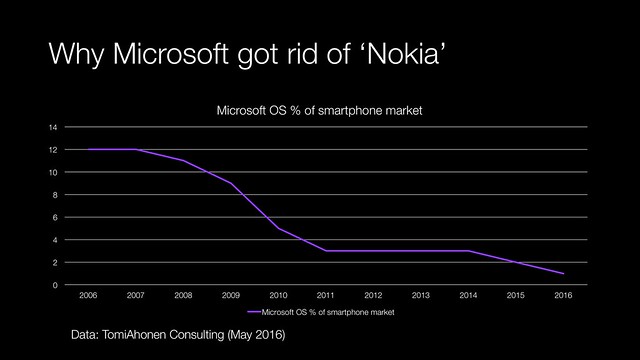
    The New Nokia can rise from the ashes of the old. Microsoft finally let go of its licence for the Nokia brand license on May 19, 2016.
    Slide03
    There is a lot of logic to this move:

    • Microsoft has already written down the full value of the business acquisition
    • It has got the most valuable technical savvy out of the team and moved it into the Surface business
    • It removes problematic factories and legacy products

    For the businesses that have acquired the rights to use the Nokia name and the factories the upsides are harder to see.

    The factories may be of use, however there is over supply in the Shenzhen eco-system and bottlenecks aren’t usually at final manufacture, but in the component supply chain.

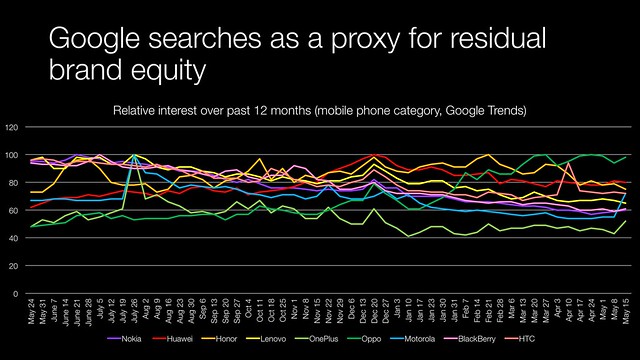
    There is still some brand equity left in the Nokia phone brand. I analysed Nokia along with a number of other international Greater China smartphone eco-system brands using Google Trend data.
    Slide06
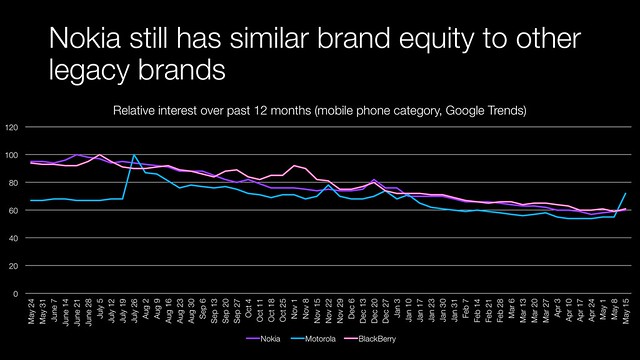
    There has been a decline in brand interest over the past 12 months for Nokia of 37%
    Slide07
    Nokia still has comparable brand equity to other legacy mobile brands such as BlackBerry and Motorola
    Slide08
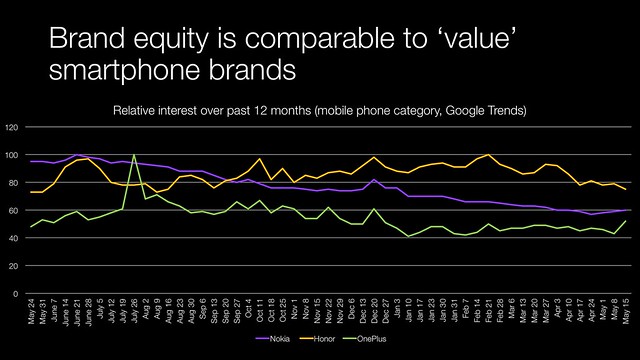
    The brand equity is comparable to other value mobile brands. Honor; Huawei’s value brand has had a lot of money and effort pumped into it to achieve its current position.
    Slide09
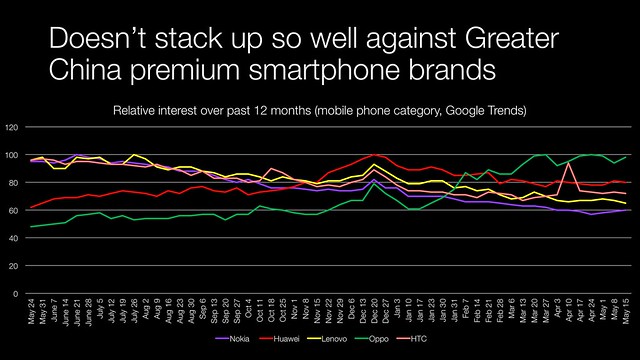
    But it’s brand equity doesn’t stack up well against premium handset brands from Greater China. The reason for this is that smartphone marketing and fast moving consumer goods marketing now have similar dynamics – both are in mature little differentiated markets. Brands need to have deep pockets  and invest in regular advertising to remain top-of-mind across as large an audience as possible. Reach and frequency are more important than social media metrics like engagement.

    In addition to advertising spend needs to be put into training and incentivising channel partners including carriers.

    They are entering a hyper-competitive market and it isn’t clear what their point of advantage will be. Given the lock down that Google puts on Android and commoditised version of handset manufacture, the best option would be to look for manufacturing and supply chain efficiencies  – like Dell did in the PC industry. But that’s easier said than done.

    Garnering the kind of investment required to seriously support an international phone brand is a hard sell to the finance director or potential external investors.

    Slide13
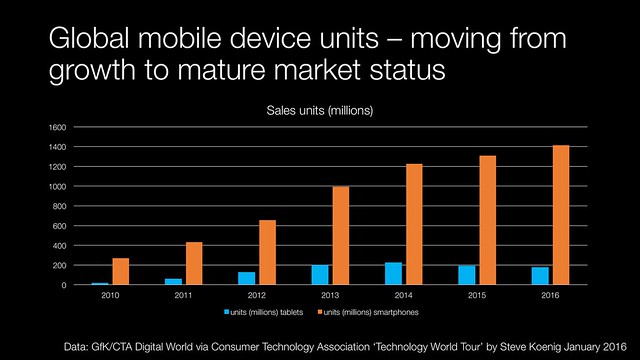
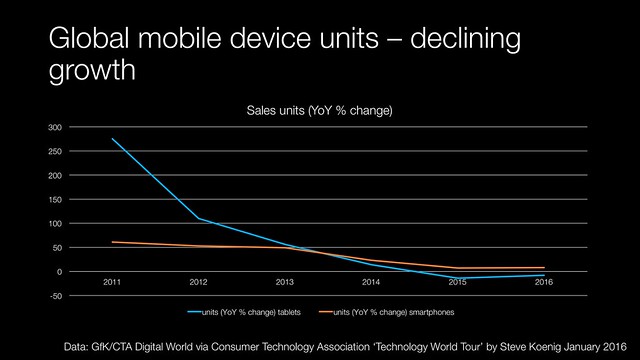
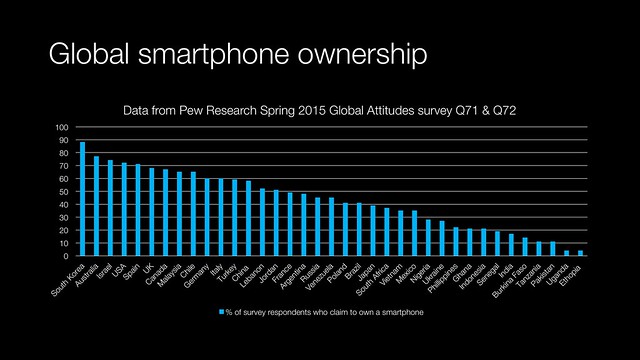
    Growth is tapering out.
    Slide14
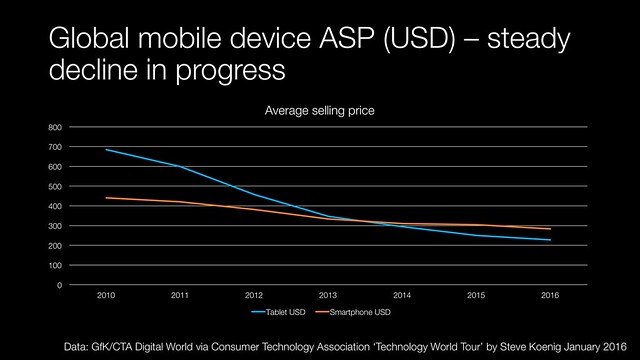
    The average selling price is in steady decline
    Slide16
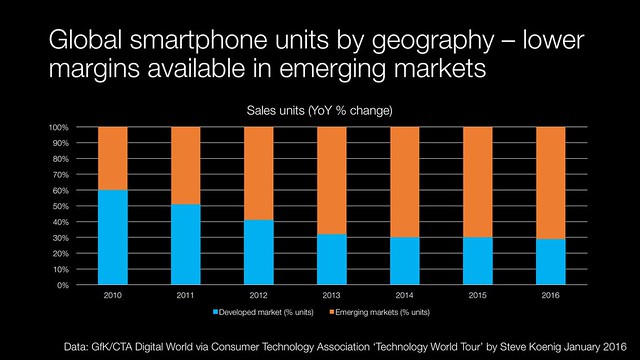
    This is partly because the emerging markets are making the majority new phone purchases.
    Slide15
    Consumers in developed markets are likely holding on to the their phones for longer due to a mix economic conditions and a lack of compelling reason to upgrade.
    Slide12
    All of the consumers that likely want and can afford a phone in developed markets have one. Sales are likely to be on a replacement cycle as they wear out. Manufacturers have done a lot to improve quality and reliability of devices.

    Even the old household insurance fraud standby of dropping a phone that the consumer was bored with down the toilet doesn’t work on the latest premium Android handsets due to water-proofing.
    Slide20

    More information

    The answer to the question you’ve all been asking | Nokia – Nokia’s official announcement
    Gartner highlights a more challenging smartphone sector for Nokia than when it “quit” in 2013 | TelecomTV
    Nokia is coming back to phones and tablets | The Verge
    So the Nokia brand returns.. with a Vengeance | Communities Dominate Brands

    Supporting data slides in full

  • Hong Kong Strong

    Brandon Li put his short film Hong Kong Strong on Vimeo last week. The video sprang up all over my Facebook feed as proud Hong Kongers shared the video. There were a number of things happening. The Hong Kong Tourist Board was having its strategy and spend challenged by some of the public and Wan Chai was shut down as a senior Chinese official arrived in the city for a three-day inspection.

    Why does Li’s Hong Kong Strong work? Its a beautiful piece of film in its own right and its cleverly edited. But you can see films with similar production values to Hong Kong Strong all over YouTube and Vimeo. 

    I think that the answer lies in the strong sense of place that it provides the viewer. In this respect it reminded me of Hollywood director John Ford’s The Quiet Man. Ford’s real name was Feeney and he was a first generation Irish American. His parents were from the west of Ireland (Galway and the Arran Islands respectively).

    As with great art Ford poured some of himself and his sense of place into the mawkish comedy. That lack of irony and love the old country saw the film become a touchstone for many Irish Americans. 

    Hong Kong is a largely thriving city but the sense of itself is under attack as the city state is absorbed by mainland China, that process has caused a dissonance in Hong Kongers which is why a film with a strong sense of place resonated so much. Hong Kong Strong captures not only what Hong Kong looks like, but also the energy and vitality of what Hong Kong is. 

    Brandon accompanied the video with a description of how it was made. The film was boiled down from over 1.7TB of rushes.

    For more Hong Kong related commentary click here.