Akio ‘Morizo’ Toyoda, of the Toyoda family who made their first fortune designing automatic textile looms in the early 20th century and their second fortune as the founders of Toyota. During the week Toyoda-san is the chairman of Toyota Jidōsha kabushikigaisha. But in his spare time he liked to do circuit racing under the name Morizo. At first, the Morizo name was to keep his moonlighting racing of the radar of Toyota board. But recently it has become an asset, with Toyota and its GR performance brand creating some of the best drivers cars available.
Toyota have started to use his natural enthusiasm for the company’s benefit. The Lexus LBX Morizo RR is currently a concept car that sees a baby Lexus LBX SUV benefit from the mechanicals of a Toyota GR Yaris.
Although talk about this as a Morizo only concept, it feels like the company might be feeling consumers out to possibly put this into manufacturing. If they did this, it would allow the company to take advantage of the GR Yaris-only components currently made and use them more widely.
The Criterion closet
Criterion as a publisher of DVDs and Blu-Rays is a badge of quality. The closest equivalent in the UK would be Curzon who bought Artificial Eye a number of years ago. One of the things Criterion do is video taste-makers who are allowed to take away some of their favourite films away from the company’s stock. Here are a couple of my favourites.
William Dafoe
Hideo Kojima
Watch trends
While much watch collector videos know feel more like Bloomberg reporting on a commodity because of the rise in the secondary market, this wrap-up strikes a nice balance. Some of the factors mentioned in this review appeared in my 2023 wrap-up and here.
Mexican street culture
If you had uttered those words to me before this week, I would have immediately thought of saints festivals, the day of the dead and the Chicano culture that grew out of Mexican communities who emigrated to the US. But there is so much more in Mexico itself as Refinery 29 shows in this film.
The 50 French words test
You can imagine the brief that came down to this government department in Quebec: make more English speaking visitors and businesses come to our province. The insights being along the lines of most English speakers don’t feel confident dealing with a foreign language, so how to do demystify French.
Brand clichés have been in the background of my career in agencies, all the way through. I am sure that brand clichés will continue long after my career is over.
I started off writing copy for technology clients. Short pithy marketing copy and longer thought leadership pieces, opinion editorials and white papers.
Back when I first started working on technology, media and telecoms brands we had a raft of clichés. These brand clichés were in the product and vendor descriptors.
Broken technology marketing
These weren’t the most sophisticated brand marketers. Marketing was sales support. There maybe some brand equity at the corporate brand level. But that was often down to user passion, rather than skilful brand marketing. You can still see that mindset at work in ingredient brands like AMD, Broadcom, Intel, MediaTek, NVIDIA, Oracle or SAP.
Created using Dall-E
Part of this was down to history, marketers were often engineers who had been promoted out of pre-sales consulting. Their corporate and product communications was often run by people who were ‘vested’ having worked early on in the companies life in an admin role. A personal assistant or an office manager, probably with a liberal arts degree from a university or community college.
The modern iteration of this dearth of marketing experience is the broken adtech space and a legion of growth hacker profiles on LinkedIn. Once you understand this broad brush picture of the technology sector the brand clichés start to make sense.
Technology brand clichés
A leading… – we compete in the following market for sector, but there isn’t anything to separate us from our peers. High fives happen in the office if we end up in the right part of the Gartner Magic Quadrant reports.
Best – Someone somewhere said that they thought we were better than our competitors based on their particular view at that time. We’ve paid an analyst firm a large amount of money for digital reprints where they said it. We will give you this as PDF if you give us all of your personal information and opt-in to being in constant contact with our marketing automation application.
Best-of-breed – we cobble together bits of technology from a number of sources, all of which are good. We usually have competitors who are vertically integrated and do everything reasonably competently in-house. It tells you more about market dynamics than it does about benefits. See ‘end-to-end’ used by vertically integrated businesses.
… compatible – usually a hygiene factor in areas were there are clear open standards like email and web browsing. It used to be that back-in-the-day a peripheral that was Mac compatible would cost double the price of PC compatible products. USB was a major change in this. Where there aren’t open standards, then beware of ‘lock-in’ where you get bled dry by vendors, rather like the Mac users of old. A second aspect of compatability is where vendors built super-standards on top of the ‘open standards’. Adding additional features over the top, if they can get their client to adopt them it can increase lock-in without having to go to the hassle of creating a completely bespoke standard. For example, POP and IMAP email doesn’t support being able to delete an email after you’ve sent it, unlike sending email from and to a Microsoft Exchange email server.
Cutting edge – will be obsolete, but not just yet.
Disruptive – we have an incumbent competitor and we hope you’ll change for the sake of change.
Enabler – we provide part of what you need, but we know that the majority of IT projects fail to reach the objectives that businesses have in mind. A classic example of this truth would be the NPfIT (national programme for IT) done by the NHS, Post Office Horizon project or most implementations from the likes of Autonomy to Adobe Workfront.
End-to-end – usually followed by solution or solutions provider. This was trying to make a virtue out of vertical integration of the corporate parent (think about the way HP used to do everything from servers to printer paper), in a market that was likely orientated towards horizontal integration (a classic example would be Windows running on an Intel or AMD processor, or Google Android running on a MediaTek or Qualcomm processor). The reality is that it’s barely a feature, let alone a benefit.
Fastest – the devil really is in the details of fastest. The measure of speed depends on what you want to measure. In technology real world speeds are difficult to capture and you can’t benchmark across systems. Way before Volkswagen’s Dieselgate scandal chip companies like Intel and Nvidia were routinely doing conceptually similar design tricks to recognise and optimise for benchmarking tests, often to the detriment of real-world use.
First – this would be then followed by a really arcane descriptor. For example ‘Product X is the first tree-based database structure in cloud services that supports MUMPS database language instructions aimed at industry 5.0 applications’.
Innovative – we spent money on design and putting things together. Appreciate it. Often used to support disruptive.
… ready – usually this is about a technology that might be in the news but is years away from the standards being developed being ready for commercialisation, or the standards may not even exist. In 2023, we saw several blockchain based companies talk about their technology being metaverse ready. You can read here about how far away and uncertain that statement is. The reality is often that this is pure hype.
Scaleable – it will work with more of our stuff. It might even work with other people’s products. If by any chance your business grows, we want to sell more stuff.
Solution – a mix of web hosting, other vendors products, our products and consulting time as a kludge to make things work. Think of every collaboration in streetwear and luxury fashion that was a dog’s dinner – this is exactly the same, but in IT.
The world’s leading… – this might be supported by either market share data for one quarter’s sales, or a number of analyst reports. Basically ‘a leading…’ but with a bit more confidence. Usually you will find that the brand has some visibility within their market sector and is likely considered. So when green tech company 1pointFive announced an agreement with the Boston Consulting Group (BCG) – BCG was described as:
Boston Consulting Group (BCG), one of the world’s leading management consulting firms
Yes business people are likely to have heard about BCG, but that doesn’t mean that they would prefer to hire them over McKinsey, Teneo, Bain, Accenture etc.
Value-added – a synonym for expensive and complex.
Bland brand clichés
Now the key ones I see, tend to be throughout the brand book. A good proportion of the reason why these have become brand clichés is down to over-use. In a world where brands are the above average equivalent of the children in Lake Woebegon.
Authentic – we do what we say (most of the time). Unless it has implications for our bottom line. Often used interchangeably with principled and brand purpose. The latter two often look at higher order ambitions than the business.
Dedicated – more about the focus of the business than the quality of the product or services. Through to the 1980s in western countries, there were companies called conglomerates which were a mass of disparate businesses. Originally they may have started off as looking to integrate businesses into their offering. So if you sold hardware to businesses, you might want to provide software that those businesses would want. You might help them put it all together, which then meant you had a professional services business. All of this doesn’t come cheap, so you might add a finance business to help them spread the payments rather than an overly expensive bank loan. All of a sudden you are a conglomerate. Being a conglomerate makes it harder for you to focus on what you do well. Being dedicated means that in theory you have that focus.
Helpful – We do enough so that you will probably do business with us again.
Passionate – we behave in a professional manner. Basically they weren’t the guy in the coffee shop I went to on Saturday, where he let us wait in a queue to be served while he finished rolling out five cigarettes. He then asked ‘what do you want?’. He demonstrated authenticity, but not dedication or helpfulness.
Trusted – customers pay us for what we do. Some of them do this on a repeat basis.
The inspiration for this post on FOOH (fake out of home advertising) was Ryan Wallman’s marketing predictions for 2024 on LinkedIn. In particular two of his five predictions
2. Someone will post a viral ad that is a) fake and b) terrible. Hundreds of people will comment: ‘Genius!”
5. Marketers will try to emulate the success of Barbie but will completely misconstrue its relevance to their brand, culminating in a series of fucking stupid and totally unsuccessful stunts.
Ryan Wallman
As with many marketing predictions, they are equally applicable for 2023 as well as next year (and probably several years on).
These two particularly resonated with me, due to the current trend of FOOH. This is where a creative agency has put together photography or video showing an out of home execution that doesn’t exist.
These aren’t concepts that have been mocked up for a client to show them how indicate how their campaign would look when activated. Or as a creative calling card by an agency or team to catch the eye of a new client a la the famous Volkswagen Polo car bomb advert which leaked out on to the general public.
Instead, they are created with the express intent with fooling a good deal of the public that the execution is real. In the case of Maybelline, it was pushed out on third party influencer accounts on TikTok and YouTube as ‘truth’.
Other examples
The Popeyes and Truff collaboration campaign can be seen here. British Airways mocked up a billboard at the Glastonbury festival, but wouldn’t have been able to buy the space even if it wanted to.
The Independent were fooled by Jacquemus with these FOOH-ed giant handbags. It is particularly interesting that a mainstream news media channel was fooled.
And I find that troubling for a number of reasons. And let’s illustrate this through a quick thought experiment.
The John Holmes thought experiment
You probably don’t know me, I am an overweight white male with a shaven head and distinctly average in every physical way.
A quick John Holmes primer
John C Holmes via Wikipedia
The late Mr Holmes was taller than me. He was an army veteran and then worked a number of blue collar jobs from ambulance driver to factory worker and forklift truck driver. He eventually hit a patch of unemployment and agreed to do nude modeling and appear in pornographic films. At the time these films were closely linked with organised crime in the US. Times things changed. During the early 1970s the industry saw a golden age where porn films became mainstream culture. Roger Ebert reviewed these films for the Chicago Sun-Times and his peers did similar at the likes of the New York Times.
Holmes became a popular culture figure and his name spread far wider than the viewership of his films. Mark Wahlberg’s character in Boogie Nights is heavily influnced by John Holmes. He was famous for his penis size.
For the latter part of his adult life he was an addict, which affected his ability to work. The movie Wonderland dramatises a low point in Holmes life and his association with murder of the Wonderland drug gang.
Back to the thought experiment
By some strange incident, a video of me stepping out of the shower and then putting a towel happens to be made. A creative chum decides to make lemonade from these lemons and uses <insert generative AI video tool du jour here> to create a realistic looking, but fake, appendage.
Nothing has changed, I am still as I introduced myself earlier, distinctly average in every physical way. Then I add it to a dating profile. In my opinion it would be both unedifying and distinctly dishonest. This is what brands are doing when they create FOOH campaigns to generate social currency (virality, talkability etc).
Authenticity
These videos and photos are demonstrations of creative craft and creativity, but good judgement asks not only can something be done, but should it be done. It’s often not part of an ad format that makes it clear that the image isn’t ‘real’ and there is no ‘wink-wink’ moment to bring the audience in on the truth. This isn’t ‘truth well-told’ as advertising as McCann the advertising agency would have put it.
Brands step across the line of believability, inevitably letting consumers down.
Authenticity vs. fakery
While FOOH showcases the incredible capabilities of CGI and digital storytelling, so do 3D digital billboards. 3D billboards do it in a more honest, authentic and entertaining way. The Air Max Day billboard campaign in Tokyo would be genuinely memorable, creating a sense of wonder and generate talkability.
By comparison FOOH is a fiction cosplaying as reality. FOOH raises questions about the authenticity of the brand experience itself. Advertisers push the boundaries of what is possible with a minimum spend. These simulations of awe-inspiring moments dilute the credible real-life experiences we’ve come to appreciate. Authenticity is a pivotal factor in establishing trust between a brand and its audience. What does it say about the brand as a corporate citizen, when they are normalising fraud, lies and astro-turfing on social platforms? We have enough problems in the media eco-system already, without brands making it worse. FOOH can be seen as a manifestation of brand sociopathy.
The inspiration for this post on every old idea is new again came from my opening up Rakuten‘s Viber messaging app on my iPhone. Viber is a messaging platform and also does voice over IP, including out to the phone network. It is a hybrid of Skype and WhatsApp in terms of functionality. Viber is popular in parts of Asia, much of central and Eastern Europe, Greece and Russia – often as a second string to Telegram or Zalo.
Scratchcards, giveaways
I saw the following image in Viber.
Viber’s scratch card giveaway promotion.
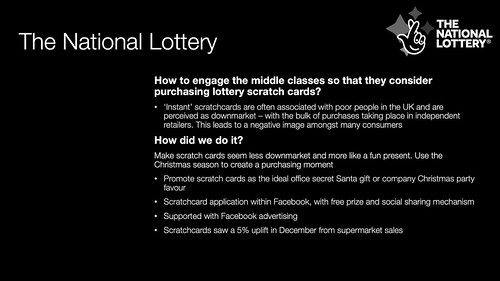
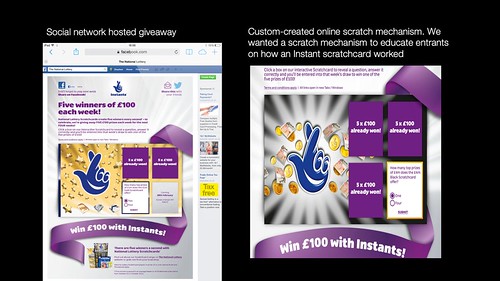
Which took me right back to roughly the same time of the year back in 2012, when I worked at Ruder Finn and did a similar digital scratch card execution to promote The National Lottery scratch cards in the run up to Christmas.
I was fortunate to work with a great creative and technology team: Stephen Holmes and Dru Riches-Magnier on the project. The promotion was executed within a high security environment because Camelot’s IT standards were way beyond what we usually worked with.
Here’s the case study that I wrote up about the scratch card project in my portfolio.
This was the most stressful time I had during my time working at Ruder Finn and one of two high points in terms of the work that we did.
So when I saw the Rakuten Viber execution, I had a deja-vu moment and the epiphany that every old idea is new again.
Strawberry fields forever & the square mile
So how do we get to a point where every idea is new again? Years ago I used to DJ in bars, clubs and parties. A couple of young lads on a music production course saw a record label release one of their assignments to tap into the psychedelia and dance-indie hybrid sound. The record was a cover version of a Beatles track with a Soul II Soul type break beat underneath. It became successful and topped the charts.
There were a surprising number of people who didn’t realise that it was artfully created cover version of The Beatles, I even heard the original described as a poor version of Candy Flip.
Newness is a matter of perspective. This was brought home to me at a talk that Damien McCrystal gave years ago. This was about the time that he was a business columnist at The Observer. I can’t remember the context but McCrystal said that the memory of ‘the square mile’ (think Wall Street in US parlance) was about eight years.
Which was the reason why the 2008 mortgage crash looked eerily like the savings and loans crisis of the 1980s. And that is despite most of the people in investment banks having a passing familiarity of Michael Lewis’ insider account Liar’s Poker which outlined how derivatives fuelled much of the 1980s Savings & Loans crisis.
I got to read it in college, despite having no interest in entering the world of finance. By and large I managed to stay clear of finance aside from being an in-house marketer early on in my career at what’s now HBOS and credit card provider MBNA. I also had a bit of early luck in my career timing, as I left MBNA before the payment protection insurance scandal hit the sector.
This was the classic example of every old idea is new again, but with the added wrinkle that a bad set of ideas can suddenly turn into good ones over time.
But as a strategist, this taught me to be careful on interventions pointing out a given concept is an old idea, given that every old idea is new again at some point.
Porsche committed to major long form content as it followed Michael Fassbender on the road to Le Mans.
Season one
Road to Le Mans started off over four years ago with six short form films, each no longer than 10 minutes in length. So far, pretty much what you would expect in a prestige luxury car brand film. I was reminded of BMW’s ‘The Hire’ film series over the years with Clive Owen as the driver.
Season two
Porsche must have had positive feedback to continue with a second series in a similar vein to series one of Road to Le Mans. But some of the episodes were double the length of series one and three more episodes in this series. Looking at the Porsche YouTube channel the two seasons were likely considered to be a complete arc. They build a playlist that holds only season one and season two.
The manage to switch around the voices in the narrative which I think adds more in season two and season three.
Season three
By season three, the series seems to have hit its stride. The episodes are as long as they need to be.
Season four
Season four seems to have more of Fassbender’s voice in it.
Feature film
The theme of resilience in the face of failure was an interesting, honest angle in the film. Road to Le Mans emphasises stoicism and resilience as much as it emphasises the performance of the car. The feature film is an edit together of season four.
Although it’s Fassbender’s journey and I respect what he’s done, it feels a bit self indulgent at times. I think that this is because the actor’s journey as a profession isn’t a team sport in the same way that most other roles are.
What Road to Le Man also brought through to me was the depth of achievement in Porsche’s 18 Le Mans overall victories. This film feels like a final chapter to this Road to Le Mans at least.
Porsche seem to have shouldered the cost of the film themselves, I was a bit surprised that the content wasn’t licensed to a streaming service like Netflix and then eventually put on YouTube. More related content here.