Category: business | 商業 | 상업 | ビジネス

My interest in business or commercial activity first started when a work friend of my Mum visited our family. She brought a book on commerce which is what business studies would have been called decades earlier. I read the book and that piqued my interest.

At the end of your third year in secondary school you are allowed to pick optional classes that you will take exams in. this is supposed to be something that you’re free to chose.

I was interested in business studies (partly because my friend Joe was doing it). But the school decided that they wanted me to do physics and chemistry instead and they did the same for my advanced level exams because I had done well in the normal level ones. School had a lot to answer for, but fortunately I managed to get back on track with college.

Eventually I finally managed to do pass a foundational course at night school whilst working in industry. I used that to then help me go and study for a degree in marketing.

I work in advertising now. And had previously worked in petrochemicals, plastics and optical fibre manfacture. All of which revolve around business. That’s why you find a business section here on my blog.

Business tends to cover a wide range of sectors that catch my eye over time. Business usually covers sectors that I don’t write about that much, but that have an outside impact on wider economics. So real estate would have been on my radar during the 2008 recession.

  • The rise & fall of American growth

    The rise and fall of American growth

    It has been five years since The rise and fall of American growth was written by Robert J Gordon. When it was first published it was a New York Times bestseller and won awards from the FT and McKinsey. I felt that it was particularly interesting to go back and visit now, given current economic circumstances and the view that its data provides on the techno-optimism versus techno-pessimism that is currently raging on.

    The Rise and Fall of American Growth

    Understanding the author’s perspective

    Robert J Gordon developed his career as an economist in a crucible. He started his career during a time of battle between Keynesian and the monetarist supporting economists. Keynesian ideas had reached their peak in the 1950s. It was challenged by economists such as Milton Friedman and George Stigler. Both of whom were from the Chicago School. The Chicago School was the University of Chicago. It became a centre for economic conservativism. The Chicago School At his time, drew on the likes of Hayek for its ideas.

    Gordon became a ‘New Keynesian’. They assume that there is imperfect competition in price and wage setting to help explain why prices and wages can become “sticky”. They do not adjust instantaneously to changes in economic conditions. Wage and price stickiness, and the other market failures present in their models, imply that the economy may fail to achieve full employment. They argue that macroeconomic stabilisation by the government and the central bank leads to a more efficient macroeconomic outcome than a laissez faire policy would.

    American growth and techno-optimism

    The techno-optimism viewpoint is that continuing technology innovation is going to bring about a new golden age. There are essays trading perspectives on this back-and-forth.

    Gordon’s research suggests that the kind of growth suggested by techno-optimists as an outcome is usually because of very special circumstances.

    When he looked at American growth through the 19th century; growth had occurred in short spurts and much of it wasn’t driven by technology, but was multiple factors coming together. He further posits that those factors that drove American growth are unlikely to be repeated in the future.

    The last spurt of this growth was during the irrational exuberance of the dot com era.

    As you’d expect from an economist, Gordon pulls together to support his ideas very carefully and it is based on empirical analysis. IT has driven little economic growth, which makes one wonder about the benefits of digital transformation as touted by management consultancies.

    Gordon’s work is also an argument against globalisation, at least for the American economy. It brings into question the American dream.

    Finally, with technology unlikely to drive the kind of stellar growth promised, it brings into question the massive premium set on growth stocks over the long term and venture capital investments in the technology sector and the current Silicon Valley model.

    Gordon’s current research is focused on looking at European and American growth so it will be interesting to see commonalities and differences. I expect to see a spurt of growth from second generation mobile devices that freed up small businesses by providing an instantaneous connection with the customer. Rather than relying on an answer machines or a member of their family as receptionist.

    The Rise and Fall of American Growth: The U.S. Standard of Living since the Civil War: 70 (The Princeton Economic History of the Western World, 70)

    More book reviews can be found here.

    More information

    Robert Gordon’s academic papers here.

    Answering the Techno-Pessimists (complete) – Noahpinion 

    Interview: Patrick Collison, co-founder and CEO of Stripe – Noahpinion
  • White Motorcycle & other things this week

    White Motorcycle Concepts WMC250EV

    I have watched this video by White Motorcycle Concepts a few times and still don’t quite get it. White Motorcycle have hollowed out the centre of their motorcycle, to allow air flow through the middle of the bike rather than cutting the air cleanly. The little that I have seen make it hard to discern the effect of Bernoulli’s principle on the shape of the White Motorcycle.

    Tenacious D channel the Beatles

    Tenacious D are better known for their homage pieces to metal bands. For a charity single donating to Doctors Without Borders – they try and channel The Beatles. Its hard as The Beatles had so many sounds that they changed abruptly and crashed into each other.

    I think they did pretty well.

    Stories, players and games

    Nigel Scott has put together an interesting set of ideas on business and marketing. There’s some bits I’d disagree with (are Google, Facebook et al really changing the game, or just costing marketers more?). Really worthwhile going through it all here.

    Akira behind the scenes

    This brief look behind the scenes looks like an excerpt from a longer programme. But it gives an idea into the work which went into making the animated film Akira. The precision and level of detail is mind boggling.

    Gimme 5 mixes

    Gimme 5, the label of long time streetwear distributor Michael Kopelman have a library of good mixes up on Soundcloud and I have been listening to their back catalogue. They’re worthwhile listening to for their eclectic mix of material.

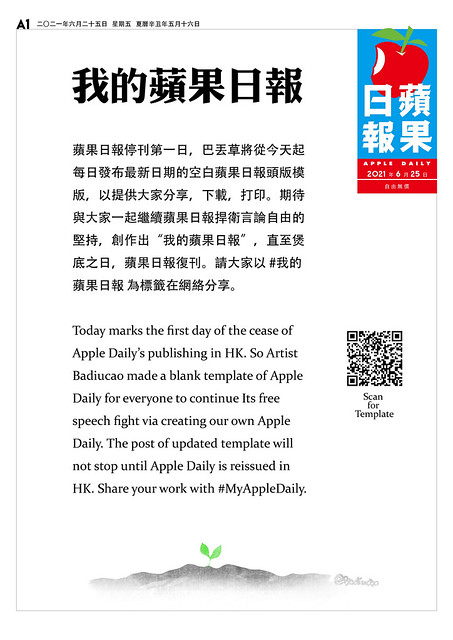
    #MyAppleDaily art project

    Chinese artist Badiucao is publishing a blank template of the paper’s front page for each day that the Apple Daily isn’t published. The idea is to encourage people to publish their own front page instead.

    More from Badiucao here.

    my apple daily introduction
  • Hawker markets & things this week

    Hawker markets

    Eating out is an important part of life in many Asian countries. Cheap eats in Singapore are provided by hawker markets. Imagine Asian street food, if it was run by Germans. They had a similar tradition to hawkers called da pai dang (大牌檔). But the Hong Kong government has slowly squeezed them out and there are now less than 25 left. Instead I used to usually go to small hole in the wall restaurants. Da pai dang are treasured by Hong Kong citizens; hawker markets are treasured by the Singaporean people and their government. Singaporean channel Our Grandfather Story put together a video on how to support offline hawker markets. Its also a great critique of online food services.

    MiniDisc

    Sony’s MiniDisc format was a fascinating format. Friends of mine used it to record DJ mixes as it gave better quality than cassette taps. But it never beat out the humble compact cassette as a universal media. I went from cassette tapes to recordable CDs. MiniDisc operated in an interesting technological and temporal space.

    It is a very cyberpunk retro-futuristic looking media. The optical disc in the protected diskette case. If you wanted data safe, secure and offline, then this form factor looks sensible. And Sony’s Blu-Ray in a diskette is used for archiving purposes today by Sony and Panasonic under the format name Archival Disc.

    When I look at the MiniDisc, I think of dinky portable player / recorders that were almost like the watch-makers art. If it hadn’t existed, anime and manga artists would have created it as a fictional device.

    It had a second life as a pre-iPod format that offered the shareability of cassette mixtapes.

    The secret life of MiniDisc in Japan is fascinating. All of the above factors and more are featured in this documentary.

    Apple Daily

    Hong Kong’s national security police arrested senior journalists at the Apple Daily.

    Hong Kong police arrest editor-in-chief of Apple Daily newspaper in morning raids | Hong Kong | The GuardianSteve Li Kwai-wah, head of the police’s national security division, said there was “very strong evidence that the questionable articles played a very crucial part in the conspiracy, which provided ammunition for foreign countries, institutions and organisations to impose sanctions,” adding that those arrested played “a very important role” in their publication. The articles reportedly date back to 2019. Authorities have made repeated assurances since the implementation of the controversial and wide-ranging national security law in June 2020 that it was not retroactive.

    They seized journalist computer hard drives, money and materials. The Apple Daily team didn’t let that hold them back and live-streamed the publication of their early edition of Friday’s paper.

    Hong Kongers came out to support the newspaper, queuing and buying multiple copies of the Apple Daily paper at news stand as soon as the early edition was published.

    They have an English language version of the Apple Daily paper here and I urge you to consider subscribing via the Apple app store or the Google Play store.

    You don’t have to subscribe because the Apple Daily is the lone free voice in Hong Kong media; universally disliked by those in charge (and many who wish they were in charge). You can subscribe for Chinese and Hong Kong coverage that you wouldn’t otherwise see in English language media. Such as Alibaba’s Taobao e-commerce platform having over a billion data records taken. A huge hack not mentioned elsewhere yesterday in the media.

  • 6G development + more things

    6G development

    Japan teams up with Finland on 6G development – Nikkei Asia the consortium on 6G development features a number of familiar names. On the Japanese side the following organisations are involved:  includes NTT, NTT DOCOMO, KDDI, SoftBank, Rakuten Mobile and the University of Tokyo. I was a bit surprised not to see NEC here as they are Japan’s domestic telecoms equipment manufacturer. From Finland you have the following 6G development partners: University of Oulu and Nokia. (Paywall)

    Culture

    Part one of what is due to be a three part podcast: oral history of The Avalanches – Since I left you 

    Ethics

    The Secret IRS Files: Trove of Never-Before-Seen Records Reveal How the Wealthiest Avoid Income Tax — ProPublica – validation of what everyone suspected. I wouldn’t be surprised if this was a strategic leak by the Biden administration

    Finance

    China’s bid for digital-yuan sphere raises red flags at G-7 – Nikkei Asia – total information awareness of global markets, surveillance and money that can be invalidated at the push of a key….

    Indian tycoons surpass Chinese tech moguls in global rich list | Financial Times – which says more about the Chinese government clipping the laissez faire approach to its tech entrepreneurs

    Luxury

    Why Shenzhen – not Hong Kong – is luxury’s new golden ticket – only Hong Kong’s property oligarchs will be sad to see this happen

    Marketing

    ‘How the hell have we allowed this to happen?’ Rory Sutherland on creative devaluation | Campaign Live – I think that its down to a wider marketing focus on performance marketing rather than brand building

    Olympics: India drops Chinese kit sponsor ahead of Tokyo Games | Olympics News | Al Jazeera – not great for Li-Ning

    Media

    The underground zines that kept self-expression alive in Mao’s China – The Boston GlobeDespite Beijing’s tight control of the printed word and its dissemination, a new and diffuse network of underground printers — low-tech, affordable, remarkably flexible, and incredibly hard to police — springs up. Equipped with nothing more than Chinese typewriters, mimeograph machines, and stencil duplicators, underground publishers mass-produce an untold quantity of materials for a vast and diverse readership.

    Security

    How to Turn Off Amazon Sidewalk | WIREDFor the Echo family of speakers, open the Alexa mobile app and go to More, Settings, Account Settings, Amazon Sidewalk and choose Disable. In the Ring app, go to the Control Center, Amazon Sidewalk, Disable, Confirm.

    Technology

    iPhone? AirPods? MacBook? You Live in Apple’s World. Here’s What You Are Missing. – WSJ – (paywall) more Apple related content here.

    Web of no web

    Finnish Group Readies Non-cellular Technology for IoT – EE Times Europe

  • Myanmar

    Myanmar first came on my radar as a child. I was peripherally aware of it through the bits of Rudyard Kipling that I had read in the school library. Though I was reading Kipling more for his use of words and compact style with which he wrote.

    I had also read a book that made grim reading on jungle warfare from the perspective of Wingate’s Chindits. The Chindits that went into Myanmar were named after the Chindwin river that they crossed. They were made up of underfed troops often weakened by diseases such as malaria and dysentery and suffered an extremely high casualty-rate. It is one of them weird bits of history that the British celebrate, but in reality sound like one long slow train wreck. The closest comparison that I think think of is the Irish lionisation of 1798 rebellion exemplified by Thomas Flanagan’s The Year Of The French. My impression of Myanmar, was a country that is hot and hard to live in. Myanmar was also well known for rubies and sapphires.

    I moved to Hong Kong in 2012, the year before a civilian government had come to power in Myanmar after decades of military rule. Things rapidly started to open up. I worked alongside Red Fuse the dedicated agency that WPP had put together for Colgate-Palmolive.

    In reality, Red Fuse was pretty much the whole of the Young & Rubicam office in Hong Kong at the time. Colgate launched its oral health month campaign in Myanmar with the marketing material printed on the insides of the brown cardboard boxes that there products where distributed to retailers in.

    My more adventurous colleagues took short breaks in Yangoon. Some bought locally mined jade to take back to Hong Kong. A colleague whose partner worked for an airline even moved to Yangoon as airlines set up new routes and hotels opened up catering for business and tourism. I worked on Telenor’s recruitment of of local resellers in Myanmar for its soon to start mobile network. We provided strategy for a local agency to implement.

    Soon after I came back in 2014, I put together a presentation on the potential of Myanmar. But why Myanmar? Well from my perspective other markets were either already on their way or on their way to decline.

    China waning

    I had already seen that China was slowing down from a growth perspective. China was aging, the demographic dividend would last for only another decade or so. (Population growth stalled in China during 2020 according to government official figures. The FT reported that China’s population had gone into decline. I am inclined to believe the FT more.) The Chinese government are sufficiently rattled that they have introduced a three child policy.

    Chinese markets for products were saturated, particularly in FMCG. Whole sections of the economy are still walled off from foreign participation. There is continued capital flight out of the country by local business people and government officials.

    The most important factor that I didn’t put in my slide deck was the gradual Han nationalism tone that was rising in China at the time.

    Vietnam well on its way

    Vietnam was already on the rise and well known by this point. We were getting some of our online creative built in Ho Chi Minh city by staff who were better than Indian or Chinese development houses.

    Myanmar looked like Vietnam in the early 1990s. It has proven oil deposits that are largely tapped out. The Burmah Oil Company and Standard Oil extracted oil from Myanmar from the late 19th century onwards. In 1991, Shell discovered natural gas deposits. By the time I went to Hong Kong, western companies were joining the Indians, Chinese and Malaysians in developing natural gas fields.

    Like Vietnam, there was a large young population, the majority of whom still lived on the family farm. 70 percent of people worked on the land and just 7 percent of people worked in industry. Meaning that workforce could be turned to manufacturing. The population at the time was almost 51.5 million and would grow to 54 million in a couple of years.

    Myanmar by numbers

    In 2012 and 2013, internet penetration was in single percentage figures. That’s why Young & Rubicam were printing marketing materials on the insides of brown cardboard boxes.

    The economy was growing from a low base partly caused by the financial crisis and international sanctions against the military rulers at the time. The economic growth had been stifled by 59 years of military rule.

    Year on year growth looked like the go-go years of China. The average income of a Burmese person was just $10 a day. Although most of the senior business and military elites were very well off indeed with bolt holes for them and their family in Dubai.

    Myanmar had:

    • 119.8 million tons of copper available to mine
    • 283 billion cubic metres of proven natural gas reserves
    • Only 49 percent of the population had access to electricity
    • At least four international tobacco companies had entered Myanmar and up to half of Burmese smoked. Of those who smoked less than 5 percent were smoking filtered cigarettes

    Myanmar challenges

    • Distribution partners. Tobacco companies and Telenor were encouraging people to become retail entrepreneurs
    • Infrastructure development had been prioritised for military rather than commercial needs. Those roads that are available are often of poor quality
    • While half the population had access to electricity, the supply isn’t reliable
    • Corruption is a major issue that I didn’t include in the presentation. The military and historic business elites didn’t get their Dubai penthouses through hard work and enterprise of their own.

    2021

    Of course the military overthrow of the elected government through all that into chaos.