Category: consumer behaviour | 消費者行為 | 소비자 행동

Consumer behaviour is central to my role as an account planner and about how I look at the world.

Being from an Irish household growing up in the North West of England, everything was alien. I felt that I was interloping observer who was eternally curious.

The same traits stand today, I just get paid for them. Consumer behaviour and its interactions with the environment and societal structures are fascinating to me.

The hive mind of Wikipedia defines it as

‘the study of individuals, groups, or organizations and all the activities associated with the purchase, use and disposal of goods and services.’

It is considered to consist of how the consumer’s emotions, attitudes and preferences affect buying behaviour. Consumer behaviour emerged in the 1940–1950s as a distinct sub-discipline of marketing, but has become an interdisciplinary social science that blends elements from psychology, sociology, social anthropology, anthropology, ethnography, marketing and economics (especially behavioural economics or nudge theory as its often known).

I tend to store a mix of third party insights and links to research papers here. If you were to read one thing on this blog about consumer behaviour, I would recommend this post I wrote on generations. This points out different ways that consumer behaviour can be misattributed, missed or misinterpreted.

Often the devil is in the context, which goes back to the wide ranging nature of this blog hinted at by the ‘renaissance’ in renaissance chambara. Back then I knew that I needed to have wide interests but hadn’t worked on defining the ‘why’ of having spread such a wide net in terms of subject matter.

  • Gray house

    The gray house phenomenon is a fascinating microcosm of urban development. Gray because its a specifically American phenomenon, rather than grey. But some of the aspects of it will be equally familiar to city dwellers elsewhere.

    Gray House
    Photo by massmat

    Quick fix

    The act of painting a brick house is a quick fix by developers, rather like body filler on old car:

    …it’s a cheap, easy way to refresh a brick facade. Many rowhouses in the city are a century old, or close to it, and “you probably don’t want to risk [damaging] hundred-year-old mortar by power-washing,” notes Kevin Wood, a realtor with Slate Properties. Left as is, old brick may appear dingy—especially if the house dates to the era when coal was burned in D.C.—or it will have gaps between courses where the mortar needs repointing, a painstaking repair job. New paint can hide a multitude of small flaws.

    Grayed Expectations | Washington City Paper

    This causes anxiety among people who want to preserve an areas character with soot stained natural brick finish.

    Flip house gray

    Grey was chosen because it was an inoffensive neutral colour that was designed to blend in. Think norm core for house exteriors. Neutral colours are recommended on websites that provide advice to people looking to refurbish and resell a house. But it has come to mark out a home that was painted to sell it, or as one article put it ‘flip house gray’. It stands out in neighbourhoods and provides a visual marker for gentrification. The gray house is either for sale, or a house were people have moved into a neighbourhood.

    More jargon related content here.

    More information here

    Grayed Expectations | Washington City Paper

    What Are the Best Paint Colors for Selling a House? – House Flip Central

    Sherwin Williams Light French Gray SW 0055 – West Magnolia Style

  • VR Headset + more things

    Apple’s first VR headset will reportedly be powerful and pricey – CNET – its a rumour so take with a pinch of salt, the approach outlined reminded me of being rather similar the way Oculus was in their early model VR headset devices. It is also interesting how they consider a VR headset as a stepping stone to AR glasses. Will Apple be enough to mainstream the VR headset? More related content here.

    Next drops bid to buy Topshop after Arcadia’s breakup | Philip Green | The GuardianThe Next consortium was pitted against Shein, a Chinese online fashion retailer and Authentic Brands, the US owner of the Barneys department store, which has been linked to a joint bid with JD Sports. The online retailers Asos and Boohoo are also thought to be involved in the mix. Shein tabled an offer worth in excess of £300m for Topshop and Topman, according to Sky News which first reported the development. It added that a separate process was being run for other Arcadia brands such as Burton and Dorothy Perkins

    ‎Finding Genius Podcast: Telehealth Technology Breaking the Barrier of Geography on Apple Podcasts – practitioner discussion on the realities of telehealth for diabetes and obesity management treatment

    Asians dump WhatsApp for Signal and Telegram on privacy concerns – Nikkei Asia 

    TSMC hikes capex to record $28bn as chip race heats up – Nikkei Asia 

    ‘Absolute carnage’: EU hauliers reject UK jobs over Brexit rules | Brexit | The Guardiandata showed that an increasing number of freight groups rejected contracts to move goods from France to Britain in the second week of January. Transporeon, a German software company that works with 100,000 logistics service providers, said freight forwarders had rejected jobs to move goods from Germany, Italy and Poland into Britain. In the second week of January the rejection rate for transport to the UK was up 168% on the third quarter of 2020 and had doubled in the first calendar week of the year

    Battle of the Robots Still Favors Japan and Europe—For Now – WSJCovid-19 has accelerated automation in factories, especially in manufacturing powerhouse China. Foreign companies have long dominated the market for industrial robots and automation tools there—but there are signs that dominance is fraying around the edges. As the factory for the world, China is unsurprisingly far and away the largest market for industrial robots. Before the pandemic, however, the U.S.-China trade war was slowing growth. New installations of industrial robots amounted to 140,500 in 2019, a 9% decline from the previous year, but still almost three times the number for second-place Japan, according to the International Federation of Robotics. Last year was likely much better: Credit Suisse estimates that China’s industrial-robotics market grew 9.5% in 2020.

    Audi and BMW shut down car subscription programs | EngadgetWhen Mercedes-Benz shuttered Collection, however, it cited mediocre demand and complaints about the hassles of switching personal items between vehicles. While it wasn’t mentioned at the time, the COVID-19 pandemic hasn’t helped matters. People are commuting less if at all, and may be more interested in saving money than the flexibility of swapping cars.Subscription ervices like Volvo Care are still going, although it’s not certain how well they’re faring.There may be a slight revival. Automotive News claims Cadillac is testing a resurrected Book service with dealers, although it would arrive a year after the brand’s hoped-for early 2020 revival. However, the overall market appears to be contracting

    Majority of Europeans fear Biden unable to fix ‘broken’ US | World news | The Guardian“Europeans like Biden, but they don’t think America will come back as a global leader,” said the thinktank’s director, Mark Leonard. “When George W Bush was president, they were divided about how America should use its power. With Biden entering the White House, they are divided about whether America has power at all.” The survey of 15,000 people in 11 European countries, conducted at the end of last year, found that the shift in European sentiment towards the US in the wake of the Trump presidency had led to a corresponding unwillingness to support Washington in potential international disputes

    Exclusive: City of London Corp boss says ‘not our place’ to criticise China : CityAMNathan Law, one of the leaders of the 2014 Umbrella Movement protests in the territory and now in exile in London, told City A.M.’s City View podcast yesterday that UK firms’ “compliance and collusion” with the Chinese Communist Party’s agenda threatened the West’s “democratic values”. The pointed criticism comes after firms including HSBC and Standard Chartered, headquartered in London but who see significant revenues in Asia, backed the imposition of a draconian National Security Law in Hong Kong

    Damaging brand image is rarely harmful because it matters so littleIn the age of Trump, what people think of you is far less important than the more brutal objective of getting people to think about you. – Salience is so important

    Zoom spy claims a warning for multinationals in China | Financial Times – the point is that every MNC is compromised because of the pressure that China brings on employees in their country

    IWC’s Christopher Grainger-Herr: “We Are Currently Experiencing Extraordinary Times.” – part of the issue with IWC is pre-COVID product related including using movements that watch fans look down on

    China-US rivalry: how the Gulf War sparked Beijing’s military revolution | South China Morning Post 

  • Doughnutism

    Doughnutism is a phrase that I found out about from a presentation of Carat’s 2021 trends paper. In the paper itself it is called the donut problem, but when talked about the phrase doughnutism was used.

    COVID-19 has changed behaviours. More people are telecommuting, which has changed people’s travel needs. As a consequence, there has been an uptake in locally bought products and services.

    Carat found data that suggested there was a common phenomenon in multiple cities. Lots of activities on the peripheral, where the bulk of people live, but a sharp decline in footfall in the middle. This would be shops that catered for commuters in central business districts, urban tourist traffic or destination shopping areas.

    This void in the centre is where doughnutism comes from.

    Carat cited CACI research that showed retail footfall returned to only 25 per cent of pre-COVID levels after the spring lockdown was lifted. This was in sharp contrast to the return to pre-COVID levels of activity in residential areas.

    As the report says:

    In a way, it’s the idea of the ‘fifteen-minute city’ brought to life. In Sorbonne University professor Carlos Moreno’s model, people would be able to access everything they need for everyday living within a 15-minute walk and have everything else delivered.

    Carat Trends 2021 – The Year of Emotionally Intelligent Marketing

    There were some indications that local-oriented social media like site Nextdoor rose in user activity. Facebook is developing a competitor. It also offers an opportunity for digital out of home media to thrive.

    Carat thinks that doughnutism will continue. If it does depend on how long COVID lasts and how it affects knowledge workers in the long run. There was a piece in the FT that talked about how creativity might be being adversely affected with the move to remote working.

    Creativity often comes out of having an itch that you can’t scratch. A classic example of that would be the story behind Post-It notes.

    The idea for the Post-it note was conceived in 1974 by Arthur Fry as a way of holding bookmarks in his hymnal while singing in the church choir. He was aware of an adhesive accidentally developed in 1968 by fellow 3M employee Spencer Silver. No application for the lightly sticky stuff was apparent until Fry’s idea.

    9 Things Invented or Discovered by Accident – howstuffworks

    Six years later the Post-it note was brought to market and the rest as they say was history.

    But it can also come out of serendipity, whether its a conversation whilst in the coffee queue or in an ideation meeting. Experiences that Zoom, Microsoft Teams, Slack or Google Duo don’t perform that well.

    “Exposure to new and different experiences — sounds, smells, environments, ideas, people — is a key source of creative spark,”… “These external stimuli are fuel for our imaginations and the imagined, made real, is what we typically mean by creativity.” “Homeworking can starve us of many of these creative raw ingredients — the chance conversation, the new person or idea or environment. Homeworking means serendipity is supplanted by scheduling, face-to-face by Zoom.” “Homeworking can starve us of many of these creative raw ingredients — the chance conversation, the new person or idea or environment. Homeworking means serendipity is supplanted by scheduling, face-to-face by Zoom.”

    Where’s the spark? How lockdown caused a creativity crisis – FT

    This quote was attributed by the FT to Andy Haldane, an economist at the Bank of England.

    A longer term driver of doughnutism in London and other world cities is more likely to be the gradual conversion of office blocks, retail spaces and nightlife venues into investment properties. Many of these investment properties have overseas owners, who leave them vacant rather than living in them, renting them out or doing short term letting (a la AirBnB).

    More jargon watch related content here.

  • Fractured tech lobby + more things

    The fractured tech lobby’s uphill battles – Axios – The fractured tech lobby is a sign of too many firms working at cross purposes. – The Internet Association was founded almost a decade ago to be Silicon Valley’s voice in Washington. But now its biggest members — companies like Facebook, Google and Amazon — increasingly bump heads as they each seek to channel policymakers’ fury away from themselves, and they can have wildly different goals from smaller members. Facebook, for instance, has signaled that it’s open to new federal laws introducing privacy regulations and modest updates to Section 230, tech’s liability shield. Smaller companies worry giants could handle the burden of complying while they’d struggle to survive. – The fractured tech lobby is going to offer a bounty for law firms and K Street lobbyists. It will also open up investigations around the world from the EU to Seoul, Korea. China won’t be involved since it blocks most of the key members of the Internet Association – the fractured tech lobby in question.

    The Kremlin’s Anti-Western (and Remarkably Successful) Middle East Media Project | Interpreter magazineDr. Naila Hamdy, an associate professor of journalism and mass communication at the American University in Cairo, noted how “RT may have filled up that gap” left in Egypt and the wider region following the Arab Spring, when an increasing number of viewers began to see Al-Jazeera as closely affiliated with the Muslim Brotherhood and other Islamist parties. This increasing regional polarization erupted in the summer of 2017 with the Saudi-led embargo of Qatar, with Saudi and its Gulf Cooperation Council (GCC) partners demanding the closure of Al Jazeera as punishment for Qatar’s alleged support for the Brotherhood, as well as Iran and its regional Shiite proxies

    The Radicalization of Kevin Greeson — ProPublica – interesting article and an under-covered subject. The flpside of this article is how the Democrats have lost their base in these communities and it reminds me a lot of how Labour lost its base outside the major cities in that respect. They no longer represent working people, but are instead considered to be playing identity politics, the economics of new-liberalism is largely universal

    China’s rich spent US$54 billion at home on luxury goods last year with coronavirus halting overseas trips | South China Morning Post 

    From Dialect to Grapholect: Written Cantonese from a folkloristic Viewpoint by Chin Wan-kan Hong Kong Policy Research Institute Ltd. – fascinating white paper on Cantonese culture and language. What becomes apparent is that Beijing’s adoption of Mandarin demonstrates its inability to decolonise its culture, by taking the language of the Manchu people who conquered the Han people and others. (PDF) More China related content here.

    Sony takes wraps off secret Unreal Engine project, unveils new subsidiary: Sony Immersive Music Studios – Music Business Worldwide 

    Unilever workers will never return to desks full-time, says boss | Working from home | The Guardian – to be honest with you, this was the way Unilever operated with its hot desking policies way before COVID-19. Global headquarters 100VE had way less seats, phones, desk space and meeting rooms than were needed

    Xi encourages Starbucks to help promote China-U.S. ties – Xinhua | English.news.cn – one has to ask where is the line that executives from businesses like Starbucks and Goldman Sachs cross to be viewed as foreign agents in the US due to their relationship with the Chinese government

    Sheryl Sandberg downplayed Facebook’s blame for Capitol riot, but evidence points to role – The Washington Post – Fliers and hashtags promoting the pro-Trump rally circulated on Facebook and Instagram in the days and weeks beforehand

    Ad Aged: Standing up for truth. (Haha.)For a society or an industry to function it needs to have a set of common facts. It’s really that simple. If you hear an assertion, ask for evidence. Whether or not you agree with it. If you make an assertion, be prepared to back it up with a piece of paper.

    WhatsApp fights back as users flee to Signal and Telegram | Financial TimesThe encrypted messaging app, which has more than 2bn users globally, and several of its senior executives spent Tuesday trying to clarify forthcoming privacy policy changes covering the data that can be shared between WhatsApp and its parent now that it is deepening its push into ecommerce. Signal was downloaded 8.8m times worldwide in the week after the WhatsApp changes were first announced on January 4, versus 246,000 times the week before, according to data from Sensor Tower. The app also got a boost when Elon Musk, the chief executive of Tesla, tweeted “Use Signal” on January 7.  By contrast, WhatsApp recorded 9.7m downloads in the week after the announcement, compared with 11.3m before, a 14 per cent decrease

    Detained US lawyer urges Hong Kong to look to Ireland for inspiration | Financial TimesLook at Irish history . . . They were completely hopeless for so long, but eventually they got part of Ireland — they got a republic,” Mr Clancey told the Financial Times. “In a difficult situation we shouldn’t just give up and have no hope for the future.” Mr Clancey was still asleep when police arrived to detain him last Wednesday. After his arrest, police escorted Mr Clancey, a Hong Kong permanent resident, to his office to conduct a search. His firm, headed by veteran lawyer Albert Ho, is known for representing anti-government activists. His arrest has stirred fears authorities will target lawyers in Hong Kong who represent opposition figures in political cases — a tactic common in mainland China

    Chinese freight platform to raise more cash on huge investor demand | Financial Times – investor frenzy bidding seven times the amount that Didi Chuxing was looking for when doing a capital round for its freight business


  • Cummings effect

    The Cummings effect was named by The Guardian after former government advisor Dominic Cummings. Now famous for his unorthodox approach to sight tests.

    The Cummings effect describes how consumers have been testing the rules governing lockdown, often ignoring the government’s ‘stay at home’ instruction.

    Dominic Scummings
    Dominic Cummings lampooned on sticker art by duncan c

    “What is happening is people are beginning to flout the rules, they are beginning to think, ‘How can I get away with the rules?’” Paul Netherton, Devon and Cornwall’s deputy chief constable

    ‘Cummings effect’: why are people bending lockdown rules? – The Guardian

    Cummings effect is part of broader trust deficit

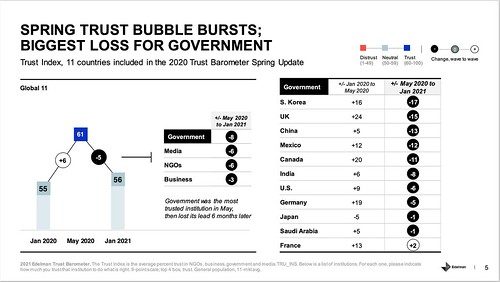
    Edelman released their Trust Barometer, and the findings were ugly for government trust, across most of the countries that they surveyed.

    Government trust down
    2021 Edelman Trust Barometer

    They were also bad for societal leaders as well. Dominic Cummings bizarre behaviour was a question of the wrong thing at the right time and fits into this broader disappointment.

    Societal leaders not trusted
    2021 Edelman Trust Barometer

    Do as I say, not as I do

    Throughout COVID-19; there has been a consistent desire for sufficient lockdowns to get COVID-19 under control. The latest bit of YouGov consumer opinion research still indicates a desire for lockdown to try and control COVID better.

    However, there was evidence as far back as April that the first lockdown instructions in the UK weren’t being adhered to. UCL analysed data from Huq found that the first lockdown lasted just three weeks in areas outside London. News reports and infection rates indicate that the situation maybe similar if not worse this time around. More related content here.

    More information

    Britain on the move even before Johnson eased lockdown, data showFinancial Times (May 12, 2020)

    Most people don’t think the government will meet its 2m a week vaccine target – YouGov (January 7, 2021)

    Edelman 2021 Trust Barometer

    ‘Cummings effect’: why are people bending lockdown rules?The Guardian (January 11, 2021)