Economics or the dismal science was something I felt that I needed to include as it provides the context for business and consumption.
Prior to the 20th century, economics was the pursuit of gentleman scholars. The foundation of it is considered to be Adam Smith when he published is work An Inquiry into the Nature and Causes of the Wealth of Nations. Smith outlined one of the core tenets of classical economics: each individual is driven by self-interest and can exert only a negligible influence on prices. And it was the start of assumptions that economists model around that don’t mirror real life all the time.
What really is a rational decision maker? Do consumers always make rational decisions? Do they make decisions that maximise their economic benefit?
The problem is that they might do actions that are rational to them:
Reducing choice when they are overwhelmed
Looking for a little luxury to comfort them over time. Which was the sales of Cadbury chocolate and Revlon lipstick were known to rise in a recession
Luxury goods in general make little sense from a ration decision point of view until you realise the value of what they signal
Having a smartphone yet buying watches. Japanese consumers were known to still buy watches to show that they care about the time to employers when they could easily check their smartphone screen
All of which makes the subject area of high interest to me as a marketer. It also explains the amount of focus now being done by economists on the behavioural aspect of things.
Bob Cringely was writing about the concept of big sky in one of his recent columns and I thought that it was worthwhile sharing here.
Big sky by Whatknot. (The picture was originally taken in Nevada).
Origins of big sky theory in early flight
Big Sky theory came from early aviation. The main problem pilots faced was crashing into the ground rather than a mid-air collision. There was relatively few planes happening compared to the big sky out there. That meant the odds of collision were so low as to be not worth worrying about.
Or as Cringely put it:
Another version of Big Sky is Inshallah, an Arabic language expression meaning “if God wills” or “God willing.” The term is mentioned in the Quran and Muslims often use it when speaking about future events. Climate change or organized crime or the well running dry or uncontrolled instrument flight won’t negatively affect us if we are on the correct side of God, Inshallah.
Bob Cringely
It was only with the increasing air travel of the mid-1950s that the air traffic controller directed traffic we are used to now came into force. This traffic controller directed process is known as positive control.
Data as antidote
The phrase is used in areas such as environmental concerns around climate change, deforestation or peak oil. It makes the most sense when based on individual empirical experience or opinion. It works really well in rhetoric. Often dangerously so. It is usually countered by the use of data. Data provides qualitative risk calculations. Data is now used to conduct planes along airways one after the other. It is the same with shipping lanes.
From economics to pandemic prevention data based regulation has proved it’s worth.
In essence it represents thinking 180 degrees away from Malthusian ideas. More similar content here.
How does the UK rank as a knowledge economy? – Soft Machines – The big story is the huge rise of China, and in this context, inevitable that the rest of the world’s share of the advanced economy has fallen. But the UK’s fall is larger than competitors (-46%, cf -19% for the USA and -13% for rest of EU) – the definition of knowledge economy used in the research doesn’t play to the UK’s strengths in areas like financial services, education, legal services, accounting services and advertising. But there is no denying the overall pattern, that the UK failed to make the knowledge economy work for it in the same way that China, the US or the EU have managed to do over the last decade
Cultural institutions in crisis | Financial Times – Financial losses from Covid-19 are not the only challenges museums face. Well before the pandemic, environmental and social activists were holding western institutions vigorously to account. Museums were already struggling with issues of diversity — both in staffing and, more importantly, in representation in their collections — the status of objects in those collections and calls for restitution. The situation is further complicated by criticism of many traditional sources of philanthropic funding and ongoing concern for the environment. The Black Lives Matter movement and other world events put a renewed spotlight on racism, illuminating the “white gaze” of western institutions. Even as museums scrambled to promise that change was afoot, they found themselves ensnared in further criticism. “Did our lives matter when you STOLE ALL OUR THINGS?” retorted writer Stephanie Yeboah when Hartwig Fischer, director of the British Museum, tweeted solidarity for Black Lives Matter (paywall)
As Understanding of Russian Hacking Grows, So Does Alarm – The New York Times – By staging their attacks from servers inside the United States, in some cases using computers in the same town or city as their victims, according to FireEye, the Russians took advantage of limits on the National Security Agency’s authority. Congress has not given the agency or homeland security any authority to enter or defend private sector networks. It was on these networks that S.V.R. operatives were less careful, leaving clues about their intrusions that FireEye was ultimately able to find. By inserting themselves into the SolarWinds’ Orion update and using custom tools, they also avoided tripping the alarms of the “Einstein” detection system that homeland security deployed across government agencies to catch known malware, and the so-called C.D.M. program that was explicitly devised to alert agencies to suspicious activity (paywall)
Why 2021 will be a bumper year for M&A | Vogue Business – the big three trends for M&A in 2021: conglomerates looking for an opportunity to consolidate, luxury brands stepping up vertical integration by investing in distressed parts of their supply chain, and a focus on investment in digital expertise and the APAC region. – more luxury related content here.
How “God Makes God” is a 1993 CD ROM about probability, game theory, genetic algorithms, and evolutionary strategies | Boing Boing – I remember having my mind blown by this CD ROM at college. It reminded me of Jostein Gaarder’s book Sophie’s World in terms of its approach to making philosophy entertaining and accessible. I remember reading Sophie’s World around the same time as having played How God Makes God. There was something about HyperCard and the CD ROM authoring tools that followed. Amidst all the brochureware there were creators who drove extraordinary media projects, most notably for me was the game Myst, which I don’t think has been bettered. I suspect part of it was the excitement of new ‘hyper-media’, the limitations of the tools (though 640MB storage at the time seemed vast when I was using an Apple PowerBook 165 with 4MB of RAM and an 80MB hard drive at the time) and the media economics of the time. CD-ROM authoring tools were becoming more sophisticated. CD manufacturing plants were proliferating, lowering the cost per CD ROM disk and CD recordable drives were relatively affordable in the price range of $10,000 – $20,000. Still eye wateringly expensive, but this was a vast improvement from just two years before and allowed for better prototyping, small production runs and testing across devices.
Instacart Is a Parasite and a Sham | The New Republic – The gig economy company, like many of its peers, has seen business skyrocket during the pandemic—while exploiting workers and even failing to turn a profit. That last bit reminds me a lot of the first generation dot com companies who tried to break through the wall of economics and succeed by moving at internet speed. This time they seem to have supplemented the usual ‘throw money at it’ approach with a lack of morality
Regulators tell Jack Ma’s Ant Group to rectify five problems – the five areas included: Ant’s inadequate governance; regulatory negligence; unlawful profit-seeking; monopolistic practices and; infringement of consumer rights, said China’s central bank vice governor Pan Gongsheng.
China orders Ant Group to rein in unfettered expansion as regulators put up fences around financial risks | South China Morning Post – Ant must return to its origins in online payments and prohibit irregular competition, protect customers’ privacy in operating its personal credit rating business, establish a financial holding company to manage its businesses, rectify any irregularities in its insurance, wealth management and credit businesses, and run its asset-backed securities business in accordance with regulations, the People’s Bank of China’s deputy governor Pan Gongsheng said in a statement on Sunday.
Luxury
From TikTok to Depop: Fashion’s new trend funnel | Vogue Business – trends like leather, feathers, neutrals or hot pinks, were relatively easy to follow: the trend funnel moved from runway to rack, with some help from popular culture along the way. This year, Gen Z users on TikTok and Depop jumpstarted a new trend funnel, quickly giving rise to aesthetics like “cottagecore” and “dark academia”, influencing young shoppers’s purchases. “If one of your favourite [TikTok] creators changes their aesthetic due to a particular trend, a whole style can be born out of it,” says Yazmin How, TikTok’s content lead. “The fashion industry is no longer the only voice directing the new season’s trends. People are tapping into TikTok to see what emerging styles are ‘in’ and what previously popular trends are coming back around.” TikTok trends manifest into purchases on Depop, where 90 per cent of users are Gen Z. In step with the rise of the cottagecore trend on TikTok, search for the term on Depop rose 900 per cent between March to August, when it reached its peak. Greater connectivity and increased time at home has boosted the amount of these consumer-led movements, and brands whose aesthetics fit the trends are benefiting, like LoveShackFancy, who specialises in the prairie dresses and gingham blouses associated with cottagecore’s countryside aesthetic – reminds me a bit of the Harajuku trends from the past 30 years. Culture and the trends that come out of it, are now massively parallel in nature
Why Bella Poarch’s “M to the B” video was the top TikTok of 2020 – Vox – TikTok automates the mix of all these topics, going farther than any other platform to mimic the human editor.” At the same time, he says, it’s also “an eternal channel flip, and the flip is the point: there is no settled point of interes t to land on. Nothing is meant to sustain your attention.” The result, he argues, is what essentially amounts to “soft censorship,” or a feed that becomes as “glossy, appealing, and homogenous as possible rather than the truest reflection of either reality or a user’s desires.” How did a perfectly average competitive dancer become the No. 1 internet celebrity in the world? Why did half a billion people watch Poarch’s face bob up and down? Because these two women are the logical endpoint of the world’s most powerful entertainment algorithm: young people centering their conventional attractiveness in easily repeatable formats
Retailing
Amazon and the Rise of the Retail “Sniffer” Algorithm | The Fashion Law – the “sniffer algorithm” – or better yet, “one or more” sniffer algorithms that not only sniff out topics that a speaker is potentially interested in but that also “attempt to identify trigger words in the voice content, which can indicate a level of interest of the user.” For example, as Amazon’s patent application states, “A keyword that is repeated multiple times in a conversation might be given assigned a higher priority than other keywords, tagged with a priority tag.” At the same time, “a keyword following a ‘strong’ trigger word, such as ‘love’ might be given a higher priority or weighting than for an intermediate trigger word such as ‘purchased.’” – when does assistance become creepy?
Insecure wheels: Police turn to car data to destroy suspects’ alibis | NBC News – investigators have realized that automobiles — particularly newer models — can be treasure troves of digital evidence. Their onboard computers generate and store data that can be used to reconstruct where a vehicle has been and what its passengers were doing. They reveal everything from location, speed and acceleration to when doors were opened and closed, whether texts and calls were made while the cellphone was plugged into the infotainment system, as well as voice commands and web histories. But that boon for forensic investigators creates fear for privacy activists, who warn that the lack of information security baked into vehicles’ computers poses a risk to consumers and who call for safeguards to be put in place
Web of no web
Tencent backs Chinese healthcare portal DXY in $500M round | TechCrunch – China has done a lot of work to move towards telemedicine and technology augmented health. Tencent’s WeChat was used by local governments for their COVID certificates, tracking and tracing applications. More Tencent related content here.
Hackers threaten to leak plastic surgery pictures – BBC News – this follows on from the hack on Finnish mental health services. Given the link between plastic surgery and self image; black hat hackers have a lot of sustained leverage. More security related posts here.
Regulators tell Jack Ma’s Ant Group to rectify five problems – the five areas included: Ant’s inadequate governance; regulatory negligence; unlawful profit-seeking; monopolistic practices and; infringement of consumer rights, said China’s central bank vice governor Pan Gongsheng. China orders Ant Group to rein in unfettered expansion as regulators put up fences around financial risks | South China Morning Post – Ant must return to its origins in online payments and prohibit irregular competition, protect customers’ privacy in operating its personal credit rating business, establish a financial holding company to manage its businesses, rectify any irregularities in its insurance, wealth management and credit businesses, and run its asset-backed securities business in accordance with regulations, the People’s Bank of China’s deputy governor Pan Gongsheng said in a statement on Sunday.
The OnlyFans revolution – The Face – Selena suggests we “talk about OF in a way that doesn’t glamourise the economics of the operation”. Instead, we need a more “nuanced conversation about the nuts and bolts of what the actual labour looks like. We aren’t seeing the injustices. It’s either focused on our trauma or on the glamorous hyperbolic examples, while most of us are somewhere in the middle.” There are many sides to running an OnlyFans that are less visible, including work that goes into maintaining a profile and the emotional labour involved in keeping up with fans. Historically, sex workers basically act as ad hoc therapists to their clients – it’s said to come with the territory, from escorting to camming to BDSM. And the “girlfriend experience” applies here too. A key part of the site’s success is one-to-one connection – often creators’ bios will explicitly state they talk with all their followers – for the right brands there is an opportunity for influence campaigns
Looking back at 2020 was based on desk research I undertook at the end of March through to the beginning of May this year for 90TEN; with a healthy dollop of hindsight added.
The first thing that I tried to make sense of was all the noise from experts who claimed that everything was going to change. Clearly that wasn’t going to be the case. But what would elements would be most affected? I narrowed it down to a combination of three factors:
Demand side and supply side economic change
Accelerating trends
Behavioural change
Where you have an intersection of all three, then you are more likely to have lasting change.
Behavioural change on its own won’t work. When we had the Spanish flu, there was a similar level of masking and social separation. But what followed was the hedonism of the roaring 20s. But all three factors together would act as a push-and-pull on sustained behaviour change.
Thinking specifically about acceleration, we saw a number of things happen.
Changes in sectors and practices that would have taken years have taken months. Such as the adoption of remote working practices
Things that were on the edge suddenly became mainstream, like mask wearing that was previously only popular in east asian countries like Korea, Taiwan, Hong Kong and Japan
The rise of e-commerce and food delivery was a classic edge case to mainstream move.
Looking back 2020, one of the topics is the speed of change in circumstances and the relative lack of change in human behaviour. One academic claimed that it revealed what really mattered to a population. Although this misses out that the competency of a government as a key determining factor.
Canvas8 presented a model of human behaviour during an epidemic, which I shared in looking back at 2020. This shaped a key part of my thinking around human behaviour.
Like the grief process, the pandemic human behaviour model starts with denial.
And then anxiety…
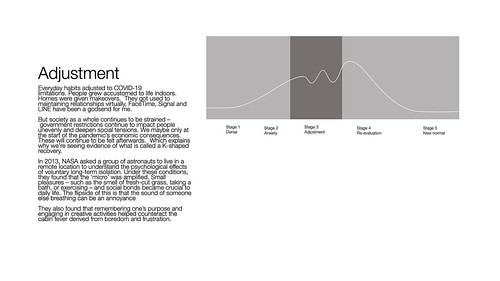
Adjustment is how people have adapted to the circumstances. Society as a whole is still under strain.
Life is reconsidered moving forward, a classic example of this would be the Wuhan EDM pool party held in the autumn.
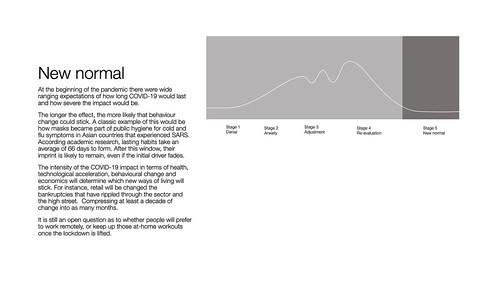
The new normal where COVID-19 is now under control and will have shaped future consumer behaviour.
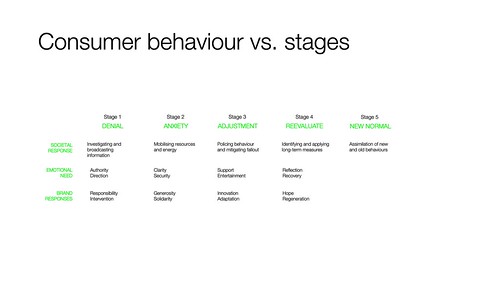
Canvas8 also mapped out likely consumer behaviour against the stages.
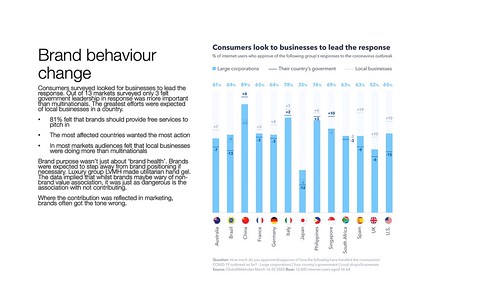
Consumers had a clear view of what they wanted from brands. Brands often struggled to match the expectations of consumers. Dettol’s UK marketing efforts being an exemplary example of how to get it wrong. Looking back at 2020, we had the opportunity to do fantastic marketing work utilising digital and TV platforms, but very little of that opportunity was utilised.
A couple of organisations deserve for their efforts to be highlighted. My former colleagues at LONDON Advertising used their own marketing during the middle of the crisis to demonstrate the power of marketing. Secondly, the IPA ran a sustained campaign in the FT promoting the power of advertising to the c-suite.
The economic factors that will be a driver in societal change, made up the third factor alongside behavioural aspects and acceleration of existing trends.
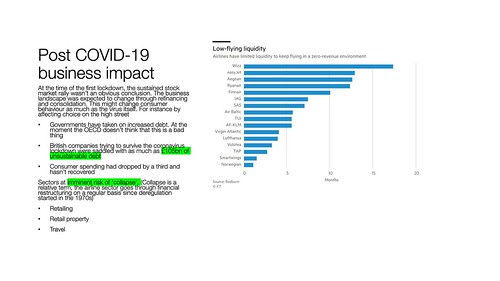
The initial economic forecasts were very negative which drove a ‘correction’ in the stock markets.
Past trends indicate that these kind of crises cause an economic decline that countries bounce back from. However a lot of the change happening is non-COVID related or only tangentially related like China’s escalating trade sanctions on Australia.
Post COVID-19 economic impact is like dropping industry sectors in a time machine. The kind of change that would normally have taken years to run its course has happened in months. What is more worrying is the amount of unsustainable debt that has been taken on board by businesses across sectors. Over time this will benefit larger established businesses over smaller, or newer ones.
I put in an extra section into looking back at 2020 about the young because the insights challenge many of marketers holy cows in terms of views on younger members of society.
Telemedicine attitudes and usage shows that the heuristic of young people being technology adopters doesn’t hold up. Which is usually presumed in sentiment around digital natives.
The resisters shatters a stereotype of young people being progressive, purpose driven people. And they are media literate and media savvy by nature. Yet they are exhibiting behaviours that would be more in tune with older people with reactionary views.
I put in the links to the sources that I mention in the presentation. However I formed my views by looking at much more material. Just over a gigabyte of data sources that relate to COVID-19 which I went through is on Google Drive. Everything from consumer behaviour to economic data is available here. The looking back at 2020 presentation is available for download here. (More on issues related consumer behaviour here.)