Category: jargon watch | 術語定義 | 용어의 정의 | 用語の定義

Jargon watch as an idea was something that came from my time reading Wired magazine. I found that in my work terms would quickly spring up and just as quickly disappear. So it made sense to capture them in the moment.

The best way of illustrating jargon watch is by example. I came across the term black technology through mainland Chinese friends. One of the key things that Chinese consumers think about technology products is the idea of ‘black technology’. This makes no sense to your average western reader. It equates to cool and innovative.

The term itself comes from a superior technology featured in a Japanese manga series plot. As an aside the relationship between Chinese and popular Japanese culture is becoming increasingly attenuated due to Chinese nationalism.

What might be black technology this year might be humdrum in six months as the companies quickly catch up. Black technology is a constant moving target, but generally its sophisticated and likely has a cyberpunk feeling to it.

I keep an eye out for jargon like this all the time, hence jargon watch. I find this content in my professional reading and in the sources that I follow online. What makes something worthwhile to appear here is purely subjective based about how I feel about it and how much I think it resonates with my ideas or grabs my attention. A lot of British youth culture doesn’t make it because it doesn’t have that much of an impact any more beyond the UK.

  • Gray house

    The gray house phenomenon is a fascinating microcosm of urban development. Gray because its a specifically American phenomenon, rather than grey. But some of the aspects of it will be equally familiar to city dwellers elsewhere.

    Gray House
    Photo by massmat

    Quick fix

    The act of painting a brick house is a quick fix by developers, rather like body filler on old car:

    …it’s a cheap, easy way to refresh a brick facade. Many rowhouses in the city are a century old, or close to it, and “you probably don’t want to risk [damaging] hundred-year-old mortar by power-washing,” notes Kevin Wood, a realtor with Slate Properties. Left as is, old brick may appear dingy—especially if the house dates to the era when coal was burned in D.C.—or it will have gaps between courses where the mortar needs repointing, a painstaking repair job. New paint can hide a multitude of small flaws.

    Grayed Expectations | Washington City Paper

    This causes anxiety among people who want to preserve an areas character with soot stained natural brick finish.

    Flip house gray

    Grey was chosen because it was an inoffensive neutral colour that was designed to blend in. Think norm core for house exteriors. Neutral colours are recommended on websites that provide advice to people looking to refurbish and resell a house. But it has come to mark out a home that was painted to sell it, or as one article put it ‘flip house gray’. It stands out in neighbourhoods and provides a visual marker for gentrification. The gray house is either for sale, or a house were people have moved into a neighbourhood.

    More jargon related content here.

    More information here

    Grayed Expectations | Washington City Paper

    What Are the Best Paint Colors for Selling a House? – House Flip Central

    Sherwin Williams Light French Gray SW 0055 – West Magnolia Style

  • Doughnutism

    Doughnutism is a phrase that I found out about from a presentation of Carat’s 2021 trends paper. In the paper itself it is called the donut problem, but when talked about the phrase doughnutism was used.

    COVID-19 has changed behaviours. More people are telecommuting, which has changed people’s travel needs. As a consequence, there has been an uptake in locally bought products and services.

    Carat found data that suggested there was a common phenomenon in multiple cities. Lots of activities on the peripheral, where the bulk of people live, but a sharp decline in footfall in the middle. This would be shops that catered for commuters in central business districts, urban tourist traffic or destination shopping areas.

    This void in the centre is where doughnutism comes from.

    Carat cited CACI research that showed retail footfall returned to only 25 per cent of pre-COVID levels after the spring lockdown was lifted. This was in sharp contrast to the return to pre-COVID levels of activity in residential areas.

    As the report says:

    In a way, it’s the idea of the ‘fifteen-minute city’ brought to life. In Sorbonne University professor Carlos Moreno’s model, people would be able to access everything they need for everyday living within a 15-minute walk and have everything else delivered.

    Carat Trends 2021 – The Year of Emotionally Intelligent Marketing

    There were some indications that local-oriented social media like site Nextdoor rose in user activity. Facebook is developing a competitor. It also offers an opportunity for digital out of home media to thrive.

    Carat thinks that doughnutism will continue. If it does depend on how long COVID lasts and how it affects knowledge workers in the long run. There was a piece in the FT that talked about how creativity might be being adversely affected with the move to remote working.

    Creativity often comes out of having an itch that you can’t scratch. A classic example of that would be the story behind Post-It notes.

    The idea for the Post-it note was conceived in 1974 by Arthur Fry as a way of holding bookmarks in his hymnal while singing in the church choir. He was aware of an adhesive accidentally developed in 1968 by fellow 3M employee Spencer Silver. No application for the lightly sticky stuff was apparent until Fry’s idea.

    9 Things Invented or Discovered by Accident – howstuffworks

    Six years later the Post-it note was brought to market and the rest as they say was history.

    But it can also come out of serendipity, whether its a conversation whilst in the coffee queue or in an ideation meeting. Experiences that Zoom, Microsoft Teams, Slack or Google Duo don’t perform that well.

    “Exposure to new and different experiences — sounds, smells, environments, ideas, people — is a key source of creative spark,”… “These external stimuli are fuel for our imaginations and the imagined, made real, is what we typically mean by creativity.” “Homeworking can starve us of many of these creative raw ingredients — the chance conversation, the new person or idea or environment. Homeworking means serendipity is supplanted by scheduling, face-to-face by Zoom.” “Homeworking can starve us of many of these creative raw ingredients — the chance conversation, the new person or idea or environment. Homeworking means serendipity is supplanted by scheduling, face-to-face by Zoom.”

    Where’s the spark? How lockdown caused a creativity crisis – FT

    This quote was attributed by the FT to Andy Haldane, an economist at the Bank of England.

    A longer term driver of doughnutism in London and other world cities is more likely to be the gradual conversion of office blocks, retail spaces and nightlife venues into investment properties. Many of these investment properties have overseas owners, who leave them vacant rather than living in them, renting them out or doing short term letting (a la AirBnB).

    More jargon watch related content here.

  • Cummings effect

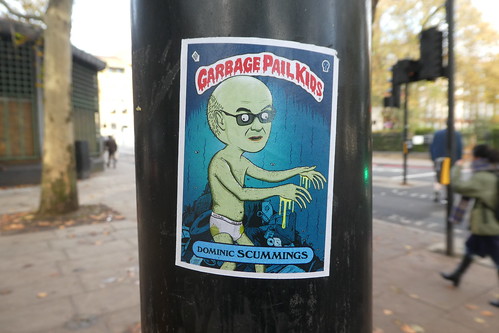
    The Cummings effect was named by The Guardian after former government advisor Dominic Cummings. Now famous for his unorthodox approach to sight tests.

    The Cummings effect describes how consumers have been testing the rules governing lockdown, often ignoring the government’s ‘stay at home’ instruction.

    Dominic Scummings
    Dominic Cummings lampooned on sticker art by duncan c

    “What is happening is people are beginning to flout the rules, they are beginning to think, ‘How can I get away with the rules?’” Paul Netherton, Devon and Cornwall’s deputy chief constable

    ‘Cummings effect’: why are people bending lockdown rules? – The Guardian

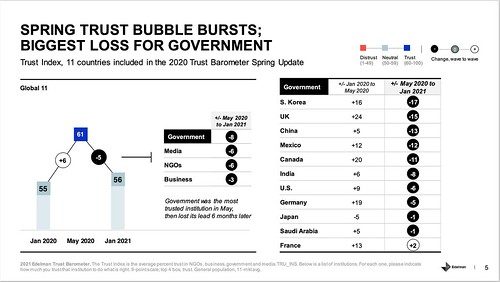
    Cummings effect is part of broader trust deficit

    Edelman released their Trust Barometer, and the findings were ugly for government trust, across most of the countries that they surveyed.

    Government trust down
    2021 Edelman Trust Barometer

    They were also bad for societal leaders as well. Dominic Cummings bizarre behaviour was a question of the wrong thing at the right time and fits into this broader disappointment.

    Societal leaders not trusted
    2021 Edelman Trust Barometer

    Do as I say, not as I do

    Throughout COVID-19; there has been a consistent desire for sufficient lockdowns to get COVID-19 under control. The latest bit of YouGov consumer opinion research still indicates a desire for lockdown to try and control COVID better.

    However, there was evidence as far back as April that the first lockdown instructions in the UK weren’t being adhered to. UCL analysed data from Huq found that the first lockdown lasted just three weeks in areas outside London. News reports and infection rates indicate that the situation maybe similar if not worse this time around. More related content here.

    More information

    Britain on the move even before Johnson eased lockdown, data showFinancial Times (May 12, 2020)

    Most people don’t think the government will meet its 2m a week vaccine target – YouGov (January 7, 2021)

    Edelman 2021 Trust Barometer

    ‘Cummings effect’: why are people bending lockdown rules?The Guardian (January 11, 2021)

  • PDI

    PDI or purpose driven innovation is Trendwatching’s approach to identifying and help clients act on ‘meaningful’ business opportunities. I think its interesting as it captures the aspirations of corporate responsibility professionals in businesses; a case in point being the steady changes that Unilever have made in their business over the past decade or so, like their concentrated aerosol can design.

    PDI factors

    In their own words:

    Make a difference through innovation

    Turn overwhelm into opportunity

    Move from anticipating and meeting customer expectations to setting them

    The principles that it holds itself to are:

    Don’t extract from the earth

    Don’t produce harmful substances

    Don’t degrade nature

    Don’t overwork people (wellbeing)

    Everyone’s voice matters (inclusivity)

    Help people to self-develop (empowerment)

    Don’t discriminate (fairness/justice)

    Celebrate diversity

    While Unilever’s concentrated aerosol can initiative leaves a lighter footprint on the earth, it would still fail on some of Trendwatching’s purpose driven innovation principles. In particular degradation of nature and extracting from the earth, due to its use of aluminium and butane gas propellant.

    The sweet spot for any idea that fits in with their principles is at the intersection of: drivers of change, innovation and consumer basic needs – like most other successful trend driven ideas. At a macro level this net out to accelerating societal and cultural trends that are moving from the edge to the mainstream, behaviour change and both demand and supply-side economics.

    PDI approach examples

    Patagonia’s ReCrafted range is the kind of project that Trendwatching would hope to get out of PDI.

    Patagonia ReCrafted – a classic example of the kind of project PDI should generate

    More design related content here.

    More information

    Unilever shakes up the aerosol world | Packaging World and Unilever’s compressed aerosols cut carbon footprint by 25% per can | The Guardian on Unilever’s concentrated aerosol can design.

    Patagonia Launches ReCrafted, a New Collection of Upcycled Gear | Make Fashion Better – Patagonia’s up cycled clothing range

    More on the Trendwatching approach here.

  • Big sky theory

    Bob Cringely was writing about the concept of big sky in one of his recent columns and I thought that it was worthwhile sharing here.

    Big Sky
    Big sky by Whatknot. (The picture was originally taken in Nevada).

    Origins of big sky theory in early flight

    Big Sky theory came from early aviation. The main problem pilots faced was crashing into the ground rather than a mid-air collision. There was relatively few planes happening compared to the big sky out there. That meant the odds of collision were so low as to be not worth worrying about.

    Or as Cringely put it:

    Another version of Big Sky is Inshallah, an Arabic language expression meaning “if God wills” or “God willing.” The term is mentioned in the Quran and Muslims often use it when speaking about future events. Climate change or organized crime or the well running dry or uncontrolled instrument flight won’t negatively affect us if we are on the correct side of God, Inshallah.

    Bob Cringely

    It was only with the increasing air travel of the mid-1950s that the air traffic controller directed traffic we are used to now came into force. This traffic controller directed process is known as positive control.

    Data as antidote

    The phrase is used in areas such as environmental concerns around climate change, deforestation or peak oil. It makes the most sense when based on individual empirical experience or opinion. It works really well in rhetoric. Often dangerously so. It is usually countered by the use of data. Data provides qualitative risk calculations. Data is now used to conduct planes along airways one after the other. It is the same with shipping lanes.

    From economics to pandemic prevention data based regulation has proved it’s worth.

    In essence it represents thinking 180 degrees away from Malthusian ideas. More similar content here.