Annyeonghaseyo – welcome to the Korean category of this blog. This is where I share anything that relates to the Republic of Korea, business issues relating to Korea, the Korean people, Korean culture and the Korean language.
At the time of writing this category descriptor its been about 10 years since I have last been able to visit Korea. In that time the country has risen on the world stage.
There have been continual disputes with Japan and more recently continual bitter disputes with China. The Japanese disputes are related to history and territory. Korea had been occupied as part of the Imperial Japanese empire. Independence came with the end of the second world war.
The Chinese disputes are more complex. Chinese investors are buying up Korean property particularly in Seoul, Busan and Jeju island, while many Koreans can no longer get on the property ladder. Chinese tourists blitz Korean shops in a similar way to what they’ve previously done in Hong Kong.
Chinese nationalism has seen claims made on Korean cultural assets from the national dress to kimchi. Finally China has interfered in Korea’s efforts to defend itself from the threat in the north.
Often posts that appear in this category will appear in other categories as well. So if Samsung launched a new smartphone that I thought was particularly notable that might appear in wireless as well as Korea. If there is Korean subjects that you think would fit with this blog, feel free to let me know by leaving a comment in the ‘Get in touch’ section of this blog here.
China’s ‘Lipstick Brother’ Livestream Has Record $2 Billion Day – BNN Bloomberg – Beauty livestreamer Li Jiaqi aka Lipstick Brother sold $1.9 billion worth of products in one twelve hour show on Taobao. That’s slightly less than the total sales from all four Selfridges stores during 2019. Lipstick Brother is one of a number of live-streaming sales stars like Mr Bags aka Tao Liang. There are clear parallels between Lipstick Brother and informercial stars on US shopping TV. The reason why live-streaming commerce happened was because of the historic iron grip that the Chinese government has held on TV station. This drove audiences online because the content was that bad and there wasn’t a QVC analogue for the likes of Lipstick Brother to appear on. The key difference is in the breadth of products that Lipstick Brother and his peers sell, Lipstick Brother and Mr Bags work with topline luxury brands in their respective categories rather than mid-market brands. It is interesting that Lipstick Brother has managed to survive the communist party’s purge from public life of sissy men across off-line and online media.
China cuts finance pledge to Africa amid growing debt concerns | Financial Times – Chidi Odinkalu, senior manager for Africa at the Open Society Foundations, said the reduced financial pledge showed that Beijing no longer had to try so hard in Africa. “China’s strategic objective was to get a foot in the door. Now that it’s in the door, it can choose to dictate the terms,” he said. He criticised some African governments for relying too heavily on loans from Beijing. “The volume of credit that some of them have binged on makes them dependent beyond any sensible notion of sovereignty,” he said.
South Korean presidential hopeful plays down reunification with north | Financial Times – South Korean ruling party’s candidate for president has downplayed the prospect of the future reunification of the Korean peninsula, as the country’s voters tire of decades of fruitless diplomacy with the North. Lee Jae-myung of the progressive Democratic party, whose manifesto includes a commitment to “seek unification through peaceful measures”, told reporters on Thursday that competition between the two Koreas in terms of ideology and efforts to prove the superiority of each system “has no meaning” and did not offer the prospect of “real gains any more” – potentially a big move from the Moon regime position, also probably linked to a more hawkish position on China
Macau casinos gamble on relations with Beijing | Financial Times – casinos increase the shareholdings held by Macau permanent residents. A speedy public consultation has ended and business is waiting for the final law to be put to the legislature, a process that is also expected to determine how many of the casinos have their licences renewed, and for how long. The situation is particularly troubling for the three Macau casino groups that are largely US-owned: Las Vegas Sands, founded by the late Sheldon Adelson, MGM and Wynn operate nine resorts in Macau, and their local subsidiaries are listed in Hong Kong. Local operators Galaxy Entertainment, the late Stanley Ho’s SJM Holdings and Melco, which is dual-listed in the US and Hong Kong, also hold concessions – guessing that this adds pressure on gaming operators to try and put pressure on the US government rather like Wall Street does for China
Luxury Stores Across the US Hit By Mass Heists in the Same Week – Robb Report – this sounds like a classic example of steaming. Steaming is a British phrase describing the phenomenon of shoplifting, when a large group of (usually youths) enter a store en masse and engage in shoplifting. Steaming puts a strain on shop security, it often causes panic in the store and creates so many suspects for the police to chase down. For the shoplifters steaming reduces the individual risk of getting caught. In large department stores, steaming becomes easier because of the number of exits. There are usually enough people involved to push past hastily set up security checkpoints during steaming. Young people are particularly attracted to steaming for a couple of reasons:
Low risk, high reward
Low impact of criminal penalties for many depending on their age
Peer pressure from other older members organising the steaming group
When I was in secondary school, we had a trip to Paris. A good number of peers one day engaged in steaming. They managed to make off to a large amount of Lacoste and Sergio Tachini sports clothing which was popular in Merseyside at the time. Steaming was also a central part of football casual culture. Much of the sportswear back in the 1980s were fenced goods. Criminal gangs followed European football games and practiced steaming in the lead up to a match at major department stores across France, Spain and Italy. The items were then sold on to groups of football fans back home through informal networks. What surprised me about this group doing the steaming was the nature of their crime. They were steaming boutiques, which have less entrances and exits than department stores. Boutiques often have queues of people to get in and security on the doors that would be bad for practicing steaming.
So what went wrong with store security to prevent steaming? Has steaming been facilitated by a cut back in security for cost cutting purposes? If so, will insurance companies honour losses incurred through these steaming attacks?
Beauty
Prestige beauty: Inside Unilever’s growth engine | Vogue Business – Dana Kreutzer, project lead for beauty and personal care at US research firm Kline, says the acquisition “demonstrates the company’s focus on expanding its portfolio to include more digitally-led brands and clinical-grade skin care, which is a fast-moving segment in the skincare space”.
Opinion | We Spent a Year Investigating What the Chinese Army Is Buying. Here’s What We Learned. – POLITICO – the Chinese military is “intelligentizing” warfare by purchasing AI systems for all manner of applications, including autonomous vehicles, intelligence analysis, decision support, electronic warfare and cyber operations. At the same time, we found reason to be skeptical of the most ominous predictions about China’s efforts to fully automate warfare through “doomsday”-like weapons. Perhaps most importantly for U.S. policymakers, our investigation into the PLA’s buying habits shows how Chinese progress in military AI is being driven, in part, by access to American technology and capital. Our report highlights the critical role U.S. companies play in supplying China with data, software and funding. This points to serious shortcomings in the U.S. export control system, which wasn’t built to screen the high volume of technology transfer and capital flows into China, and which struggles to distinguish between military and civilian purchasers. Even as the United States attempts to decouple supply chains from China when it comes to American goods, it also needs to consider new strategies to prevent American know-how from inadvertently powering China’s technological advancements
In the Russian Arctic, China treads on thinning ice | China Dialogues – In order to reach its goal of becoming a ‘polar great power’ China will need to lessen its dependence on Russian support and expand its economic and political ties with other Arctic states. This may present Arctic states with an opportunity to set limits on China’s regional influence, but the benefits of any such limitation must be measured against the importance of giving China a stake in the fight against climate change. In the traditionally calm waters of the Arctic, China’s ‘Arctic Policy White Paper’ made much of a splash when it was first released in 2018. The paper showed, as was argued at the time by politicians and pundits, that Beijing would seek to establish itself as a new Arctic power, and in the process deprive the eight Arctic states of their control over the region’s abundant natural resources
Solomon Islands PM Manasseh Sogavare faces calls to resign over China diplomatic ties | South China Morning Post – The protest began peacefully, but schools and businesses were shut by the afternoon as crowds tried to enter parliament demanding PM Manasseh Sogavare step down. Protesters were angry about lack of promised development and the Solomons government’s 2019 decision to cut ties with Taiwan and establish a formal relationship with China – the big question is what will China do to keep Sogavare or his party in power and maintain the status quo?
Secret Chinese Port Project in Persian Gulf Rattles U.S. Relations With U.A.E. – WSJ – U.S. intelligence agencies learned this spring that China was secretly building what they suspected was a military facility at a port in the United Arab Emirates, one of the U.S.’s closest Mideast allies, according to people familiar with the matter
Is the China-Europe Express becoming a political weapon in the hands of China? | RailFreight.com – China launched the Belt and Road initiative with the purpose to enhance Eurasian transport links. It includes Chinese cities, transit countries through Asia and European destinations. Understandably, such a vast investment from the Chinese side, including involvement in other countries’ economies, could constitute a political and economic hazard. Maja Bakran Marcich, the Deputy Director-General for Mobility and Transport at the European Commission, had warned some months ago that good synergies between Europe and China should be characterised by mutual respect and control over the power relations.
It seems that when Marcich was saying that, she had a similar situation in mind. The New Silk Road is a crucial and fast-developing part of the global supply chain, putting rail freight at the forefront of transportation. However, it looks like it has the possibility of becoming a dangerous card on the table of diplomatic and political games. Should China have the liberty of just cancelling Eurasian train services in the name of political disputes? And shouldn’t the New Silk Road focus only on transportation purposes?
Chinese doctors query Beijing’s Covid contact tracing policy | Financial Times – the way that the Chinese government is going about it fits in with the concept of struggle in Stalinist thought. That the struggle is not only done but seen to be done. The doctors challenge therefore represents a much more profound dissonant voice against the CPC than the content in the article suggests. For this reason alone, they’ll likely spend some time down at the local public security office sitting in a tiger chair and agreeing to sign a document apologising. They will also have earned a huge black mark on their credit score at the very least.
Kevin Rudd: “China views the UK as weaker after Brexit” – New Statesman – three core ideological undercurrents that form Beijing’s economic and foreign policy. First, China’s domineering relationship with its neighbours is shaped by its perception that it sits atop a regional hierarchy rooted in its imperial past. Second, the Chinese Communist Party’s Marxist-Leninism results in the dual conclusions that China’s time has come and the struggle between reactionary and progressive forces places China in opposition to the United States. The third undercurrent is national reunification with Taiwan – what Rudd describes as the central organising principle of China’s plans for East Asia first and then globally. Hence China’s work in the Antarctic and inserting itself as an Artic power without any semblance of claims.
China Is Jihadis’ New Target – In early October, an Islamic State-Khorasan bomber killed nearly 50 people at a mosque in Kunduz, Afghanistan. That the militant group claimed responsibility for the attack wasn’t surprising, but, in a worrying new twist for Beijing, it also decided to link the massacre to China: The group said that the bomber was Uyghur and that the attack was aimed at punishing the Taliban for their close cooperation with China despite its actions against Uyghurs in Xinjiang. China was long seen as a secondary target by international terrorist organizations. Groups like al Qaeda and the Islamic State were so focused on targeting the United States, the West more generally, or their local adversaries that they rarely raised their weapons toward China, even though they may have wanted to due to, for example, China’s mistreatment of Uyghur Muslims. But in Kunduz, this narrative was brought brutally to a close. China can now consider itself a clear target. – probably more worrying for China is the risk that this kind of action will pose to them in other geographies like the Middle East and Africa and along the parts of the belt and road that go through restive muslim majority regions of the former Soviet Union
Why Is Gen Z Acting Like Boomers Right Now? – Gen Z’s frantic, chain email-flavored TikToks prove naivety and gullibility is ageless. Not surprising given the younger cohorts in the resistor segment of COVID regulation compliance that research by Kings College London found last year.
Chinese parents find new ways to give their children an edge | Financial Times – parents have been seeking new ways to give their children an edge in the cut-throat university entrance examinations. Instead of signing up for foreign language classes, barred by the regulations, parents instead opt for non-core curriculum subjects like art, which are taught in English, says Ekaterina Kologrivaya, co-founder of Edtech Expand, a Beijing-based consulting start-up. Many of the large tutoring companies have closed their physical classrooms, transferring online to save costs. But Beijing barred local firms from hiring tutors located overseas, driving up demand for the depleted number of foreign teachers in China, unable to get into the country due to strict border controls. This has pushed up the prices of classes taught by foreigners, including debate classes, another crafty way for students to master prized English skills while abiding by the new rules
Is China’s catch-up growth over? – by Noah Smith – Noahpinion – But all things come to an end. Every other spurt of rapid development has eventually slowed to the stately pace of a mature economy. There are basically two reasons this happens. First, as you build more physical capital — more buildings, roads, railways, machine tools, vehicles — the added output of each new piece of capital goes down, while the upkeep costs just keep rising. This is the basis of the famous Solow growth model, and we’ve seen this happen again and again to fast-developing countries. The second reason rapid growth peters out is that it’s easier to copy existing technologies from other countries than to invent new ones yourself. The real question is when this slowdown happens. Japan’s history provides an interesting example here. Here’s a graph of Japan’s income per capita (at purchasing power parity) as a fraction of America’s: You can see that Japan’s catch-up (at least, post-WW2) really happened in two phases. There was rapid catch-up until the early 1970s, then a few years where catch-up paused, then a resumption of catch-up at a slower pace for about 15 more years. After the bursting of the country’s famous land bubble, its economy actually lost ground to the U.S. (rapid population aging was also a big part of this), and settled in at around 75% of U.S. levels (fairly standard for a medium-sized developed country). Economists have found that this pattern is very typical. In a pair of famous papers in 2012 and 2013, Barry Eichengreen, Donghyun Park and Kwanho Shin found that fast-growing countries tend to slow down when they reach a certain income level – peak China
Finance
The ‘Tesla-financial complex’: how carmaker gained influence over the markets | Financial Times – the real importance and wider footprint of what might be called the “Tesla-financial complex” far outstrips the company’s market capitalisation. This is thanks to a vast, tangled web of dependent investment vehicles, corporate emulators and an enormous associated derivatives market of unparalleled breadth, depth and hyperactivity. Combined, these factors mean Tesla’s influence over the ebb and flow of the stock market is far greater than even its size would imply. It may even be historically unrivalled in its wider impact, some analysts say – is there a market squeeze opportunity? The parallels with Porsche in this regard are striking
Close Reading of the QAnon Shaman’s Conspiracy Manifesto ‹ Literary Hub – the legitimate skepticism inspired by historical events like the assassination of JFK (and the Warren report’s open-and-shut verdict on it) has mutated into a toxic skepticism that is not only hostile to government institutions but has turned on gatekeepers like the press, scientists, and medical authorities, provoking an epistemological duel to the death over facts and alt-facts, truth and truthiness. The effect of these attacks and counterattacks is “mutually assured disqualification,” Bratich argued, in a 2017 lecture, punning on the Cold War doctrine of Mutually Assured Destruction. And the effect of that is what could be called epistemological vertigo—the pervasive sense of not knowing how to sort fact from falsehood; of being unmoored from the truth. It’s what makes so many grab onto the reassuringly black-and-white theology of conspiracism. And it is a theology, Manichean in its cosmic struggle between good and evil, apocalyptic in its conviction that we’re living in the end times. “There is a war on humanity, there is a war on religion, there is a war on human assembly,” said Naomi Wolf, on Fox News Primetime. “Big Tech wants to drive everyone indoors and dissolve the bonds between people.” – interesting, though the writer shows their own belief in conspiracy theories
Carbon Counter/EVs: cleaner electricity makes a big difference to emissions | Financial Times – In the UK, US and Germany such vehicles offer large emission reductions of 76 per cent, 60 per cent and 49 per cent respectively when run on the typical mix of power sources in mains electricity. Germany’s poor performance reflects its exposure to dirty lignite and coal as fuels. Hydroelectric-dependent countries such as Norway do strikingly better. However, a much smaller reduction in emissions occurs in China, at less than a fifth. China has the biggest market for plug-in cars. Fully electric vehicles accounted for 9 per cent of its entire market in the first half of this year, more than double the figure for 2019. Every year it adds more solar power capacity than any other nation. But as of November 2020, two-thirds of China’s electricity came from coal-fired generation, says the IEA. China’s huge appetite for coal means it plans to add almost a fifth to its coal-powered generation capacity of more than 1,000GW.
Disney CEO: We’re Ready for a Metaverse Future – The Hollywood Reporter – “Our efforts to date are merely a prologue to a time when we’ll be able to connect the physical and digital worlds even more closely, allowing for storytelling without boundaries in our own Disney metaverse, and we look forward to creating unparalleled opportunities for consumers to experience everything Disney has to offer across our products and platforms, wherever the consumer may be.”
This presentation on South Korea was done before Squid Game took off on Netflix. South Korea can enhance and leverage its soft power in fields such as K-pop, soap operas, movies, video games, contemporary art, sports, education, business, and technology. Geography dealt Korea a poor hand as it historically has been invaded by China and by Japan. South Korea now has the economic and cultural resources to produce significant soft power, allowing it to design a foreign policy that will give it a larger role in global governance. South Korea today has an unparalleled opportunity to expand its international influence in ways that would have been unimaginable just a generation ago. Scholars, journalists, authors, industry leaders and other leading experts join us for sessions to raise the level of understanding of South Korea’s soft power and analyze the role of soft power in the context of U.S.- ROK alliance while offering suggestions for how Korean soft power can be used to broaden and strengthen the alliance.
Rush Doshi
Rush Doshi, former director of the Brookings China Strategy Initiative and a former fellow in Brookings Foreign Policy, and Michael O’Hanlon, director of research in Brookings Foreign Policy, followed by a panel discussion with experts who focused on analysis concerning the U.S.-China relationship and China’s grand strategy. This was to mark the launch of Doshi’s book The Long Game.
Dasani UK case study
One of the first posts I wrote on this blog was about Dasani which was in reaction to one of the stories that run about the brand in the media. Dasani is a bottled water brand owned by Coca-Cola; it is similar to Watson’s Water in Hong Kong and Singapore. It is processed and purified, rather than being a natural spring water. Tom Scott does a complete run down of the history of Dasani in the UK.
Shanghai Animated Film Studio
Shanghai Animated Film Studio has made films from world war two to the present day. The golden age for the studio was between the 1950s when they experimented with films using Chinese art techniques to the cultural revolution. Havoc in Heaven draws on Peking Opera.
There is heat starting to generate (finally) behind RISC V: Marvell founders back data centre RISC-V chiplet startup | EE News Europe and Apple is doing their due diligence with a RISC V code port: Apple is Reportedly Designing Various Embedded Subsystems across all Operating Systems using RISC-V – Patently Apple – is now exploring and developing various embedded subsystems across all Operating Systems using RISC V. The emerging Open Source RISC V architecture is now being used by companies like Nvidia, Google, Oculus, Qualcomm, Rambus and others for IoT devices to supercomputers, smartwatches and autonomous vehicles. Amazon and Alibaba are currently designing their own cloud and data center chips. This week Apple was shown to be recruiting RISC V “high-performance programmers. More specifically, Apple is currently seeking out experienced programmers with detailed knowledge of the RISC V instruction set architecture (ISA) and Arm’s Neon vector ISA for the Vector and Number Group (VaNG) of its core operating system group. Apple’s VaNG is responsible for the development and improvement of various embedded subsystems running on iOS, macOS, watchOS and tvOS. – Not surprising that Apple will be keeping its options open for porting across architectures including RISC V, like it did with Intel and ARM respectively. Apple has taken a similar approach for decades. Apple had the Rosetta Stone version of Intel instructions years before it moved the Mac to Intel. RISC V came out of a research requirement for an open-source computer system and was started in 2010. RISC V was originally thought of as a fun 3 month research project… RISC V designs and specifications were released under a BSD and Creative Commons licence. The foundation overseeing RISC V is based in Switzerland to get around US trade sanctions against potential adoptees like China (or North Korea)
Australia’s education industry facing US$15 billion loss as frustrated, worried students ponder futures | South China Morning Post – Australia’s international education sector was worth around A$40 billion (US$29 billion) in 2019 before the coronavirus pandemic. But students, the majority who come from China, are considering their options as Australia’s borders remained closed – on balance this could be good for Australia as it would also remove a lever of soft power that China has in Australia with subverted academia. This also makes you wonder about the craven nature of UK universities: Universities hire planes to fly in China students | News | The Sunday Times – There are about 220,000 Chinese students studying in the UK. Across the Russell Group, one in every ten students is Chinese, and they provide nearly a fifth of all tuition fee income, worth an estimated £1.3 billion every year. In Glasgow, about a third of the university’s tuition income comes from Chinese students. At Liverpool University, one in five of its students in 2019 was Chinese — these 5,550 students were worth an estimated £90 million to the university. Experts warned that universities were at risk of overlooking the needs of British youngsters as they fretted over the potential loss of fee income from their overseas students, who pay up to £35,000 a year in fees, nearly four times the fees paid by their British counterparts
China Evergrande bonds suspended as prices plunge | Reuters – The Shanghai Stock Exchange said in a statement that it had temporarily suspended trading in China Evergrande Group’s 6.98% July 2022 corporate bond following “abnormal fluctuations.” The exchange had also suspended trading in the bond on Friday. Shanghai exchange data showed the bonds sliding more than 25% to a low of 40.18 yuan after the resumption of trade on Monday afternoon. The company’s 5.9% May 2023 Shenzhen-traded bond , which was also suspended, fell more than 35% after trading resumed – read with Soho China shares plunge 40% after Blackstone deal collapses | Financial Times – this isn’t just about a property sector rout, but also about the founders wanting to be independent of China moving forwards
In the driver’s seat: China’s electric vehicle makers target Europe | Merics – Government subsidies for China-based manufacturers could distort global markets. That China has become the leading EV market is the result of substantial government support. But Chinese exports are also directly supported by central and local governments sponsorship of new production plants, R&D centers and overseas acquisitions
A Generation of American Men Give Up on College: ‘I Just Feel Lost’ – WSJ – At the close of the 2020-21 academic year, women made up 59.5% of college students, an all-time high, and men 40.5%, according to a Wall Street Journal analysis of enrollment data from the National Student Clearinghouse, a nonprofit research group. U.S. colleges and universities had 1.5 million fewer students compared with five years ago, and men accounted for 71% of the decline, the Journal analysis found. – this looks like a political and demographic time bomb waiting to go off. Think about the potential wasted at a time when the US needs more engineers, technologists and innovators of both genders. The deficit of hope scares the crap out of me and should scare you
Culture
Taste of the East: How The British Fell In Love With Chinese Cuisine | Newham Chinese Association – Until the 1940s, the majority of customers in the restaurants were not English but Chinese immigrants. In the aftermath of World War II Chinese food began to grow in popularity. British servicemen returned from various parts of the Empire and the Far East with a willingness to try different foods and cuisine and a new enthusiasm for Chinese food and restaurants. This in turn saw the rise of the restaurant trade in Soho. Chinese people entered the catering trade because of the downturn in shipping and the closing of laundries, traditional areas of employment. In the 1950s and early 1960s there was an influx of Chinese from Hong Kong who provided the necessary workforce. The restaurants served Cantonese food because of Britain’s old colonial links to Hong Kong
Is China uninvestable? | Financial Times – The problem the party has to solve is almost the opposite: investment is so high that much of the capital is malinvested. As a result, debt is growing faster than gross domestic product. The irrelevance of foreign investors to China key problems doesn’t mean Chinese stocks might not go up, “but you have to get both the valuations and the politics right, and that’s just really hard” – soft innovation and rent seeking investments versus the hard innovation desired – Cathie Wood’s Ark cuts China positions ‘dramatically’ | Financial Times – I think strategic alignment wit CPC agenda is a greater predictor than how much of a sycophant the company has been, which is what Ms Woods relying on
Galway in line for Intel megafab | EE News Europe – A former military firing range in Oranmore near Galway in the west of Ireland is the Industrial Development Agency’s “preferred site” for an Intel chip foundry that would employ 10,000 people, according to reports. This is more than twice the 4,900 people Intel employs at its established facility in Leixlip, Ireland on the outskirts of Dublin. Pat Gelsinger, Intel CEO, visited Leixlip last week and met with Ireland’s prime minister, Taoiseach Michael Martin. The site in Galway is a 216-hectare rifle range, owned by the Irish Department of Defence. The project would involve the building of eight factory modules on the campus, the reports said
South Koreans sour on China ahead of Wang Yi visit – Nikkei Asia – Survey results released in June by Sisain, a current affairs magazine, and pollster Hankook Research indicate a souring of South Korean public opinion toward China, particularly among the young. Only 26% of respondents had warm feelings toward China, compared with 57% who felt warmly toward the U.S. Even Japan, South Korea’s traditional rival, came out ahead of China with 28%. “Dislike of China is arguably emerging as the spirit of our times,” Sisain wrote in an accompanying article. “The question ‘what kind of country is China to us?’ is changing to ‘why and how much do we dislike China?”
The four fashion personas of China’s Gen Z | Vogue Business – Despite the youthfulness of Gen Z consumers, their understanding of fashion and luxury culture is as mature as older generations. – there is so much in the way that they picked their sample which makes this research something to be approached with caution. Shanghai is not representative of high growth lower tier markets. Gen Z believes that to qualify as true luxury, a brand needs more than high price points, heritage and craftsmanship. It must also convey an elevated sense of aesthetics, with unique qualities and character. – and this has been an issue that luxury brands have been struggling with. Male Gen Z shoppers are outspending women by 20 per cent on fashion and luxury goods. Not every Gen Z consumer in China is obsessed with celebrities and influencers. – this surprised me as many men are having to save up to impress their girl and get the requisite items needed for a partner to say that they would marry you. The men surveyed are likely to be princelings. Interestingly, many Gen Z are critical of them and the culture that surrounds them. – this mirrors the wider Chinese government criticism of culture. More sophisticated marketing campaigns may, therefore, work effectively with Gen Z shoppers. For example, they appreciate exhibitions that mix brand stories with art and culture. They also like brands with creative crossover collaborations. Finally, they appreciate word-of-mouth recommendations from friends and families. Among those celebrities who do impress Gen Z, the key names include Yibo Wang, Mi Yang, Wen Liu and Yangqianxi Yi (also known as Jackson Yee). Key opinion leaders (KOLs) include Mia Kong and Fil Xiaobai.
Chinese star calls time on Swiss watch brand after CEO says Taiwan is a ‘country’ | South China Morning Post – Audemars Piguet CEO referred to Taiwan as ‘a very tech-oriented country’ in a video conversation months ago. Actor-singer Lu Han and team had wanted the watchmaker to apologise on global platforms in Chinese and English – effeminate looking showbiz star tries to save career and look masculine by leaning into Chinese nationalism
Chinese debts unravel historic fashion stores | Business | The Times – Troubles in China are putting some of the oldest names in British fashion in a precarious position, with Aquascutum quietly pulling out of the UK entirely and Gieves & Hawkes battling a winding-up order. The trenchcoat maker and the tailor are owned by Shandong Ruyi, which has come under increasing pressure over its bloated $4 billion debts after an acquisition spree intended to turn it into China’s answer to LVMH, the French luxury goods conglomerate
Hong Kong media group Next Digital says it aims to wind down, board quits | Reuters – the Hong Kong government has never indicated which articles published by Apple Daily allegedly violated the national security law, and the uncertainty created a climate of fear, resulting in many resignations including those responsible for the regulatory compliance duties of the publicly traded company. “We observe that the events affecting the company and its people following the invocation of the National Security Law occurred despite there having been no trials and no convictions,” it said. “Under this new law, a company can be forced into liquidation without the involvement of the courts.” “As Apple Daily often observed, Hong Kong people have a collective memory of what life was like elsewhere when freedom of speech was denied: No other rights are safe” – the Hong Kong government response to this was Kafta-esque
China uses anti-fraud app to track access to overseas financial news sites | Financial Times – The app was launched in March by the public security ministry’s National Anti-Fraud Center and blocks suspicious phone calls and reports malware. Police said it was needed to combat a surge in fraud, often perpetrated by overseas operations managed by Chinese and Taiwanese nationals. The ministry recommended that the app was downloaded but numerous local government agencies made it mandatory for their employees and individuals with whom they work, such as students and tenants. One Shanghai-based user told the Financial Times he was contacted by police after accessing a US financial news service. He was also asked whether he had contacts abroad and regularly visited overseas websites. The user, who asked not to be identified, said police seemed genuinely concerned about foreign scams. “But the questions they raised about whether I have contacted foreigners made me feel like they don’t want me accessing foreign websites,” he added. “I deleted the app after the meeting.” A second user in eastern Shandong province said police called him on four consecutive days after the app showed he had visited what it labelled “highly dangerous” overseas information providers, including Bloomberg – if I was Bloomberg or the FT Chinese service I would be concerned
Typical CVS Shopper Is Urban Gen Xer, Earns High Income – In addition to OTC pain medication and cough remedies, the typical retail shopper often prefers to buy candies, chocolates, and bottled water. Their favorite sweets brands at CVS are M&M’s and Reese’s, and they also buy a lot of Hallmark cards. Just 1.6% of a CVS shopper’s total dollars are spent at CVS, compared with 6.8% of their spending on Amazon. At other retailers, the CVS shopper buys more fresh garlic, hand sanitizer, bar soap, and non-dairy milk alternatives than the national average shopper. They’re also big fans of fast-food chicken nuggets
Pro-China misinformation operation attempting to exploit US Covid divisions, report says – CNNPolitics – worth while reading Reuters take as well – Pro-China social media campaign hits new countries, blames U.S. for COVID | Reuters – synopsis from the China Research Group: According to research published on Wednesday by Mandiant and Alphabet’s Google unit, thousands of accounts across dozens of social-media platforms—including Facebook, YouTube and Twitter —and online forums have urged Asian-Americans into the streets to protest against racial injustice in the US. The network of fake social media accounts is “almost certainly supported by a government sponsor, either directly through a government agency or a third-party contractor”.
China Is OK With Interfering in Guinea’s Internal Affairs – the inconsistency it demonstrates—nonintervention but only when it works for China—risks undermining the validity of China’s promises to potential partners, among whom only the “irredeemably corrupt or terminally naive” take Beijing’s “win-win” rhetoric seriously. Indeed, Beijing’s mercurial wielding of noninterference risks further exposing the ugly underbelly of China’s fiercely realpolitik foreign policy. China’s pitch to leaders the world over is straightforward: Beijing offers vast sums of development funds (and political support) and expects certain goods—natural resources, ports, military bases, and international political support—in return. Many developing world leaders sign up for this bargain not out of authoritarian solidarity but for Chinese money; it solves problems, and there is no obvious Western alternative. Where poverty and underdevelopment are the most pressing issues, leaders will not say “no.” But with Chinese money, leaders often lean more autocratic – coup messed with China’s access to bauxite (which it doesn’t want to buy from Australia) and its ability to make aluminium which is a strategically important metal
Why 5G may be taking longer than we thought – Arup – roll-out of 5G networks commenced in earnest in 2019, and is now well underway in many countries, this is largely being driven by the commercial mobile network operators. This has led to a focus on serving major cities and towns, where the service is deemed to be commercially viable and attractive to do so. In addition, much of the focus of these deployments has been on delivering enhanced mobile broadband use cases for public consumers (such as high definition video streaming, VR/AR and gaming). The focus isn’t initially on delivering the lower latency and higher network reliability that would be needed for industrial automation and autonomous vehicles
ABC the American network broadcast brand has had its logo redesigned. Like some of the best design in corporate American the logo owes its roots to designer Paul Rand back in 1962. It went colour when TV broadcasting did and went skeuomorphic web web 2.0 and early versions of iOS were in vogue.
ABC logo redesign
The design has gone flat again, very close to Rand’s original design with slight changes in the proportions of the letters. This will work for everything from station ID and watermarking to app logos. You can read more on the ABC logo redesign at Variety.
Shang Chi
Shang-Chi is a character that Marvel came up with with the kung fu craze started to kick off in the early 1970s. Originally his power was derived from his father being Fu Manchu.
The Castle of Fu Manchu
Dr Fu was invented as a character in the early 20th century as a kind of super villain in the mood of Marvel or James Bond films. He predated Marvel but appeared in the origin story in a Wold Newtonesque way. It tapped into stereotypes around yellow face portrayals of Chinese culture, eastern devilry and unemotional cruelty. Themes of orientals invading the west and white slavery came up in the books and films.
Marvel have since had to rewrite the origin story considerably for Shang Chi as they want to sanitise the original racist back story. Dr Fu becomes Xu Wenwu. Marvel managed to get Hong Kong cinema’s equivalent of Cary Grant or George Clooney Tony Leung Chiu-wa aka ‘small Tony’ to play Xu.
Despite all that work the Marvel film may not open in China at all. A straw poll of Asian friends found that the costumes felt ‘dated’ in comparison to local dramas and films of a martial arts fantasy or ‘wuxia’ style.
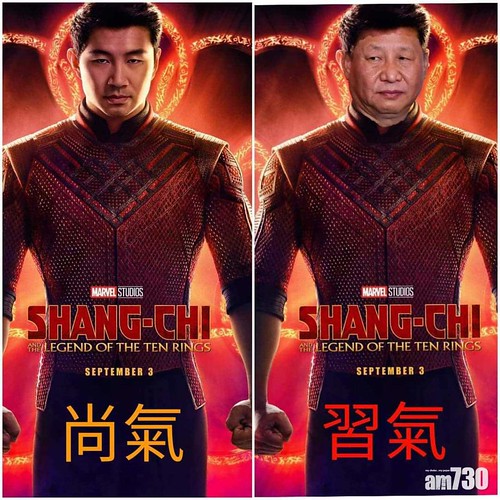
The veteran Hong Kong actors outshone the ‘heroes’. The main hero was ‘ugly’ and looked like a young Xi Jingping.
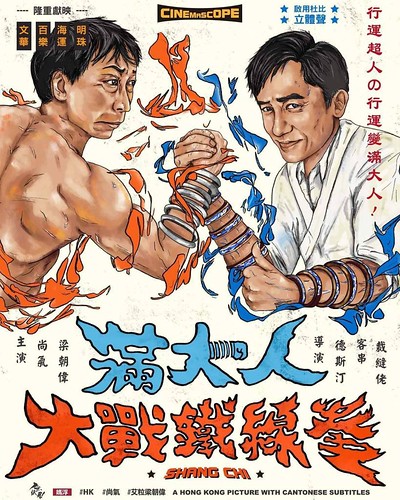
Iron rings are generally used for training in martial arts, in a similar way that a runner may run with ankle weights to build strength. There have been a few films where the rings became an offensive weapon notably Kung Fu Hustle, which got memed. (They are also used for fighting in the Return Of The 5 Deadly Venoms – you have to be a fan of cult kung fu films to be familiar with them. Iron rings appear as part of the training regime in Drunken Master & The 36th Chamber of Shaolin. )
D.P.
Netflix have had a ht on their hands with D.P. (Deserter Pursuit) – Korean soldiers tasked with tracking down deserters who have left the army during their conscription period. The series seems to have struck a nerve with the armed services who denied that the bullying shown in the show is tolerated any more.
But the media has plenty of conscripts willing to admit that it has and was even worse in real life.
Lady Dior bag
The Lady Dior bag is an iconic design for Christian Dior. It appears year after year in their range. It was made famous by Princess Diana. Back then it was called the Chouchou. Confused yet? You can see the bag being made from lambskin leather by hand in this video.
The bag is built around a last like a shoe, the last has a split in it, which I think is designed to aid its removal from the bag at the right time. More related content here.