Over the space of 20 years, luxury changed enormously. The Japanese had been a set of new consumers for luxury, but in terms of numbers they hadn’t eclipsed the US as the biggest market for luxury.
China’s ascent into the WTO (World Trade Organisation) made a lot of business people and politicians a lot richer. China challenged the US in terms of luxury market size. On their rise, Chinese consumers changed a lot in their sophistication as they educated themselves on luxury consumption.
These new consumers picked up new traits such as wine drinking. This also meant that luxury goods became new asset classes as Chinese money looked to acquire only the best. Chinese culture in turn impacted luxury design. Chinese new year became more important than Christmas.
Then there was the second generation money. Young rather than old consumers. Consumers who were looking for something less formal, either because they didn’t wear anything but streetwear or they worked in the creative classes rather than the traditional professions and high finance.
The industry had traditionally avoided rap artists and R&B singers, now Jay Z and Beyonce are the face of Tiffanys and Fendi had collaborated with Rihanna.
They no longer wanted to have to wear a jacket and tie to have afternoon tea at the Mandarin. They took an eclectic look more attuned to the Buffalo Collective than Vogue Italia.
You had hybridisation with the street to create a new category of luxe streetwear in a way that also owes a debt to football casual terrace wear and the pain.
Now you have Zegna badge engineering approach shoes from alpine brand La Sportiva and Prada has done a similar thing with adidas’ iconic Stan Smith tennis shoes. Balenciaga with their Speed Sock looks like a mix between Nike’s flyknit football boots and the Nike Footscape sole.
Luxury has traditionally reflected status. Goods of a superior nature that the ‘wrong sort’ of people would never be able to afford. Luxury then became a symbol that you’d made it. In Asian markets, particularly China, luxury became a tool. People gifted luxury products to make relationships work better. It also signified that you are the kind of successful business person that partners could trust. You started to see factory managers with Gucci man bags and premium golfwear to signal their success. Then when the scions of these business people and figures in authority were adults, luxury has become about premium self expression.
The highlight of this week was briefly catching up with a couple of friends from Yahoo!. The people that I met along the way at Yahoo! were great and I am proud to say that I have more than a couple of friends from Yahoo! The company got culture right, but board level business wrong.
I didn’t get to watch The Oscars, but even I was aware that it was FUBAR’d. The Mobile World Congress saw the launch of new handsets by Sony, LG and Huawei – but were drowned about by Nokia reinventing their iconic 3310 feature phone. This showed that smartphone manufacturers had crafted their products to a high degree and no longer came up with products that amazed us. They are all now much-of-a-muchness.
Rolex broke out an advertising campaign across TV and online to coincide with The Oscars. It shows the heritage that Rolex had in Hollywood. It surprised me that Rolex felt the need to do this
Siberian tigers take out a drone that had been harassing them
A Bathing Ape (BAPE) have done a tie-in with the new King Kong film. Given the Vietnam era setting I think that they could have done so much more such as ‘combat Zippo’ lighters, embroidered jackets and fatigues – instead there’s a t-shirt. You can tell that Nigo is no longer behind the wheel over there.
At the end of January I wrote a blog post about the landmark luxe streetwear collection by Louis Vuitton and Supreme.
I delved into the history of streetwear and the deep connection it shared with luxury brands. This linkage came from counterfeit products, brand and design language appropriation.
This all came from a place of individuality and self expression of the wearer.
I reposted it from my blog on to LinkedIn. I got a comment from a friend of mine which percolated some of the ideas I’d been thinking about. The comment crystalised some of my fears as a long-time streetwear aficionado.
This is from Andy Jephson who works as a director for consumer brand agency Exposure:
The roots of street and lux that you point to seem to be all about individuality and self expression and for me this is what many modern collabs are missing. To me they seem to be about ostentatious showmanship. I love a collaboration that sees partners sharing their expertise and craft to create something original. The current obsession with creating hype however is creating a badging culture that produces products that could have been made in one of the knock-off factories that you mention. Some collabs that just produce new colourways and hybrid styles can be amazing, reflecting the interests of their audience. But far too many seem gratuitous and are completely unobtainable for the brand fans on one side of the collaborative partnership.
The streetwear business is mad money
From Stüssy in 1980, streetwear has grown into a multi-billion dollar global industry. Streetwear sales are worth more than 75 billion dollars per year.
By comparison the UK government spent about 44.1 billion on defence in 2016. Streetwear sales are more than three times the estimated market value of Snap Inc. Snap Inc., is the owner of Snapchat.
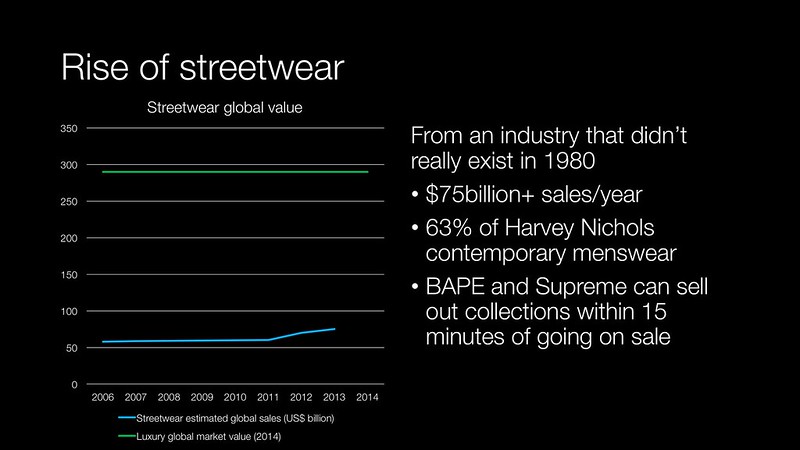
It is still about one third the size of the luxury industry. Streetwear accounts for the majority of menswear stocked in luxury department stores. Harvey Nichols claimed that 63% of the their contemporary menswear was streetwear. Many luxury brands off-the-peg men’s items blur the boundary between luxe and streetwear.
The industry has spawned some technology start-ups acting as niche secondary markets including:
Kixify
K’LEKT
THRONE
StockX
SneakerDon
GOAT
Large parts of the streetwear industry has become lazy and mercenary. You can see this in:
The attention to detail and quality of product isn’t what it used to be. I have vintage Stüssy pieces that are very well-made. I can’t say the same of many newer streetwear brands
Colour-ways just for the sake of it. I think Nike’s Jordan brand is a key offender. Because it has continually expands numbers of derivative designs and combinations. New Balance* have lost much of their mojo. Especially when you look at the product their Super Team 33 in Maine came up with over the years. The fish, fanzine or the element packs were both strong creative offerings. By comparison recent collections felt weak
The trivial nature of some of the collaborations. This week Supreme sold branded Metro Cards for the New York subway
Streetwear brands that sold out to fast moving consumer products. This diluted their own brand values. While working in Hong Kong, I did a Neighborhood Coke Zero collaboration. The idea which had some tie-in to local cycling culture and nightscape. Aape – the second-brand of BAPE did a deal wrapping Pepsi cans in the iconic camouflage
Hong Kong brand Chocoolate did three questionable collaborations over the past 18 months:
Vitaminwater
Nissin (instant noodles)
Dreyer’s (ice cream)
By comparison, Stüssy has a reputation in the industry for careful business management. The idea was to never become too big, too fast. The Sinatra family kept up quality and selective distribution seeing off Mossimo, FUBU and Triple Five Soul. Yes, they’ve done collaborations, but they were canny compared to newer brands:
“The business has grown in a crazy way the past couple of years,” says Sinatra. “We reluctantly did over $50 million last year.”
Reluctant because, according to Sinatra, the company is currently trying to cut back and stay small. “It was probably one of our biggest years ever — and it was an accident.”
Sinatra characterises Stüssy’s third act as having a “brand-first, revenue second” philosophy, in order to avoid becoming “this big monstrosity that doesn’t stand for anything.”
The Evolution of Streetwear. The newfound reality of Streetwear and its luxury-like management academic study uncovered careful brand custodianship.
It’s not clothing; it’s an asset class
Part of the bubble feel within the streetwear industry is due to customer behaviour. For many people, street wear is no longer a wardrobe staple. Instead it becomes an alternative investment instrument. Supreme items and tier zero Nike releases are resold for profit like a day trader on the stock market.
Many of the start-ups supported by the community play to this ‘day trader’ archetype. It is only a matter of time for the likes of Bonham’s and Sotherby’s get in on the act.
A key problem with the market is that trainers aren’t like a Swiss watch or a classic car. They become unusable in less than a decade as the soles degrade and adhesive breaks down.
There is the apocryphal story of a Wall Street stock broker getting out before the great stock market crash. The indicator to pull his money out was a taxi driver or a shoe shine boy giving stock tips.
Streetwear is at a similar stage with school-age teenagers dealing must-have items as a business. What would a reset look like in the streetwear industry? What would be the knock-on effect for the luxury sector?
The $143bn flop: How Warren Buffett and 3G lost Unilever | FT – Back in London on Saturday, as [Unilever CEO] Mr Polman tapped into his network of contacts, he was informed that Finsbury was working with Kraft Heinz on PR. Within seconds, Mr Polman blasted off an email to Sir Martin Sorrell, the founder and chief executive of WPP, the advertising company that counts Unilever as one of its most important clients. Finsbury, which is majority owned by WPP, was removed from the Kraft Heinz side by the end of the day. – guessing Kraft Heinz isn’t worth that much for WPP, also think that you can take Colgate Palmolive off the table as well since they are a big WPP customer
Apple Severed Ties with Server Supplier After Security Concern — The Information – I imagine that this is what being a target of the NSA’s tailored access programme would look like. There are a number of other state actors with similar capabilities. SuperMicro is interesting because it assembles servers outside China – instead it has factories in San Jose, The Netherlands and Taiwan
POSIX has become outdated by Atlidakis, Andrus, Geambasu, Mitropoulos & Nieh (Columbia University) – this seems arcane but will impact every part of information technology from mainframes and web infrastructure to Macs and smartphones (both iPhone and Android). POSIX is an IEEE approved standard. It was developed to maintain the comparability between different operating systems. POSIX defines APIs (application protocol interfaces) at system and user levels. It also includes command line shells and utility interfaces. This allows for software portability between different types of Unix and other operating systems. The Mac that this is written on runs an operating system (macOS) that is POSIX compliant and has been for a good number of years. So is my iPhone and iPad. So are banking mainframes and many of the computers that run the internet.
Business
General Motors Is in Talks to Sell Opel – WSJ – General Motors Co. has entered talks to sell its European business Opel to Peugeot as the U.S. auto giant seeks to shed money-losing operations abroad – I imagine that China and the US will be its main focus. Surprised Ford hasn’t taken a similar move
The recent collaboration between New York’s Supreme and Louis Vuitton seems like a natural fit. The reality is that luxury and streetwear have been dancing around each other for a good while.
Snide started it all
Snide was slang in the 1980s for fake or counterfeit. Hip Hop and the Caribbean-influenced Buffalo movement in the UK each used counterfeit and real luxury in their own way.
Daniel Day, better known as Dapper Dan was a was a Harlem-based craftsman and business man who dressed a lot of New York based artists from the golden age of hip hop. Dan’s first hip hop client was LL Cool J back in 1985. Dan’s style was luxe, the finest silks and furs were standard issue – think Puff Daddy before Puff Daddy. They went for customised outfits with their branding on which Dan provided. As the scene took off Dan incorporated suit lining material (which replicated the likes of the Fendi, Bally or MCM brands) and Gucci or Louis Vuitton branded vinyl to make one-off products.
He customised trainers, clothing and even car interiors. Dan’s own Jeep Wrangler had an interior retrimmed in MCM branded vinyl.
Much of the luxury branding Dan used was coming in from Korean factories which at that time supplied the fake trade. Now similar products would have come out of China. I took a trip to the South China City complex in 2010 where fabric suppliers would offer Louis Vuitton labels and Supreme tags side-by-side. I can only imagine that the Korean suppliers of the 1980s had similar markets in textile industry centres like Deagu. Outside of hip hop, Dan was the go-to tailor for all the hustlers in Harlem – so you can see how he could have got the hook-up into the counterfeit suppliers.
At the time hip hop culture was not in a relationship with brands who where concerned about how it might affect them. LL Cool J was the first artist to get a deal with Le Coq Sportif. Run DMC got a long term deal with Adidas after their single ‘My Adidas’ became successful. But these were the exceptions to the rule. So with Dan’s help they co-opted the brands to try and demonstrate success.
Over in the UK, the Buffalo collective of stylists, artists and photographers including Ray Petri, Jamie Morgan, Barry Kamen (who modelled for Petri), Mark Lebon and Cameron McVey. Buffalo was known as an attitude, which threw contrasting styles together and filtered into fashion shoots and influenced the collections of major designers including Yohji Yamamoto, Jean Paul Gaultier and Comme des Garçons. Even if you didn’t know what Buffalo was, you would have recognised the aesthetic from the likes of i-D, Blitz, New Musical Express and Arena.
Buffalo mixed Armani jackets with Doctor Martens work boots, or a Puma bobble hat. Petri used music to sound track his process and this was pretty similar to the kind of stuff that influenced street wear pioneer Shawn Stussy over in California. Motown and hip-hop to dub reggae was the sound which explains the Feeling Irie t-shirts created by the white surfboard maker.
If you thought Bros looked cool in their MA-1 bomber jackets and stone washed Levi’s 501 jeans – there was a direct stylistic line back to Buffalo – rehabilitating the items from their link to skinhead culture.
Buffalo permeated into the street style of the decade; influencing the likes of Soul II Soul. Meanwhile over in Bristol The Wild Bunch were yet to morph into Massive Attack. Two members headed to London; producer Nelle Hooper and Miles Johnson (aka DJ Milo who went on to work in New York and Japan). A shoot was organised by i-D magazine and they turned up wearing their street clothes alongside DJ Dave Dorrell and model / stylist Barnsley. At the time, it was considered to be ‘very Buffalo’ in feel, but Dave Dorrell admitted in an interview that they had just came as they were. Dorrell wore his t-shirt as ‘advertising’ for it.
The Hermes t-shirt and belt were snide, the Chanel Number 5 t-shirt sported by Dave Dorrell were being knocked out by a group of friends. Young people in London co-opted brands just like the hip-hop artists heading to Dapper Dan’s in Harlem.
Homage
From 1980, surfer Shawn Stussy had been growing an clothing empire of what we would now recognise as streetwear. Stussy had originally came up with the t-shirts as an adjunct and advertisement of his main business – selling surfboards. But the clothing hit emerging culture: skating, punk, hip-hop and took on a life of its own. It went global through Stussy’s ‘tribe’ of friends that he made along the way.
Stussy is known for his eclectic influences and mixing media: old photographs alongside his own typography. In a way that was unheard of in brand circles at the time, Stussy manifested his brands in lots of different ways. The back to back SS logo inside a circle was a straight rip from Chanel; the repeating logo motif that appeared in other designs was a nod to MCM and Louis Vuitton.
All of this went into the cultural melting pot of world cities like Tokyo, New York, London and Los Angeles. Stussy went on to do collaborations from a specially designed party t-shirt for i-D magazine’s birthday party to the cover art of Malcolm Maclaren records. Collaboration with mundane and high-end brands is baked into streetwear’s DNA.
(Neighborhood x Coke Zero was something I was involved with during my time in Hong Kong.)
Japan with its engrained sense of quality and wabisabi took the Buffalo mix-and-match approach to the next level. Japan’s own streetwear labels like Visivim, Neighborhood, W-Taps, The Real McCoy and A Bathing Ape (BAPE) took streetwear product quality, exclusivity and price points into luxury brand territory. That didn’t stop BAPE from making a snide versions of various Rolex models under the ‘Bapex’ brand.
Some two decades later Supreme came up in New York. The brand takes design appropriation and homage to a new level. Every piece Supreme seems to do is a reference to something else. The famous box logo rips from Barbara Kruger’s piece ‘I shop therefore I am’. From taking a snide swipe at consumerism to ending up in the belly of the beast took Supreme a relatively short time. This heritage of appropriation didn’t stop Supreme from using legal means against people it felt had appropriated its ‘look’.
In an ironic twist of fate, Supreme was sued by Louis Vuitton in 2000 and yet the 2017 collaboration looks exceptionally similar to the offending items…
North East Asia’s fast growing economies had been borne out of learning from developed market expertise, state directed focus on exports and ruthless weeding out of weaker businesses. Intellectual property was cast aside at various points. Korea, Hong Kong, Japan and China went from making knock-off products to displacing Europe and the US as the leading luxury markets.
Asian luxury consumers, particularly those second generation rich in China were younger than the typical customer luxury brands cater too. These consumers bought product as they travelled taking in style influences as they went. First from nearby markets like Japan, Hong Kong and Singapore and then Korea. This drew from a melange of hip hop, streetwear, Buffalo styling and contemporary western designers like Vivienne Westwood – as well as the more matronly styles of the traditional European luxury houses.
The luxury brands had to adapt. They brought in new designers who themselves were drawing from similar influences. These designers also collaborated with sportswear brands like Alexander McQueen and Puma or Jeremy Scott and Raf Simons for Adidas.
Luxury brands got seriously into new product categories making luxe versions of training shoes that could be charitably called a homage to the like of Nike’s Air Force 1.
Bringing things full circle
As the supreme_copies Instagram account notes the collaboration with Supreme and Louis Vuitton brings things full circle with the pieces having a nod to Dapper Dan’s custom work as well as Supreme’s own ‘homage’. Luxury brand MCM (Michael Cromer München), which Dan borrowed from extensively in the 1980s was restructured in 1997 with shops and brand being sold separately. The brand was eventually acquired eight years later by the Korean Sungjoo Group. Korea now has its own fast developing luxury fashion and cosmetics brand industry. Textile city Deagu which was the likely source of Dapper Dan’s fabric is now a fashion and luxury business hub in its own right. The Korean entertainment industry is a trend setter throughout Asia. For instance, Hallyu drama My Love From A Star drove breakout sales for the Jimmy Choo ‘Abel’ shoe.
The only question I still have is why did a move like Louis Vuitton’s collaboration with Supreme take so long? The luxury brands spend a lot on customer insight, they were using social listening far longer than they had been on social media. They know that a customer wearing their jacket could have a Visivim backpack slung over the shoulder and a pair of Adidas Stan Smiths on their feet. Customers mix-and-match Buffalo style for all but the most formal occasions. For streetwear brands, collaboration is in their DNA and they get an additional leg-up in the quality stakes. More luxury related posts here.