Category: media | 媒體 | 미디어 | メディア

It makes sense to start this category with warning. Marshall McLuhan was most famous for his insight – The medium is the message: it isn’t just the content of a media which matters, but the medium itself which most meaningfully changes the ways humans operate.

But McLuhan wasn’t an advocate of it, he saw dangers beneath the surface as this quote from his participation in the 1976 Canadian Forum shows.

“The violence that all electric media inflict in their users is that they are instantly invaded and deprived of their physical bodies and are merged in a network of extensions of their own nervous systems. As if this were not sufficient violence or invasion of individual rights, the elimination of the physical bodies of the electric media users also deprives them of the means of relating the program experience of their private, individual selves, even as instant involvement suppresses private identity. The loss of individual and personal meaning via the electronic media ensures a corresponding and reciprocal violence from those so deprived of their identities; for violence, whether spiritual or physical, is a quest for identity and the meaningful. The less identity, the more violence.”

McLuhan was concerned with the mass media, in particular the effect of television on society. Yet the content is atemporal. I am sure the warning would have fitted in with rock and roll singles during the 1950s or social media platforms today.

I am concerned not only changes in platforms and consumer behaviour but the interaction of those platforms with societal structures.

  • What if Stories are Brain Code?

    The boy on the wall

    From Hollywood to the marketing industry we’re told that stories resonate with us. They are the reason why films, books, video games and TV dramas entertain. According to storytelling theorists like Joseph Campbell; we find fulfilment understanding what is happening. Campbell et al think that our enjoyment of stories analogous to the enjoyment of solving puzzles. What if stories can be more than puzzles for our enjoyment?

    Our understanding of storytelling

    Our understanding of storytelling is of a more tenuous nature than Newtonian physics or organic chemistry. You could argue that Joseph Campbell was a ‘victim’ of his discipline. He worked in the fields of comparative mythology and religion. Campbell was looking for universal patterns in stories. He assumed that rest of us are as well. Though this ‘understanding’ would be occcuring at a ‘low level’ in computing terms. Only select (mostly educated) people would think of it at a higher conscious rational level.

    Like many academics in the early and mid-20th century his work drew inspiration from eastern religions. In Campbell’s case, like Nietzsche; he drew from Hindu thought. Campbell’s interest in Indian philosophy was due to a meeting. In 1924, Campbell encountered the messiah elect of the Theosophical Society. He was on a cruise liner from Europe to the US. Campbell was also profoundly affected by Nietzsche’s work.

    • Did Nietzsche open Campbell to Indian philosophy or was it the other way around?
    • Was it just the nature of a naturally enquiring mind?
    • Were there factors that made him more open to it?

    Campbell based his theories on myth and its connection to the human psyche in part on Sigmund Freud. Campbell’s myth concepts drew on Jung’s dream interpretation methods. Jung’s insights into archetypes drew from The Tibetan Book of The Dead. Campbell quotes Jung on The Tibetan Book of The Dead in The Mythical Image:

    “belongs to that class of writings which not only are of interest to specialists in Mahayana Buddhism, but also, because of their deep humanity and still deeper insight into the secrets of the human psyche, make an especial appeal to the layman seeking to broaden his knowledge of life… For years, ever since it was first published, the Bardo Thodol has been my constant companion, and to it I owe not only many stimulating ideas and discoveries, but also many fundamental insights.”

    (Bardo Thodol is another name for The Tibetan Book of The Dead). A lot of this hinges on the value of dreams. Heres what Dream interpretation and false beliefs has to say. It was published in the journal Professional Psychology: Research and Practice in 1999:

    “Dream interpretation is a common practice in psychotherapy. In the research presented in this article, each participant saw a clinician who interpreted a recent dream report to be a sign that the participant had had a mildly traumatic experience before age 3 years, such as being lost for an extended time or feeling abandoned by his or her parents. This dream intervention caused a majority of participants to become more confident that they had had such an experience, even though they had previously denied it. These findings have implications for the use of dream material in clinical settings. In particular, the findings point to the possibility that dream interpretation may have unexpected side effects if it leads to beliefs about the past that may, in fact, be false.”

    This doesn’t necessarily invalidate Campbell’s theory in terms of storytelling. But it seems to cast doubt on the application of Jungian dream interpretation for clinical use. The best advice that I can give in this matter is caveat lectorem.

    From Academia to Hollywood: formulaic stories


    Joseph Campbell was a prolific author.  He published material that went into over 40 books. Part of this was due to the efforts of the Joseph Campbell Foundation, which collected his papers and published a number of work after his death. These included: coverage of his academic work, travel diaries and even his personal philosophy. It was picked up on by the American public, which has been endless quoted and misinterpreted due to the phrase ‘follow your bliss’.

    The key work of Campbell was his 1949 work The Hero With A Thousand Faces. it was his first solo work and got him recognition outside academic circles. The central them is that ‘myths’ from around the world all share a common structure. This is what Campbell called a ‘monomyth’. The monomyth or hero’s journey was mapped out visually on Wikipedia

    heroes journey

    Campbell went on to propose the purpose of these myths which he grouped into four functions. Wikipedia described it thus:

    The Metaphysical Function – Awakening a sense of awe before the mystery of being The Cosmological Function – Explaining the shape of the universe The Sociological Function – Validate and support the existing social order The Pedagogical Function – Guide the individual through the stages of life

    Campbell’s work went on to influence luminaries of the 1960s counterculture movement including Jerry Garcia of the Grateful Dead and Jim Morrison. It’s obvious influence in film kicked in around the same time. Stanley Kubrick introduced it Arthur C. Clarke. This happened during their collaboration to turn Clarke’s short story The Sentinel into 2001 A Space Odyssey screen play and book. George Lucas’ role in the popularisation of Campbell’s work was probably the biggest single effect. Hollywood at the time was in a state of dramatic change. This change mirrored the kind of change that the punk ethic and independent labels wrought on the music industry a decade later. Artistic and cultural change, further globalisation of artistic culture, new motion film camera technology and the rise of television created a set of factors that helped facilitate the rise of New Hollywood. The initial success of these director-driven films allowed power shifted from the producers to the studios for a time.

    • Directors drew on foreign influences: new wave cinema, Japanese cinema
    • The MPAA ratings system allowed more adult subjects to be discussed that would have otherwise been taboo
    • The Panavision Panaflex camera provided a more compact way to shoot on 35mm film. This facilitated greater use of location shooting, providing a more naturalistic style and also facilitated Lucas’ special effects in Star Wars

    Whilst Lucas was part of this movement; both THX 1138 and American Graffiti, fit within the New Hollywood genre. But like Stephen Spielberg, Lucas unwittingly created the next stage in movie development that helped producers take back their seat of power. Star Wars became a blockbuster. Though the ingredients were very different to the corporate creations of Marvel Studios or the Transformers franchise.

    Its homage to the chambara films of Akira Kurosawa, pre-war Flash Gordon episodes and vintage westerns smacked of New Hollywood. It’s blockbuster status meant that the industry paid attention to valuable lessons learned. George Lucas became the first film maker to publicly cite The Hero With a Thousand Faces and other Campbell works as influences. Lucas repaid the creative debt that he owed to The Hero With A Thousand Faces by allowing Bill Moyes to shoot a series of interviews with Joseph Campbell  at Skywalker Ranch.

    Campbell and storytelling theory then became baked into Hollywood’s DNA. Over time it came into marketing, firstly through the creative side of the advertising industry. Television advertising at the time borrowed creative direction and stories from movie expertise. Directors like Tony Kaye and Ridley Scott moved between advertising and film projects. Eventually storytelling moved through other parts of the marketing industry including public relations. Hollywood have taken a number of turns at further refining Campbell’s monomyth model.

    One has to note that their goals are different from Campbell’s research. Hollywood largely seeks to entertain (for profit) and getting the viewer to suspend disbelief for the duration fo the movie or TV series rather than  achieving one of Campbell four functions.
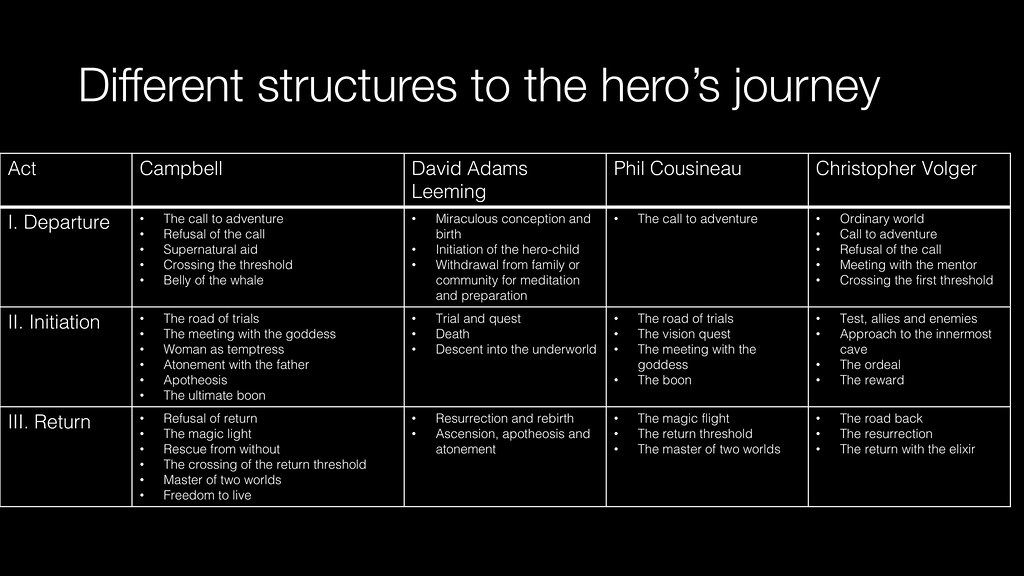
    Different cuts on the hero's journey

    Volger is commonly cited by modern script writers. He refines and expands the thinking around the monomyth. Volger puts more emphasis than Campbell on the hero’s change in emotional state and internal journey.  His emphasis on emotion is important when one is creating content to land brand messages and would be of interest to the advertising community. The biggest area of disagreement that many have with Volger’s approach is that his structure implies a steady change in emotional state and internal journey of the hero. A paradigm shift in state would possibly create greater dramatic tension for the viewer.

    From monomyth to winning algorithm.

    Technology has moved from the creative process of film making an into the commercial side of the process. The movie industry is supporting machine learning based startups like ScriptBook. Belgium-based ScriptBook analyses screen plays to produce forecasts before a film is put into production. ScriptBook provides a box office earnings forecast, likely MPAA rating and recommended market demographics. Of course, many classic films had screen plays that were altered or completely rewritten several times. The tortured overworked scriptwriters working miracles in really short times and ‘script doctors’ called into ‘fix’ a bad situation. Both are part of the Hollywood system and its own mythology. In many respects ScriptBook mirrors the marketing industry’s move towards the adoption of predictive analytics for consumer behavioural change.

    How stories work for the brain.

    Behavioural scientist Nick Chater has roughly two decades of published academic work behind him based on research in various aspects of cognitive science. He has a depth and credibility to his work that we currently don’t have  on people and storytelling.

    In his book The Mind is Flat, Chater posits that the mind doesn’t have conscious and unconscious aspects. Emotions aren’t hard wired, instead thoughts and feeling are created on the fly. This effectively invalidates Freudian psychology principles. Our inner voice is effectively our brain telling storytelling to itself.  Our identities are constructed and given shape on the fly by the stories that we tell to ourselves as we go along. The unconscious mind would appear to be a conceit about our depth.

    This brings to mind the final episode in season two of Westworld, where the systems who had been trying to replicate humans realised their challenges. They had assumed humans were complex in nature, where as the show claims that they can be replicated in 10,247 lines of code, with definite limits on their potential. Of course 10,247 lines of code, whilst less than Photoshop could have a world of fractal complexity.

    Essentially there is no ‘deeper’ language than storytelling. Stories aren’t only about rules and plot consistency, but about creative leaps.

    This means from a marketing perspective whilst if we get stories right, they can be more powerful than we had previously imagined. In computing terms we would be writing direct the processor or ‘hitting the metal’ as games programmers would call it. It also needs to take into account that getting great stories is really hard.

    It also casts more questions about whether we have learned the right lessons to date about storytelling from the likes of Joseph Campbell?

    More information

    Joseph Campbell – The Mythical Image
    The Tibetan Book of The Dead
    Mazzoni, G. A. L., Lombardo, P., Malvagia, S., & Loftus, E. F. (1999). Dream interpretation and false beliefs. Professional Psychology: Research and Practice, 30(1), 45-50.
    The Hero With A Thousand Faces by Joseph Campbell
    Hero’s Journey – Wikipedia
    2001: A Space Odyssey by Arthur C Clarke
    The Writer’ Journey by Christopher Volger
    Artificial Intelligence Might Affect How Studios Greenlight Movies | Cinemablend
    Artificial Intelligence Could One Day Determine Which Films Get Made | Variety
    ScriptBook “Hard science, better box office” and Crunchbase profile
    This Man Says the Mind Has No Depths | Nautilus
    The Mind is Flat: The Illusion of Mental Depth and The Improvised Mind by Nick Chater
    ‘Westworld’ Season Finale Recap: Code Unknown | Rolling Stone Online

  • COSCO Shipping + more things

    COSCO SHIPPING Lines | Customer advisory on network breakdown within America Regions – Customer statement on how their business IT systems were (allegedly hacked and) shut down. COSCO is one of China’s state shipping companies. COSCO is also one of the largest owners of containers in the world. COSCO also owns OCS, the Hong Kong shipping line. More security related content here.

    ITV Self Serve – this could be the equivalent of 1980s era slideshow style cinema ads for your local Indian restaurant. I could see the benefits for estate agent chains, car supermarkets and local hotels. All of which will be reliant on powerful expensive intermediaries (rightmove, autotrader and booking.com respectively)

    Facebook Added Several Creative Tools to Its Ads Manager App – Adweek – reminds me a fair bit of percolate’s editing features

    Hollywood Marketing Firm Ant Farm Is Shuttering | Hollywood Reporter  – Omnicom, an advertising and media holdings conglomerate, is seeking to shed any venture that doesn’t have a substantial return on investment, or a 25 percent margin. “Omnicom is having a tough go, and they didn’t think they [Ant Farm] was core to their strategy,” said one insider.

    Why Monocle shuns social media in favour of going swimming with its readers | The Drum – contrarian strategy in action

    Resilient Anonymous Communication for Everyone (RACE) – Federal Business Opportunities: Opportunities – interesting project, there is a tension between this and the US law enforcement community’s concern about ‘going dark’

    China economic analysis by Martin Wolff | FT – mix of rising debt, slower growth and lower than needed domestic consumption

    Facebook stock plummets after warning of slower revenue growth – Axios – most of the growth now must be in the developing world

    Apple Is in Danger of Abandoning Creative Pros – ExtremeTech“You will see us do more in the pro area,” CEO Tim Cook said back in early 2017 at a shareholder meeting, in a response to a question about the Mac Pro. “The pro area is very important to us. The creative area is very important to us in particular.” I still don’t doubt the company’s commitment. But I’m certainly disturbed by its inability to execute lately.

    Molecular clock chip promises improved smartphone navigation | eeNews Europe – huge for navigation and time stamped applications

    The man who invented the self-driving car (in 1986) – POLITICO – interesting reflection on where machine learning has been before

    There is no precedent—a president sides with America’s enemies – interesting if optimistic take on the rise of China. I think that the west’s beliefs have been shown to be malleable over the past couple of decades

    Understanding multimodality: An analysis of early JUMP users – drives overall app use, cannibalises short distance drives

    Before scooter shares, The Sharper Image was selling Razors to tech workers — Quartz – circular innovation in action. I remember the first person I saw with a micro-scooter was a German freelancer that we had in the office. It made him look like a knob as he tried to ride it through Covent Garden during the dot com boom. When working on Genie (a still birth mobile internet product that was extended out of a trial proof of concept) we had lots of them all over the office. The bag that the scooter came in was a solid cotton canvas duffle that I still have. As far as I remember I only took the bag and there was a load of these scooters sitting folded up and unloved in a cupboard in the back of the office when I left a year or so later

    WPP courts Chinese tech giants‎ Alibaba and Tencent over $2.5bn deal – if they wait until Brexit drops, Alibaba and Tencent could push through a tricky purchase easily

    The Chinese Communist party entangles big tech | Financial Times – there’s some antitrust arguments the west can easily make

    Multinational brands predict higher spend on influencer marketing | PR Week – not sure why at the moment, where is the business case?

    Amazon advertising is working directly with brands now, cutting out ad agencies – Digiday – this is similar to what Baidu, Sina and Tencent do in China.

  • The Heat & more stuff

    The heat. At least in Hong Kong I lived with air conditioning, but there is no respite from the heat in London. In my area of London there hasn’t been much of a breeze either, the heat has been inescapable.  At least my music needed to be cool, and I reached back to nu-disco and space disco over the past few years. If there was one tune of the week it was this on

    Watch Kraftwerk Perform a Real-Time Duet with a German Astronaut Living on the International Space Station | Open Culture – literally out of this world. Kraftwerk pushing performance innovation after five decades.

    Carver M-500t power amplifier at the top

    I still lust after Ferris Bueller’s Carver M-500t power amplifier (on the top in the screen shot above), E-mu Systems Emulator II sampler and his l33t maker skills. Check out this blog that collated all the immense taste that went into his bedroom design: TimLybarger.com: Ferris Bueller’s Bedroom

    Scooter is one of those guilty secrets with catchy melodies and nonsensical lyrics that confound comprehension for English speakers. It was unusual to hear ‘How Much Is The Fish ‘ played on the piano and its a pleasant surprise. Scheps is better known as a classical pianist in Germany and has brand sponsorship deals with Audi and Chopard – so a world away from the image of Scooter.

    Here is the original for comparison purposes….

    As a student of Silicon Valley history, I was aware of General Magic. It is now getting a well deserved documentary about it. General Magic tried to build the predecessor of the Palm PDA and modern smartphones, before the the internet wi-fi and very nascent cellular networks. I’d heard of some people using them as a desk phone replacement

    Here’s the trailer

    Here is the documentary’s website

    Here is a guide to their DataRover 840F. Check out the skeuomorphic interface that is reminiscent of Microsoft Bob. Stylistically the fonts, design details and Easter eggs reminded me of the early Macs that I used. This isn’t surprising as it was started by Mac veterans.  Why is General Magic important now? Like the later PayPal mafia the General Magic alumni have been all over Silicon Valley developing some the most successful products and services. More on technology here.

  • Crimson Hexagon + more things

    Facebook Suspends Analytics Firm Crimson Hexagon on Concerns About Sharing of Public User-Data – WSJ – Crimson Hexagon will likely get out of the penalty box soon, the co-founder works at a joint Facebook academic research partnership… Its also not that surprising what Crimson Hexagon did, given how crap Facebook is at providing data to social insights platforms like Crimson Hexagon or Brandwatch

    Congress is wrong to question Huawei’s academic partnerships | FT – op-ed by Eric Xu of Huawei, you could cynically interpret it as a plea for easier espionage and an interesting use of ‘freedom’ (paywall)

    INTERNET: Baidu Sambas Out of Brazil | Young’s China BusinessThere are lots of reasons for the inability of China’s Internet companies to succeed outside their home market. One is simply inexperience. But another is really the direct result of Beijing’s determination to set up what almost amounts to a parallel Internet in China that in some ways is identical to the global Internet but in others is very different. That strategy has helped to keep out most of the major global competitors in any meaningful way, allowing Chinese companies to thrive on their home turf thanks to their booming local economy. But that approach has also made these companies quite unprepared to compete globally, since they engage in many practices that are either unacceptable outside or simply undermine trust of local people. – China’s Galapagos syndrome: WeChat has NO end-to-end encryption, is censored worldwide for instance. Will only succeed in low risk categories – photo altering apps or casual games

    Why Hong Kong’s property bubble won’t burst anytime soon | HKEJ Insights – Hong Kong’s property market no longer serves only the city’s seven million people. We now must also serve a country of 1.3 billion with a growing number of rich people anxious to get their wealth out. Hong Kong’s red-hot property sector is a perfect place for rich mainlanders and international investors to park their money. Their hot money, combined with the local psyche that prices will continue to climb means the bubble will never burst. – You could substitute most of the world’s major cities as hot money from fast developing economy entrepreneurs and rent seek oligarchs park their hot money in property safe havens. Hong Kong isn’t going to see a tailing off of house prices until China deals with corruption.

    Amazon’s new Part Finder helps you shop for those odd nuts and bolts | TechCrunch – so cool,  I am just really scared that if I showed this to my Dad this ‘tinkerer’ element of his character would go into overdrive

    Publicis Groupe: First Half 2018 Results | Publicis Groupe – poor job done at controlling market expectations

    Android has created more choice, not less | Google Blog – yeah right. Basically we can’t get paid in data so pay us a licence fee. I wonder how much Google will have to pay to keep Google Search in the device if they do that. It could also create an opportunity for Oxygen, Yandex app store, Jolla and home grown distributions by the likes of Huawei instead

    Mark Penn on his update to MicroTrends

    Media – Twitter’s guide to getting the most out of the platform

    MEDIA Protocol – WTF

    Looking Through the Eyes of China’s Surveillance State – The New York Times  – I tried the glasses out on a group standing about 20 feet away. For a moment, the glasses got a lock on a man’s face. But then the group noticed me, and the man blocked his face with his hand. The minicomputer failed to register a match before he moved. Seconds later, the people scattered. Their reaction was somewhat surprising. Chinese people often report that they’re comfortable with government surveillance, and train stations are known to be closely watched

    Amazon crashes just minutes into Prime Day | The Drum – makes you wonder about AWS availability and uptime…

  • Marketers bookshelf recommendations

    Books

    My recommendations for a marketers bookshelf is based on my own reading. My own experience is very consumer, brand communications and behavioural change focused. Here’s some recommendations, they aren’t in a ranking or grouped in a particular order.

    Insights, planning and strategy

    Most marketing communications projects are trying to create some sort of behavioural change in the audience, so understanding more about persuasion has got to be a pretty handy thing right? Robert Cialdini  has two great works:

    How Brands Grow part 1 and part 2 – pretty much the modern marketers bible for B2C brands of various stripes. Byron Sharp distills down decades of evidence-based research that has been carried out by Ehrensberg-Bass Institute of Marketing Science attached to the University of South Australia. The research institute has got a who’s who of corporate sponsors supporting their work and using their data:

    • General Mills
    • Grupo Bimbo
    • Procter & Gamble
    • Red Bull
    • Unilever

    You get the idea. If the research is good enough for these brands, it’s good enough for you.

    A key part of planning is working out that insight which will speak to your target consumers. Trends books are sometimes a handy short cut to creating a first draft of a hypothesis. You can do worse than leave through pollster Mark Penn’s Microtrends, Microtrends Squared and Microtrends Cubed that he has built up. If you’re thinking about transformation then Kevin Kelly’s The Inevitable: Understanding the 12 Technological Forces That Will Shape Our Future is the Microtrends for digital transformation. Tom Doctoroff’s What Chinese Want: Culture, Communism, and China’s Modern Consumer – is a another great primer.

    The Long And the Short of It by Les Binet and Media in Focus: Marketing Effectiveness in the Digital Era. Binet is a respected communications planning expert, he is currently head of effectiveness at Adam & Eve DDB. He has published some of the best works on marketing effectiveness for the IPA.

    If you studied marketing in college David A. Aaker is probably a familiar name. His Strategic Marketing Management book is often an introductory core course text. It used to double as a doorstop in a lot of dorm rooms that I visited. If you want to refresh your memory on branding he has written an accessible primer to recharge long lost lecture memories: Aaker on Branding: 20 Principles That Drive Success.

    Truth, Lies and Advertising – Jon Steel’s work on account planning is that rare thinking; a very readable text book. I like to go back to it to boil things down to first principles and forget complexity.

    Inspiration

    When you’re looking for inspiration, there are two good approaches:

    • Go lateral. Brian Eno and Peter Schmidt’s Oblique Strategies isn’t a book, but a set of 100 cards. Eno periodically suffered writers block in the studio and these cards are a successful approach that he developed over time with collaborator Peter Schmidt. It also works for finding your way through planning
    • Look back into time. If you are looking back into time, I would recommend Sun Tzu’s The Art of War if you are looking for inspiration on strategic approach. Buy the cheapest copy that you can get in print. Mine is covered in post-it notes and scribbles in the margins. More expensive versions have ‘business thought leaders’ trying to reinterpret it for you and just end up muddying the water. Those 13 chapters are well worth visiting on a regular basis. Bill Bernbach’s Book is a source of inspiration; as is the better known Ogilvy on Advertising by David Ogilvy
    Communications

    How To Write A Thesis by Umberto Eco. I know what you’re thinking: ‘Ged have you lost your marbles, why would I care about writing a thesis?’ Eco’s book is a really good guide to collecting one’s thoughts and presenting facts gained through a comprehensive research process. As the old martial arts mantra goes: slow is smooth, smooth is fast. Whilst Professor Eco isn’t a marketing scholar he knows a lot about thinking and being cogent.

    What about the last book on the marketers bookshelf? You’ve distilled all the knowledge from the rest of the books in this list, along with desk and possibly primary search.  You are ready to present your killer ideas to the client, or internal decision makers. Jon Steel has got you covered. Perfect Pitch: The Art of Selling Ideas and Winning New Business is a great refresher that helps shake you’re presentation game up.

    What books would add to a marketers bookshelf? If you have additional recommendations, put them below in the comments section. More related content here.