Welcome! I guess the first question that you have is why oprah time? Well in my last year of college I used to sit in the house that I shared with my landlord and write my essays whilst watching cable TV.
There I would be sipping tea, writing away and referencing from text books spread around me on the couch and coffee table. One of the programmes on the in the background was Oprah Winfrey. A lot of the show was just background noise. But I was fascinated by Oprah’s book club.
She’d give her take on a book, maybe interview the author. And then it would be blasted up the New York Times bestsellers list. This list appears weekly in the New York Times Book Review. Oprah’s book club was later emulated by other talk show hosts, notably the UK’s Richard Madeley and Judy Finegan.
On the high end you had Melvyn Bragg‘s South Bank Show when they profiled an author of the moment.
When I came to writing my own review of books that I’d read, I was was brought back to that time working on a sofa. Apple laptop in hand. It made sense to go with Oprah time.
You might also notice a link called bookshelf. This is a list of non-fiction books that I have kept. And the reasons why I have kept them.
If you’ve gone through my reviews and think that you’d like to send me a book to review. Feel free to contact me. Click this link, prove that you’re human and you will have my email address.
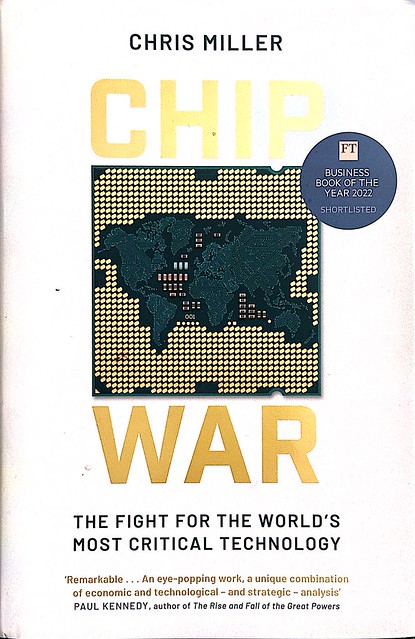
It has taken me far too long to finish Chip War and write this review, so apologies in advance. Chip War was one of the FT’s best business books of 2022. In reality it’s a book about history, that happens to feature businesses.
The lens shaping everything else that I have written here
I am a sucker for books on the history of technology and Chip War was right in my wheelhouse. It complemented, rather than overlapped some of my existing favourite technology history books like Bob Cringely’s Accidental Empires, John Markoff’s What The Dormouse Said or most of Michael Malone and Steven Levy’s output to date.
The author
The author Chris Miller wasn’t a familiar name to me. Unlike Cringely, Markoff, Malone or Levy; Miller is an academic rather than a former journalist. Miller currently teaches international history at Tufts University. Chip War wasn’t his first book, his previous ones have focused on Soviet and Russian history. As a technology sector outsider, Miller’s Chip War has a very different tone my other favourite books from the genre.
It also allowed Miller to view the history of semiconductors in terms of a global perspective, that I hadn’t previously seen done.
On to Chip War itself
Other reviewers have used words like ‘outstanding’ and ‘epic’ to describe the book – which while being a reasonable guide to overall quality and length of read aren’t really all that helpful. It took me six months to read as a casual book. This is partly down to a hectic work schedule and that its a long book. I suspect that some readers when they reviewed the book seem to have thought ‘long’ as difficult to read. It’s actually 351 pages ignoring acknowledgements and the footnotes at the back of the book. Being an academic Miller worked hard to source everything in Chip War.
The book starts in the post-war period as the defence industry moves from being focused on hammering steel to developing smarter systems using semiconductors. That road takes the book past Texas Instruments and the early Silicon Valley of Bob Noyce and other members of the treacherous eight.
The book also zooms out to cover the Soviet Union’s failed efforts to replicate Silicon Valley as well as domestic industrial espionage and the start of globalisation which begat the current industry.
The Japanese challenge is covered in depth as is the rise of Korea including challenges that the industry faced in the early 2000s. The rise of Taiwan and its use of semiconductors as a hedge against invasion from the mainland. European tool maker ASML gets its own section, which is a case study in how to make a virtue of necessity. Finally it covers the technology conflict with China. Bring this up to date circa 2022.
If you are student of Silicon Valley history, then Chip War is unique in the way it puts everything in context. There were some completely new parts to me such as the political role that Sony founder Akio Morita played in advocating for a robust Japanese semiconductor industry as part of reasserting Japanese importance internationally.
You can get hold of Chip War here. More book reviews here.
I spent part of the bank holiday weekend reading and finally managed to tuck into designer Bruce Mau’s signature book MC24. For those that haven’t heard of him Bruce Mau is a Canadian designer and academic. He founded a brand design agency: Bruce Mau Design which is now part of marketing combine Stagwell. His Massive Change Network (MCN) is in the transformation business similar to Stewart Brand’s Global Business Network (acquired by the Monitor Group now called Monitor Deloitte) and The Long Now Foundation. The philosophy of Bruce Mau and feels like it had been lifted from an amalgam of TED Talks. Bruce Mau believes in a sustainable future with techno-optimist bent to his views.
Bruce Mau, like Robert Greene has principles that seem to contradict each other. Publisher Phaidon have wrapped the hard back cover of the book in an iridescent satin fabric that a photograph doesn’t do justice to. Regardless of whether you think the book is a self-help bible, your creative muse, an objet d’art or something nice to thumb through on a Sunday afternoon Bruce Mau and his book MC24 are ideal.
China
Where China is beating the world – by Noah Smith – interesting article, although it lacks some nuance about Chinese development, consider it a starting point that you can explore in more depth from, rather than the full story
I have alluded to the impact of China’s new espionage law. VisualPolitik has pulled together a good video on how it’s being interpreted by multinationals, policy wonks and politicians. It will have precisely the opposite impact that China would like it to have on its economy.
Consumer behaviour
How many Britons agree with Andrew Tate’s views on women? | YouGov – so much in this. You also need to think about bias in questions, that its done online and the ‘you can think it, but you shouldn’t say it’ aspect of how Tate supporters might think about the questions
Interesting debate on how the ‘evangelical bloc’ has evolved over time from being primarily theological to being primarily political in nature.
How doctors buy their way out of trouble | Reuters – When federal enforcers alleged in 2015 that New York surgeon Feng Qin had performed scores of medically unnecessary cardiac procedures on elderly patients, they decided not to pursue a time-consuming criminal case. Instead, prosecutors chose an easier, swifter legal strategy: a civil suit. Qin agreed to pay $150,000 in a negotiated settlement and walked free to perform more cardiac surgeries at his new solo practice in lower Manhattan. Qin faced no judge or jury. He did not admit to wrongdoing. He maintained his license to practice. What’s more, neither Qin nor government officials were required to notify patients who purportedly were subjected to vascular surgical procedures they didn’t need. Those included fistulagrams to spot issues like narrowed blood vessels or clots, and angioplasties to open clogged coronary arteries. Within months of the settlement, a registered nurse working for Qin at his Manhattan practice alerted authorities that something seemed amiss. The nurse, who ultimately turned whistleblower, alleged to federal prosecutors that the surgeon was performing unnecessary procedures on patients, mostly elderly Asian and Black immigrants whose care was covered by the public programs Medicare or Medicaid. Prosecutors indicted Qin in 2018 on a felony count of fraud, which carried a maximum sentence of 10 years in prison. But in 2021, in a deal brokered behind closed doors, prosecutors dropped that charge in favor of yet another civil settlement, court records detailing that agreement show. Once again, Qin kept his New York license to practice with no restrictions; a restricted license is one of the few ways the public can learn that a doctor has been disciplined for bad behavior. Qin agreed to pay a total of $800,000 in annual installments ending in December 2025, deposited with the U.S. Department of the Treasury. As an added penalty, he was banned from billing public health programs until February 2025
Their inability to live up to the past German reputation for quality
Chinese manufacturers at the low-end
German automobile makers struggles with software
Japanese and Korean car manufacturers challenging the luxury end of the market. I would rather have a Lexus LX than a G-Wagen. At the moment Lexus have had to shut down the list on the LX they are that oversold
Hong Kong
chanhiu design – really nice graphic design. I love their project reflecting on Hong Kong-made knock-off toys familiar to Hong Kong children as well as European children – where these toys turned up in markets during the 1960s through to the early 1980s. More here: Chan Hiu explores Hong Kong’s playful past – The China Project
Cayman Islands fights attempts by Singapore and Hong Kong to lure Asia’s wealthy | Financial Times – the sharp uptake of Singapore vehicles versus Hong Kong vehicles is very interesting – an order of 10x magnitude greater. Interesting implications for Hong Kong’s wealth management business and China’s efforts to prevent capital flight from Greater China. It also implies that Hong Kong hasn’t been as successful at attracting foreign funds for investment in China. So the Hong Kong pivot towards the Middle East investor makes sense.
Apple expanding supplier base in China, Southeast Asia, and India – the number of manufacturing facilities/locations of Apple’s top 200 suppliers grew in 2022 in China, Japan, Thailand, Malaysia, the Philippines, and India. However, manufacturing facilities/locations in the US and South Korea have dropped from 72 to 62 and 42 to 36, respectively. The latest list shows that Apple’s supplier base in South and Southeast Asia is growing amid Apple’s diversification move. Meanwhile, Apple keeps expanding its reliance on China, a sign that Apple is likely to prepare for a decoupled global manufacturing ecosystem. Due to Apple’s change of methodology, disclosing only “locations” instead of “facilities,” the numbers of certain geographies, including Taiwan, cannot be compared historically. For example, Apple said that TSMC had five “facilities” globally in 2021 but had three manufacturing “locations” globally in 2022. The methodology change led to fewer listed manufacturing locations of Apple suppliers in Taiwan, from 72 to 41
The author of The Big Score is a lifetime inhabitant of Silicon Valley, Michael Malone. Malone went to school with Steve Jobs and spent his entire working life as a journalist covering technology companies of the area. His own career sounds like a veritable history of technology sector business reporting. Malone had written and or edited for the San Jose Mercury News, Fast Company, Upside, Forbes (ASAP), The New York Times, Wall Street Journal and Wired magazine. Now he co-hosts a weekly podcast on the goings on in Silicon Valley.
The book was originally published in 1985 and has been finished prior to the launch of the Apple Macintosh. At the the time of writing, Malone had been an early to mid-career journalist.
Silicon Valley time capsule
His book is time capsule of how Silicon Valley would have likely seen itself. The people portrayed in it lack the kind of artifice that pioneering PR people like Pam Edstrom would later drum into a young Bill Gates with media interview training and briefing books. Companies have since gone a step further and seldom engage with the media at all; instead putting out news by blog post or staged video production a la Apple under Steve Jobs and Tim Cook.
Steve Jobs on Apple’s future back in 1997
When we come to understand modern-day Silicon Valley five decades into the future, we won’t have the same level of intellectual honesty that we have in The Big Score because the artefacts and interviews will be so vanilla.
The book had become a largely forgotten business history book. Michael Malone revisited much of the history of covered in the book with a slightly longer term perspective in his 2002 work The Valley of Hearts Delight, which covered the history of the area from the 1960s to the dot com era. While The Big Score might have been forgotten, it was resurrected when Stripe through its publishing arm put it out again in 2021. They did this because while the book was forgotten by the general public, it has been read in libraries by university students and in their own collections by people like me who followed the technology sector.
Getting things wrong
In the introduction to the book, late career Malone freely admits the three things that he got wrong in The Big Score:
The impact of the internet. While it didn’t reach public consciousness until I was in college; as a high schooler in 1969 Michael Malone had got a chance to try the ARPAnet during a class visit to Xerox PARC (Palo Alto Research Center). Secondly, the San Jose Mercury News had been using email and bulletin boards as part of their business process and offering since the 1980s. Yet Malone’s past familiarity gave him little idea of what was likely to lie ahead. His elevated access as a journalist to the great and the good of the technology sector didn’t help either; in fact Bill Gates made a similar error to Malone in the first edition of his bookThe Road Ahead. Gates worked very quickly with the publishers to get out a second edition that corrected his mistake. But I think Malone’s inability to see and his intellectual honesty about that is instructive for all of us
While he had the chance to meet Doug Engelbart, Malone wrongly assumed that Engelbart was an eccentric inventor trying to get people to pay him his dues for technology that got bypassed. So, Engelbart doesn’t feature in The Big Score at all, despite The Mother of All Demos
Intel’s Andy Grove, who Malone now considers to be the most important business man in the history of Silicon Valley doesn’t get a prominent role in the book. That’s not so bad as Andy Grove managed to write a lot in his own right, notably Only The Paranoid Survive
The Big Score on excess, greed and ethics
Malone’s The Big Score like Robert X Cringely’s later work Accidental Empires wastes no time in showing Silicon Valley’s underbelly. At the time of writing there was a large amount of industrial espionage happening between hardware companies, many start-ups were being developed by greedy experienced executives and top performing workers were burning out by trying to keep up self medicating with drugs and stimulants and alcohol to take the edge off. Something you still see today with engineers using Adderall to help them focus.
In this respect The Big Score is very different from other works that cover this era such as Chip War, Fire In The Valley and Where Wizards Stay Up Late.
The Big Score by Michael Malone tells the tale of Silicon Valley before the Apple Macintosh and the large media companies of Yahoo!, Excite, Alphabet or Meta et al.
While the counterculture did play a substantial role in the PC revolution, much of early Silicon Valley was about trying to accumulate wealth and while the successful are lionised for a while; most people did middling to ok at best. There was a work culture of hard working and hard drinking which meant that marriages didn’t last. The first barrier that Silicon Valley broke through was one of class, if you were bright and successful enough, class didn’t matter.
Robert X. Cringely in his later book Accidental Empires talked about how Bob Noyce (a key player at Shockley Labs, Fairchild Semiconductor and Intel) was rejected from joining a local country club despite his business success. Class still existed, but not within these companies to the same extent. Michael Malone in The Big Score conveys how the culture clash over class between its workers and those who funded it, ripped apart Silicon Valley and created an explosion of semiconductor companies that dominated from the late 1960s to the mid-1980s and beyond.
While Silicon Valley provided a greater egalitarian opportunity for the corporate man who worked there, women are seldom mentioned.
(Aside: At the start of my career in agency life I had LSI Logic as a client. LSI Logic was founded by Wilf Corrigan a veteran of Fairchild Semiconductor. Even then at the height of the dot com bubble; ‘real men’ were engineers or salesmen and women worked as secretaries or in public relations. As the company had grown their female corporate marketing manager had been pushed out of the headquarters and to the far flung European office, which was the smallest part of the business were she could do the least damage. I still remember how awkward it was to see her treated with distain by her main colleagues. She had many faults, but the treatment lacked decorum and discretion. This kind of culture is fostered from the top of an organisation down. Despite all this she had still been granted shares in the business and a good deal of share options meaning she could be comfortably well off and fund various American christian endeavours.
I even got to meet Corrigan, the son of a Liverpool docker came across as a Silicon Valley analogue of Michael Gambon’s character in The Layer Cake – rich but not sophisticated. Someone who mistook his mix of hard work and good fortune as a divine right.)
While much is said about the egalitarian nature of David Packard, William Hewlett and Bob Noyce, they still had the social conservatism of Leave It To Beaver. Malone eulogised Hewlett and Packard in his later award winning business history Bill and Dave. The Big Score portrays them with a clearer eye. But Bill and Dave came out later on when Silicon Valley was starting to lose its moral compass. H-P under Carly Fiorina had ruptured the H-P way and was an indicator of what was to come – so Malone recast them as mythical heroes.
Silicon Valley soap opera
Malone’s description in The Big Score of the break away of talent from Shockley Labs and Fairchild Semiconductor is accurate. But the story itself is engaging in the same way that the family drama of the soap operas that my Mam used to follow.
Stripe Press
Stripe Press have given The Big Score a much needed needed design refresh. They typography makes it easy to read and the book is immensely well read. The hardback cover, binding and paper are high quality for a book of this nature. It is the kind of book that will be an heirloom that can be handed on down to the next generation. If not for the value, for the historical knowledge. Beyond the self penned introduction at the front, the contents of the book itself were left alone.
Recommendation?
If you are student of Silicon Valley history or have read Malone’s other books The Big Score is a great complementary read. The republishing of the book by Stripe Press is timely given the fads of the metaverse and NFTs that have swept through the technology sector recently.
However if you wanted one book to start you off on your Silicon Valley journey, I wouldn’t recommend it. I would suggest that you read the following books before getting to The Big Score. Its not because these books are better, but that they provide a better initial entry point into the world of Silicon Valley and its history. Malone’s book was written relatively early one and other books can provide a better basic knowledge framework because of The Big Score‘s age:
Accidental Empires by Robert X Cringely was something so different to what I’d been used to. I’d worked in industry, but hadn’t experienced anything like this. There are similarly great books to read like Fire In The Valley and Where Wizards Stay Up Late – but they aren’t as entertaining to read as Accidental Empires and pull their punches in order to be seen as ‘serious’ business books
Architects Of The Web by Robert H. Reid. He wrote up the profiles of many of the pioneer web companies including Netscape, Real Networks, Marimba, Yahoo! and Silicon Graphics. It’s helpful to revisit the future the way it was envisaged during the late 1990s and see how the future has changed.
Bill and Dave by Michael Malone tells the story of Silicon Valley pioneers Bill Hewlett and Dave Packard. Nowadays people think of them as just a brand of laptops or printers. But Hewlett Packard was much more. They pioneered the Silicon Valley start-up, their successor businesses Agilient, HPE and HP. Bill and Dave’s biggest impact was in Silicon Valley culture and lore. They built the company in a garage and started the egalitarian culture with The HP Way.
Chip War by Chris Miller. Miller is a think tank wonk and history professor who tells the story of the semiconductor industry specifically through its relationship with the military industrial complex and its relationship with national security. Chip War deservedly was recommended as one of the FT’s business book’s of the year 2022.
Dogfight by Fred Vogelstein. Fred Vogelstein is an experienced journalist who most notably covered the technology sector for Wired magazine. If your familiarity with the tech industry starts with Google and Apple. Dogfight is a great entry point.
The New, New Thing by Michael Lewis. Pretty much every book that Lewis writes will compare unfavourably to his first book Liar’s Poker, but that book doesn’t mean that The New, New Thing shouldn’t be read. The book profiles Jim Clark, who founded Netscape and Silicon Graphics and aimed at the time to turn the healthcare industry with a new project. Lewis is capturing Clark when he is past his prime from a creative point of view. What Lewis does capture is the optimism and hubris in Silicon Valley that it can change anything.
What The Dormouse Said by John Markoff. John Markoff is one of the titans of reporting on the business of technology alongside Steve Lohr and Walt Mossberg. In this book Markoff draws a line between the counterculture of the 1960s and the personal computing revolution through to Web 2.0
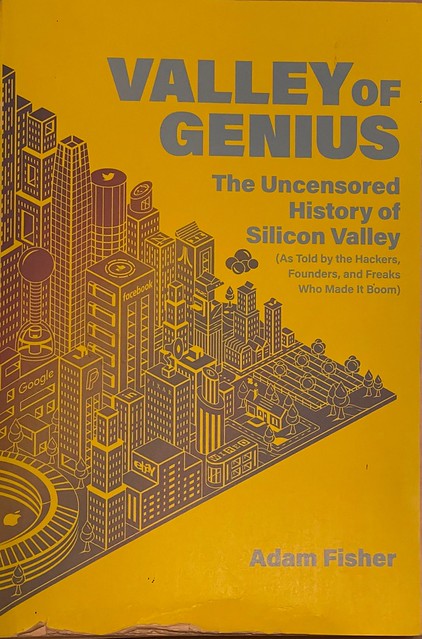
Valley of Genius by Adam Fisher promises to be ‘the uncensored history of Silicon Valley’ based on stories that founders and programmers told to each other. All of which begs the question how much is myth making and how much is true?
Valley of Genius front cover
Getting to the truth
Having worked for Silicon Valley clients and in-house at Yahoo!; I recognise that the truth doesn’t get out there and the myth making is largely self-serving. There is also a big question about how far the collective memory actually goes back.
Finally, there is the challenge of how big tech companies have got so good at controlling their story in the wider world. Whether it was keeping close tabs on journalists like Fred Vogelstein found out while working at Wired magazine, through Frank X Shaw’s reputation for robust rebuttal, funded their own media outlets like Pando Daily and eventually disintermediated the media altogether.
Adam Fisher
Adam Fisher grew up in the Bay Area and became a journalist and later editor at Wired. He left there and freelanced for a number of publications, branching out from technology writing to other areas like travel and tourism.
Style
The most noticeable thing about Valley of Genius when you get into it is that there is no prose. It is all dialogue. Fisher has cut together segments of interviews to tell a story. Sometimes it feels like people around a table, other times it feels more disjointed.
The book is described as an oral history and Fisher in his interviews describes the process as being like putting together documentary interviews.
Fisher went out and interviewed many of the great and the good of Silicon Valley to get this material, however given some of the soundbites were things I had heard before such as Steve Jobs talking about a computer as a ‘bicycle of the mind’; I was not sure if these people like to self reference or if Fisher has interspersed his interviews with archival material. Right at the end of the book, Fisher comes a list of people by chapter and where he had to source secondhand quotes from.
I’ve read a number of books on Silicon Valley over the years, so had a frame of reference and I had context, so I found Valley of Genius enjoyable to read. But for someone who is coming to the subject with just a cursory knowledge of Silicon Valley, there is benefits to having a guide. Reading the quotes without understanding the context, or having been to Silicon Valley still leaves you outside.
I honestly don’t know if Fisher would have been a good guide, so him removing his voice from the book maybe less of a loss than we might think. But a new reader to the subject matter would benefit from a guide like Michael S. Malone or the insider snark of Robert X. Cringely (aka Mark Stephens). Fisher’s book Valley of Genius is a book for insiders and future academics who might be looking at the history of Silicon Valley in the future. According to Fisher, he managed to secure the last interview that Bob Taylor ever gave. Bob Taylor played key roles in moving Silicon Valley forward while in managerial positions at NASA, ARPA and XEROX PARC. In those interview quotes are more granular aspects of things, like Nolan Bushnell having a champagne party on the grass outside the offices of a recently bankrupt competitor, or that the video card to power the monitor used in Doug Engelbart measured about 3 foot by 4 foot in size.
It’s also a very one dimensional view of Silicon Valley. It largely misses out hardware and hard innovation; which is problematic for a technology hub that is competing against China and India for that matter. There is no 3Com, Cisco or Juniper Networks. The hardware story is very much lacking, there is no Intel, AMD or Nvidia, Sun Microsystems or SGI. It is largely a consumer technology vision that writes out businesses like Oracle and Salesforce together with the characters that lead them.
Plot line
Valley of Genius ignores a good deal of early Silicon Valley, such as the the pre-war nature of Stanford, Varian, Bill Hewlett and David Packard’s garage start-up, Shockley Labs, the treacherous eight, defence contracting and the missile age.
Mother of all demos
Instead Valley of Genius history starts at 1968, when Dough Engelbart of Stanford Research Institute provides the Mother of all Demos to a mix of academics, government people from the likes of the department of defense and technologists.
Engelbart talks about his developments in 1986
He the talked about his career on the Google campus in 2007.
Atari
The story moves on to Atari and Nolan Bushnell. Bushnell was responsible for popularising computer games and arcade consoles. Bushnell was a bridge between the counter culture and Silicon Valley hustle. A few chapters later Valley of Genius also covers the acquisition and eventual (first) failure of Atari.
Here’s Bushnell being interviewed for the 50th anniversary of Atari by IGN.
Bushnell did a Google Talk a number of years ago as well.
Xerox PARC
PARC (Palo Alto Research Center) was a west coast R&D facility put together by Xerox to understand what the future of work would look like. They had already realised that it would be computerised. From PARC came modern computers, local area networks, file servers, laser printers and productivity software.
Apple
In separate chapters Valley of Genius covers Steve Jobs and Steve Wozniak’s commercialisation of phone hacking tools, and the evolution of the Apple computer line up from the Apple II to the Macintosh.
Retailer High Technology did the first adverts featuring the Apple II computer
Which was a far more budget affair than Apple’s own launch of the Machintosh.
The book goes on to cover the return of CEO Steve Jobs and the rejuvenation of Apple as a business including the iPod, iPhone and iPad through to the death of Jobs.
The hacker ethic, or hacker culture
The hacker ethic or culture, a digital equivalent of the person who tinkers away with things in a shed or garage has their own section. The section is atemporal in nature, which I can understand to a certain extent. Steve Wozniak came out of hacker culture, as have many software developers over time.
Fisher focuses on what hacker culture is, rather than what it means (both good and bad). I would recommend Steven Levy’s Hackers: Heroes of the computer revolution as a companion to this chapter in Valley of Genius. The copy I read years ago was published by Penguin, but O’Reilly have re-published it as the book this is part of myth-making and cultural norming in software development teams.
The WeLL
The WeLL was the proto-online community that is still going and features first generation digerati such as journalist Wendy Grossman, the founders of Wired magazine and cyberpunk author Bruce Sterling.
Stewart Brand talked about the founding of The WeLL during a Google hosted talk
The WeLL never scaled in the same way that we think about social networks now but it has quality discussions and is much kinder than Twitter or Reddit.
VPL
VPL was a failed start-up in the mid-1990s that set much of the expectations and tempo on VR to this day. You will most likely know it from the VR suit featured in The Lawnmower Man movie. I covered it in more depth in my metaverse discussion paper.
General Magic
Take a series of burnt out Apple employees and have them invent a predecessor of the net appliance or smartphone. That was General Magic and it was a glorious failure. Sarah Kerruish’s documentary on General Magic tells the story much better.
Wired magazine
Wired magazine gets its own chapter. it represented a way of melding culture and technology. I had read Wired before I had used the web, but it gave me a good idea of what to expect. But I don’t know if it is more important than ZDnet or other technology publishing houses. Valley of Genius goes on to celebrate Wired’s online endeavours including HotWired, Suck – a sarcastic version of Wired and Webmonkey – which taught a lot of people web development skills and probably doesn’t get the love it deserves in Valley of Genius. Mondo 2000, a rival to Wired in terms of setting the cultural zeitgeist for technologists also gets a chapter.
Pixar
Pixar as a Silicon Valley story is an accident due to two things
George Lucas’ Industrial Light & Magic being based in North California rather than in Los Angeles
Steve Jobs looking for a project post-Apple
But it didn’t necessarily move Silicon Valley forward.
Netscape
The jump to Netscape as the first commercial browser makes sense. AOL, AT&T True Experience, CompuServe and Prodigy services were all driven by businesses outside the traditional Silicon Valley space.
At the time Netscape seemed as much about the crazy public valuation of the business which was emblematic of the dot com boom, as it was about the software that would kick off the open web. These kind of valuations re-emerged with businesses like Uber and WeWork.
eBay
eBay was the standout e-commerce play for Silicon Valley. Amazon was a Seattle company and so was an outsider in a similar way that Microsoft always had been. eBay was also founded by an ex-General Magic employee and so was part of Silicon Valley’s version of ‘Rock family trees‘. We see this even now with the ‘PayPal mafia’.
Google
Google changed the web experience that Silicon Valley had pioneered via Yahoo! and Excite. Brin and Page became a key point of focus in Valley of Genius. However, this ignores the complexity both around search and the development of foundational web technologies that other companies produced. If you are interested about the nature and history of Google, Steven Levy’s In The Plex is probably a better option to read.
Google’s move to pay per click advertising gets its own chapter that greatly reduces the complexity of the real story.
Napster
Napster was the poster child of market value destruction and disruption that predated Uber and its ilk.
Dot bomb
The dot com boom can be charted from the last quarter of 1995 and reached its nadir in the last quarter of 2002.
Eric Steiner tells his tale as the CEO of Inktomi through the dot com boom and bust
Valley of Genius covers it in terms of its sociological impact on the Bay Area, as much as its economic impact. The reality is more complex, even the dot.com label attached to it is a misnomer. It encompassed telecoms, networking hardware, datacenters and more in terms of its impact rather than just e-businesses.
Facebook
While Facebook was an east coast invention, the movement of the company and its CEO Mark Zuckerberg west saw a cultural change in Silicon Valley that took it down a much darker patch. By comparison Twitter in its start-up phase looked more like Atari in terms of its counterculture influence.
Future gazing
At the end of the book there is a section on future gazing, which became what made Silicon Valley great. The business model was prioritised over innovation. Veteran journalist John Markoff even talked about how Salesforce had moved to a ‘vertical campus’ model with Salesforce tower. Which is how every other business in places like Singapore, Hong Kong and even Wall Street work anyway.
There was a singular lack of reflection on challenges ahead or areas of introspection by the people telling these stories. If anything, that was what concerned me the most about the book. Innovation is at a technological, scientific and socio-cultural cross-roads and the inhabitants of the Valley of Genius apparently doesn’t have a clue. More on the book here. You can find more of my book reviews here.
Extra content – Valley of Genius promotional tour interviews
Panel hosted by Adam Fisher to promote the Valley of Genius book
Leo LePort interviews Fisher on Valley of Genius at the time of its launch.
Subprime attention crisis is a short book, or a long essay depending on the way you want to look at it. It was written by Tim Hwang.
About Tim Hwang
Hwang is a lawyer working for email newsletter platform Substack. Prior to this he worked in a US think tank attached to Georgetown University: Center for Security and Emerging Technology and in public policy at Google focused on machine learning. So he brings a deep set of knowledge to writing Subprime attention crisis. One also has to bear in mind that his current employee Substack is based on the online media model moving from online advertising driven to subscription driven.
Timing is everything
I read this book over a couple of days at the beginning of this month. By this time, Meta and Alphabet has published quarterly results that were below what investors expected with falling sales. Add into the mix that the problems that Twitter and Snap have had (which are are bigger issues than just down to the dynamics of the online advertising market), all of which makes this book feel timely.
On the other hand, one could also argue that much of the crisis had already landed. Ad tech businesses like Rubicon Project have either gone under or merged with their peers creating a massive amount of consolidation. The latest wave of consolidation happened in 2020 – 2021.
Meta-specific issues
Even with Meta and Alphabet there are business specific issues. Meta has struggled to compete effectively with TikTok. The poisonous nature of debates on Facebook, together with an aging audience on the platform hasn’t helped. In fact it’s a wonder that the context collapse that the platform has suffered from for at least the past six years hadn’t dragged it down yet. WhatsApp has helped enrich Facebook data and provided a channel for business services. At the time Facebook bought the business partly because Zuckerberg needed a brain trust for the future. The brain trust is gone and Zuckerberg’s dive into the Metaverse looks very similar to Apple’s peak John Sculley moment with the Knowledge Navigator concept. You can see glimpses of the Knowledge Navigator in the smartphone, the iPad, the now abandoned WikiReader product or the use of contextual information and national language processing like Siri. Apple didn’t waste the kind of money that Meta has spent chasing an illusory vision of the future.
Alphabet-specific issues
I was surprised that Alphabet growth had lasted this long based on the following considerations:
With mobile, Google also pivoted a different type of search from product search to where is my nearest coffee shop with free wifi and has managed to sell search ads against them. This meant that Amazon and eBay managed to capture a lot of product searches, with consumers only hitting up Google afterwards and Amazon’s advertising has been eating Google’s lunch. Secondly a lot of the high street and neighbourhood shops have been eaten alive by food delivery services and this was then exasperated by the COVID which has changed at least some people’s consumer behaviour
Historically, Google has been too focused on looking for multi-billion dollar opportunities which haven’t panned out and closed down smaller services that were making money and bringing in attention. In essence, over the years they have thought Google Reader, the Google Search Appliance, Google Health, Boston Dynamics and several other projects were the big payday. They weren’t, but they were respectable business opportunities, just too small for Google to want to pursue. In its wake Google had destroyed entire sectors, or turned them into cottage industries such as enterprise search and knowledge management, RSS newsreaders autonomous robots
“something like almost 40% of young people when they’re looking for a place for lunch, they don’t go to Google Maps or Search, they go to TikTok or Instagram.”
YouTube seems to struggle getting brand building advertising dollars in the face of TikTok, Instagram and this explains why you saw a decline in sales over 2 percent. Instead you see a lot of D2C product ads a la day trading and drop shipping courses advertised. Part of this might be down to the product. YouTube has been screwing over creators and creators have made it clear that they’re not happy. You don’t need to go to YouTube if you get the directors cut of your favourite creators content on Patreon or Curiosity Stream. Censorship of political analysis content around China or Ukraine seems to be particularly bad.
Back to Subprime attention crisis
Hwang in Subprime attention crisis points out many of the things that agency employees and owners have known for years:
Online advertising effectiveness has declined compared to its performance 25 years ago
Audiences don’t see a lot of the ads that are displayed. Different reports will give you different numbers on this
Online advertising is destroying the very media industry that its content is shown on
Online advertising fraud is a big problem
Online advertising business practices are an even bigger problem with up to 70 percent of of online programmatic advertising spend going to advertising technology intermediaries such as The Rubicon Project (now Magnite) and Xaxis
This has allowed businesses like Procter & Gamble and adidas to reduce advertising spend at no loss in effectiveness. In the case of P&G Subprime attention crisis highlights how they cut $200 million in online advertising spend, moved that spend on to offline media like radio and print AND managed to increase their reach by 10 percent.
More on adidas via its inhouse head of media Simon Peel
Hwang marshals his facts well. Which is what you would expect from a lawyer. He uses analogous examples from the US financial services sector including the 2008 financial crisis. The book itself is 141 pages in length and there is a substantial section detailing his sources. Subprime attention crisis is based exclusively on desk research.