Welcome to the Singapore category of this blog. So first up a disclosure, back when I worked in Hong Kong, I did some work for the Singapore government ‘home team’. The work was done for their Central Narcotics Bureau and the Singapore Prison Service. Beyond friends that live there, I have no connections commercial or otherwise with Singapore now.
I have had the opportunity visit the city state and really loved it. Is it better to Hong Kong, politics non withstanding I don’t think a true comparison works that way. It has a more Germanic character than Hong Kong, but both are very similar in terms of the people and the built environment.
This is where I share anything that relates to Singaporean business issues, the Singaporean people or culture. Often posts that appear in this category will appear in other categories as well. So if Singapore Air launched a new ad campaign. And that I thought was particularly interesting or noteworthy, that might appear in branding as well as Singapore la.
So far, I haven’t had too much Singaporean related content here at the moment. That’s just the way things work out sometimes.
I am fascinated by the way Singapore has been deftly playing China to increase its stature as the place to do business. I am only interested in local politics when it intersects with business. An example of this would be legal issues affecting the media sector for instance.
If there are Singaporean related subjects that you think would fit with this blog, feel free to let me know by leaving a comment in the ‘Get in touch’ section of this blog here.
Political polarisation between Democrats and Republicans
Political polarisation has been talked about for years. The schism in UK society caused by Brexit has been exhaustively examined including sometimes on this blog. This video is based on research by PRRI, you can see more about the research here. There are a number of outtakes in the data including the different party supporters relative openness to diversity and by implication societal change which was covered by Vox a couple of years ago. Republicans were reluctant to have a trans person in their family. Scott Galloway highlights that prejudice isn’t only about colour or gender identity.
We’re seeing Democrat supporters who believe that their personal identity is intrinsically entwined with their political opinions. They believe that a confrontation with your opinion is the same as a confrontation with your identity. All of which implies an underlying brittleness and lack of resilience to their prejudice rather than ignorance.
When Shinto became a religion
Really interesting video on the history and nature of Shinto, the Japanese belief system.
Artist creates personas for Singapore
I loved this project design that uses iconic every day items to reflect what Singapore might look like as a person. In many respects the items selected also reminded me of everyday live in Hong Kong. Which I guess goes to show that we have more in common than things that separate use.
Pets.com
I was looking at vintage ads as part of a wider internal project at work on Super Bowl advertising. During that time I delved into Pets.com content. One of the things I found was some outtakes that TBWA\Chiat\Day shot for use by San Francisco interactive agency Lot21. (Interactive agency ages this to the late 1990s, back to when the agency wanted to do both CD-ROM type experiences and websites in their agency in case this web thing turned out to be a fad.)
This content was designed to be held on the Pets.com puppet profile page, think a Geocities type page or author profile page on Blogspot or Live Journal. It all feels like the kind of things that brand teams would so for social platforms now.
Koyaanisqatsi
Philip Glass’ soundtrack for movie Koyaanisqatsi gets the 8-bit treatment with a remake by Shiryu. Shiryu calls it a remix, but really its a cover version.
Product design is pain
Mike Glover talks about how he and his colleagues problem solved to come up with the specification for the modern Opscore military helmet. Its an interesting story from a product design point of view.
You can hear about how they modified their old equipment and these alterations were then parleyed into the current industrial design by the manufacturer.
Luxury Stores Across the US Hit By Mass Heists in the Same Week – Robb Report – this sounds like a classic example of steaming. Steaming is a British phrase describing the phenomenon of shoplifting, when a large group of (usually youths) enter a store en masse and engage in shoplifting. Steaming puts a strain on shop security, it often causes panic in the store and creates so many suspects for the police to chase down. For the shoplifters steaming reduces the individual risk of getting caught. In large department stores, steaming becomes easier because of the number of exits. There are usually enough people involved to push past hastily set up security checkpoints during steaming. Young people are particularly attracted to steaming for a couple of reasons:
Low risk, high reward
Low impact of criminal penalties for many depending on their age
Peer pressure from other older members organising the steaming group
When I was in secondary school, we had a trip to Paris. A good number of peers one day engaged in steaming. They managed to make off to a large amount of Lacoste and Sergio Tachini sports clothing which was popular in Merseyside at the time. Steaming was also a central part of football casual culture. Much of the sportswear back in the 1980s were fenced goods. Criminal gangs followed European football games and practiced steaming in the lead up to a match at major department stores across France, Spain and Italy. The items were then sold on to groups of football fans back home through informal networks. What surprised me about this group doing the steaming was the nature of their crime. They were steaming boutiques, which have less entrances and exits than department stores. Boutiques often have queues of people to get in and security on the doors that would be bad for practicing steaming.
So what went wrong with store security to prevent steaming? Has steaming been facilitated by a cut back in security for cost cutting purposes? If so, will insurance companies honour losses incurred through these steaming attacks?
Beauty
Prestige beauty: Inside Unilever’s growth engine | Vogue Business – Dana Kreutzer, project lead for beauty and personal care at US research firm Kline, says the acquisition “demonstrates the company’s focus on expanding its portfolio to include more digitally-led brands and clinical-grade skin care, which is a fast-moving segment in the skincare space”.
Opinion | We Spent a Year Investigating What the Chinese Army Is Buying. Here’s What We Learned. – POLITICO – the Chinese military is “intelligentizing” warfare by purchasing AI systems for all manner of applications, including autonomous vehicles, intelligence analysis, decision support, electronic warfare and cyber operations. At the same time, we found reason to be skeptical of the most ominous predictions about China’s efforts to fully automate warfare through “doomsday”-like weapons. Perhaps most importantly for U.S. policymakers, our investigation into the PLA’s buying habits shows how Chinese progress in military AI is being driven, in part, by access to American technology and capital. Our report highlights the critical role U.S. companies play in supplying China with data, software and funding. This points to serious shortcomings in the U.S. export control system, which wasn’t built to screen the high volume of technology transfer and capital flows into China, and which struggles to distinguish between military and civilian purchasers. Even as the United States attempts to decouple supply chains from China when it comes to American goods, it also needs to consider new strategies to prevent American know-how from inadvertently powering China’s technological advancements
In the Russian Arctic, China treads on thinning ice | China Dialogues – In order to reach its goal of becoming a ‘polar great power’ China will need to lessen its dependence on Russian support and expand its economic and political ties with other Arctic states. This may present Arctic states with an opportunity to set limits on China’s regional influence, but the benefits of any such limitation must be measured against the importance of giving China a stake in the fight against climate change. In the traditionally calm waters of the Arctic, China’s ‘Arctic Policy White Paper’ made much of a splash when it was first released in 2018. The paper showed, as was argued at the time by politicians and pundits, that Beijing would seek to establish itself as a new Arctic power, and in the process deprive the eight Arctic states of their control over the region’s abundant natural resources
Solomon Islands PM Manasseh Sogavare faces calls to resign over China diplomatic ties | South China Morning Post – The protest began peacefully, but schools and businesses were shut by the afternoon as crowds tried to enter parliament demanding PM Manasseh Sogavare step down. Protesters were angry about lack of promised development and the Solomons government’s 2019 decision to cut ties with Taiwan and establish a formal relationship with China – the big question is what will China do to keep Sogavare or his party in power and maintain the status quo?
Secret Chinese Port Project in Persian Gulf Rattles U.S. Relations With U.A.E. – WSJ – U.S. intelligence agencies learned this spring that China was secretly building what they suspected was a military facility at a port in the United Arab Emirates, one of the U.S.’s closest Mideast allies, according to people familiar with the matter
Is the China-Europe Express becoming a political weapon in the hands of China? | RailFreight.com – China launched the Belt and Road initiative with the purpose to enhance Eurasian transport links. It includes Chinese cities, transit countries through Asia and European destinations. Understandably, such a vast investment from the Chinese side, including involvement in other countries’ economies, could constitute a political and economic hazard. Maja Bakran Marcich, the Deputy Director-General for Mobility and Transport at the European Commission, had warned some months ago that good synergies between Europe and China should be characterised by mutual respect and control over the power relations.
It seems that when Marcich was saying that, she had a similar situation in mind. The New Silk Road is a crucial and fast-developing part of the global supply chain, putting rail freight at the forefront of transportation. However, it looks like it has the possibility of becoming a dangerous card on the table of diplomatic and political games. Should China have the liberty of just cancelling Eurasian train services in the name of political disputes? And shouldn’t the New Silk Road focus only on transportation purposes?
Chinese doctors query Beijing’s Covid contact tracing policy | Financial Times – the way that the Chinese government is going about it fits in with the concept of struggle in Stalinist thought. That the struggle is not only done but seen to be done. The doctors challenge therefore represents a much more profound dissonant voice against the CPC than the content in the article suggests. For this reason alone, they’ll likely spend some time down at the local public security office sitting in a tiger chair and agreeing to sign a document apologising. They will also have earned a huge black mark on their credit score at the very least.
Kevin Rudd: “China views the UK as weaker after Brexit” – New Statesman – three core ideological undercurrents that form Beijing’s economic and foreign policy. First, China’s domineering relationship with its neighbours is shaped by its perception that it sits atop a regional hierarchy rooted in its imperial past. Second, the Chinese Communist Party’s Marxist-Leninism results in the dual conclusions that China’s time has come and the struggle between reactionary and progressive forces places China in opposition to the United States. The third undercurrent is national reunification with Taiwan – what Rudd describes as the central organising principle of China’s plans for East Asia first and then globally. Hence China’s work in the Antarctic and inserting itself as an Artic power without any semblance of claims.
China Is Jihadis’ New Target – In early October, an Islamic State-Khorasan bomber killed nearly 50 people at a mosque in Kunduz, Afghanistan. That the militant group claimed responsibility for the attack wasn’t surprising, but, in a worrying new twist for Beijing, it also decided to link the massacre to China: The group said that the bomber was Uyghur and that the attack was aimed at punishing the Taliban for their close cooperation with China despite its actions against Uyghurs in Xinjiang. China was long seen as a secondary target by international terrorist organizations. Groups like al Qaeda and the Islamic State were so focused on targeting the United States, the West more generally, or their local adversaries that they rarely raised their weapons toward China, even though they may have wanted to due to, for example, China’s mistreatment of Uyghur Muslims. But in Kunduz, this narrative was brought brutally to a close. China can now consider itself a clear target. – probably more worrying for China is the risk that this kind of action will pose to them in other geographies like the Middle East and Africa and along the parts of the belt and road that go through restive muslim majority regions of the former Soviet Union
Why Is Gen Z Acting Like Boomers Right Now? – Gen Z’s frantic, chain email-flavored TikToks prove naivety and gullibility is ageless. Not surprising given the younger cohorts in the resistor segment of COVID regulation compliance that research by Kings College London found last year.
Chinese parents find new ways to give their children an edge | Financial Times – parents have been seeking new ways to give their children an edge in the cut-throat university entrance examinations. Instead of signing up for foreign language classes, barred by the regulations, parents instead opt for non-core curriculum subjects like art, which are taught in English, says Ekaterina Kologrivaya, co-founder of Edtech Expand, a Beijing-based consulting start-up. Many of the large tutoring companies have closed their physical classrooms, transferring online to save costs. But Beijing barred local firms from hiring tutors located overseas, driving up demand for the depleted number of foreign teachers in China, unable to get into the country due to strict border controls. This has pushed up the prices of classes taught by foreigners, including debate classes, another crafty way for students to master prized English skills while abiding by the new rules
Is China’s catch-up growth over? – by Noah Smith – Noahpinion – But all things come to an end. Every other spurt of rapid development has eventually slowed to the stately pace of a mature economy. There are basically two reasons this happens. First, as you build more physical capital — more buildings, roads, railways, machine tools, vehicles — the added output of each new piece of capital goes down, while the upkeep costs just keep rising. This is the basis of the famous Solow growth model, and we’ve seen this happen again and again to fast-developing countries. The second reason rapid growth peters out is that it’s easier to copy existing technologies from other countries than to invent new ones yourself. The real question is when this slowdown happens. Japan’s history provides an interesting example here. Here’s a graph of Japan’s income per capita (at purchasing power parity) as a fraction of America’s: You can see that Japan’s catch-up (at least, post-WW2) really happened in two phases. There was rapid catch-up until the early 1970s, then a few years where catch-up paused, then a resumption of catch-up at a slower pace for about 15 more years. After the bursting of the country’s famous land bubble, its economy actually lost ground to the U.S. (rapid population aging was also a big part of this), and settled in at around 75% of U.S. levels (fairly standard for a medium-sized developed country). Economists have found that this pattern is very typical. In a pair of famous papers in 2012 and 2013, Barry Eichengreen, Donghyun Park and Kwanho Shin found that fast-growing countries tend to slow down when they reach a certain income level – peak China
Finance
The ‘Tesla-financial complex’: how carmaker gained influence over the markets | Financial Times – the real importance and wider footprint of what might be called the “Tesla-financial complex” far outstrips the company’s market capitalisation. This is thanks to a vast, tangled web of dependent investment vehicles, corporate emulators and an enormous associated derivatives market of unparalleled breadth, depth and hyperactivity. Combined, these factors mean Tesla’s influence over the ebb and flow of the stock market is far greater than even its size would imply. It may even be historically unrivalled in its wider impact, some analysts say – is there a market squeeze opportunity? The parallels with Porsche in this regard are striking
Close Reading of the QAnon Shaman’s Conspiracy Manifesto ‹ Literary Hub – the legitimate skepticism inspired by historical events like the assassination of JFK (and the Warren report’s open-and-shut verdict on it) has mutated into a toxic skepticism that is not only hostile to government institutions but has turned on gatekeepers like the press, scientists, and medical authorities, provoking an epistemological duel to the death over facts and alt-facts, truth and truthiness. The effect of these attacks and counterattacks is “mutually assured disqualification,” Bratich argued, in a 2017 lecture, punning on the Cold War doctrine of Mutually Assured Destruction. And the effect of that is what could be called epistemological vertigo—the pervasive sense of not knowing how to sort fact from falsehood; of being unmoored from the truth. It’s what makes so many grab onto the reassuringly black-and-white theology of conspiracism. And it is a theology, Manichean in its cosmic struggle between good and evil, apocalyptic in its conviction that we’re living in the end times. “There is a war on humanity, there is a war on religion, there is a war on human assembly,” said Naomi Wolf, on Fox News Primetime. “Big Tech wants to drive everyone indoors and dissolve the bonds between people.” – interesting, though the writer shows their own belief in conspiracy theories
Carbon Counter/EVs: cleaner electricity makes a big difference to emissions | Financial Times – In the UK, US and Germany such vehicles offer large emission reductions of 76 per cent, 60 per cent and 49 per cent respectively when run on the typical mix of power sources in mains electricity. Germany’s poor performance reflects its exposure to dirty lignite and coal as fuels. Hydroelectric-dependent countries such as Norway do strikingly better. However, a much smaller reduction in emissions occurs in China, at less than a fifth. China has the biggest market for plug-in cars. Fully electric vehicles accounted for 9 per cent of its entire market in the first half of this year, more than double the figure for 2019. Every year it adds more solar power capacity than any other nation. But as of November 2020, two-thirds of China’s electricity came from coal-fired generation, says the IEA. China’s huge appetite for coal means it plans to add almost a fifth to its coal-powered generation capacity of more than 1,000GW.
Disney CEO: We’re Ready for a Metaverse Future – The Hollywood Reporter – “Our efforts to date are merely a prologue to a time when we’ll be able to connect the physical and digital worlds even more closely, allowing for storytelling without boundaries in our own Disney metaverse, and we look forward to creating unparalleled opportunities for consumers to experience everything Disney has to offer across our products and platforms, wherever the consumer may be.”
ABC the American network broadcast brand has had its logo redesigned. Like some of the best design in corporate American the logo owes its roots to designer Paul Rand back in 1962. It went colour when TV broadcasting did and went skeuomorphic web web 2.0 and early versions of iOS were in vogue.
ABC logo redesign
The design has gone flat again, very close to Rand’s original design with slight changes in the proportions of the letters. This will work for everything from station ID and watermarking to app logos. You can read more on the ABC logo redesign at Variety.
Shang Chi
Shang-Chi is a character that Marvel came up with with the kung fu craze started to kick off in the early 1970s. Originally his power was derived from his father being Fu Manchu.
The Castle of Fu Manchu
Dr Fu was invented as a character in the early 20th century as a kind of super villain in the mood of Marvel or James Bond films. He predated Marvel but appeared in the origin story in a Wold Newtonesque way. It tapped into stereotypes around yellow face portrayals of Chinese culture, eastern devilry and unemotional cruelty. Themes of orientals invading the west and white slavery came up in the books and films.
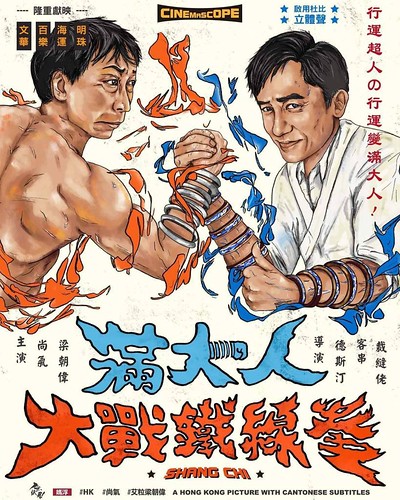
Marvel have since had to rewrite the origin story considerably for Shang Chi as they want to sanitise the original racist back story. Dr Fu becomes Xu Wenwu. Marvel managed to get Hong Kong cinema’s equivalent of Cary Grant or George Clooney Tony Leung Chiu-wa aka ‘small Tony’ to play Xu.
Despite all that work the Marvel film may not open in China at all. A straw poll of Asian friends found that the costumes felt ‘dated’ in comparison to local dramas and films of a martial arts fantasy or ‘wuxia’ style.
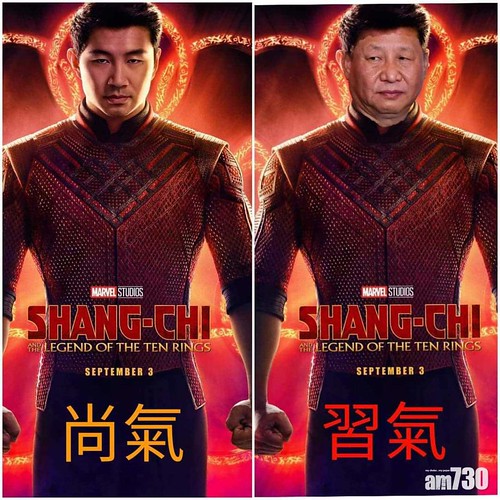
The veteran Hong Kong actors outshone the ‘heroes’. The main hero was ‘ugly’ and looked like a young Xi Jingping.
Iron rings are generally used for training in martial arts, in a similar way that a runner may run with ankle weights to build strength. There have been a few films where the rings became an offensive weapon notably Kung Fu Hustle, which got memed. (They are also used for fighting in the Return Of The 5 Deadly Venoms – you have to be a fan of cult kung fu films to be familiar with them. Iron rings appear as part of the training regime in Drunken Master & The 36th Chamber of Shaolin. )
D.P.
Netflix have had a ht on their hands with D.P. (Deserter Pursuit) – Korean soldiers tasked with tracking down deserters who have left the army during their conscription period. The series seems to have struck a nerve with the armed services who denied that the bullying shown in the show is tolerated any more.
But the media has plenty of conscripts willing to admit that it has and was even worse in real life.
Lady Dior bag
The Lady Dior bag is an iconic design for Christian Dior. It appears year after year in their range. It was made famous by Princess Diana. Back then it was called the Chouchou. Confused yet? You can see the bag being made from lambskin leather by hand in this video.
The bag is built around a last like a shoe, the last has a split in it, which I think is designed to aid its removal from the bag at the right time. More related content here.
CSIS has a great talk that looks at the resilience of Chinese institutions. The CSIS is a US think tank better known as the Center for Strategic & International Studies. They held a talking on Rethinking Chinese Politics – in terms of having a better understanding of the dynamics and the resilience of the Chinese institutions involved. The recentralisation of power under Xi Jingping was seen to subvert Chinese institutions, but Jiang Zemin’s actions had a similar role in previous years.
Interesting discussion on the resilience of Chinese institutions
Consumer behaviour
China’s Generation N: the young nationalists who have Beijing’s back | South China Morning Post – Nationalism has been on the rise, encouraged by the Communist Party and put to effective use by President Xi Jinping. Younger generations’ perceptions and expectations of their country differ from those of the past, offering the government support but also challenges – basically China might get screwed over by its own rhetoric and propaganda to its people. However it poses problems for western businesses that rely on the Chinese market
State Media Calls on Hong Kong to Compensate For Tide of Emigration — Radio Free Asia – “There is a high proportion of professionals — 12 percent — among those emigrating,” the article said. “The Hong Kong government should pay close attention to the increase in the number of professionals emigrating, and set out a long-term response strategy,” it said. The article appeared particularly concerned over the loss of medical professionals from Hong Kong, suggesting the government focus on recruiting healthcare workers from mainland China and overseas. The exodus looks set to hit the healthcare sector hard, with the Hospital Authority (HA) reporting the loss of 4.6 percent of doctors and 6.5 percent of nurses in public hospitals – there is a similar impact in third level teaching as well
Chinese media back diatribe calling for crackdown to be expanded | Financial Times – “The capital market will no longer become a paradise for capitalists to get rich overnight . . . the cultural market will no longer be a paradise for sissy stars and news and public opinion will no longer be in a position worshipping western culture,” – pretty much on point for Chinese state belief. There has been concerns that K-pop idol culture with its androgynous dressing stars would be ruining Chinese macho culture. This also fits into the dialogue about left behind women considered responsible for the decline in birth rate
SenseTime heads for IPO on Hong Kong exchange | Financial Times – SenseTime said it was subject to “complex and evolving” laws around data protection, including new draft regulations for cyber security reviews in China. “We cannot predict the impact of the draft measures, if any, at this stage,”
ARM China Seizes IP, Relaunches as an ‘Independent’ Company – ExtremeTech – It is not clear how much pressure was put on SoftBank to form the merger, but this looks like one of the most blatant examples of IP theft that we’ve seen. The Chinese arm of a company has gone rogue and refused to obey the ruling of its own board. The head of that company is essentially treating it as a personal fiefdom, and Chinese authorities do not appear to have taken meaningful action to reign in Mr. Wu. While ARM China does not currently have access to the ARMv9 instruction set or any additional ARM IP, it appears that the company will attempt to use previously transferred assets to bootstrap its own transformation into an “independent” company – yes, sounds about right. China waging war by other means, also splitting fits into China’s desire to self-reliant
Apple CEO Tim Cook Expected To Retire After Completing One Last Product Category / Digital Information World – Tim Cook noted that, when asked, he would probably not be around for Apple in approximately the next ten years. And just like that, one of the most influential men in the world steps down, leaving an unpredictable future in his stead. However, 10 years is a long time, and Tim Cook seems to have an idea as far as establishing a legacy goes. – the hubris of John Sculley and the Newton comes to mind….
I couldn’t avoid doing a post on Afghanistan given what had been going on this week. The Afghanistan conflict posed a number of interesting questions about:
What privacy and security means for the people left behind in Afghanistan in the digital age
Why strategy is seldom a teacher and several countries have made the same mistake in Afghanistan – (Britain did so twice!)
The failure of intelligence in Afghanistan reminded me of the failure of intelligence agencies to realise that the fall of the Berlin Wall would happen. There was also a failure to underhand who the players were and their motivations in Afghanistan
What will Afghanistan mean for Pakistan moving forwards? Once out, the west has the perfect opportunity to shun Pakistan; which will leave the country vulnerable to Chinese predatory practices
The US Is Removing Records of Its War in Afghanistan From the Internet – Lives are on the line here, but helping them may mean destroying—even if temporarily—the memory of the war and all that happened. It’s a horrible problem to face. One potential solution would be for the U.S. and its allies to take as many Afghan refugees as want to flee the country. – it assumes that the Taliban and supporters like the Pakistani ISI intelligence agency haven’t been caching this material themselves over the years. Things got rolled up so fast, they probably have hold of records from Afghanistan government payroll ledgers to intelligence reports
Germany Flew 65,000 Beer Cans Out of Afghanistan, but Just 7 People on an Evacuation Flight – “There was transport capacity for alcohol, but not for the local staff in Afghanistan,” read a piece in Germany’s Bild newspaper, referring to the fact that the German military had earlier flown home 65,000 cans of beer and 340 bottles of wine before it withdrew from its bases in Mazar-e Sharif and Kabul at the end of June. – surely they could have blown up the alcohol and put people on the flights? – this is the kind of thing that fuels future grudges that morph into terrorist attacks. But it also shows the colossal failure in intelligence in a microcosm
SIGAR | Lessons Learned. The Ides of August – a couple of good post-mortem reads on Afghanistan. A few things struck me. Mission creep had been baked in, although much of that was down to the allies partnering with the Northern Alliance and liberal values. The dual nature of Pakistan, which I suspect Pakistan will get punished for in the longer term. The lack of intelligence on the main players involved such as former president of Afghanistan Hamid Karzai
Beauty
Skincare Preferences by Generation | NPD Group – Despite the generational differences in skincare preferences, there are also commonalities. At the end of the day, it seems we’re not so different, after all. Whether they are more like my mother or my cousin, we see from consumers across-the-board that they are open to trying new things, are looking for clean ingredients, and simply want skincare that produces results from a brand they can trust. Regardless of the trends driving the category, the demand for efficacy and transparency is here to stay
Business
Wolfsburg, we have a problem: How Volkswagen stalled in China | Reuters – Last month, though, he said Volkswagen had fixed the problems revealed by the test, that the ructions of the episode had subsided and the carmaker’s Chinese business was recovering. “We have once again clearly one of the safest cars on the market in this segment,” Woellenstein told reporters in July. “We will once again take up the old leadership of the Passat.”But there is quite some ground to regain in the large family car segment. A total of 47,480 Passats were sold in the first six months of this year in China, some way behind the 91,110 Toyota Camrys (7203.T) and 89,157 Honda Accords (7267.T), according to LMC. The figures from the same period of 2019, before the pandemic struck, show how steeply the Volkswagen model has fallen away of late: 91,400 Passats were sold versus 111,968 Accords and 85,396 Camrys. – I am surprised by this, given Volkswagen’s obsession with common platforms
Tata’s rise mirrors the sweep of India’s history | Financial Times – Tata is no longer at India’s entrepreneurial vanguard. The likes of Mukesh Ambani’s Reliance Industries and Gautam Adani’s eponymous group, with their investments in telecoms and renewable energy, hold stronger claim to be the “nation builders” of today. These tycoons represent a different way of doing business, one that has prompted much consternation. They lack Tata’s ambivalence about the state, aligning themselves unabashedly with Narendra Modi, and share few of the conservative Tatas’ qualms about “wealth creation for its own sake”.
Biden is sandbagging on immigration – by Noah Smith – Noahpinion – the new American support for throwing open the country’s gates is more broad than it is deep. There’s a real desire to cleanse the stain of Trump’s human rights abuses and flirtation with white-nationalism — to at least be able to say that America is still the Nation of Immigrants, that we still have compassion for the people of the poor countries of the world. But beyond that idealistic impulse, I’m not so sure that most liberals have a strong, enduring commitment to welcoming in as many refugees, asylum-seekers, and economic migrants as possible.
One reason is that the Democratic party is increasingly the party of the educated, and to most educated Americans, people like refugees and asylum seekers live in a different world. There’s little natural class solidarity or empathy there. And when it comes to skilled immigrants — the people waiting desperately for that backlog of 100,000 green cards to be processed — well, to most educated Americans, that’s the competition. Both for themselves and for their kids in schools.
Beijing’s American Hustle | Foreign Affairs – U.S. institutions, especially in finance and technology, cling to self-destructive habits acquired through decades of “engagement,” an approach to China that led Washington to prioritize economic cooperation and trade above all else.
If U.S. policymakers and legislators find the will, however, there is a way to pull Wall Street and Silicon Valley back onside, convert the United States’ vulnerabilities into strengths, and mitigate the harmful effects of Beijing’s political warfare. That must begin with bolder steps to stem the flow of U.S. capital into China’s so-called military-civil fusion enterprises and to frustrate Beijing’s aspiration for leadership in, and even monopoly control of, high-tech industries—starting with semiconductor manufacturing
How Chinese pressure on covid origins probe shocked WHO — and led Tedros to push back – The Washington Post – When a WHO scientist on a coronavirus origins probe announced in February that the idea that the virus leaked from a lab was “extremely unlikely” and unworthy of further investigation, senior WHO staff in Geneva were shocked. “We fell off our chairs,” one member told the authors. The team in Wuhan appeared to have given in to Chinese pressure to dismiss the idea without a real investigation. Later, when the WHO-China team released a report that again dismissed that scenario, Tedros pushed back, saying that the research was not “extensive enough” and that there had not been “timely and comprehensive data-sharing.” Since then, relations between the WHO and China have nosedived. Chinese officials said in July that they would not accept any further investigation into the origin of the coronavirus in China and accused the United States of pressuring scientists. The WHO last week released a statement that resisted the idea that “the origins study has been politicized, or that WHO has acted due to political pressure.”
China, the WHO and the power grab that fuelled a pandemic | News | The Sunday Times – In 2017 Chan crowned her final year in office by welcoming Xi to Geneva. While he was there, she signed an agreement that committed the WHO to working alongside China on health as part of the country’s Belt and Road initiative. It was the first time any UN agency had signed up to the initiative, which seeks to extend Chinese influence and trade in more than 70 developing countries by financing infrastructure projects. The initiative is highly controversial because its critics argue that China uses it to shackle countries, particularly in Africa, to “unsustainable debt” as a way of gaining access to the continent’s raw materials and buying political favours. “I think health is too special to get into the really seedy politics that Belt and Road is part of, and I wouldn’t want the WHO to be associated with it,” Gostin argues. “The cost in terms of human rights and debt, and other adverse events for Africa, was a bridge too far.”
Hong Kong’s Leader Killed Her City – The Atlantic – Regina Ip, a pro-Beijing lawmaker and member of Lam’s cabinet, told me that simply having the laws on the books would provide a “deterrent effect” to protesters, and that the fears of journalists and activists over the curtailing of freedoms were not “completely misguided.”
How the daigou can help new brands | Vogue Business – The classic image of the daigou is of an entrepreneurial and well-connected individual who buys global luxury brands on behalf of Chinese clients abroad, where prices are lower and hard-to-find products are more accessible. But the new model daigou is also working closer to home, and mixing emerging Chinese designers with foreign brands. The motivation for the evolution of the daigou’s role comes from a wave of young Gen Z Chinese consumers who are seeking more interesting and affordable fashion and don’t care as much about the name on the label. This is good news for new brands in China – and elsewhere. In a fiercely competitive market, any well-designed brand has the potential to catch consumers’ eyes. What’s needed in the early days of a new brand’s development is an effective sales channel. – Building a similar relationship with daigou, that brands currently have with fashion stylists
[Report] Bad News, By Joseph Bernstein | Harper’s Magazine – In the beginning, there were ABC, NBC, and CBS, and they were good. Midcentury American man could come home after eight hours of work and turn on his television and know where he stood in relation to his wife, and his children, and his neighbors, and his town, and his country, and his world. And that was good. Or he could open the local paper in the morning in the ritual fashion, taking his civic communion with his coffee, and know that identical scenes were unfolding in households across the country. Over frequencies our American never tuned in to, red-baiting, ultra-right-wing radio preachers hyperventilated to millions. In magazines and books he didn’t read, elites fretted at great length about the dislocating effects of television. And for people who didn’t look like him, the media had hardly anything to say at all – give this a read
COVID slows Apple and Google production shift away from China – Nikkei Asia – AirPods — both entry-level and high-end models — were among the earliest products that Apple began making in significant amounts in Vietnam, having moved production there around two years ago during the height of U.S.-China trade tensions. Apple’s plan to bring some MacBook and iPad production to Vietnam has also been put on hold due to a lack of engineering resources, an incomplete notebook computer supply chain and the dynamic COVID situation, one of the people said. Production of smart doorbells, security cameras and smart speakers for Amazon, which recently moved to Vietnam, has also faced delays since May as assembly lines in the northern part of the country coped with a surge in local cases and tougher COVID prevention measures
Opinion | We built a system like Apple’s to flag child sexual abuse material — and concluded the tech was dangerous – The Washington Post – Our research project began two years ago, as an experimental system to identify CSAM in end-to-end-encrypted online services. As security researchers, we know the value of end-to-end encryption, which protects data from third-party access. But we’re also horrified that CSAM is proliferating on encrypted platforms. And we worry online services are reluctant to use encryption without additional tools to combat CSAM. We sought to explore a possible middle ground, where online services could identify harmful content while otherwise preserving end-to-end encryption. The concept was straightforward: If someone shared material that matched a database of known harmful content, the service would be alerted. If a person shared innocent content, the service would learn nothing. People couldn’t read the database or learn whether content matched, since that information could reveal law enforcement methods and help criminals evade detection. Knowledgeable observers argued a system like ours was far from feasible. After many false starts, we built a working prototype. But we encountered a glaring problem.
Our system could be easily repurposed for surveillance and censorship. The design wasn’t restricted to a specific category of content; a service could simply swap in any content-matching database, and the person using that service would be none the wiser. A foreign government could, for example, compel a service to out people sharing disfavored political speech. That’s no hypothetical: WeChat, the popular Chinese messaging app, already uses content matching to identify dissident material. India enacted rules this year that could require pre-screening content critical of government policy. Russia recently fined Google, Facebook and Twitter for not removing pro-democracy protest materials. We spotted other shortcomings. The content-matching process could have false positives, and malicious users could game the system to subject innocent users to scrutiny. – Emphasis in bold is mine
Technology
Laptops Shortage Is Easing as Pandemic Demand Wanes – Bloomberg – The waning demand for PCs will likely last for at least several more quarters. Memory prices are dropping precipitously on fears the chip cycle is over. But it’s good news for anyone looking to buy a laptop, printer, webcam or router. Expect them to be much easier to find in stores this fall. – I am hoping that the price of SSDs will fall again
Intel with an old take on big.little for Alder Lake | EE News Europe – Intel’s next-generation desktop chip, code-named Alder Lake, is the company’s first hybrid architecture to integrate two core types – the Performance-core and Efficient-core. This is similar to ARM’s big.little approach which used a small core optimised for low power consumption with lower performance alongside a larger, higher performance core. Both cores could run the same code depending on the context, avoiding the problems of having a scheduler to allocate tasks to multiple cores. This has traditionally been a limiting factor for the system-level performance of multicore chip designs
Epic’s Fortnite lawsuit has become a nightmare for Google – Protocol – Google ‘estimated in 2019 that it risked losing as much as $6 billion per year if app makers and app store operators banded together with Epic and began creating alternative distribution channels. So instead of offering a superior product, the company muscled its way to a market position now being viewed by U.S. regulators as potentially anticompetitive’ – this might feed into a wider FTC case later on given the focus on revenue. More related content here.