Soon after I started writing this blog, web services came up as a serious challenger to software. The thing that swung the tide in software’s favour was the rise of the mobile app ecosystems.
Originally mobile apps solved a gnarly problem for smartphone companies. Web services took time to download and were awkward compared to native software.
Now we tend to have a hybrid model where the web holds authentication functionality and the underlying database for many applications to work. If you pick up a Nokia N900 today, while you can appreciate its beautiful design, the device is little more than a glowing brick. Such is the current symbiosis between between software apps and the web services that support them.
That symbiosis is very important, while on the one hand it makes my Yahoo! Finance and Accuweather apps very useful, it also presents security risks. Some of the trouble that dating app Grindr had with regards security was down to the programmers building on third party APIs and not understanding every part of the functionality.
This means that sometimes things that I have categorised as online services might fall into software and vice versa. In that respect what I put in this category takes on a largely arbitrary view of what is software.
The second thing about software is the individual choices as a decision making user, say a lot about us. I love to use Newsblur as an RSS reader as it fits my personal workflow. I know a lot of other people who prefer other readers that do largely the same job in a different way.
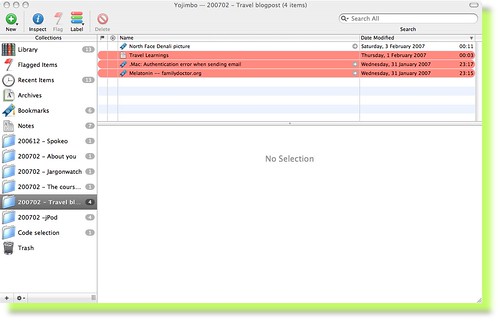
Yojimbo is a central repository for content making it ideal for projects. Some of my blog posts are written on the fly often in reaction to something that has happened or something that I had as an idea and didn’t have the time to develop it fully. A couple of cases in point, my blog post on things I learnt to make long-haul business travel more palatable was created over two weeks whilst I was on the road and when I got back. My post on Spokeo was started in December, and I added a few bits and pieces while I waited for material from Harrison that never came.
Yojimbo is a kind of sketch pad for ideas and a scrap book where I can keep related links and images. There are other products out there like DEVONThink Professional, which is a great exceptionally thorough product in its design, performance and feature set: but too involved for what I needed.
I like the intuitive nature of Yojimbo and its light agile nature:
Not being too feature-rich to make working with it hard, which also plays into the creation of a clean user experience as you can see from the screen grab.
Being a small application that runs fast, even when my thinking doesn’t
Part of the approach that makes Yojimbo my killer app for blogging and organising thoughts is its heritage. Bare Bones Software have produced a number of lean applications that have been essential users for Mac uers over the past decade, in particular I can recommend downloading the free application TextWrangler which facilitates text manipulation without all the features that get in the way from even the simplest word-processors like TextEdit. I find it really handy for editing the HTML tags on my links of the day postings.
Google Answers decides to close up shop – Google Answers is an attempt to create high quality material for knowledge search and a monetisation model at the same time. At the top end, Google Answers looked like consultancy on the cheap. Given the size of the core Google business versus other media opportunities Google Answers was never going to be big. However closing Google Answers seems to be less a criticism of knowledge search and more a broader retrenchment to only focus on ‘Google-sized’ opportunities – effectively ossification of the business.
Design
x0xb0x– amazing improvement by German designers on Roland’s iconic TB-303
Health Disparities Persist for Men, and Doctors Ask Why – New York Times – health disparities for men exist in all socioeconomic groups, all are doing poorly in terms of health. Health disparities for men is a multi-factorial problem including economic marginality, adverse working conditions, and gendered coping responses to stress. Which can lead to high of health-damaging behaviours and an aversion to health-protective behaviours. Will equality for women drive similar effects on their health to what is occurring in health disparities for men? More health related content here.
Linspire have finally released a free distribution of their Linux operating system. This is an interesting move, which could see Inspire moving away from being a z-list box shifter to being the iTunes of consumer software through CNR. There is lots of tired Gateway and Dell boxes out there that could be given a new lease of life by Linspire through the installation of Freespire provides a good way of removing and helping proof against malmare targeting the Windows platform.
It would be especially attractive in wi-fi enabled homes were computer access is at a premium as kids and parents currently duke it out over two or more computers.
For any tech-heads passing its based on the Debian distribution like Linspire.
AOL
AOL promises that it is releasing a MySpace product for the rest of us that will be ‘kick-ass’ according an AOL spokesperson quoted over on a Business 2.0 article at CNN Online. Looks like they’ve finally figured a way to leverage their huge instant messenger user base.
17 inch MacBook Pro
Apple have released a 17-inch version of the MacBook Pro, but it isn’t really news as the rumour sites had it down pat for a few weeks now. Over at Crack Unit Iain Tait has been talking about life with his new MacIntel companion.
Yahoo!
I have left Yahoo! after being made redundant and about to start a new role agency-side (which is both exciting and kind of scary all at the same time), I now feel that I can now say nice things independently about the Yahoo! family of products on here, without it being construed as the insepid scribblings of a paid shill. I used to be a European buzz marketing manager working on various bits of the business including Yahoo! Search, My Web, Answers, Delicious, 360, Flickr, Research and the technology development team which put me pretty much right at the centre of the web 2.0 vortex.
You can find some of the good stuff that was happening here.
Not so much a product big-up but Carole McManus – community manager of Y!360 in Sunnyvale has put up a useful posting on how to blog. Obvious I know, but some good tips on writing style and getting around writers block (also check out the comments section on the posting).
Ok, a question to leave you with: how can the scribblings of an engineer like Robert Scroble or Jeremy Zawodny be considered to be great communication but a PR person’s postings be always viewed with suspicion (except when discussing the dark arts of misdirection and deception)? Answers on a comment below please.
A couple of interesting artifacts that I found online and wanted to share with y’all.First up, video conferencing, why is it so crap and what are you going to do about it?
Ok, we’ve had video online, we’re now living in an age of pretty much ubiquitous broadband, why do we stop with using our VoIP client of choice and use video instead.Well there is the network side of things: IP networks provide a ‘best effort’ service so the signal may be come degraded. All the pixels will get to the other end eventually but they won’t get there in the right order and the latency of the signal will depend on the slowest part of network travel that they have to make through the internet ‘cloud’ no matter what kind of pipe you have between you and your local telephone exchange, wireless hub or cable television outfit. Look at video streaming, it has errors and flaws in its signal even on my 2MB pipe AND the signal is buffered to smooth out these glitches like a CD player. With real-time interactive video conversations that is not a technical option.
Also you may not want to have the person see you as well as speak to you, imagine if you have a bad hair day or want to lie?
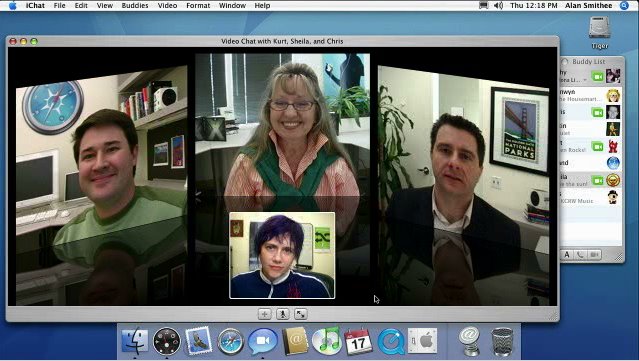
The third factor is a much more basic human system and the best way of illustrating it is by looking at the picture above. Notice how you don’t have eye contact with the people that you have a conference with because the camera’s perspective is slightly different to the view you would have if it were a real-world conversation. Notice how the men on the left and right are looking above their screens and the ladies are looking below, this is just enough for you to notice and process at a low level. It doesn’t feel natural, the conversation won’t flow as well as a real-world sit down would because the eye contact feels wrong.
This is why video conferencing can feel so wrong, even Apple’s attempt at correcting it with a small mirror picture (the one at the bottom) to see how you look to the callers feels wrong.
Historically the way to do that is to have the difference between camera angle and the viewing angle of the screen as small as possible. This was achieved by using big TV screens with a camera on top and the participant perched at the end of a big conference table at the other end of the room. That’s why big oil companies and George Bush love video conferencing but you’re not likely to see it adopted en masse in UK homes soon.
Its also not exactly the most elegant solution, which the reason why I was really intrigued by this Apple patent which I saw courtesy of those nice people at AppleInsider.
Imagine where the screen viewing area was the camera with camera elements squeezed in between the pixels on your LCD. The back-light would provide the ambient light required for the picture, you an have eye contact with whoever you are speaking with without living in a mansion and having a conference table the size of a small yacht.
In theory this principle would also work with on mobile screens (at a lower quality-level), televisions etc. On the scary side it would also allow the omni-present two-way tele screens for surveillance like Orwell’s Nineteen Eighty-Four. More content here.
Web 2.0 and the Enterprise
News.com have an interesting article Web 2.0 meets the enterprise how companies like IBM and Visible Path are using technologies like social networking, RSS feeds and wikis to help large companies build IT systems. News.com make a big show of how these ‘consumer’ (their word, not mine) technologies are changing the enterprise software landscape.In addition, Forrester sent out an email newletter talking about how service-orientated architecture (SOA) (simply put: enterprise-grade web 2.0-type technologies) are having an accelerated take-up with happy IT directors to be found everywhere.
The truth is more complex than the News.com story about how the kids are showing big business the way, the process is much more complex.
AJAX is generally a hard thing to do well so it is interesting that Michael Robertson is selling AJAX-based web services through ajaxLaunch and looking to use AJAX as a way of providing applications and widgets on top of an OS. Its an interesting take from a business head on all the utopian dreams such as the network computing meme or Netscape’s ‘the browser is the OS’-hype back in the day and an ideal way for novices to get web 2.0 see his ‘everything is moving to the cloud’ keynote here which also has a good product demo (RealPlaya required).
Nice definition of what AJAX means to marketing people – ‘rich web applications right to your computer’.