Category: technology | 技術 | 기술 | テクノロジー

It’s hard to explain to someone who didn’t live through it how transformation technology has been. When I was a child a computer was something mysterious. My Dad has managed to work his way up from the shop floor of the shipyard where he worked and into the planning office.

One evening he broad home some computer paper. I was fascinated by the the way the paper hinged on perforations and had tear off side edges that allowed it to be pulled through the printer with plastic sprockets connecting through holes in the paper.

My Dad used to compile and print off work orders using an ICL mainframe computer that was timeshared by all the shipyards that were part of British Shipbuilders.

I used the paper for years for notes and my childhood drawings. It didn’t make me a computer whiz. I never had a computer when I was at school. My school didn’t have a computer lab. I got to use Windows machines a few times in a regional computer labs. I still use what I learned in Excel spreadsheets now.

My experience with computers started with work and eventually bought my own secondhand Mac. Cut and paste completely changed the way I wrote. I got to use internal email working for Corning and internet connectivity when I went to university. One of my friends had a CompuServe account and I was there when he first met his Mexican wife on an online chatroom, years before Tinder.

Leaving college I set up a Yahoo! email address. I only needed to check my email address once a week, which was fortunate as internet access was expensive. I used to go to Liverpool’s cyber cafe with a friend every Saturday and showed him how to use the internet. I would bring any messages that I needed to send pre-written on a floppy disk that also held my CV.

That is a world away from the technology we enjoy now, where we are enveloped by smartphones and constant connectivity. In some ways the rate of change feels as if it has slowed down compared to the last few decades.

  • Gawker-Peter Thiel in context

    Why do a post about the Gawker-Peter Thiel court case?

    Because the Gawker-Peter Thiel court case marks a step change in Silicon Valley culture and will likely change media practices in new media companies.

    What is the Gawker-Peter Thiel court case?

    Silicon Valley veteran financier Peter Thiel was behind the financing of a court case that Terry Bollea “Hulk Hogan” filed over a sex tape. An extract of the video was published by Gawker Media.
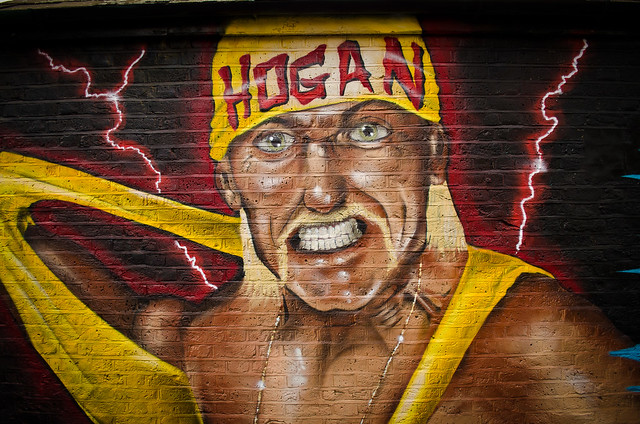
    Hulk Hogan
    What Bollea did was stupid. As a veteran celebrity he must have realised that any kind of compromising position would be a tempting pay check for even his closest friends. The behaviour ran of the risk of endangering any commercial endorsements or media deals that he may have had in place. Usually commercial deals of this nature come with a good behaviour clause – I’ve had these clauses in every celebrity and influencer endorsement I’ve been involved with.

    Bollea does have a family who would be caused considerable embarrassment by his actions. And it could be argued that secretly filmed sex between two consenting adults isn’t really newsworthy or pertinent for public consumption.

    Gawker Media did what growing media empires have done in the past  and conduct ‘yellow journalism’.  Content of a puerile or sensational nature had been the stock in trade of William Randolph Heart, Joseph Pulitzer, Rupert Murdoch or William Aitken (Lord Beaverbrook). It isn’t morally defensible and it isn’t clever, it is an indictment of the audience.

    Gawker did do the public a service, shining a torch on Silicon Valley in a way that hadn’t been done since the early days of InfoWorld’s Notes From The Field column and the book Accidental Empires: How the Boys of Silicon Valley Make Their Millions, Battle Foreign Competition, and Still Can’t Get a Date. The problem was that both of those were pre-smartphone and pre-Internet era portraits of the ‘Valley; back when it really did have foundries manufacturing microprocessors.

    As an external observer and someone who has done PR for similar companies in the past. I would argue that the relationships between journalists and the Silicon Valley technology beat had become sufficiently docile that media didn’t provide the reader with insightful analysis of what was really going on.

    It is the kind of relationship that the US military struggled to have in Iraq and Afghanistan through the embedding process. Instead of MREs and sharing the emotional highs and lows of action; San Francisco journalists got executive access and invites to the same social mixers and conferences.

    Valleywag shook up media practices. Although editorial teams won’t admit it; the likes of Recode, TechCrunch and The Information took note.

    Peter Thiel is the most interesting person in the cast of the Hulk Hogan court room drama. Thiel is known for his wealth and unique take on libertarianism. I won’t go into is Thiel right or wrong as none of the parties including Mr Thiel deserve our unreserved sympathies.  It all just makes me want to re-apply hand sanitiser before using the internet.

    What I find most interesting about Thiel’s actions is the way it signifies a cultural shift in Silicon Valley that I have talked about for a good while.

    It is hard to believe that within living memory San Francisco was a port city with fish canneries that attracted drug addled misfits drawn by everything from its freewheeling culture and access to drugs. The Santa Clara valley to the south was fertile farm land that grew apricots and prunes. Fruit brand Del Monte started right here. The area grew up as Stanford University and the scientific developments of the late 19th to mid-20th century science revolutionised the US military.

    Silicon Valley had a reputation for doing things differently. The mix of academia, counterculture and defence expenditure created a unique culture that evolved over time. The collegiate work environment founded by Bill Hewlett and Dave Packard had much to do with their background in education at Stanford. The HP Way, a set of values guided the company for over 60 years until Carly Fiorina’s tenure as CEO.

    Bob Noyce came to Silicon Valley to do pioneering work at Shockley’s lab. Unfortunately, Bill Shockley’s poor people management meant that Noyce became a last minute member of the traitorous eight and went on to found Fairchild Semiconductor and then Intel. In both of these businesses he founded a relaxed culture that was decades ahead of its time and similar to a modern day worker. If you work in a ‘cube farm‘ rather than offices – you can likely blame that on Noyce. His culture influenced interior design and did away with corner offices.

    Whilst the enterprise software businesses like Oracle and chip companies like AMD mirrored the hard driving sales teams of their East Coast counterparts at IBM; many Bay Area companies were made of something different. Counterculture had seeped into the industry. The hacker culture of sharing software and the transformative nature of technology brought forth the Home Brew Computer Club and a missive from a nascent Microsoft CEO complaining about early software piracy. Steve Jobs had talked about how his LSD experiences had helped him do the things he did at Apple. Wired magazine was founded by former hippies like Stewart Brand and Kevin Kelly. There was a very good reason why The Grateful Dead were one of the first bands with a website.

    I interviewed with a H-P employee back in the late 1990s who told me how had bought his ‘dancing bears’ tie and Jerry Garcia mouse mat from dead.net

    The hippies in Silicon Valley brought their ‘back to the land’ ethos and doing their own thing. It is a form of libertarianism, but not one that Thiel or Uber’s Travis Kalanick would likely recognise as their own.

    This was the libertarianism of the pioneer who ventured westward or the outlaw biker gang that yearned for the same freedom. The key difference is that the hippy technologist build their frontier to carry onwards, not having to worry about the Pacific ocean and instead going to new realms in code and network infrastructure.

    The counterculture ethos could be seen even in web 2.0 products like Flickr which freely allowed customers to move their data or build their own apps on the APIs that the development team used.

    Facebook is a marker in time for when the cultural tone of Silicon Valley changed. The hippies were out and the yuppies had taken over. Brogrammers and zero hour working for ‘Uber for’ applications that provide labour as a service.

    The Gawker court case marks a similar milestone event in Silicon Valley culture. Thiel’s actions brought a number of his peers out in public to support him. Silicon Valley stops sounding like yuppies and more like the titan’s of the gilded age that would brook no disrespect and governed riches in the face of massive inequality. The Bay Area version of the American dream is dead for the secretaries and engineers who will no longer become financially independent on share options.

    Customer service, once seen as a a way into start-ups is now a purgatory. I used to have a client in the late 1990s who worked their way up through a chip company from being in admin when the business was a new start-up to running marketing communications and PR across EMEA in the space of 10 years or so. That progression just wouldn’t happen now, the gilded class have their compliant (if at times resentful workforce) and now want a more respectful media.

    The seeds of destruction are already sown for the gilded class. Innovation has moved East to the other side of the Pacific. Baidu is likely to be a leader in deep learning, driverless vehicles and innovation. The leading drone brand is DJI based in Shenzhen – rather than being designed in California and just assembled in China. Networks infrastructure leader Huawei are showing the kind of smarts marketing Android smartphones that Silicon Valley hardware makers would have had a decade ago.

    Tencent has shown how dangerous it could be with the right marketing smarts. It already has as good software design chops as the Bay Area. Facebook Messenger bots have been on WeChat for years. If you haven’t done so give WeChat a try, just to see what the application looks like.

    A compliant sycophantic media won’t help the gilded class build the financially successful future Silicon Valley in the same way that an inquiring body of journalists could do.

    More information
    The changing culture of Silicon Valley
    Barbarians in the Valley
    From satori to Silicon Valley by Theodore Roszak
    A Declaration of the Independence of Cyberspace
    Tech Titans Raise Their Guard, Pushing Back Against News Media – New York Times
    Those Entry-Level Startup Jobs? They’re Now Mostly Dead Ends in the Boondocks — Backchannel — Medium
  • Competition in logistics + more

    Failure of competition in logistics market – The EU thinks this website is the key to fixing its weak e-commerce market — Quartz – surely there is some arbitrage play for ‘trumpeting’ deliveries in and out to take advantage of lowest cost parcel routing? Given the amount of parcel carriers why is there a failure of market competition in logistics. I suspect that gathering data on this by the EU is the first step; in a similar way to what happened on mobile roaming rates. More Europe-related posts here

    WeChat failed to go global | Techinasia – the thing I took away from this foreign campaigns was how similar they were to what I would have expected a foreign company to do in China. I suspect that they weren’t localised enough and Tencent didn’t think about a compelling hook

    Housing crisis in China’s ‘Silicon Valley’: Huawei, other hi-tech giants head for cheaper cities as rising costs deter talents – also provides opportunities for start-ups to take up staff that don’t want to make the move

    Nokia could cut up to 15,000 jobs | Telecom Asia – not surprising there would have been a lot of overlap between them

    Adidas to Return Mass Shoe Production to Germany in 2017 | Business of Fashion – isn’t likely to be traditional adidas models like the Gazelle or Superstar as designs are adapted for the robot production line that Adidas intends to use

    Why Huawei is suing Samsung over cellphone patents – Recode –  the amount of redactions in this document is interesting. The optics of the court case are trying to position Huawei as an innovator. Huawei will win in the Chinese court filling. The US one could be more interesting. If Huawei is considered to be abusing its position it could find itself in an EU court case though

    A new study shows how government-collected “anonymous” data can be used to profile you — Quartz

    Even Apple is acknowledging that the “iPads in education” fad is coming to an end | Quartz – which has to be worrisome for tablets in business surely?

    Why Big Apps Aren’t Moving to Swift (Yet)

  • Consumer Packaged Goods innovation

    Consumer packaged goods innovation – CB Insights put together an interesting presentation on the changing landscape of the consumer packaged goods sector.

    The key takeouts for me were:

    • The similarity to the technology sector in terms of startups developing a brand and selling out to a bigger firm
    • A key part of what they are buying is brand building – an activity that the likes of P&G and Unilever have excelled at in the past. Historically new product launches in CPG has a low success rate. Many brands have been going for decades. The startup acquisitions allow the Unilevers of the world to buy successes and change their portfolios faster
    • Start-ups and partnerships focused on process improvements across all business functions from supply chain management to the final interface between customer and product prior to purchase. Success and institutional heritage have baked processes and infrastructure in existing businesses that might hold them back looking at new channels. When I worked on an assignment at Unilever there were best practice guides for everything. These guides were smart and well written with lots of good heuristics in them. But you also had to complete an eight page form to get a search run on a social listening platform
    • Premium is defined around consumer values towards the environment rather than ‘luxury’. In this respect the CPG market kind of feels like the early 1990s in laundry products. Ecover started to get prominent place in UK supermarkets. You saw a good deal of product innovation from P&G and Unilever. You had liquid laundry dispensers that went in the tub and were supposed to reduce the amount of water used in the wash. However, pragmatism overran environmental concerns during the recession and supermarket’s own washing powder started to take off. Major brands were accused of brand washing

  • Credit card + more things

    Satan’s Credit Card: What The Mark Of The Beast Taught Me About The Future Of Money – BuzzFeed News – interesting read on the human factors of credit cards and payments in general. What happens when your credit card sits underneath your skin? In Sweden you can actually do this. Sweden has already gone virtually cashless already. The irony is that the confusion in your wallet becomes an even greater confusion of apps. There is still a place for artefacts. For instance a Centurion card will look more impressive in reality than as part of an Apple wallet.

    Playtime Credit Card

    Microsoft Acquires Leading Web-Based Calendar Company Jump Networks | Microsoft News Center – almost two decades of online PIM (personal information management) and email. I used Jump prior the acquisition and used to have the email address ged@jump.com before Microsoft shut it down. It used to sync with my Palm device through a conduit on my work desktop machine. All of this has become effortless in the smartphone age. Now I take for granted my calendar and other data syncing seamlessly between devices.

    Surrey teen charged over Mumsnet hack attack | The Register – not sure how this would go down in terms of bragging rights on dark net forums… On one hand, there is the quality of the data, but then there is the embarrassment of it all. I don’t know who this Surrey teen needs to be more worried about more: the police or a phalanx of middle-class Mums…

    Your next server will be a box full of connected stuff, not a server • The Register – Linux is just a poor copy of Unix anyway, Linus Torvalds apparently founded it because he didn’t know about BSD. BSD ran the infrastructure of Hotmail for many years. macOS, tvOS, iOS and iPadOS all run a variant of BSD proving that there is still a place for it. Unix won by becoming so ubiquitous in nature.

  • The New Nokia

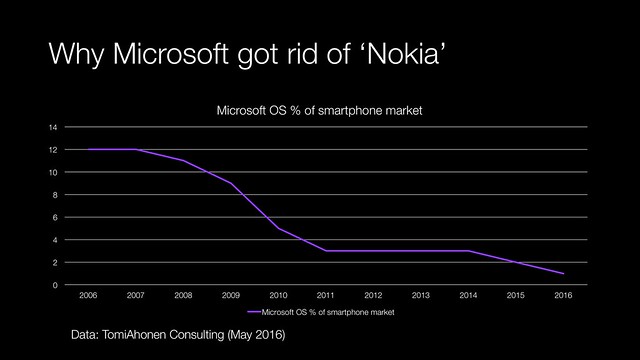
    The New Nokia can rise from the ashes of the old. Microsoft finally let go of its licence for the Nokia brand license on May 19, 2016.
    Slide03
    There is a lot of logic to this move:

    • Microsoft has already written down the full value of the business acquisition
    • It has got the most valuable technical savvy out of the team and moved it into the Surface business
    • It removes problematic factories and legacy products

    For the businesses that have acquired the rights to use the Nokia name and the factories the upsides are harder to see.

    The factories may be of use, however there is over supply in the Shenzhen eco-system and bottlenecks aren’t usually at final manufacture, but in the component supply chain.

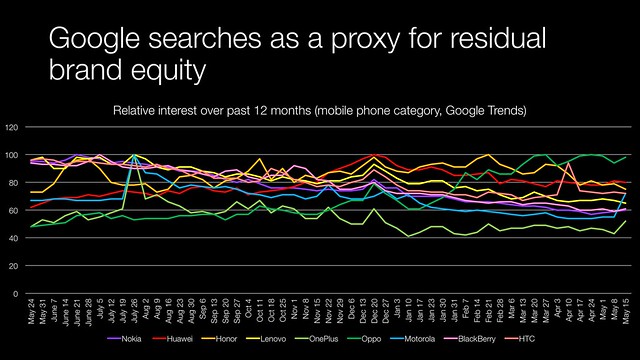
    There is still some brand equity left in the Nokia phone brand. I analysed Nokia along with a number of other international Greater China smartphone eco-system brands using Google Trend data.
    Slide06
    There has been a decline in brand interest over the past 12 months for Nokia of 37%
    Slide07
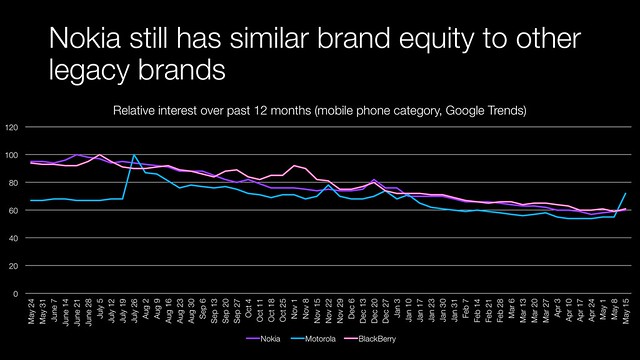
    Nokia still has comparable brand equity to other legacy mobile brands such as BlackBerry and Motorola
    Slide08
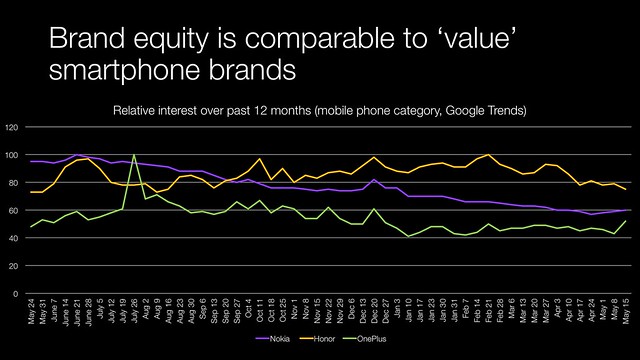
    The brand equity is comparable to other value mobile brands. Honor; Huawei’s value brand has had a lot of money and effort pumped into it to achieve its current position.
    Slide09
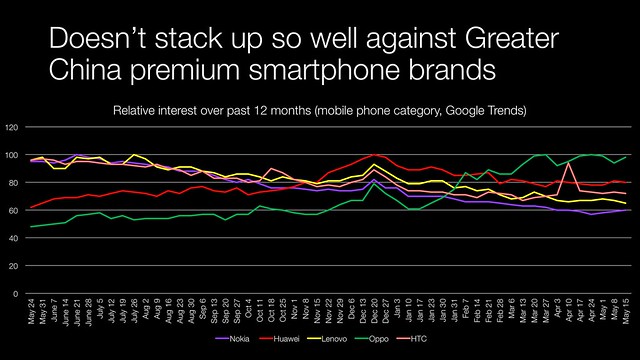
    But it’s brand equity doesn’t stack up well against premium handset brands from Greater China. The reason for this is that smartphone marketing and fast moving consumer goods marketing now have similar dynamics – both are in mature little differentiated markets. Brands need to have deep pockets  and invest in regular advertising to remain top-of-mind across as large an audience as possible. Reach and frequency are more important than social media metrics like engagement.

    In addition to advertising spend needs to be put into training and incentivising channel partners including carriers.

    They are entering a hyper-competitive market and it isn’t clear what their point of advantage will be. Given the lock down that Google puts on Android and commoditised version of handset manufacture, the best option would be to look for manufacturing and supply chain efficiencies  – like Dell did in the PC industry. But that’s easier said than done.

    Garnering the kind of investment required to seriously support an international phone brand is a hard sell to the finance director or potential external investors.

    Slide13
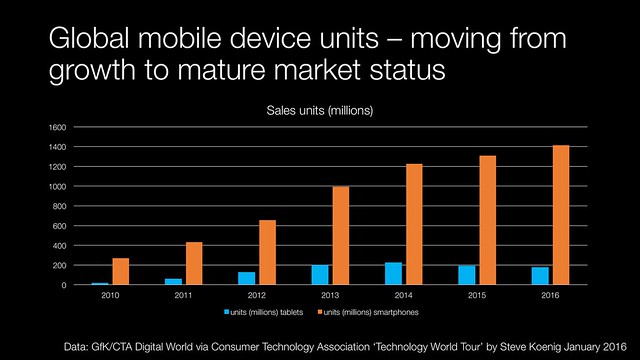
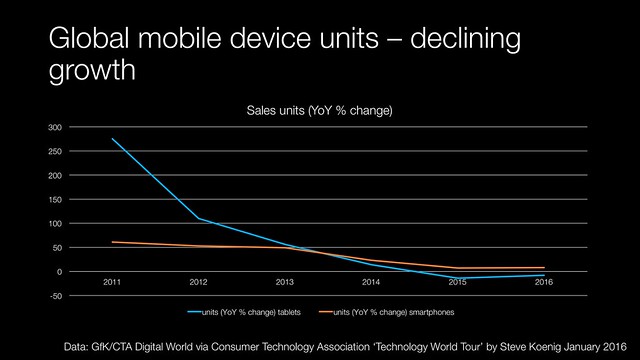
    Growth is tapering out.
    Slide14
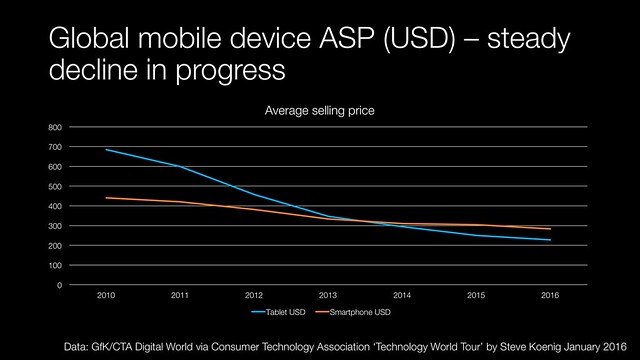
    The average selling price is in steady decline
    Slide16
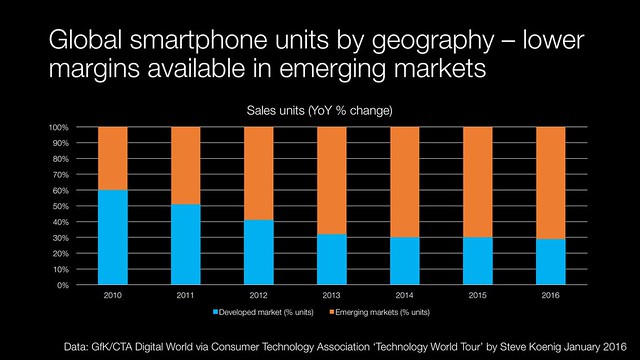
    This is partly because the emerging markets are making the majority new phone purchases.
    Slide15
    Consumers in developed markets are likely holding on to the their phones for longer due to a mix economic conditions and a lack of compelling reason to upgrade.
    Slide12
    All of the consumers that likely want and can afford a phone in developed markets have one. Sales are likely to be on a replacement cycle as they wear out. Manufacturers have done a lot to improve quality and reliability of devices.

    Even the old household insurance fraud standby of dropping a phone that the consumer was bored with down the toilet doesn’t work on the latest premium Android handsets due to water-proofing.
    Slide20

    More information

    The answer to the question you’ve all been asking | Nokia – Nokia’s official announcement
    Gartner highlights a more challenging smartphone sector for Nokia than when it “quit” in 2013 | TelecomTV
    Nokia is coming back to phones and tablets | The Verge
    So the Nokia brand returns.. with a Vengeance | Communities Dominate Brands

    Supporting data slides in full