It’s hard to explain to someone who didn’t live through it how transformation technology has been. When I was a child a computer was something mysterious. My Dad has managed to work his way up from the shop floor of the shipyard where he worked and into the planning office.
One evening he broad home some computer paper. I was fascinated by the the way the paper hinged on perforations and had tear off side edges that allowed it to be pulled through the printer with plastic sprockets connecting through holes in the paper.
My Dad used to compile and print off work orders using an ICL mainframe computer that was timeshared by all the shipyards that were part of British Shipbuilders.
I used the paper for years for notes and my childhood drawings. It didn’t make me a computer whiz. I never had a computer when I was at school. My school didn’t have a computer lab. I got to use Windows machines a few times in a regional computer labs. I still use what I learned in Excel spreadsheets now.
My experience with computers started with work and eventually bought my own secondhand Mac. Cut and paste completely changed the way I wrote. I got to use internal email working for Corning and internet connectivity when I went to university. One of my friends had a CompuServe account and I was there when he first met his Mexican wife on an online chatroom, years before Tinder.
Leaving college I set up a Yahoo! email address. I only needed to check my email address once a week, which was fortunate as internet access was expensive. I used to go to Liverpool’s cyber cafe with a friend every Saturday and showed him how to use the internet. I would bring any messages that I needed to send pre-written on a floppy disk that also held my CV.
That is a world away from the technology we enjoy now, where we are enveloped by smartphones and constant connectivity. In some ways the rate of change feels as if it has slowed down compared to the last few decades.
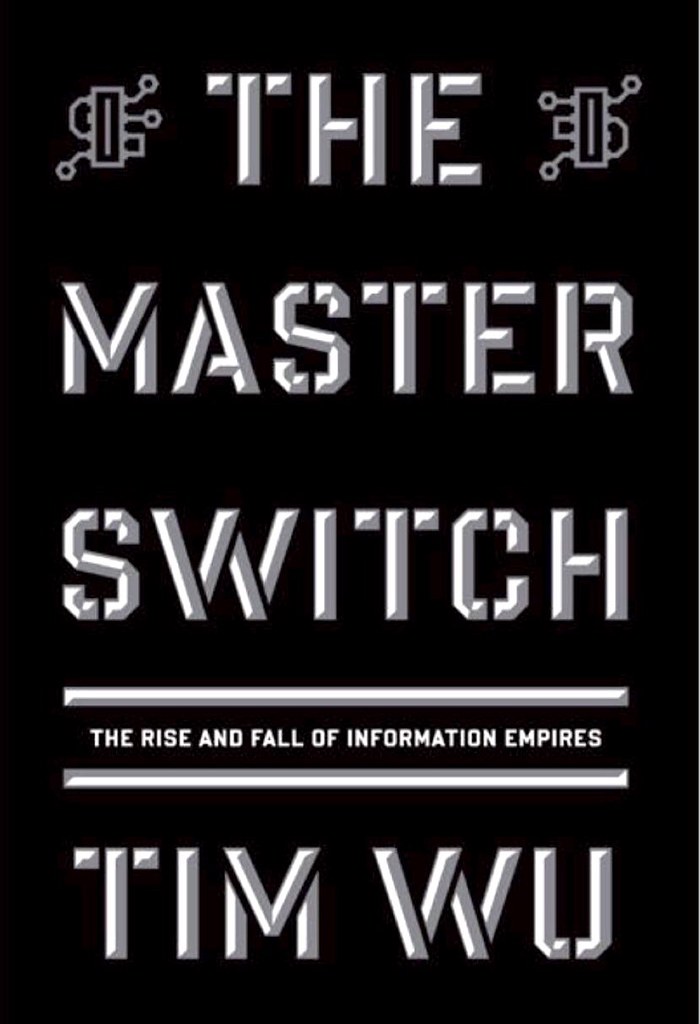
The Master Switch author Tim Wu is an American lawyer, professor and expert on internet matters. He is main claim to fame is coining the phrase ‘net neutrality’ back in 2003. He is well known as an advocate of the open internet.
One needs to bear all this in mind when thinking about The Master Switch: The Rise and Fall of Information Empires. In it Wu posits a natural lifecycle for the rise and maturation of platform and media companies; which he called the ‘long cycle’.
Wu uses the following companies as examples:
Western Union’s telegraph monopoly
Western Union-owned Associated Press’ relationship with the nascent newspaper industry
AT&T in telecoms
The early film industry and the rise of Hollywood studios
Apple’s history – though this point is less nuanced because Apple has cycled a number of times between open and closed systems – a nuance that Wu doesn’t fully pick up on
In The Master Switch, he points about how these companies have moved from open systems to closed systems in order to maximise profits and resist change. Wu then uses these cycle to argue that a repeat of history was under way with the modern internet. In 2010 when the book was written; this would have ben the rise of Google, Facebook and Amazon.
Ed Vaizey announced that ISPs should be free to abandon net neutrality in the UK and it was abandoned in the US when FCC chairman Ajit Pai was appointed by Donald Trump. More telecoms related content here.
I love Connie Chan blog posts and presentations. In this talk she covers how Asian applications manage to squeeze so much more features into their apps than their western equivalent to provide a fuller eco-system of services that she terms super-apps.
Connie Chan isn’t only smart, but manages to talk about Chinese eco-systems in a simple coherent way, which is an art in itself. More Connie Chan related content here.
For These Young Entrepreneurs, Silicon Valley Is, Like, Lame – WSJ – for most of the 18 entrepreneurs and investors, and especially for those in their 20s and 30s, last week’s visit largely failed to impress. To many in the group, northern California’s low-rise buildings looked shabbier than the glitzy skyscrapers in Beijing and Shenzhen. They can’t believe Americans still use credit cards and cash while they use mobile payment for almost everything back home – not terribly surprised. Silicon Valley is no longer the place ‘where wizards stay up late’. Agencies work harder than their Bay Area tech clients and it is full of hubris
Luxury is thriving in China again, thanks to millennials — Quartz – Chinese millennials start buying luxury younger, and they buy high-end products more frequently, the firm says. (It undoubtedly helps that they have more spending power than previous generations did at their age.) What they’re buying is also different. Bain surveyed about 500 Chinese millennials and found their interests leaned toward casual and street-inspired fashion – Supreme rather than Prada, put into context here
Huawei – Really Convincing Story, Not. | Radio Free Mobile – this means that this feature (RCS – Rich Communication Services), like its AI assistant, AI chip and its now commoditised imaging offering will be unable to generate any differentiation for Huawei in its devices. This leaves it exactly the same boat as all of the other Android handset makers who differentiate purely on the basis of hardware
Introducing the WhatsApp Business App | WhatsApp blog – a free-to-download Android app for small businesses. Our new app will make it easier for companies to connect with customers, and more convenient for our 1.3 billion users to chat with businesses that matter to them. Here’s how: Business Profiles: Help customers with useful information such as a business description, email or store addresses, and website. Messaging Tools: Save time with smart messaging tools — quick replies that provide fast answers to frequently asked questions, greeting messages that introduce customers to your business, and away messages that let them know you’re busy. Messaging Statistics: Review simple metrics like the number of messages read to see what’s working. WhatsApp Web: Send and receive messages with WhatsApp Business on your desktop. Account Type: People will know that they’re talking to a business because you will be listed as a Business Account. Over time, some businesses will have Confirmed Accounts once it’s been confirmed that the account phone number matches the business phone number. Free to download on Google Play in Indonesia, Italy, Mexico, the U.K. and the U.S – surprised that Hong Kong didn’t make this list
Mark Ritson: The Diet Coke relaunch shows its marketers have lost the plot – Marketing Week – a few things I don’t get. Moving away from the one Coke brand architecture. Are they trying to position diet coke against Red Bull? (Thinking about the can size). Or is there some shopper marketing related insight at play that says they need to maximise choice in a given shelf space? Decidedly odd, I would have expected this lot of ‘product’ innovation more in a market like Japan where you see constant consumer demand for the new new thing. Don’t even get me started on the ad creative…
How China’s market economy has fuelled a prostitution boom | South China Morning Post – My grandma was always grateful to Mao, mainly because she was upgraded from a concubine to a wife under the Communists “one wife” rule. – There is also the shredding of culture and community during the cultural revolution probably ruined community / support mechanisms
Luxury
The Pet Shop Boys are the face (and sound) of Christian Dior’s men’s collection this summer.
American Views: Trust, Media and Democracy – Edelman – I suggest that the public relations business move itself from a reliance on advocacy toward a new policy of informing the populace more broadly on subjects of the day. That means providing the positive and negative facts, with third party attribution
Should the Tech Giants Be Broken Up? | WSJ City – Apple and Microsoft supply 95% of desktop operating systems – but this point hides the huge disparity in market size and power between Microsoft and Apple still in the PC market
Benedict Evans on ten-year future predictions (well as good as anyone can)
Unilever under fire over Gaytime ice cream in Indonesia | PR | Campaign Asia – no idea where they got that idea, I imagine it could become a cult brand if launched elsewhere. Gaytime ice cream makes me think of a more innocent time in my life when, if I was home from school, I would be sat down with Marie biscuits and a cup of Barry’s tea by my Mum. This was a thinly veiled bribe to be quiet, which wasn’t really needed.
The reason for this ritual would be a soap opera called Harbour Hotel and a chat show called The Gay Byrne Show. Both where on RTÉ Radio 1. Back then gay could mean happy; or in the case of Gay Byrne it was short for Gabriel. The radio meant that voices from home where beamed into our house around the clock via medium wave and long wave.
https://youtu.be/hByFDVwiQq8
Of course, I wouldn’t have mentioned it at my English school as there would have been an ocean of sniggers. The Muslim outrage at Gaytime also mirrors the PC revisionist view of The Flintstones ‘we’ll have a gay old time’ lyric in their theme tune. Apparently its original meaning of happy or fun, was interpreted as being intolerant of the LGBTQ community.
The problems that the Labour Party faces with Corbyn and the general distrust of politicians in what should be ‘heartland’ seats
The continued credibility of Nigel Farage
The anti-German sentiment. The EU was seen as a German vehicle to win the war again by stealth – this has almost a Basil Fawlty quality to it. But at least some of the panelists believed it was true
How the political divisions around the societal change driven by Margaret Thatcher’s government reverberated into the Brexit vote
Poundland’s naughty elf campaign which riffed on British smut and the ‘Elf On A Shelf’ franchise affected consumer attitudes to the brand according to YouGov. The research is at odds with the overall positive response it got from Twitter (outside the London media-advertising industrial complex) – YouGov | Poundland’s X-rated ads generated publicity, but consumer perception has dropped
Three Thoughts on Day One at CES 2018 – not surprised that computing is moving to the edge as the network represents latency and potential unreliability – think about how cloud failure when it hit Nest devices and IoT obselescence
Casio AL-1000 – the nixie tube display and ferrite core memory make it a thing of beauty to behold
Huawei’s US market dreams ‘harmed again’ after AT&T walks away from smartphone pact | South China Morning Post – “We have been harmed again,” Huawei’s consumer business unit chief executive officer Richard Yu said in a text message to the South China Morning Post – you can see from later articles how Huawei progressively got their act together in terms of media response though much of the coverage added a thin veneer of analysis whilst repeating the original WSJ article – China’s Huawei hit by last minute collapse of AT&T phone distribution deal | Reuters – the collapse of the deal with AT&T, first reported by the Wall Street Journal, will mean that Huawei will likely struggle to make a hit of its smartphones there as a U.S. mobile carrier would typically promote the products as well as provide subsidies and special package deals
GoPro quits the drone business – The Verge – because of the grip that DJI has on the drone market. GoPro had expanded into drones in the face of declining growth in the action camera market. You can start to see drone footage being cut into extreme sports videos providing a variation of views that weren’t possible previously.
TCCC Unity on the App Store – Coca-Cola did an iPhone app to explain the ethos behind its bespoke fonts (presumably beyond not having to pay licence fees and hubris)…
AT&T Backs Off Deal to Sell Smartphones From China’s Huawei – WSJ – if true it represents a spectacular loss of face for Huawei. There would be likely internal repercussions in Shenzhen as it dents the company’s reputation as a brand on the rise, its aspiration to be seen as a globally recognised premium brand and the oft talked about objective of cracking the US handset market beyond burner phones