Category: thailand | 泰國 | 태국 | タイ国

Sawadee krub – this category features any blog posts that relate to the country of Thailand, the Thai people, the Thai culture or language.

After the second world war, the country was best known for the quality of its rice and its silk. It played a major role during the cold war and is now the second largest economy in southeast Asia.

Thailand’s tourism industry started when the country was an R&R (rest and recreation) destination for soldiers during the Vietnam conflict. A decline in crop prices from 1982 – 1986 drove a migration of rural workers to the city. This provided a ready workforce for both tourism and manufacturing.

Thailand has become a hub for Japanese manufacturing companies. The Toyota Hilux pick up is made there. As are electronic components and consumer electronics.

There are pharmaceuticals manufacturing plants in the country. It also has a building products sector to support the large amount of property development in the country supporting economic development and rural to urban migration. Thailand has a financial sector that belies its developing world status.

All of this has meant that Thailand has developed a uniquely creative advertising industry to support these businesses.

It is likely the post will also in other categories too for example an advert developed for Thailand may appear in marketing and Thailand categories. If there is Thai subjects that you think would fit with this blog, feel free to let me know by leaving a comment in the ‘Get in touch’ section of this blog here.

  • Hiroshi Fujiwara & things from last week

    I first knew of Hiroshi Fujiwara though his work on old school Japanese hip-hop label Major Force. He was cited as an influence in Bomb The Bass’ first album Into The Dragon. His influence has been much bigger in terms of streetwear and Harajuku culture that fuelled fashion and culture of the past two decades. He is now collaborating Moncler and did some media interviews :

    Thailand is famous for emotion-filled adverts and this Sunsilk film is no exception, dealing with family acceptance of Kathoei (กะเทย). Its a beautiful piece of work by JWT’s Bangkok office.

    I’ve never worn Doctor Martens myself but they were often seen in the school yard and during my early working life. They are as British as Marks & Spencers chicken tikka masala. I thought product had been moved offshore as part of globalisation, but it seems that there is still a small production facility in the UK. The process of how the shoes are made is fascinating.

    The application of machine learning in the criminal justice system is something of concern. The natural inclination of authority is to inflate itself with every tool that progress provides.

    Great documentary on Chinese wealthy migration away from China. The move to Vancouver was pioneered in the early 1970s with wealthy Hong Kongers preparing for its handover in the decades to come. They’ve been followed families who got rich on the mainland following the opening up of the economy.

    It reflects the reality of major cities around the world now as capital flight out of China continues. Non-domestic earnings (like that from Russia and Middle East) is a factor driving unaffordability of housing. The experience of Mau and the opening up founded a culture of ‘now’. This has manifested itself in different ways: capital flight, having a bolt hole abroad and a foreign passport in case things go suddenly bad. It also explains historic product quality issues as entrepreneurs think about the now and let the future take care of itself, preferably while you have gone abroad to live a comfortable life.
  • Audrey Li + more things

    My friend and former colleague Audrey Li wrote a great rambling essay. Audrey’s family live in a small town / village in Sichuan province. Sichuan is in the west of China. The essay covers WeChat, payments, crime and the party’s fight against pollution. WeChat scams are surprisingly common for an authoritarian regime that surveils everything. Although Audrey’s Mum seems to have a similar level of technology literacy to my Mum and Dad, I am surprised she uses mobile payments. The battle against pollution has hard costs, which Audrey Li goes into – Smart Phone, No-cash Society, and Jobless — A Short Conversation with My Mother

    Line loses users in 3 of its most important countries – interesting changes in Taiwan, Indonesia and Thailand. I wonder what has eaten into LINE’s market share outside Japan? Maybe LINE has to provide a more fully featured experience like LINE Japan

    Dissecting the Jimmy Choo Michael Kors Deal | News & Analysis | BoF – The Jimmy Choo deal was part of a wider Michael Kors strategy. Michael Kors appears to be focusing on creating a collection of ‘affordable luxury’ brands, a strategy that mirrors Coach’s approach. This differs from companies like LVMH and Kering, which concentrate on high-end luxury brands. Additionally, LVMH and Kering are more established, possessing numerous brands and centralized systems to leverage their combined strengths. I find it interesting that Jimmy Choo is now ‘accessible luxury’. The comparison with Coach is very interesting, it does make one wonder two things:

    • Do American luxury brands have ‘brand permission’ to do high end luxury?
    • Given that accessible luxury and the ‘high-end luxury’ of Kering, LVMH etc. both actually rely on middle class customers for the bulk of their sales – who will win out in a downturn?

    More luxury orientated content here.

    Is Beijing getting serious about selling off state firms? | SCMP – Tencent and Alibaba buying into Unicom could be an interesting dynamic. The big would be around the extra power these groups would get. I could see China going the other way greater state enterprises rather than market liberalisation

    Kaspersky’s stellar antivirus finally goes free | PCWorld – feature limited but powerful

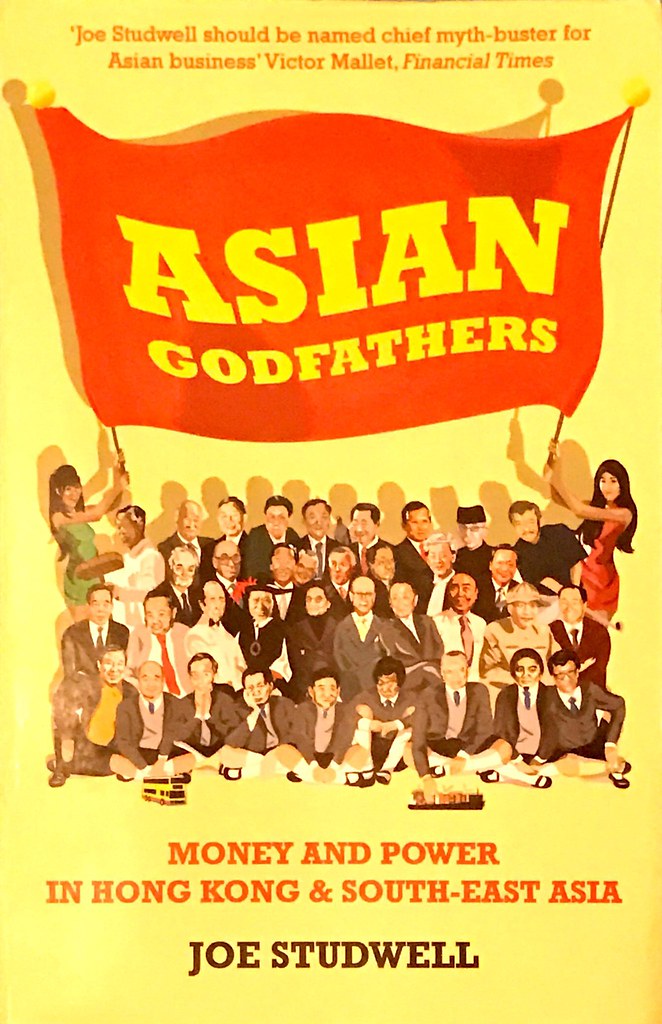
  • Asian Godfathers by Joe Studwell

    I’d read Joe Studwell’s How Asia Works over lunar new year so Asian Godfathers was an obvious follow-on. Studwell dealt directly with the reasons for East Asia’s economic growth and Southeast Asia’s failing to follow them.

    Asian Godfathers

    Studwell attached this same subject through through a different lens. Studwell looks at it through the lens of the business community in these different countries. In Asian Godfathers, he tells the story through Asia’s business tycoons. From the taipans of Hong Kong to Stanley Ho – the Macau gambling tycoon.

    The Asian godfathers were generally cosmopolitan privileged people who where in the right place at the right time. Some of them had colourful origin stories as black marketers selling fake medicines and blockade runners. Mao’s China relied on business tycoons across Asia when the country had closed itself off from the world.

    Studwell tells of an elderly tycoon who goes to sleep in a bedroom with no windows, such was his paranoia about revenge from the families of people who had been ‘treated’ with his black market antibiotics decades earlier.

    This also explains the paranoia that Hong Kong’s tycoons had over politicised youth in Hong Kong  as well. These are the people who are most likely to kick back against their rent seeking businesses.

    But these Asian Godfathers are just a side show in a wider panorama of political greed and incompetence across Southeast Asia. Asian Godfathers is more like Hotel Babylon than an economics analysis like How Asia Works, yet it delivers its message forcefully. More related content here.

  • How Asia Works and reading over Chinese New Year

    I have managed to catch up on a lot of reading over the Lunar New Year festival. Joe Studwell’s How Asia Works is fascinating reading. It talks about how Korea, Japan and China have grown while their counterparts haven’t. Studwell highlights a number of factors that contribute to economic growth:

    • With an agrian economy, a market garden approach to agriculture rather than farming at scale delivers the best results. But only if rent seeking interests are removed through effective agricultural reform
    • Industry requires total mastery of technology – which is the reason why low grade heavy industry is the starting point
    • Exports planned into industrial development from the beginning and a continued relentless focus on exports is required
    • Governments are best at keeping businesses focused on total technology mastery, raising cheap finance and weeding out failures that might be a resource suck

    Studwell critiques how different countries throughout Asia have managed to process in this manner including both the strengths and the weaknesses of their respective approaches.

    It was fascinating to read how Taiwan managed to succeed in spite of nationalised industries and the challenges in China’s agricultural model.  How General Park ‘motivated’ Korean chaebols and the tragedy of development in Thailand, Malaysia and the Philippines. I can highly recommend How Asia Works.

    China’s Crony Capitalism by Minxin Pei explained the mechanism of how corrupt officials, state enterprise employees and businesspeople managed to bilk the Chinese government and people of vast amounts of money. Much of the challenge is structural. China has a federalised government with power lying at provincial, city and county level. Pei is hawkish on the country’s prospects.

    For an outside observer Pei’s research into the mechanisms, one can appreciate the challenge that the central government faces in combatting corruption and bad behaviour. President Xi’s ‘tigers and flies’ campaign to root out the worst corruption in the party and business is part of the solution; but according to Pei there is also careful structural reform required. This will only be possible through a massive aggregation of power towards the centre. More related content here.

  • Demographics of social + more

    Demographics Of Social Media By Gender – Business Insider – interesting opportunities for smart mass targeting by using the demographics of social outlined in the article. More content related to the demographics of social here.

    Samsung Addresses a Growing Mobile Health Market with Industry’s First Smart Bio-Processor – Samsung Blog – am sure Apple already has custom silicon that does similar, at least since the M7 motion co-processor in the Apple iPhone 5S or the Apple Watch’s S1 SiP. It feels like they might be a little disingenuous or even dishonest claim by Samsung to call it the first ‘bio processor’ without a much narrower definition

    NO.1 A10 Rugged Smartwatch – closer to what I would want a smart watch to be in terms of ruggedness, lacks the style of Casio’s G-Shock at the moment

    Chinese Communist Party Modernizes its Message — With Rap-agandaChina Real Time Report – WSJ – more Cassette Boy style than Jay Z (paywall)

    Hong Kong MTR payphones to be pulled from all subway stations – SCMP – universal wireless coverage on MTR and universal cellphone ownership in population. One of the first clients that I worked with was a company called iMagic who made PowerPhones –  a cross between a payphone and an internet enabled kiosk. These PowerPhones were rolled out across the MTR network and in Chep Lap Kok  (paywall)

    Daring Fireball: Doomsaying Apple Analyst Loses Job – as was once attributed to an IRA spokesperson about the Brighton bombing of the Conservative party conference in 1985 ‘…we only have to be lucky once, you have to be lucky always‘. Eventually expect a story that Adnaan Ahmad is eventually vindicated when Apple misses a quarter or two on its numbers

    A look at how Australian Bank ANZ is creating their own quality content via @ANZ_BlueNotes | Andrew Grill | LinkedIn – more of a wake-up call for PRs than a revelation for digital marketers

    Google, HP, Oracle Join RISC-V | EE Times – interesting developments as ‘anything but ARM’ grouping forms in data centre giants

    Why Snapchat is ‘the one to watch in 2016’ — at the expense of Twitter – Business Insider – at least in the US, according to MEC

    There’s An App That Takes Care Of Your Customer Service Woes | Refinery 29 – interesting, mediated customer service experiences

    China to Require Internet TVs to Use Homegrown Smart TV OS | Marbridge ConsultingChina’s State Administration of Press and Publication, Radio, Film and Television’s (SAPPRFT) Science and Technology Department and the Ministry of Industry and Information Technology (MIIT)’s Electronic Information Department recently announced a new smart TV operating system, TVOS 2.0 – (paywall)

    Samsung will reportedly make 5M Galaxy S7 phones ahead of February launch | VentureBeat – relatively small beer when you think that Huawei alone sold 100 million handsets this year

    China Antiterror Law Doesn’t Require Encryption Code Handovers – WSJ – China passed a new antiterrorism law that stepped back from previous language of concern to global technology firms, however its still very similar to Teresa May’s nosey parker powers in the UK (paywall)

    Delivery Rates on Kickstarter by Ethan R. Mollick :: SSRNUsing a large survey with 47,188 backers of Kickstarter projects, I examined the factors that led to projects failing to deliver their promised rewards. Among funded projects, a failure to deliver seems relatively rare, accounting for around 9% of all projects, with a possible range of 5% to 14%. There are few indicators at the time of project funding as to which projects might ultimately fail to deliver rewards, though small projects (and to a lesser extent very large projects) are more likely to fail to deliver rewards, as are some project categories.

    A Brief Introduction to the Basics of Game Theory by Matthew O. Jackson :: SSRN – really nice primer

    Mobile Web – Opinion – Quinn: Living our lives from inside a messaging app – US adoption on Facebook Messenger over 30 percent of population, surprised Skype is a mere 19 million monthly UUs

    LeBron James releases virtual reality film for Oculus and Samsung Gear VR – Months after it had been used in football by Vincent Kompany and Aaron Ramsey

    GQ is now blocking its readers running ad blockers – Digiday – Conde Naste taking action against ad blockers

    Thai prime minister releases New Year song to appeal directly to the people | PR Week – (reg wall)