Category: web of no web | 無處不在的技術 | 보급 기술 | 普及したテクノロジー

The web of no web came out of a course that I taught at the La Salle School of Business at the University Ramon Llull in Barcelona on interactive media to a bunch of Spanish executive MBA students. The university wanted an expert from industry and they happened to find me by happenstance. I remember contact was made via LinkedIn.

I spent a couple of weeks putting together a course. But I didn’t find material that covered many of things that I thought were important and happening around us. They had been percolating around the back of my mind at the time as I saw connections between a number of technologies that were fostering a new direction. Terms like web 2.0 and where 2.0 covered contributing factors, but were too silo-ed

So far people’s online experience had been mediated through a web browser or an email client. But that was changing, VR wasn’t successful at the time but it was interesting. More importantly the real world and the online world were coming together. We had:

  • Mobile connectivity and wi-fi
  • QRcodes
  • SMS to Twitter publishing at the time
  • You could phone up Google to do searches (in the US)
  • Digital integration in geocaching as a hobby
  • The Nintendo Wii controller allowed us to interact with media in new ways
  • Shazam would listen to music and tell you what song it was
  • Where 2.0: Flickr maps, Nokia maps, Yahoo!’s Fireeagle and Dopplr – integrated location with online
  • Smartphones seemed to have moved beyond business users

Charlene Li described the future of social networks as ‘being like air’, being all around us. So I wrapped up all in an idea called web of no web. I was heavily influenced by Bruce Lee’s description of jeet kune do – ‘using way as no way’ and ‘having no limitation as limitation’. That’s where the terminology that I used came from. This seemed to chime with the ideas that I was seeing and tried to capture.

  • Google I/O 2016

    Google I/O 2016 happened on May, 18 – 20.  There had been a lot of pieces of coverage about the different products and services released. But I wanted to spend a bit of time reflecting on what Google I/O 2016 told us about their viewpoint on technology.

    Giving apps a second chance

    Google knows as well as anyone that the app moves towards a maturity model where consumers stick with the core apps that they want and then don’t go any further.
    apps
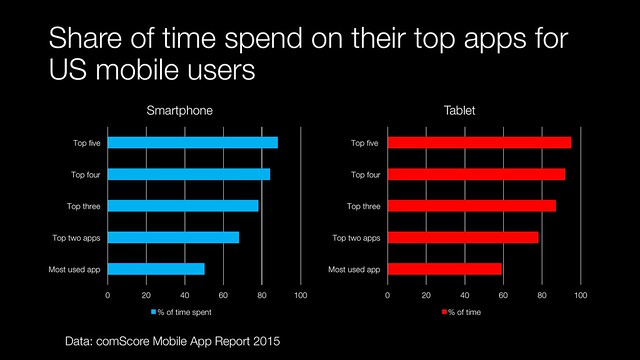
    Data shows that consumers use their top five apps 88 per cent of the time. So why would Google care when it knows that 60 percent of the top apps on the Android platform?

    The reasons for an expanded app usage include:

    • A proportion of Google’s advertising (like Facebook) is derived from the promotion of app downloads
    • Android devices are reaching market maturity in many markets, growth is likely to come from new uses – at least some of which will be derived from third party platforms
    • Google has staked its ambition in the PC sector on its Chrome operating system being able to run apps from the Android eco-system. In order for that to happen there needs to be a healthy community of developers
    • In the same way that DoubleClick’s ad network greatly expanded the inventory of Google’s advertising business, third party applications offer Google an additional source of usage for its own services. If you want to see the future of Google Apps look at the the way the likes of Baidu and Tencent allow third-party integration with their own tools

    Streaming or ‘instant’ apps is part of Google’s efforts to encourage consumer trial of new apps and enhance relationships with developers. Firebase, it’s new analytics platform for mobile developers helps them have a better relationship with their installed user base allowing them to use data to target notifications and campaigns.

    More faith in wider area networks (WANs) than personal area networks (PANs)

    Android Wear’s updates were interesting. Put simply Google has more faith in data being delivered in a timely manner over cellular or wi-fi networks than it does for inter device transfers over variants of Bluetooth. Both the Apple Watch and Android Wear products suffered from performance lags when the watch was a thin client of a phone. Having a cellular radio on board the phone presents challenges with battery life, but speeds up real world performance.

    The original design failure wasn’t down to network performance, but is likely to have implications for personal area network technology like Bluetooth in its different variants or ZigBee. These technologies are all about scale, lose a scale advantage and it poses a problem for future adoption by others. This can happen in a virtuous way. Apple’s adoption of USB benefited the standard greatly and drove interest in peripheral development for both Mac and PC. Apple’s abandonment of FireWire and the 3.5″ diskette marked their decline.

    Lots to be concerned about from a privacy point of view?

    Google Home moved yet another pair of Android powered ears into our environment. It was obvious from Google’s description of services that a paid marketing model to be the ‘car booking’ or equivalent service of Home could be very lucrative for the search giant. How this device could be used for market research, tracking brand mentions or government surveillance also poses some conundrums moving beyond smartphones to brown goods.

    Android N features file based encryption rather than treating the whole device as an encrypted disk. This raises questions around the comparative ease of access from a privacy perspective. Secondly, SafetyNet allows Google to reach into a phone to remove pre-existing applications without user permission. There is no explanation if they also have write privileges to the phone as well. If so, expect law enforcement and intellectual property owner interest. From the way it reads this would affect apps and content that have been side loaded as well as got from an app store.

    Android is giving the high ground to Apple on privacy presumably because it considers its own customers don’t care about it that much.

    Reference designs in VR to drive adoption and commoditisation 

    Google’s Daydream project looks to provide standardisation in hardware. By going down this route, Google hopes to spur on the sensor market required for improved AR experience and drive uptake. These will likely be a very different experience to the computer workstation powered Occulus Rift. Driving this technology into the smartphone market may combat the current stagnation in phone sales growth.

    More information
    Google I/O 2016 event page
    A16hz on Google I/O 2016
    Everything Google just announced at its I/O conference
    Palm, Apple, Google and the whole mobile device thing
    The Limits of Google
    If Google’s right about AI, that’s a problem for Apple – Marco.org
    ISIS’s Mobile App Developers Are in Crisis Mode | Motherboard

  • Crush Google Plus + more

    How Mark Zuckerberg Led Facebook’s War to Crush Google Plus | Vanity Fair – Zuckerberg et al were helped by Google Plus having a poor product experience and dumb rollout approach. This has been evident across Google’s products from Google Wave to GTalk and the Google Cloud service. Facebook didn’t need to crush Google Plus, it just needed to do a better job on a consistent basis. More on Facebook here.

    Huawei Draws From Apple Playbook, Narrows IPhone Market Lead | Digital – AdAge – Guo Ping talks a good game, but why would someone develop specifically for Huawei rather than Android?

    Smart TVs are a dumb idea | TechEye – really nails it in terms of the value created and consumer behaviour

    The foibles of freemium – …turn the commercial model upside down by no longer relying just on journalists to report the news but also articles from a raft of other contributors – including corporate brand and advertising PR people. City AM goes all Forbes and Huffington Post blurring the line in editorial and advertorial content

    Samsung’s subtle nudge to get potential customers to upgrade – interesting acknowledgement that the competition is existing devices in mature markets like Europe and North America

    Huge: Microsoft opens up its Windows Holographic platform to third parties – In what could be a defining moment in the nascent augment reality and virtual reality spaces, Microsoft Corp. has opened up its Windows Holographic platform – trying to become the OS for immersion in the same way that AltSpace is the social platform for VR interactions

    SMARTPHONES: Microsoft Puts Smartphone Bets on Xiaomi Bottom line: Microsoft probably took a 10-20 percent stake in Xiaomi as part of the pair’s deal. At least Xiaomi doesn’t have a carrier relationship to burn by bundling Skype on a handset – let’s hope the do a lot better than Nortel, Nokia, Motorola, Palm, Sendo or LG. All of whom had been in bed with Microsoft at one time or another

    Mobile location data is accurate up to 30 meters: report – Location data accuracy fluctuates which isn’t terribly surprising

  • June 2016 research slides

    Here is a copy of the slides that I pull together (when I have the time) of publicly available data that would be of use. This is the June 2016 research slides.

    Google search volumes

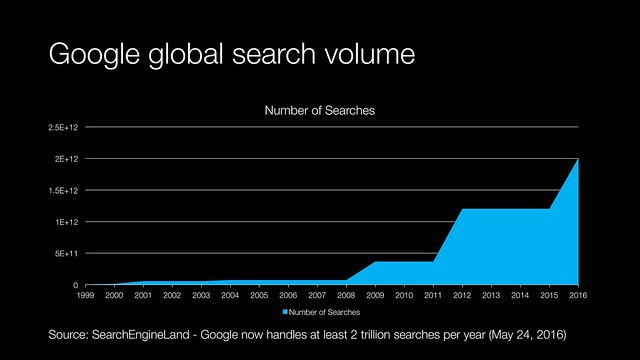
    This month I have some new data around search which came from disclosures at Google I/O in terms of search volumes. We talk about social as if search has gone out of style but its growth is still staggering. This is now driven by mobile device penetration and adoption as computing devices on the go. It also speaks to the wider number of questions that search now answers. It used to be that search answered with ‘facts’ found online. It then became more contextual with shortcuts that gave you the weather forecast or a foreign exchange rate. Mobile moved this on further to items like local recommendations.

    Partly through the search box, but also by more meta detail about the device doing the searching and its location to within a few metres due to GPS and cell tower triangulation. Voice interaction has also started to impact search volume. Image driven search still seems to be an area that could drive much more potential search volume, that would be valuable for commerce.
    Google global search volume
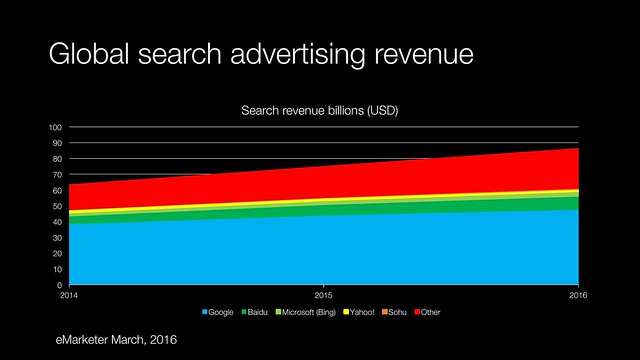
    Looking at global search revenue over time, Google’s monopoly position becomes immediately apparent. It is amazing how Bing and Yahoo! haven’t managed to grow market share but just transfer value from one to the other. In the Chinese market, Sohu has been obliterated with Baidu search. But one does have to wonder about the value of web search, when so much internet usage now happens in the WeChat eco-system.
    Global Search Revenues
    More details about me here.
    Slide20

    Full presentation

    Full presentation available for download as a PDF on Slideshare and you can find more research related posts here.

  • Mobile searches + more

    Saying a third of mobile searches are local, Google brings “Promoted Pins” to Maps – but still no development platform for third party integration. Google Maps is still behind Baidu Maps in this respect. But the pivot towards local mobile searches offers opportunities for many small and medium sized businesses. More on where 2.0 related topics here.

    Samsung will no longer make Android Wear devices, all in with Tizen OS [Update] | 9to5Google – as Benedict Evans said: Samsung is (probably) giving up on making Android Wear watches. The Apple Watch is only a partial success so far, but Android watches don’t seem to have worked at all

    I, Cringely Apple and Didi is about foreign cash and the future of motoring – I, Cringely – as ever thought-provoking, Bob Cringely’s take on Apple’s Didi investment

    EXCLUSIVE: The Dirty Advertising Practices of the Industry’s Biggest Brands, Bloggers — The Fashion Law – the legal challenges for influencers of becoming native advertising formats

    Anti-EU Campaign Offers A £50 Million Prize For Whoever Can Predict Euro 2016 – BuzzFeed News – smart data capture. Likely to skew male

    Spotify Now Lets Brands Sponsor Its Popular Playlists | IPG Lab – history repeating as consumer brands used to sponsor radio programmes like P&G’s recession era ‘soap opera’. It will be interesting to see how much traction this it gets

    BNP Paribas in partnership with Luc Besson’s next movie, Valerian and the City of a thousand planets – really interesting execution from a French bank BNP Paribas. Valerian is a classic French comic space opera based on comics by Pierre Christin and artist Jean-Claude Mézières

    Secrets of WeChat and Weibo Feed Stream — China Internet Watch  – (paywall)

    Hoffman Fabrics | Stussy – great background on the Hawaiian shirt, my favourite picture has Tom Selleck as Magnum in the background

    PDF Decrypter Pro (Windows & Mac OS X) – Remove PDF owner password and restrictions – Download FREE – handy app to have on tap. the native macOS Preview app, or trying to hack the file on ColorSync will only get you so far

    PayPal is shutting down its Windows Phone, BlackBerry, and Amazon apps | The Verge – its an Android and iOS world. This isn’t a good environment for carriers

  • Disaster at BBC + more

    A recipe for disaster at the BBC | Broadstuff – really good guide for people outside the UK on what is happening to the public service broadcaster. From beloved Aunty Beeb to disaster at the BBC

    Nokia back in mobile phone business | TotalTelecom – interesting move via HMD. It will be interesting to see how much brand equity is left in Nokia mobile devices. It will be interesting to see how HMD will do things differently from Microsoft/Nokia. More writing on Nokia here.

    This nifty device translates foreign languages in real-time | TheNextWeb – I would have to try it, I don’t believe it from what I’ve seen so far from the likes of Nuance and Google.

    Kevin Smith Is Making an Adventures of Buckaroo Banzai TV Show – I so hope that this is true. I loved the kooky original film version. It had big vision, 80s fashion, but not a big budget to match – which was a big part of its charm

    Why Snapchat Doesn’t Care About India — The Information – build for the markets were the advertising revenue and mobile structure make it worthwhile. Countries with low ARPU may not enrich the companies. They won’t attract much ad revenue and may even require specialist apps to take account of low bandwidth or local servers to comply with national data laws.

    North Korea’s new ad men try out pitches to new consumer class | Reuters – This uniquely North Korean style of advertising may have developed out of trade fairs, Abrahamian said.

    As the “donju” have earned money in the unofficial economy, the flaunting of wealth has become more commonplace, especially in Pyongyang where those with access to political capital are often the wealthiest traders.

    The advertisements seem acceptable inside shops, but not outdoors, Abrahamian said. During North Korea’s recent Workers’ Party congress, ads could be seen in several Pyongyang shops. – this sounds like the door-to-door salesman that was popular in the UK when housewife was a more common occupation.