Category: business | 商業 | 상업 | ビジネス

My interest in business or commercial activity first started when a work friend of my Mum visited our family. She brought a book on commerce which is what business studies would have been called decades earlier. I read the book and that piqued my interest.

At the end of your third year in secondary school you are allowed to pick optional classes that you will take exams in. this is supposed to be something that you’re free to chose.

I was interested in business studies (partly because my friend Joe was doing it). But the school decided that they wanted me to do physics and chemistry instead and they did the same for my advanced level exams because I had done well in the normal level ones. School had a lot to answer for, but fortunately I managed to get back on track with college.

Eventually I finally managed to do pass a foundational course at night school whilst working in industry. I used that to then help me go and study for a degree in marketing.

I work in advertising now. And had previously worked in petrochemicals, plastics and optical fibre manfacture. All of which revolve around business. That’s why you find a business section here on my blog.

Business tends to cover a wide range of sectors that catch my eye over time. Business usually covers sectors that I don’t write about that much, but that have an outside impact on wider economics. So real estate would have been on my radar during the 2008 recession.

  • The Fifth Risk by Michael Lewis

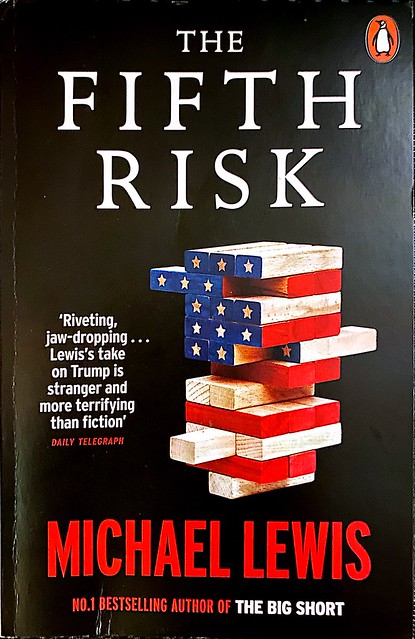
    Michael Lewis’ The Fifth Risk is marketed as a Trump presidency book.

    The Fifth Risk
    The Fifth Risk by Michael Lewis mass paperback cover.

    The Donald

    The Fifth Risk starts off by telling the story of Chris Christie. How he helped the future Trump administration organise a government in waiting. Christie and the team are let go. Trump was worried about spending money.

    Given the revelations about Donald Trump’s finances in the New York Times; I can understand his desire to control cash flow. This goes some way to explaining the problems filling senior government places.

    A second thing comes out in the first part of the book; Trump’s instinct to value personal loyalty. Which is fine; but doesn’t scale that well. That meant that people were often unsuitable for the jobs that they were given.

    A final trait that came through was a massive root-and-branch concern against climate change.

    So Lewis doesn’t say that much about the Trump administration that we didn’t already know. But that is only 30 percent of the book.

    What the government does

    The remaining 70 percent of the book tells the stories of different departments of the US government. The vital, complex roles that they play. He peels back the complex relationships between the federal government and the states. That interface builds in a lot of waste and inefficiency – to meet state political goals.

    Lewis gets experts to explain how welfare payments work and why they’re needed. Or how departments like the National Oceanic and Atmospheric Administration and the Department of Energy benefit the country.

    Lewis also covers what motivated some of the government service. TL;DR – from the new deal to the Kennedy administration young Americans felt that they could make a real difference. They felt inspired in a way that probably only clergy or military service personnel feel now.

    Finally, touches on risks. The fifth risk that the Department of Energy expert talked about was programme management. This is where the name of the book comes from. How is programme management a risk?

    • If a department is managed by someone who doesn’t understand the area involved.
    • Realpolitik – NASA was for years a victim of pork barrel politics and the o-ring failure that happened on the Challenger disaster was a function of it
    • If an administration takes a short terms, or small government world view.

    In praise of Keynesian economics

    The examples in the book tear away at the popular narrative around big government. Of inefficiencies and long queues of rapacious welfare queens.

    It shows all the things that the government does for the collective good. Things that the market wouldn’t be able to address. It also shows the hucksters involved in the markets. In particular calling out Accuweather’s founders Barry and Joel Myers. That Lewis hasn’t been sued by Myers adds to the veracity of his claims.

    This is essentially a criticism of the economic orthodoxy that has governed both of America’s political parties for the past 40 years, since the Carter administration. In this respect, the educated reader would appreciate that it fires a shot across the bow of all parties. From Sanders and Biden to Trump.

    Style

    I was introduced to Michael Lewis as a writer, when I read Liar’s Poker in college. It is a deeply personal book, full of humour and self examination. In it, he provides the ley reader an insight into the financial services system. Unfortunately, that didn’t seem to have much impact as the financial recessions following the dot com boom and the housing crisis proved.

    He then wrote a slew of books that owe a good deal to the new journalism style of Tom Wolfe. His writing covered sports, financial crises and politics. Some of the books were very of their time, such as The Future Just Happened, Boomerang and Panic!. Others like Liars Poker, are ageless. A couple of his books were made into films of the same name: Moneyball and The Big Short.

    The Fifth Risk still feels like the classic Michael Lewis new journalism style. But it also feels like it has an eye on a documentary adaptation. In this respect he reminds me a lot of Ben Mezrich in term of his cinematic approach to writing.

  • Hair Growth Helmet + more things

    LG Launches Hair Growth Helmet to Combat Hair Loss | HYPEBAE – this looks totally legit. NOT. Yes, the FDA has certified other hair growth helmet treatments, but that was to indicate that they wouldn’t harm you or interfere with medications. It doesn’t validate the hair growth helmet actually working. But on the other hand lasers in the helmet….. More beauty category related content here.

    Why loneliness fuels populism | Financial Timesdepicting loneliness solely in terms of how connected we feel to our friends, neighbours and colleagues risks occluding its other potent forms. Loneliness is political as well as personal, economic as well as social. It is also about feeling disconnected from our fellow citizens and political leaders, and detached from our work and our employer.

    “Buy British”: The viability of a nationalist commercial policy | VOX, CEPR Policy Portalattempts by successive UK governments in the 1970s and early 1980s to initiate such import substitution policies were fraught with economic and legal difficulties. Indeed, accelerating globalisation and the rapid growth of imports in intermediate products for assembly into ‘British’ goods raise significant problems in defining a ‘national’ product – and the growth of tradable services (such as insurance, education and healthcare) presents an even more intractable problem

    Arkady Bukh: Man in the Middle | CyberScoop – go-to lawyer for hackers

    China bans Australian academics in apparent tit-for-tat retaliation | South China Morning Post – this has followed soon after a good report by Alex Joske and book by Clive Hamilton on China’s influence activities abroad

    Facebook removes fake accounts with links to China and Philippines | The Guardian – Facebook says it has removed hundreds of coordinated fake accounts with links to individuals in China and in the Filipino military that were interfering in the politics of the Philippines and the US – not very surprising. More details in the South China Morning Post – How a Chinese network of fake Facebook accounts influenced online debate on South China Sea, US politics | South China Morning Post 

    Ebay ex-CEO, PR head shared texts about taking down critics: DOJ – Business Insider – probably one of the most disturbing and bizarre things that I’ve read in a while

    China has the upper hand in corporate proxy wars with US | Financial TimesMr Trump gave Mr Xi what he wanted on ZTE — a reprieve in the form of a new US commerce department settlement that allowed it to stay in business — and mistakenly assumed that this concession would smooth over the other matters. China quickly pocketed the ZTE present but continued to withhold approval of the Qualcomm-NXP deal. When the trade talks later started to unravel, Mr Xi let Qualcomm-NXP languish in regulatory limbo, where it eventually died. – Trump gave a concession too early

    How a local messaging app defeated WhatsApp in Vietnam – messaging app Zalo has been taking the country by storm for nearly a decade now. Zalo’s got a pretty firm grip on Vietnamese consumers. And now that it’s integrated mobile payment service ZaloPay into its messaging app, there’s plenty of potential for it to expand beyond being just a means of communication.

    The landlords are back – The families of China’s pre-Communist elite remain privileged | China | The EconomistThe old elite began to suffer almost as soon as the Communist Party won the Chinese civil war in 1949. China’s new rulers quickly set about seizing land from people in the countryside, redistributing it among the landless, confiscating private businesses and executing many rural landlords and people who had worked for the overthrown Nationalist regime

    Listen to an unheard Steve Jobs NeXT keynote from 1988“But why it matters is that those explorations and that fun were in the end quite significant. It’s always useful to look back and to realize that even though the tech itself might seem quite primitive today, the people were already sophisticated. We know a lot more facts, and we can do more things, but I’m not sure we have gotten that much wiser.”

  • Tech cold war + more things

    The US-China tech cold war has turned hot – but would a Biden presidency change things for Huawei and others? | South China Morning Post“No president will want to be accused of being soft on China,” said James Andrew Lewis, senior vice-president and director of the technology policy programme at the Washington-based Centre for Strategic and International Studies (CSIS). “Trump’s policies are disorganised, but consistently move to cut economic ties with China. Biden’s policies will be better coordinated, less abrupt, but move in the same direction.” – the tech cold war isn’t new. You could trace it back to the beginning with coercive IP transfer and massive industrial espionage. It kicked off in earnest with the Golden Shield Project 金盾 工程 censorship system. Where we are now was not a case of if, but when

    TikTok becomes a case study for Chinese companies planning global expansion | South China Morning PostZhang’s relationship with the ruling Communist Party is complicated. He must walk a fine line between keeping Beijing happy but not be seen as too close to raise concerns outside China. Zhang, who told Atlantic magazine in July that he was not a party member, was approached by Beijing a year ago with an offer to help when TikTok faced political troubles in India. However, Zhang sent mid-level staff to meet government officials, signalling he did not want Beijing to get involved – whether entrepreneurs like it or not, they’re likely to find the government inserted into the business like a helicopter parent. You’re likely to see coercive business development as part of Chinese diplomats wolf warrior patter; a la Huawei 5G network equipment and the Faroe Islands

    Allegations of deception dog Nikola’s lofty aims | Financial Times – my worst fear is that this will tarnish hydrogen fuel cells in the market. Hyundai are already doing interesting things with hydrogen fuel cell wagons

    Interesting report from Watches & Wonders (aka SIHH), Shanghai – Watches & Wonders Shanghai: The Future of Fine Watchmaking? | Luxury Society – more luxury related posts here.

    BJ Fogg on this old but good video explaining persuasion through technology in very simple terms

    FAA, Boeing Blasted Over 737 MAX Failures in Democratic Report – WSJ – really nice oral history of the Boeing 737 Max scandal

    Money-launderers use Chinese online shopping sites to funnel cash offshore | Financial TimesMoney launderers have used some of China’s leading online shopping sites to transfer billions of dollars to offshore gambling sites, police raids have revealed. People wishing to evade China’s strict capital controls, for example to gamble on offshore websites, have been placing fake orders on the shopping sites, including on Pinduoduo, China’s second-largest platform by users. A corresponding sum is then credited to their gaming account.

    Kraft Heinz sells parts of cheese business for $3.2bn | Financial Times – surprised if more assets aren’t sold as the 3G Capital model isn’t working

    EU tests platform to link up coronavirus tracing apps | Reuters – really interesting development in interoperability

  • Dark stores and coercive diplomacy

    I came across a couple of interesting terms recently: dark stores and coercive diplomacy.

    Dark stores

    Gartner for Marketing (formerly L2 Inc.) were talking about a new development at Amazon’s Whole Foods subsidiary. It was what Gartner called digital dark stores. The first one has been established in Industry City to serve much of Brooklyn, New York.

    Amazon themselves called it a ‘permanent online-only store‘ on their blog.

    So whats the difference between dark stores and the ‘last mile’ warehouses that Amazon uses for fulfilment in places like London?

    • Looking at the limited amount of photos available, this doesn’t feel warehouse-like. There wasn’t obvious automation in the pictures. Instead it feels like a supermarket that’s well stocked, but lacking price tags and shopper marketing accoutrements. Gartner describe it as ‘technically a grocery store’, which implies that there might be zoning or planning regulations that they might be working around
    • It is only for the Whole Foods brand; rather than fulfilling Amazon Fresh and Amazon Prime Now items

    This isn’t just an Amazon thing. Gartner points out that American supermarket brands Kroger and Giant Eagle have also embraced the order-only store model. More at Gartner for Marketing here.

    Coercive diplomacy

    The Australian Strategic Policy Institute published a report on September 1, 2020 called The Chinese Communist Party’s coercive diplomacy. It was written by Fergus Hanson, Emilia Currey and Tracy Beattie. Hanson, Currey and Beattie analysed ten years of Chinese government diplomacy. In there words:

    The Chinese Communist Party (CCP) is increasingly deploying coercive diplomacy against foreign governments and companies. Coercive diplomacy isn’t well understood, and countries and companies have struggled to develop an effective toolkit to push back against and resist it.

    The Chinese Communist Party (CCP) is increasingly deploying coercive diplomacy against foreign governments and companies. Coercive diplomacy isn’t well understood, and countries and companies have struggled to develop an effective toolkit to push back against and resist it.

    This report tracks the CCP’s use of coercive diplomacy over the past 10 years, recording 152 cases of coercive diplomacy affecting 27 countries as well as the European Union. The data shows that there’s been a sharp escalation in these tactics since 2018. The regions and countries that recorded the most instances of coercive diplomacy over the last decade include Europe, North America, Australia, New Zealand and East Asia.

    There seems to be an escalation of economic and non-economic measures deployed. Economic measures would include:

    • Trade sanctions – such as the recent ban on German pork products. This was rolled out just a few days in advance of a trade negotiation meeting between China and the European Union
    • Investment restrictions in strategic industries such as the ‘agreement‘ that Yahoo!, Softbank and Alibaba had over Alipay (which included what would now be Ant Group). Strategic industries like state security is notoriously (and deliberately) ill-defined in China
    • Tourism bans
    • Popular boycotts such as Korean corporate Lotte being driven out of China and the 2012 anti-Japan protests where the public smashed Japanese stores, attacked factories and burned Japanese cars

    Coercive pressure is also applied at below state level on businesses. It may also be applied on individuals, based on the data leak provided from Zhenhua Data seems to imply.

    Non economic measures include:

    • Arbitrary detention. The best example of this would be Michael Kovrig and Michael Spavor detained as part of China’s dispute with Canada. Another example might be Australian citizen Karm Gilespie. China didn’t admit it had detained him for over six years, until they announced his death sentence in the summer
    • Restrictions on official travel
    • State-issued threats which are usually issued on a regular basis as part of wolf warrior diplomacy. (Wolf Warrior is a set of two films with a Chinese action hero, a la Rambo – but with less humour).

    Some of the imputus for coercive diplomacy might come from the Chinese Communist Party’s continued rancour over Qing dynasty-era unequal treaties. More China related content here and more on retailing here.

  • Chinese State Security + more things

    When Chinese State Security police knocked on ABC journalist Bill Birtles’ door, he realised he was no longer safe in China – ABC News – interesting how business and finance reporting has been hard for the past few years. Which is one of the reasons why scandals like Luckin Coffee happen. Chinese state security is incompatible with the kind of transparency needed for good business reporting. More on Luckin Coffee here.

    Mulan’s official Chinese poster advances a nationalist agenda — Quartztweaked its posters, fascinating run through he symbolism

    Minitel: The Online World France Built Before the Web – IEEE SpectrumFor a generation of French citizens, Minitel wasn’t about hardware, switches, or software. It was about the people they chatted with, the services they used, the games they played, and the advertisements for these services they saw in newspapers and on billboards. Many of the services that we associate with the Web had predecessors in Minitel. Before there was Peapod, there was 3615 TMK (Tele-Market), a service that enabled Parisians to order groceries for same-day delivery. Before there was Cortana or Siri, there were Claire and Sophie, services that provided personalized information using natural-language interfaces. Before there was Ticketmaster, there was Billetel. And before there was telebanking, there was Minitel banking

    Brand Equity May Be Auto Industry’s Biggest AI Risk | CLS StrategiesThe AI Risk Index reflects a substantial gap between what is intended and what is perceived by critical stakeholders. The results are stark—especially in the context of substantial investment and many more years of public scrutiny as AI is improved—and reveal a growing crisis of trust. Though an average of 62% of Americans are familiar with companies in the transportation industry, only 35% have a positive opinion of them (compared to 43% for non-automotive manufacturing and 41% for retail companies) and only 37% trust them (compared to 44% for manufacturing and retail companies). Even more concerning is that the transportation companies most heavily involved in AI technology drive this sense of distrust, more so than traditional carmakers. That may explain why only three out of eight transportation companies analyzed during the third quarter of 2018 mentioned advancements in AI at all—indicating that auto companies are either communicating poorly or not communicating at all.

    Amazon’s profits, AWS and advertising — Benedict Evans – interesting analysis of where Amazon makes it’s money

    Strategic Management: Evaluation and Execution – Table of Contents – great book available in the creative commons

    BlackBerry Is Planning a Comeback. For Some, It Never Left | WIRED – a bit like me and Nokia feature phones LOL. On a more serious note you see this kind of loyalty on lots of diminished, but distinctive brands. SAAB would be the classic poster child

    2007 forever – The Magic iPod – resurrecting AplusD type mashup culture

    Facebook May Be Ordered to Change Data Practices in Europe | New York TimesFacebook is facing the prospect of not being able to move data about its European users to the United States, after European regulators raised concerns that such transfers do not adequately protect the information from American government surveillance. – this comes under the Irish data commissioner. More here – Facebook Fights Irish Privacy Watchdog’s Data-Transfer Curbs – Bloomberg 

    Human values: understanding psychological needs in a digital age – BBC R&D – really interesting work done by BBC Research and Development that could be applied to site and app design

    Douyin, China’s TikTok, permanently bans live-streamer who verbally harassed young women on the streets | South China Morning Post