Category: business | 商業 | 상업 | ビジネス

My interest in business or commercial activity first started when a work friend of my Mum visited our family. She brought a book on commerce which is what business studies would have been called decades earlier. I read the book and that piqued my interest.

At the end of your third year in secondary school you are allowed to pick optional classes that you will take exams in. this is supposed to be something that you’re free to chose.

I was interested in business studies (partly because my friend Joe was doing it). But the school decided that they wanted me to do physics and chemistry instead and they did the same for my advanced level exams because I had done well in the normal level ones. School had a lot to answer for, but fortunately I managed to get back on track with college.

Eventually I finally managed to do pass a foundational course at night school whilst working in industry. I used that to then help me go and study for a degree in marketing.

I work in advertising now. And had previously worked in petrochemicals, plastics and optical fibre manfacture. All of which revolve around business. That’s why you find a business section here on my blog.

Business tends to cover a wide range of sectors that catch my eye over time. Business usually covers sectors that I don’t write about that much, but that have an outside impact on wider economics. So real estate would have been on my radar during the 2008 recession.

  • The advertising industry post (prompted by WPP’s 2017 financial results)

    Sometimes the most straightforward posts take the longest to write. When I started on this one last week the big question in the minds of people who watch the big advertising conglomerates is are WPP numbers a company problem or an industry problem?

    Fortune Global Forum 2013

    WPP is looking to simplify its structure with a view to becoming a more agile and transparent business from a client perspective.

    Or as it was put in the New York Times

    WPP plans to accelerate a programme to simplify the business by aligning digital systems, platforms and capabilities to provide bespoke teams for its clients as opposed to the different agencies that currently compete with each other to win contracts.

    Other conglomerates, notably Publicis had already started on this path when it started realigning the group under the ‘Power of One’ vision. WPP is bigger with a fuller offering and wider range of specialisms than many of its peers, no one can be under the illusion about the size of this undertaking.

    Let’s talk about the tectonic plates shifting around beneath the feet of ALL  the large advertising and marketing combines:

    • Interpublic Group (IPG)
    • Omnicom
    • Havas
    • Publicis
    • WPP
    • Dentsu

    The tectonic plates are:

    • The Four
    • Amazon
    • The decline of brand marketing
    • The new competition
    The Four

    The Four is a label that Professor Scott Galloway put on Apple, Amazon, Google and Facebook. All of whom he considered to be monopolists that created value for their shareholders by putting the ‘real world economy through a shredder.

    In this case I would swap out Amazon and Apple for Alibaba and Tencent, but the allusion to a quartet of horsemen portending a digital apocalypse is a useful allegory for the advertising and marketing sector.  Amazon deserves a section of its own later.

    Galloway’s predictions of their destructive power led to an accurate prediction of WPP’s share price tumble this week. (see the video below)

    Correlation does not prove causality however — it doesn’t mean that he got the right numbers for the right reasons.

    Depending whom you believe Facebook and Google are responsible for 90 percent of online advertising growth outside of China. This represents a massive concentration of media power. It has implications for the creative and planning functions of an agency. Google and Facebook also run much of the advertising technology that purchase are made on. This has decimated much of the advertising technology sector and made it harder to differentiate media planning and buying based on the technology stack.

    1707 - ad industry

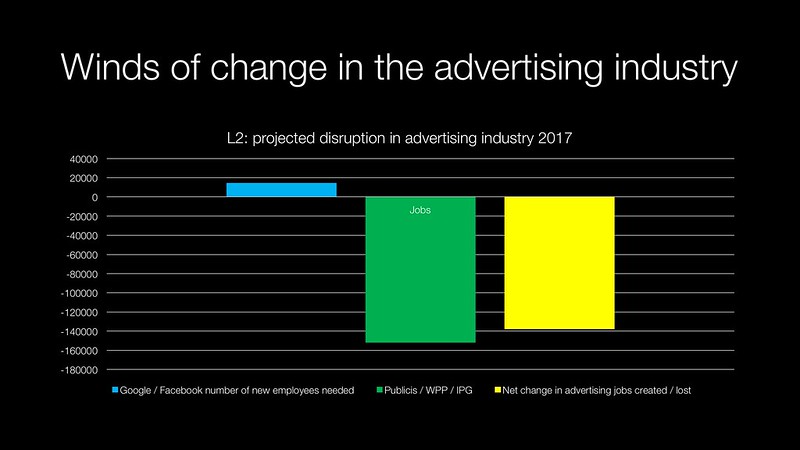
    L2 came up with this research last year based on Google and Facebook revenue targets. If they hit their numbers they would be treating around 14,193 jobs. But it would mean that the corresponding projected number of jobs lost in the advertising industry would be roughly the equivalent of every man and woman around the world employed at vehicle maker Nissan. And that’s just 2017.

    L2’s calculations don’t take into account China where the advertising industry has been digitising at a much faster rate than in the west with the bulk of growth going to companies controlled by Tencent or Alibaba.

    Given that most of the agencies within WPP and its peers operate on a billable hour model; this represents a considerable potential loss of value. Since the number of people directly equates to revenue.

    The consolidation of online media also means that many clients will look to take back control of their media planning and buying process. The argument goes something along the lines of ‘a consolidated media landscape allows for consolidated buying by a global media trading desk due to the inherent simplicity in suppliers. The data comes from the inhouse data management platform and the media vendor (Facebook, Google, Tencent or Alibaba)‘.

    The always on creative needed to fuel this process is also being increasing done in inhouse studios, in partnership with their creative agencies as a kind of hybrid model.

    This is what Marc Pritchard meant when he talked about taking back control of Procter & Gamble’s marketing as part of a process to save $1.2bn by 2021.  In the latest financial results, WPP claimed that their media buying margins had not suffered – only creative had.

    Amazon

    At the time of written Jeff Bezos is worth about 112 billion dollars, or just under double the annual defence budget of the UK for 2018. Amazon impacts the advertising and marketing industry in multiple ways.

    It is starting to become a big player in online advertising in its own right. I think it would be fair to say that this competition to Google is welcome for the marketing conglomerates judging by Sir Martin Sorrell’s commentary on the likes of CNBC.

    Amazon has decimated the high street. Toys R Us, Borders Group, Tower Records, Radio Shack, Maplins are just some of the names which have disappeared. It took a good number of years for people to realise that retailers are locked in a zero sum game when Amazon competes against them. Amazon has unique access to exceptionally cheap capital via its shareholders. There have been companies who have beaten it back like Alibaba’s Taobao and TMall in China. But the company has built up a huge amount of retail power and decimated brands that would have been advertising agency clients.

    Amazon has become the default search engine for buying things. This has already displaced up to 20 percent of Google searches depending on whom you believe. It also means that they can place imitation goods and private label goods against branded products.

    Amazon has got great data. Amazon has data at the centre of its business what consumers like, what they don’t like, what sells well on marketplace resellers. This has driven a number of the product decisions:

    • Increasing customer basket sizes
    • Expanding into new areas by screwing over marketplace resellers
    • Focusing their efforts on private label products which directly impacts branded products across categories. Amazon Basics is the most obvious private label to consumers, but there are many more where the link isn’t so obvious

    Depending on your brand category the answer may be:

    • Owning your own retail chain like Apple or LVMH’s DFS Group
    • Direct sales and subscription services have piqued the interest of FMCG brands like Dollar Shave Club

    All of this impacts the advertising sector. For more information on the power of Amazon, I can recommend Scott Galloway’s The Four.

    The decline of brand marketing

    The relative decline of brand marketing has been driven by a number of factors, some of these factors are good and some aren’t.

    Let’s talk about the good reasons first of all.

    • ‘Performance marketing’ driving customers directly to a sale has been transformed by the rise of modern online advertising techniques including search advertising and retargeting. Retailers can zero in on intent to a much greater degree than shopping television or direct response print adverts ever could. Google and social media have turned into reputation platforms which then displayed below-the-line spend from the likes of public relations agencies. This was happening at a time when journalist employed by publications have declined; implying a natural progression
    • At least some consumers can’t be reached through traditional media channels with sufficient frequency for brand advertising. Social media, online video and banner ads make sense as part of an omnichannel approach

    The bad reasons:

    • The focus on ROI rather than profits has meant that a balance longer term brand building and shorter term sales has fallen out of kilter. Marketing then becomes a reductive process. To use a farming analogy; its like moving from arable farming with crop rotation to slash and burn. This is particularly noticeable in the way private equity management has affected fast moving consumer brands under its control. Zero-based budgeting is seen as a source of cost cutting rather than ensuring the efficient and effective use of marketing resources
    • Digital first strategies – for many marketers this has meant a move from media-neutral, let the communications problem define the channels used to a digital dogma. I make my living with digital media, but I recognise the flexibility required in thinking to deliver an effective strategy

    It isn’t about one approach over another but finding balance that works for sales now and in the future.

    The new competition

    The rise of digital advertising has seen business services expand ways that we couldn’t predict. Advertising agencies like Ogilvy understood the potential for digital early on. Consultancies were focused on systems integration and the use of technologies to change business functions. As they became interconnected internally and externally; the progression into marketing made sense.

    A reduction in creative budgets caused marketing agencies to move into areas like service design. Consultancies have looked to inject creativity into their values and skills set by mirroring the kind of acquisition strategy that built the marketing conglomerates.

    In the meantime technology companies, notably Adobe have treated marketing like any other business function with a sale conducted at the c-suite level just like Oracle or similar. In many respects this move is understandable as companies use a data management platform (DMP) to derive audience insights and improve their digital marketing. This isn’t vastly different from historic data warehousing and data mining applications.

    The enterprise software companies allow large companies to do internally what they have previously asked media agencies to do.

    More information

    WPP raises spectre of adland stagnation – Breakingviews (paywall)
    WPP Vows to Do Better After Weak Results, Nervous Outlook Send Shares Plunging – The New York Times (paywall)
    I Cannes – L2 Research
    P&G brand chief vows to ‘take back control’ from agencies | FT (paywall)
    Sorrell admits creative is hurting more than media as WPP shares plunge | CampaignLive (paywall)
    Amazon is threatening Google’s ad space monopoly, Martin Sorrell says | CNBC

  • Spotify scam & other news

    Spotify scam

    The great big Spotify scam: Did a Bulgarian playlister swindle their way to a fortune on streaming service? – Music Business Worldwide – the Spotify scam is ingenious. But this also shows how topsy turvy the economics of Spotify are. It is ironic that real artists on Spotify are being paid so little, which is arguably the real Spotify scam (with complicit record labels). There will be always arbitrage opportunities in online services like Spotify

    Business

    China is quickly becoming the dominant force in startups | Quartz – makes you wonder about Silicon Valley. A lot of this problem is down to the lack of focus on hard innovation in Silicon Valley. For instance where is the modern day equivalent of the treacherous eight

    WSJ City | Five signals sent by China’s Anbang takeover – Reining in big spenders (spending capital abroad in an untargeted manner), reduction of systemic financial risk, concern over complex short-term high-yielding wealth products

    WPP Vows to Do Better After Weak Results, Nervous Outlook Send Shares Plunging – The New York Times – WPP plans to accelerate a programme to simplify the business by aligning digital systems, platforms and capabilities to provide bespoke teams for its clients as opposed to the different agencies that currently compete with each other to win contracts.

    Consumer behaviour

    Opinion | The Tyranny of Convenience – The New York Times – Americans say they prize competition, a proliferation of choices, the little guy. Yet our taste for convenience begets more convenience, through a combination of the economics of scale and the power of habit. The easier it is to use Amazon, the more powerful Amazon becomes — and thus the easier it becomes to use Amazon. Convenience and monopoly seem to be natural bedfellows. – great article by Tim Wu

    Wealthy Chinese Women Are Unique in APAC: Agility Research | Jing Daily – interesting dissonance between Hong Kong and Chinese high net worth consumers

    FMCG

    Tea Turns Up Temperature in Fight Against Coffee – WSJ – what tea misses is ritual

    Finance

    Daring Fireball: Berkshire Hathaway’s 2017 Annual Report (PDF) – they know how to play to small town audiences well

    Innovation

    Levi’s Invented A Laser-Wielding Robot That Makes Ethical Jeans | Fast Company – the laser and chemical free treatment remind me a lot of the work that Frontline Clothing in Hong Kong have been doing for years in association with their Chinese supply chain partners

    Marketing

    Burson Cohn & Wolfe – SixtySecondView – like any other business merger the focus will keep the eye off the ball at a time when the PR industry is seeing exceptionally low growth rates. I have friends and former colleagues on both sides of this in both Asia and Europe; so I hope it works out well.

    Media

    Amazon Has Officially Invaded The Advertising Industry | Forrester Research – the bit this misses is that consumers already use Amazon’s search page as a first port of call for things

    LittleThings online publisher shuts down, blames Facebook’s algorithm – Business Insider – not terribly surprising, one only had to look at the games companies that built their businesses on Facebook and got eviscerated

    Online

    WeChat New Year Data Report 2018 – China Channel

    Quality

    Smart homes and vegetable peelers — Benedict Evans – interesting starting point, but I think that there should be a second layer. Can the intelligence be local (like lighting sensors based on movement and presence in office buildings) or does it need cloud computing? Why can’t smart lightbulbs be at the edge rather than in the cloud. Why does a Nest thermostat need to be in the cloud?

    Samsung says it’s going to stop pumping out features and start making devices good instead – BGR – “We developed mobile phones earlier than China, and we were obsessed with being the world’s first and industry’s first rather than thinking about how this innovation would be meaningful to consumers,” Koh said. “Being the first turns out to be meaningless today, and our strategy is to launch something that consumers believe meaningful and valuable at a right time.” – this reads like a slap in the face to Huawei’s approach on innovation and features

    Retailing

    Struggling Esprit to close more than 40 shops in Europe | South China Morning Post – it plans to close more than 40 “heavy loss-making” shops in “core” European countries, or make around a 10 to 15 per cent reduction in its controlled space in these countries

    Security

    Huawei distances itself from executive’s comments that rivals using politics to keep it out of US | South China Morning Post  – Huawei did not authorise Yu to make comments about the US on behalf of the company, and does not agree with his views, Chen said. Yu did not immediately respond to a text message seeking comment – Richard Yu is known for going off-piste with media

  • Facebook eroding & other news

    Facebook eroding

    The tweet about Facebook eroding is part of a greater issue of what Facebook is calling internally ‘context collapse‘. Facebook recognised the issue back in 2015. There are several likely reasons for Facebook eroding:

    • Negative network effects
    • Societal norming on social media content
    • Lack of trust in the facebook brand
    • People just don’t like Facebook as a platform that much

    Business

    After Anbang Takeover, China’s Deal Money, Already Ebbing, Could Slow Further – The New York Times

    Hello, mobile operators? This is your age of disruption calling | McKinsey & Company – lots of buzz words, diagnosis but not a glimpse of a way forward

    Edelman Revenue Up 2.1% In 2018 To $894m | Holmes Report – given that all the global PR groups have had exceptionally low growth or even declines

    How Douyin became China’s top short-video App in 500 days – WalktheChat

    Wireless

    Nokia on 5G at MWC, what struck me is the sales pitch was more like an enterprise software company like IBM or Oracle than a telecoms vendor. There is lots of tech in the networks but there isn’t a recognisable killer app. His warnings about 5G upgradeable products ring true though.

    Consumer behaviour

    Asian Boss do some really nice street interviews in different Asian cities and this one about Apple iPhones in Korea is particularly instructive. Samsung is seen as the default phone as they assemble phones (mostly for Asian markets) in Korea. Whereas in Europe all of the are made in China. When I lived in Hong Kong, both Samsung and LG emphasised that they made their phones in Korea with an implicit quality guarantee. 

    The iPhone seems to have won out on product design amongst younger people. but one shouldn’t ignore the desire to support the national brand. 

  • Chinese devices in Asia + more news

    Why the iPhone Is Losing Out to Chinese Devices in Asia – WSJ  – Xiaomi has an edge in many markets because it can customize for each country while Apple creates the same products for everyone, said Jai Mani, Xiaomi’s product manager for India. – the rise of Chinese devices in Asia are picking up the kind of clients that Apple doesn’t want. More related content here.

    In an Era of ‘Smart’ Things, Sometimes Dumb Stuff Is Better – The New York Times – nails the need for divergent design and use cases

    How This Guy Lied His Way Into MSNBC, ABC News, The New York Times and More – old news, many PRs have been case studies in newspapers and magazine articles – Janet or Jim who worked in marketing and had a medical condition or an embarrassing thing happen to them – chances are they’re a PR

    Secret HSBC memo turns heat on Topshop boss Philip Green | News | The Sunday Times – this makes a lot of sense, even more so than when Green started discussions two years ago. From a historic point of view HSBC helped KS Li and his counterparts buy out many of the then British owned conglomerates in colonial Hong Kong of the 1970s. It seems natural to have them help find Chinese buyers for his British interests. Hong Kong’s Hutchison owns mobile network (including shops) 3. It also owns Super Drug through its Watson’s subsidiary. House of Fraser also has a Chinese owner. Topshop trades on the UK being cool and trendy a la Rimmel’s iconic “Get the London look” – Brexit diminishes it with its xenophobic inward look. Domestic sales still outweigh overseas sales, I can understand why he wants out, especially if the business is leveraged

    China’s cutthroat smartphone market is coming down to a handful of major brands | South China Morning Post  – Huawei Technologies, Oppo, Vivo, Xiaomi and Apple – with a 77 per cent share of the market, up from 67 per cent in 2016, according to Counterpoint. – Quite why Oppo and Vivo aren’t viewed in aggregate rather like Huawei and Honor is beyond me due to their close ties to BBK

    Instagram is killing the way we experience art | Quartz – fine art gets the kind of screen intermediation problem that live music has had for years

    Dropbox saved almost $75 million over two years by building its own tech infrastructure – GeekWire – this makes total sense when you get that to that size and scale

    Assembly of ‘Aibo’ Robot Dog (1) | NIKKEI XTECH – Nikkei have a unique take on the teardown; working with a Sony engineer to document the process of assembling the latest generation of Aibo robotic dog. It quickly comes across where your money goes as it is fiendishly complicated to build

    Young Japanese are surprisingly content – Seventh heaven at 7-Eleven | Economist – but concerned about the future

    From the Name to the Box Logo: The War Over Supreme — The Fashion Law

    Why Chengdu Spends More on Luxury Than Wealthier Cities | Jing Daily

  • The Four by Scott Galloway

    Author of The Four; Galloway is known as the founder of L2 and as a perceptive commentator on the digital economy (well as perceptive as anyone is with a bank of researchers behind them). He admits freely in his book that his fame was due to years of effort, advertising spend, researchers, script writers, video editors and studio time.

    The Four

    The Four is Scott Galloway channelling Malcolm Gladwell; explaining for the average man:

    • How Google, Facebook, Amazon and Apple make their money?
    • How the digital economy is affecting the overall economy?
    • What are the negative aspects of their effect on the digital economy?

    Galloway does a really good job of surfing the media and policy wonk groundswell against Google, Facebook, Amazon and Apple. Despite all that Scott Galloway has been a long term shareholder in at least one of the four – Amazon. Ethics only has so much.

    As a digital marketer the book won’t tell you won’t know already know.  I found it a bit disappointing given the role that Galloway and L2 play in the industry.  Secondly, Galloway has already covered all the territory repeatedly in his media appearances and opinion editorials over the past year. He has left little unsaid that would be considered an exclusive for the book

    As a digital marketer, if you want your family and loved ones to understand what you do for the living and the major issues that are shaping your job Galloway’s book is a good option.