Category: consumer behaviour | 消費者行為 | 소비자 행동

Consumer behaviour is central to my role as an account planner and about how I look at the world.

Being from an Irish household growing up in the North West of England, everything was alien. I felt that I was interloping observer who was eternally curious.

The same traits stand today, I just get paid for them. Consumer behaviour and its interactions with the environment and societal structures are fascinating to me.

The hive mind of Wikipedia defines it as

‘the study of individuals, groups, or organizations and all the activities associated with the purchase, use and disposal of goods and services.’

It is considered to consist of how the consumer’s emotions, attitudes and preferences affect buying behaviour. Consumer behaviour emerged in the 1940–1950s as a distinct sub-discipline of marketing, but has become an interdisciplinary social science that blends elements from psychology, sociology, social anthropology, anthropology, ethnography, marketing and economics (especially behavioural economics or nudge theory as its often known).

I tend to store a mix of third party insights and links to research papers here. If you were to read one thing on this blog about consumer behaviour, I would recommend this post I wrote on generations. This points out different ways that consumer behaviour can be misattributed, missed or misinterpreted.

Often the devil is in the context, which goes back to the wide ranging nature of this blog hinted at by the ‘renaissance’ in renaissance chambara. Back then I knew that I needed to have wide interests but hadn’t worked on defining the ‘why’ of having spread such a wide net in terms of subject matter.

  • The sale tag

    The sale tag is like manna from heaven for my Mum. She loves a bargain and looks forward to sales at her local stores.

    Like many people she suspects that some stores may put in special stock that they have shipped in to sell especially at this time amongst items that have just not sold.

    Allied Carpets was often the butt of jokes for its never-ending sales, but thought of as the exception rather than the norm.

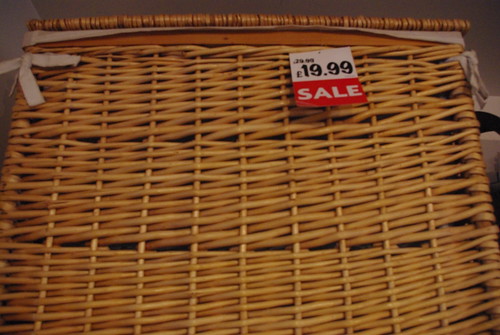
    Sale basket in Shenzhen

    A friend here in Shenzhen got this basket from a market here. The markets are usually full of production overruns and samples. I managed to pick up a couple of genuine North Face Basecamp duffle bags for 30 percent less than UK retail.

    What I found interesting about this particular item was that it had a UK sale tag attached.It reads £29.99  £19.99 SALE.

    My initial reaction was how can it be reduced if it hasn’t even reached the shopfloor yet? It was an interesting proof-point of how retailers play customers as chumps. By all means enjoy bargain hunting but don’t believe the SALE tag hype. From what my friend told me about the production overrun market; the retailer in question (Woolworths) seemed to have vastly overestimated British consumer demand for rattan laundry baskets.

    My friend had the basket for a few years. I was writing this post almost a year to the day after Woolworths Group had gone into administration, closing its stores across the UK. More retailing related content here.

  • Countdown on the traffic lights

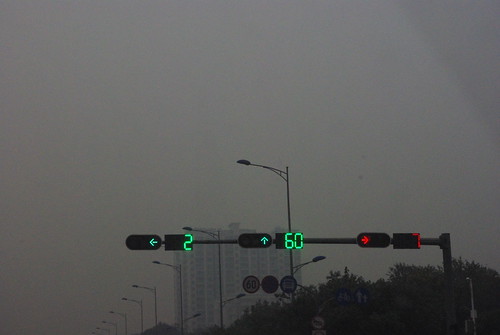
    Visiting a different country gives you a chance to notice the small everyday things that might be different to your own country. A case in point for me was the countdown on traffic lights in the Chinese city of Shenzhen.

    When I reflected on the countdown on the traffic lights, I started to think about the concept of time and traffic congestion.

    Chinese driving culture

    Time in traffic congestion is not wasted time. Waiting at a traffic lights is a time for catching up on reading, making phone calls, sending text messages or returning emails. Its the sign of hustle for a non-stop operation. Shenzhen is the Chinese dream and the people here aren’t going to waste a minute if they can be hustling for an extra yuan or two.

    Hands-free kits are the exception rather than the norm. I was in a car where a driver fished out assorted Nokia handsets out of pockets in traffic congestion to answer calls and phone other people. Business was conducted on the go.

    I presume the countdown on the traffic lights was to try and prevent road accidents. Chinese drivers have adapted their practices that would drive your average British traffic police officer.  To better use this dead time that would be otherwise wasted. Drivers use the countdown on the traffic lights; as way of optimising their time reading, making phone calls, texting or eating. Once the lights are green, drivers are told how much time they have to get across the junction. More China related content here.

  • The electric scooter

    One of the first things that I noticed about the Shenzhen streets was the prevalence of the electric scooter. They are ridden by young people and old people. They’re used for delivery services, commuting to and from work and going to the buy the groceries.

    They aren’t slick looking Tron light bike type conveyances, or Something worthy of Shotaro Kaneda’s bike that would fit into the Neo Tokyo-like streets of central Shenzhen. Instead the electric scooter looks like an emaciated Honda Cub. It all comes across a bit half-arsed.

    Electric scooter, originally uploaded by renaissancechambara.

    They represent the cheapest form of powered transport in urban China.

    These are probably the scariest things that you are likely to encounter in China, short of being invited to drink tea with the authorities. They are fast enough to be dangerous, but slow enough to be annoying for other road users. They make no sound, not even the rushing of tires on road surface.

    The riders tend to have little skill and view fellow road users as potential targets. They are also not ridden only ridden on the road, but on the pavements and pedestrians have to be constantly in a high state of vigilance watching out for errant electric scooter riders. This being China, no fucks are given. If you wipe out on the pavement, they’ll just ride on. They’re absurdly dangerous.

    Finally, given that most of China’s electricity supply comes from coal fired power stations; and your scooter will last a few years at best – their green credentials are somewhat lacking. More design related content here.

  • Saab

    Saab has been a pioneer in the automotive sector and it is now facing imminent death in the car business. Saab made the first production cars with safety belts, the first headlight washer and wiper facilities, the first impact absorbing bumper, pioneered pollen filters in the air system of its cars and the first CFC-free climate control. Saab along with the Mercedes S-Class it has had a disproportionate impact on the modern car.

    I have a personal attachment to the Saab brand. I can still remember the smell of the interior of a family friend’s Saab 99, the brooding brow over the dashboard that the VDO instruments used to look out from, the heated seats and the ignition key that also locked the gear box.

    stig_blomqvist_rally99

    Motorsport, in particular rallying was the preferred sport of my Dad and my hero didn’t wear a polyester Liverpool shirt, but a set of fireproof overalls. His name is Stig Blomqvist, one of the most talented men ever to get behind the wheel of a car. He has competed successfully in circuit racing and rallying for the past 38 years.

    saab_rally_99T

    Blomqvist’s vehicle during the late 1970s was a Saab with a distinctive avant-garde paint job that caught my imagination as an 8-year old. With the rise of four-wheel drive, he then moved to Audi, and my team allegiance went with him – when Saab bowed out of top flight rallying. But that avant garde paint job still has a place in my heart.

    Saab is now staring oblivion in the face. A financial rescue has been scuppered and the car company is likely to be consigned to the annals of history. At this point Saab reminded me of Apple circa 1996, however one thing Apple had in its darkest hours were fans of the Macintosh platform. I can remember when having an Apple Mac wasn’t cool, but marked you out as a bit of weirdo.  I know, I was one of them weirdos; and thankfully the company is still around making insanely great products that shows my loyalty was not misplaced.

    If I was a potential saviour for Saab; not even a business plan by the best brains from Goldman Sachs would persuade me after reading feedback from the loyal members of the New York Saab Owner’s Club by Michael Corkery on the Deal Journal blog on the Wall Street Journal online.

    Some of the things that caught my eye:

    1. …there are some guys in the club who are going to say : ‘good riddance they haven’t made a good car in a long time.’
    2. There are some vintage guys in the club who say that Saab hasn’t made a good car since 1999…
    3. Over the last few years club members have started bringing their non-Saab cars to meetings. It speaks to the fact that Saab has gotten away from what made them a fun driving car.
    4. There are some people who work with me and will ask for car advice. But unless they are a car person, I won’t recommend Saab. I don’t want them to come back and yell at me.

    I wouldn’t even like to guess what the net promoter score is amongst some of Saab’s long-suffering fans. Saab has lost what it was to its customers. It was no longer authentic, this isn’t about globalisation; its about a company and its brand losing its soul. This happened whilst the company was a completely-owned subsiduary of GM. General Motors is ultimately responsible for management decisions that didn’t just destroy shareholder value and brand value, they nuked it.

    The only bit of Saab that remains is in the camaraderie of the club and vintage vehicles. Graham Brown frequently talks about authenticity being the keystone for successful youth marketing, its also true for marketing to the not-so-young. More on brand related posts here.

  • The Playful World by Mark Pesce

    The Playful World was written by Mark Pesce. Pesce was an early pioneer of the web. He was instrumental in bringing a 3d interface to the web through a standard called VRML. This was an early attempt to provide the kind of immersive ‘matrix’ experience envisaged by the likes of William Gibson and Neal Stephenson in cyberpunk literature. Were a digital double of the real world (or more likely a more attenuated digital version) provides for interactions in the virtual realm.

    Since then he has been applying his ingenuity and enterprise to academia  and futurism for the past decade and a half.

    The Playful World was written about a decade ago, yet was very prescient of today’s cutting-edge web and related technology trends:

    • Augmented web – the web provided a data overlay of the real world with applications like locative digital art and turn by turn directions for navigation. Putting this inside glasses rather than on a screen would mirror some of the human computer interaction work done since the 1960s for fighter pilots.
    • The web of things – items become intrinsically linked to the web with all the security risks that entails as well.
    • Custom manufacturing – smaller production runs, intellectual property becomes more important than manufacturing scale. Globalisation gets transformed. Waste could be reduced, though that would be affected by the kind of prototyping one goes through printing items in 3D printing from an existing file.
    • Gaming – lean forward entertainment becomes more immersive, though a lot of the growth in gaming has already happened

    Pesce knits his experiences together into an engaging narrative that would brings all of it together for the reader. If you want to get where things are going I recommend you have a read of Pesce’s book. You can find more book reviews here. More related content here.