Design was something that was important to me from the start of this blog, over different incarnations of the blog, I featured interesting design related news. Design is defined as a plan or drawing produced to show the look and function or workings of a building, garment, interfaces or other object before it is made.
But none of the definition really talks about what design really is in the way that Dieter Rams principles of good design do. His principles are:
It is innovative
It makes a product useful
It is aesthetic
It makes a product understandable
It is unobtrusive
It is honest
It is long-lasting
It is thorough down to the last detail
It is environmentally-friendly – it can and must maintain its contribution towards protecting and sustaining the environment.
It is as little design as possible
Bitcoin isn’t long lasting as a network, which is why people found the need to fork the blockchain and build other cryptocurrencies.
Bitcoin uses 91 terawatts of energy annually or about the entire energy consumption of Finland.
The Bitcoin network relies on thousands of miners running energy intensive machines 24/7 to verify and add transactions to the blockchain. This system is known as “proof-of-work.” Bitcoin’s energy usage depends on how many miners are operating on its network at any given time. – So Bitcoin is environmentally unfriendly by design.
On the other hand, Apple products, which are often claimed to be also influenced by Dieter Rams also fail his principles. They aren’t necessarily environmentally friendly as some like AirPods are impossible to repair or recycle.
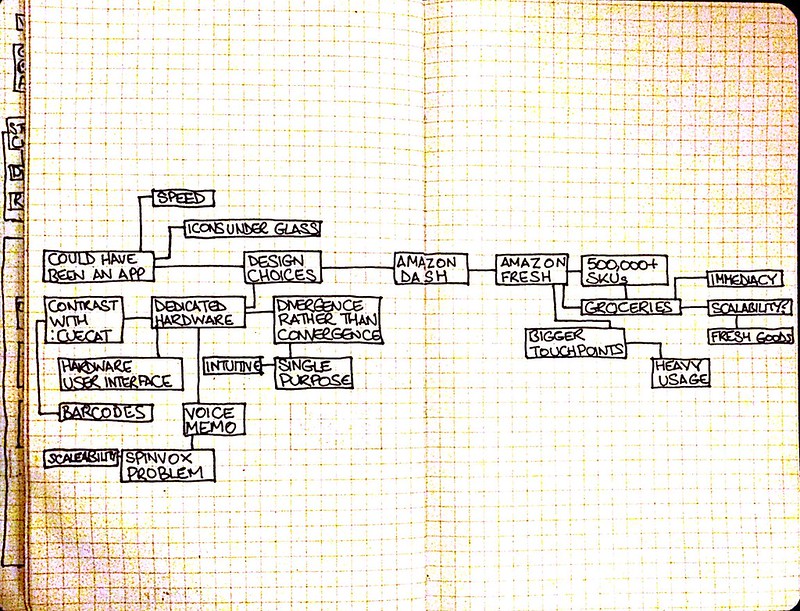
At the end of last week Amazon unveiled Amazon Dash: an accessory to aid ordering from its Fresh grocery service. Fresh promises free same-day delivery on orders of over $35 of more than 500,000 Amazon items including fresh and local products; including products from respected restaurants and coffee shops. It has been rolled out in three major US markets: San Francisco, Seattle and Southern California.
Fresh has a mobile application on both Android and iOS to aid in shopping – which makes the launch of Dash much more curious. Dash is a piece of dedicated hardware which implies a failing in terms of ease-of-use for the smartphone application. Amazon obviously thinks that Fresh customers will be heavy high-touch, high-value consumers in order to spend this much trouble engineering and manufacturing the hardware and supporting services to make Dash work.
Dash is a product that wouldn’t be out of place in a collection of Braun kitchen appliances. It’s hardware interface so simple it looks really intuitive.
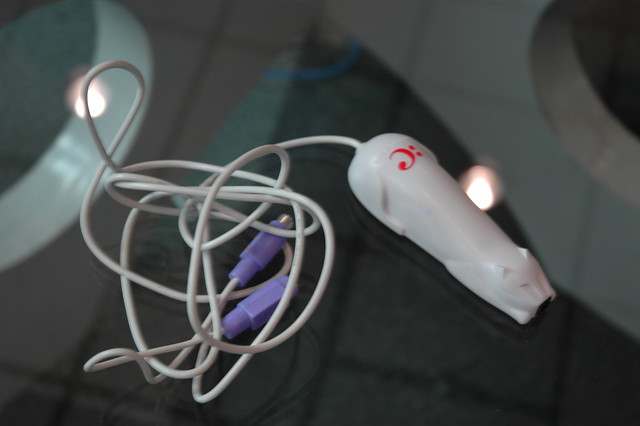
The Amazon Dash can be seen as part of a wider movement from converged general purpose devices to dedicated hardware. It is interesting to compare and contrast the Amazon Dash with the :CueCat; how just over a decade can make such a difference to a product. Back in 2000, Wired magazine sent out the :CueCat to US subscribers of their magazine. The :CueCat was a barcode scanner that allowed readers to augment the print content with a link to web content. Think a prehistoric QRCode. It didn’t work that well for a number of reasons. The codes were proprietary, partly due to consumer privacy requirements and intellectual property around barcodes. In order to use the :CueCat one needed to be connected to an internet-enabled PC via a wired USB or PS2 connection. Using the :CueCat was no easier than typing in a URL or searching via Google; a search engine on the ascendancy at the time. The :CueCat was a spectactular failing for the media industry looking to get to grips with digital media.
Moving forward to the Amazon Dash, the equivalent computing power of that desktop PC has been squeezed into a device that fits in the palm of your hand. Wireless connectivity provides a more flexible connection that removes contextual restrictions on the Dash compared to the :CueCat. The web extended computing so that the website and the PC or mobile device in a symbiotic relationship where it isn’t clear to consumers just were one starts and the other finishes.
The Dash takes inputs via a product barcode and voice memos. Despite the technology advances over the past ten years with the likes of Siri and S-Voice; there will likely be some sort of human intervention required to make these voice memos work. This is at odds with Amazon’s warehouse robot systems and lack of a human customer service face over a telephone line.
This voice memo challenge is not trivial, it was a contributing factor in SpinVox’s failure. The Fresh programme because of its logistical challenges will be hard to scale, and the economics of the Dash have to be carefully balanced between existing products that are repurchased via barcode scan and new or fresh products that would use the voice memo. Acquiring basket growth becomes incrementally more expensive. Over time the system may learn voice commands rather like Google’s old telephone-powered search; on the one hand local area focus is likely to limit dialect variations, on the other sample size maybe hard to scale to be statistically significant for machine learning. More related content here.
At the time that the news came out about Facebook’s acquisition of Oculus VR, I was in Boston (for work), the weather was biting cold, the days long and jet lag dulled my curiosity; so this post came along later than I would have liked.
The first thing that struck me was how much of the content that I had posted about the Facebook IPO and the recent WhatsApp acquisition seem to fit the Oculus acquisition as well.
How it fits into the the broader Facebook acquisition pattern
When looking at the Facebook IPO I commented that Facebook needed to look at other markets beyond online advertising whilst leveraging its existing customer base. I also made the comparison of Facebook and Xerox; in terms of its existing form being a cash generator to fund some future big bet:
I personally think that if you buy into Facebook’s future promise, Facebook looks more like Xerox. In the 1950s, the Northeastern US was the Silicon Valley of its day; with engineering and chemical factories around New Jersey and the Boston corridor through to New York being the home of the infant computer industry. Xerox was founded as a photographic supplies company that made equipment to develop photographic film, it eventually incubated its killer product – xerography which begat photocopiers and fax machines after a decades worth of work. Later on in the development period, the company invested in an insurance company to provide cash flow for future model developments. If you believe that Facebook has a bright future ahead of it, then by implication, it’s current and immediate future products like premium ads in the news feed look more like cash generative businesses to fund ‘project X’ whatever that turns out to be.
What Oculus VR, Whatsapp and Instagram represent is a spread bet on what the future is likely to be based on a few different approaches; mobile devices are important, as are lean bandwidth applications that perform well on less developed mobile networks and finally that the immersive experiences promised us by cyberpunk literature will happen .
Given that Facebook has about 100 billion dollars or so to play with it could do another two dozen such bets on the future. Oculus VR technology isn’t likely to win out when Chinese, Korean and Japanese consumer electronics brands invade the sector and bring the kind of hyper-competition that translates into razor-thin hardware margins; so the model must have some licensibility in the business model.
Google Glass is not the glasses that you are looking for
The second thing that struck me was that Facebook’s endorsement of Oculus could be viewed as a tacit acknowledgement by Facebook that Google Glass is going in the wrong direction at the moment. Oculus Rift provides an ‘in the line of sight’ view of content rather than a ‘glance up’ orientation. However Sony’s Smarteyeglass seem to be ahead of the curve on this. There is more speculation that Facebook want’s to roll out a cyberspace view of the internet promised in cyberpunk literature; however there would be a lot of work that would be needed to be done on standards and conceptual web design in order to move this idea forwards significantly.
A break in faith
The outpouring of outrage by Kickstarter fans who helped fund Oculus VR is perhaps the most interesting aspect of all this. Early adopters are often upset when their little secret becomes mainstream. It is familiar to me from club culture.
Ibiza is not like it used to be… The atmosphere went when moved from to and the crowd changed…
The implication for Kickstarter is that it will be much harder to get funding for seriously innovative tech-related projects and Oculus will have poisoned the well. Kickstarter will still work for artists looking to release albums or small short film projects and will do so very well, but it will have had its potential clipped.
How the NSA Can Use Metadata to Predict Your Personality | DefenceOne – Despite assurances that metadata is free of content, new research shows that it can be highly personal. This debate on metadata reminds me of three examples. The first one was by AOL Research, which back then was headed by Dr. Abdur Chowdhury. AOL Research released a compressed text file on one of its websites containing twenty million search keywords for over 650,000 users over a 3-month period intended for research purposes. The New York Times was able to locate an individual from the released and anonymized search records by cross referencing them with phonebook listing. The second is research done on library metadata by UCL researcher Anne Welsh. Finally, cipher operators used to be able to recognise each other by their morse code style: a form of analogue metadata. More related content here.
Bassline: The UK Dance Scene That Was Killed by the Police | VICE United Kingdom – Bassline was a Sheffield-specific scene. Sheffield has had a history of birthing electronic music genres. The most notable one for me was the bleep techno scene from the late 1980s. Bassline built on the trends that came before it. It has a more driving 4:4 beat than speed garage, lush burbling analogue synths for the techno and acid house heritage of the city. Finally some of the bassline tracks had some string stabs that brought to mind the early Chicago house and detroit technology a la Rhythm is Rhythm and OctaveOne.
The policing policies of the early 2000s were an extension of the top down culture war against youth culture of the late 1980s and early 1990s. We missed out on an interesting time in dance music with bassline. Who knows where it might have taken things, could bassline have led to a less sterile EDM sound?
Alibaba bets on Taobao mobile app to boost sales | WantChinaTimes – Chinese e-commerce giant Alibaba Group launched the 24-hour sale “Mobile Taobao 3.8 Life Festival” on March 8 in a bid to boost transactions made via mobile devices and drive mobile app adoption
Chopard named the Official Timing Partner of Porsche Motorsport – Luxury News – interesting given that Porsche has its own watch brand made by Eterna. Eterna are a Swiss watch brand that pioneered using ball bearings in watches. The Israel navy and special forces used Eterna dive watches back when the Royal Navy divers were using Rolex Submariners. This gives a good idea of how robust Eterna watches have been.