哈囉 – here you’ll find posts related to Hong Kong. That includes the territory, the culture, business, creativity and history. I lived and travelled to Hong Kong a number of times, so sometimes the content can be quite random.
In addition, I have long loved Cantonese culture and cuisine, so these might make more appearances on this category. I am saddened by the decline in the film and music production sectors.
I tend to avoid discussing local politics, and the external influence of China’s interference in said politics beyond how it relates to business and consumer behaviour in its broadest context.
Often posts that appear in this category will appear in other categories as well. So if Apple Daily launched a new ad format that I thought was particularly notable that might appear in branding as well as Hong Kong.
If there are subjects that you think would fit with this category of the blog, feel free to let me know by leaving a comment in the ‘Get in touch’ section of this blog here.
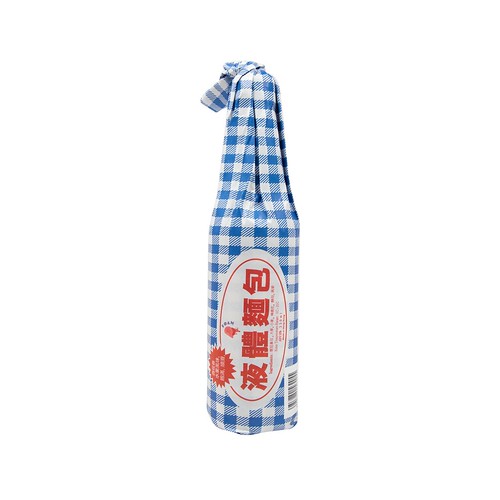
Life Bread is a brand icon. For Hong Kongers the blue or red checked wrappers mean western style bread. Life Bread is as Hong Kong as the Lion Rock – a granite peak that overlooks the city. Life Bread became an emotive icon used in the 2019 Hong Kong protests as an celebration of Hong Kong identity. It has even been celebrated in art. So when a local craft brewer FoamBeerBrewery was launching a bread based IPA it made sense that it would go with packaging that linked back to the Hong Konger lingua franca for bread.
FoamBeerBrewery Bread IPA packaging evoking the wrappers of Garden Bakery Life Bread – a local hero brand for Hong Kong
FoamBeerBrewery Bread IPA is available from local high-end supermarket citysuper.
Everybody’s business
I came across this cold war era animated film that explains capitalism and extols its virtues. Nowadays there isn’t the same efforts to promote capitalism in the face of millennial socialism. As these things go, it’s not a bad explainer for economics neophytes.
Immersive billboards
A number of Asian cities have fitted high definition digital billboards that go around the corner of a building. The latest one overlooks Tokyo’s Shibuya crossing.
The content has varied by market, including a golden bull to celebrate lunar new year in Kuala Lumpur. The Tokyo board taps into the Japanese love of cats. Here’s what the animation looks like. It appears sporadically to encourage bystanders to keep watching the adverts that stream on the billboard.
There is a live stream of the billboard available.
https://youtu.be/HX9pROOvTzA
Brand China
The communist party of China had its 100 year anniversary celebration to focus on past accomplishments and project its current strength. TL;DR China wants to smash your head into a wall of steel that has been made by 1.4 billion or so Chinese people.
Meanwhile Pew Research was looking at ‘Brand China’
While Xi Jingping might not care, it makes trade harder to do with more developed economy.
The one segment where China does seem to have unwavering support is from the progressive left, particularly in American politics. This advocacy seems to be based more on their wishful thinking than any messages delivered by China as Noah Smith discusses in their newsletter.
South Korea’s handset industry is leading indicator of supply chain shift – Samsung has chosen to place two thirds of its global production capacity at 360 million phones near Hanoi, Vietnam and one third in Noida, India. At the same time, a group of American brands led by Apple have asked their Taiwan-based OEMs to set up production facilities in India. Taiwan’s three largest manufacturers Wistron, Pegatron and Foxconn all have production lines up and running in India. Before this, Taiwan-based notebook computer manufacturers had already moved their production to major ASEAN countries. It is a definite trend that manufacturers are relocating part of their production out of China into ASEAN countries and South Asia – Apple can learn a lot from South Korea’s handset industry. Apple’s approach to its supply chain compared to the handset industry looks risky. It is betting on Chinese behaviour that seems to run counter to Xi Jingping-era China. More on handset industry related content here.
China
Ketamine and the Return of the Party-State | Palladium Magazine – as China gets richer and its factional lines get drawn across social battles instead of economic ones, we can expect rhetoric about moral regeneration to become more potent. The party’s turn towards encouraging family and child-rearing might well be the first sign of things to come. When all your political capital has been invested in the narrative of national rejuvenation, there’s no easy way out when the low-hanging fruits of the market start to run low
Former Chinese Party Insider Calls U.S. Hopes of Engagement ‘Naive’ – WSJ – “Wishful thinking about ‘engagement’ must be replaced by hardheaded defensive measures to protect the United States from the CCP’s aggression—while bringing offensive pressures to bear on it, as the Chinese Communist Party is much more fragile than Americans assume,” Ms. Cai wrote. Her 28-page paper is slated for publication this week by the Hoover Institution, a conservative-leaning think tank at Stanford University. A growing roster of Western politicians and analysts has concluded that U.S. diplomacy with China hasn’t paid dividends. But such views are rarely expressed publicly by sources as highly placed as Ms. Cai was just a short time ago. – Pretty reasonable assessment with plenty of empirical evidence to support it
How Beijing humbled Britain’s mighty HSBC | Reuters – The decision by Baowu to blackball HSBC is part of a clampdown on the global London-based bank by many of China’s gargantuan state-owned enterprises – a campaign described to Reuters in interviews with HSBC bankers, and employees at state companies who have first-hand knowledge of their operations. Controlled by China’s ruling Communist Party, these companies manage the nation’s largest industrial projects and are responsible for $9.8 trillion of revenue annually. The reason for the pullback by state firms isn’t HSBC’s financial soundness, which isn’t in question, but rather Chinese politics. People inside the state enterprises and HSBC say Beijing has grown disenchanted with the bank over sensitive domestic and international legal and political issues, from China’s crackdown in Hong Kong to the U.S. indictment of an executive at Chinese national tech champion Huawei Technologies – this makes HSBC’s pivot to China look foolish
‘Unstoppable storm’: rights take back seat under Hong Kong security law | Yahoo! News – from the journalist’s Twitter thread when she shared the article and additional material that didn’t make the cut: “Judges hope to be given more trust and discretion. Prosecution wants more power. What can defense do? …I’m not as naive to believe they won’t come after lawyers. Losing license is the minimum charge.”
Luxury
Streetwear Has a Homophobia Problem | Highsnobiety – where to start with this? I think that some of the homophobia is down to in-out group dynamics. Gays have been in the streetwear industry for a long time. Bomber jackets as a streetwear item came from creatives like Judy Blame and the Buffalo Collective
Media
America’s New Post-Literate Epistemology | Palladium Magazine – McLuhan believed that the West was due for a period of “re-tribalization,” but by “tribal” he meant much more than the commonly understood definition. Yes, there would be polarization: people would by and large become less civil, less rational, touchier, and more defensive about the smallest things. This much, we already know and see every day. But McLuhan went even further in his use of the term, arguing that electronic media—more so than any political ideology—shifts the sensorial basis of Western society away from the visual, the literate, and the abstract and toward the oral, the tactile, and the tribal. In other words, he saw re-tribalization as a process that will eventually return modern man to the mental and epistemic world of his pre-literate tribal ancestors: the “global village.” Over the long run, this can be quite benign, even sublime: in 1969, McLuhan imagined its endpoint as a society of “mythic integration” where “magic will live again.” Speaking in lofty millenarian terms, he predicted technology would merge humanity “into an inclusive consciousness…a new interpretation of the mystical body of Christ…the ultimate extension of man.”
Facebook, Twitter, Google Threaten to Quit Hong Kong Over Proposed Data Laws – WSJ – the problem is that the online platforms don’t put teeth behind it. Like taking unilateral action against Chinese advertisers and Chinese media. Lets assume that Facebook, Twitter and Google would have to leave Chinese territories. They can then squeeze China two ways:
China’s small factories rely increasingly on direct to consumer sales through Facebook and Instagram advertising. As does product aggregators like Wish.com and Shein. Squeezing them out of advertising would send 10,000s of Chinese employees out of work
Shutting out China’s SOEs (Air China etc) and Chinese media accounts would severely cripple China’s external united work front efforts to influence the global market
Vietnam
Vietnam to phase out 2G, 3G serivces starting 2022 – Vietnam’s Ministry of Information and Communication (MIC) has decided to start phasing out 2G and 3G technologies within the country in 2022 in a bid to encourage people to use smartphones and promote digital society.
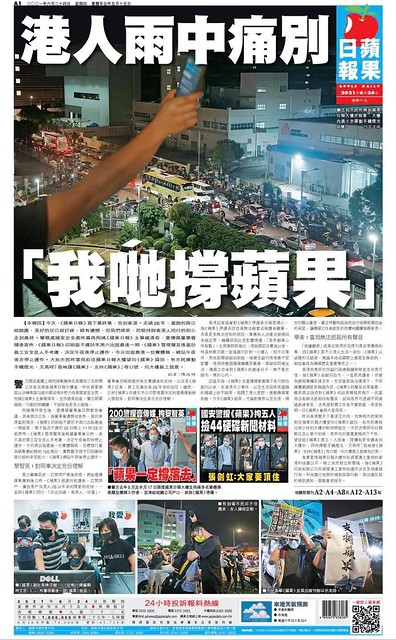
Hong Kong newspaper Apple Daily closed down. It closed under government pressure. If we’re honest about it, it had been under government pressure for years. Advertisers were reluctant to be in the paper for years, partly due to government sentiment. Despite being Hong Kong’s most popular paper, it was running on loans that Jimmy Lai gave it.
Final print edition of the Apple Daily published in Hong Kong
It’s end came with a series of cuts. Jimmy Lai has had his assets frozen as part of the national security law related investigation. The Hong Kong government extended these charges to further senior employees of the Apple Daily. Then the Hong Kong government froze the bank accounts of Apple Daily and the related companies.
The business had 67 million US dollars; so could have kept going for another 18 months until that freeze kicked in. As it was, the last paper would have come out on Saturday. On Wednesday the lead writer was arrested and the board decided to publish its last paper on Thursday. They printed 1,000,000 copies of the final edition which sold out. On previous days they had printed 500,000 to mark the asset freeze as Hong Kongers came out to support them. Back in the late 90s the paper was around 300,000 copies a day. The typical print run was 150,000 copies a day. The paper had about 500,000 paid subscribers. I was one of them. Yes their English copy was almost sub-Guardian standard (but with less typos of course). But their English language news has stories about Hong Kong business and China that other English language outlets didn’t cover.
The security secretary John Lee warned people not to associate with Apple Daily employees, creating a white terror style scenario.
A lot of the commentary from people who should know better has been about the Apple Daily‘s tabloid nature. Apple Daily was Hong Kong’s most popular paper for a number of reasons
Classism with it’s ‘estate boys’ and ‘estate girls’ referring to Hong Kongers living in public housing
But they conveniently ignore Apple Daily‘s pioneering work in internet video journalism. Its investigative journalism and an editorial stance that called government to account. Stories last year included expat police officers breaking planning and property laws. But the Communist Party of China doesn’t want to be examined, let alone held to account.
Hong Kong writer Sum Lok kei summed it up really well with this post that he put on Twitter
Yes, ppl are aware of Apple Daily’s failings, their paparazzi arm and all. What is being mourned isn’t exactly the paper, but the possibility of its existence in this city that had prided itself for its witty discretions – now replaced by a monotonic, absolute drone.
The Hong Kong government has been very opaque about the kind of journalism that is allowed. It is arbitrary and designed to promote severe self censorship.
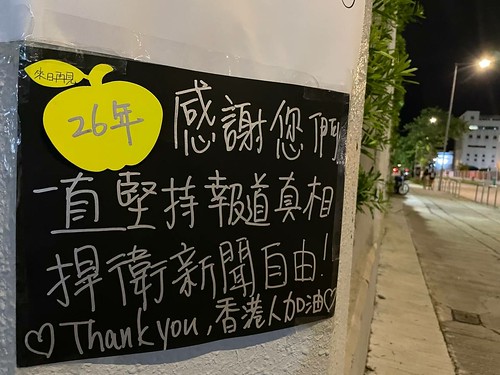
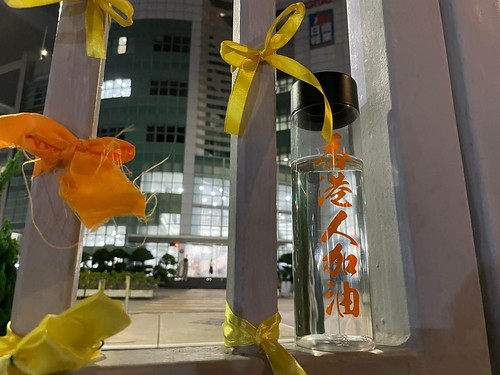
images of the now closed Apple Daily fence with tributes from Hong Kongers via Guardians of Hong Kong Telegram channel
It all hinges around the national security law:
Seccession includes acts ‘whether or not by force or threat of force’
Subversion or colluding with foreign countries are vague. So Apple Daily were accused with colluding with foreign countries without being in touch with them
The law isn’t supposed to be retroactive, yet Apple Daily content from before the July cut-off date is included in its alleged violations
China’s definitions of state interests are expansive
It is extra-territorial in nature. So this post that I have written could fall foul of inciting hatred of the Hong Kong and Chinese government. Despite the fact that this post is written and hosted outside Hong Kong. If I get shanghai-ed whilst transferring through an Asian airport you know what has likely happened
But its just the media isn’t it? No.
if you’re a strategist in an advertising agency writing about consumer attitudes and touch on areas like what Hong Kong localism means for brands. This would affect how brands position themselves, I wrote similar positions for brands on Brexit supporters versus remain supporters. (Brexit supporters preferred local brands with nostalgia compared to remainers.) Or changes in attitudes to home ownership and buying homewares due to immigration. The kind of things that the government won’t like then you could be doing eight years to life in jail
If you write critical piece of analysis on bonds, Chinese or Hong Kong ‘well connected companies’ or forward-looking views on government policies. You could be doing eight years to life in jail
If you create a legal opinion on any of the above for a client. You could do eight years to life in jail
If you did a frank audit of a well connected company as part of the audit team of an accountancy firm. You could do eight years to life in jail
You do legitimate academic research in an area that the Chinese or Hong Kong governments and their hangers on don’t like. You could do eight years to life in jail
All of this sounds like a bit of an exaggeration?
While the world was looking on at trials of Apple Daily, major retailer Watsons withdrew special edition water bottles. The water bottles were designed with the slogan #Hong Kong is very beautiful. Presumably, they had originally been created to tap into Hong Kongers love of limited edition things celebrating their city and their love of hiking in oppressively hot weather.
They were withdrawn due to perceived seccessionist overtones. Hong Kong is actually achingly beautiful with its futuristic skylines and natural environment. By comparison lot of the Chinese mainland is butt ugly like Hubei province or Beijing in winter.
Bao Choy, a freelance producer who worked at RTHK was fined for ‘improper car plate searches’ carried out investigating Pro-Beijing forces inspired Triad violence at Yuen Long.
A reporter at pro-Beijing paper Ta Kung Pao who accessed the same database, but was bound over instead.
The Department of Justice said it agreed with the order, as Wong had a clean record and was working for the pro-Beijing newspaper when he made the licence plate searches.
This would give Hong Kong increased insights into NGOs and political parties. Professional bodies in accountancy and law have been seen as a roadblock by the Chinese and Hong Kong governments. The movement against accountancy bodies is mirrored by moves against the legal profession. The latest move to make solicitors senior counsel turns the legal profession upside down.
You are now restricted in accessing company registry data, making ownership structures opaque. This will provide boundless opportunity for corruption and fraud and Hong Kong becomes as opaque as mainland China.
And in a news report from Hong Kong’s public service broadcaster RTHK:
“If it’s a police state, why not? I don’t think there’s any problem with a police state. When we say a police state, I will view the other side, that is the emphasis on security,”
June is pride month and one of the best adverts that I have seen is by Pinterest. It has members of the LGBTQI community from around the world talking about sexuality and how they learned about themselves.
Eating out is an important part of life in many Asian countries. Cheap eats in Singapore are provided by hawker markets. Imagine Asian street food, if it was run by Germans. They had a similar tradition to hawkers called da pai dang (大牌檔). But the Hong Kong government has slowly squeezed them out and there are now less than 25 left. Instead I used to usually go to small hole in the wall restaurants. Da pai dang are treasured by Hong Kong citizens; hawker markets are treasured by the Singaporean people and their government. Singaporean channel Our Grandfather Story put together a video on how to support offline hawker markets. Its also a great critique of online food services.
MiniDisc
Sony’s MiniDisc format was a fascinating format. Friends of mine used it to record DJ mixes as it gave better quality than cassette taps. But it never beat out the humble compact cassette as a universal media. I went from cassette tapes to recordable CDs. MiniDisc operated in an interesting technological and temporal space.
It is a very cyberpunk retro-futuristic looking media. The optical disc in the protected diskette case. If you wanted data safe, secure and offline, then this form factor looks sensible. And Sony’s Blu-Ray in a diskette is used for archiving purposes today by Sony and Panasonic under the format name Archival Disc.
When I look at the MiniDisc, I think of dinky portable player / recorders that were almost like the watch-makers art. If it hadn’t existed, anime and manga artists would have created it as a fictional device.
It had a second life as a pre-iPod format that offered the shareability of cassette mixtapes.
The secret life of MiniDisc in Japan is fascinating. All of the above factors and more are featured in this documentary.
Apple Daily
Hong Kong’s national security police arrested senior journalists at the Apple Daily.
Hong Kong police arrest editor-in-chief of Apple Daily newspaper in morning raids | Hong Kong | The Guardian – Steve Li Kwai-wah, head of the police’s national security division, said there was “very strong evidence that the questionable articles played a very crucial part in the conspiracy, which provided ammunition for foreign countries, institutions and organisations to impose sanctions,” adding that those arrested played “a very important role” in their publication. The articles reportedly date back to 2019. Authorities have made repeated assurances since the implementation of the controversial and wide-ranging national security law in June 2020 that it was not retroactive.
They seized journalist computer hard drives, money and materials. The Apple Daily team didn’t let that hold them back and live-streamed the publication of their early edition of Friday’s paper.
Hong Kongers came out to support the newspaper, queuing and buying multiple copies of the Apple Daily paper at news stand as soon as the early edition was published.
They have an English language version of the Apple Daily paper here and I urge you to consider subscribing via the Apple app store or the Google Play store.
You don’t have to subscribe because the Apple Daily is the lone free voice in Hong Kong media; universally disliked by those in charge (and many who wish they were in charge). You can subscribe for Chinese and Hong Kong coverage that you wouldn’t otherwise see in English language media. Such as Alibaba’s Taobao e-commerce platform having over a billion data records taken. A huge hack not mentioned elsewhere yesterday in the media.
China is intensifying efforts to check the “chaotic” power of online celebrity fan clubs – Asian fans are something else, so this is not surprising. Asian Fans will spend a fortune on their favourite bands records. They will take out full page newspaper advertisements or billboards wishing their favourite artist happy birthday. In China, the party is always first, not pop stars. Fans will be clamped down on, unless they’re fans of Xi Jingping. More on what Asian fandom here.
Chinese ecommerce site Shein hit with trademark disputes | Financial Times – “As long as they have the audience that they do, they’re going to determine that it’s worth their time and energy to move products as quickly as possible — even if some of those products violate intellectual property norms.” – business as usual in Chia then (paywall)
Hong Kong star Karen Mok comes under fire in China for wearing Dolce & Gabbana in music video | South China Morning Post – The studio of Hong Kong pop singer Karen Mok has been forced to issue an apology after she prompted controversy on Chinese social media for wearing Dolce & Gabbana in her latest music video. The brand has been seen in some quarters as anti-Chinese following a 2018 controversy over an advertisement that showed an Asian woman trying to eat pizza and spaghetti with chopsticks. The adverts were criticised by mainland audiences for “publicly insulting China” and the crisis escalated after an online leak of screenshots from a private conversation showed Stefano Gabbana, the brand’s co-founder, making insulting remarks about the country. Gabbana and the brand’s co-founder Domenico Dolce eventually issued a public apology. – how fragile is the Chinese collective ego? This makes China look weak.
Retail Could Have A Bigger Comeback Than Expected. Here’s Why. – Robb Report – interesting US estimates – the National Retail Federation revised up its annual outlook: It predicted that retail sales will now grow between 10.5 percent and 13.5 percent to the range of $4.44 trillion to $4.56 trillion. That compares with $4.02 trillion in retail sales last year
Brown Thomas and Arnotts could be changing owners – I wouldn’t be surprised if LVMH’s DFS business didn’t bid for Brown Thomas. Ireland is too small a market (even with tourists) for single brand boutiques