Innovation, alongside disruption are two of the most overused words in business at the moment. Like obscenity, many people have their own idea of what innovation is.
Judy Estrin wrote one of the best books about the subject and describes it in terms of hard and soft innovation.
Hard innovation is companies like Intel or Qualcomm at the cutting edge of computer science, materials science and physics
Soft innovation would be companies like Facebook or Yahoo!. Companies that might create new software but didn’t really add to the corpus of innovation
Silicon Valley has moved from hard to soft innovation as it moved away from actually making things. Santa Clara country no longer deserves its Silicon Valley appellation any more than it deserved the previous ‘garden of delights’ as the apricot orchards turned into factories, office campus buildings and suburbs. It’s probably no coincidence that that expertise has moved east to Taiwan due to globalisation.
It can also be more process orientated shaking up an industry. Years ago I worked at an agency at the time of writing is now called WE Worldwide. At the time the client base was predominantly in business technology, consumer technology and pharmaceutical clients.
The company was looking to build a dedicated presence in consumer marketing. One of the business executives brings along a new business opportunity. The company made fancy crisps (chips in the American parlance). They did so using a virtual model. Having private label manufacturers make to the snacks to their recipe and specification. This went down badly with one of the agency’s founders saying ‘I don’t see what’s innovative about that’. She’d worked exclusively in the IT space and thought any software widget was an innovation. She couldn’t appreciate how this start-ups approach challenged the likes of P&G or Kraft Foods.
I’ve stared at UK mainline railway station departure boards at many times over the years, yet there is hidden information design that I just caught on to. I am usually fixated on the platform number and whether it will leave on time. So it was only this week that I picked up on the hidden information design of this little train ideogram as a footnote at the bottom of each destination on London Euston station’s display. I have been staring at this screen on and off for two decades as I travelled to see families or clients.
Once you realise that the ideogram is there, it’s a revelation as it gives you a lot of pertinent information at a glance. Just look at the picture I took of it below
Ideogram as hidden information design on train departure board.
The diagram flips, this was the dominant image. It shows:
How many carriages are on the train
How full of reserved passengers each carriage is ( in this picture carriages A, B, E and J are very full).
Which coaches are first class (in this picture the first class coaches are indicated to be K,J,H & G)
A cup periodically flashed over coach C to show that was where the shop / takeaway cafe was onboard the train. (It is very rare for UK trains to have proper dining cars on board now. Instead you buy a sandwich and a coffee from a kiosk on board that you can eat at your seat).
That the quiet zone had to be indicated in text because they had pushed the limits of the constrained screen space for the ideogram
It would be interesting to see if this data was available in API form for apps or web service usage and what could be done with it. More related content here.
Unilever moves global comms planning to Mindshare from PHD | Media | Campaign Asia – huge win for Mindshare and a move away at the global level between planning guidance and media buying. It would be analogous to investment managers to go back to taking advice from sell-side analysts. I guess part of the problem is trying to get global guidance to be implemented at a country level
China’s Tariff Cuts Won’t Hurt Daigou Business For Now | Jing Daily – China plans to reduce tariffs on 187 consumer goods, including cosmetics, apparel, health supplements, food, and pharmaceuticals. The new policy will go into effect on December 1. The average tax rate will drop to 7.7 percent from 17.3 percent.
China’s Toutiao Tried to Buy Reddit — The Information – One reason was general skittishness among Reddit’s investors about selling to a Chinese internet company whose user and revenue numbers were tough to assess – and there is the burn
Apple: Chinese Buying Huawei et. al. but Sticking with iPhone, Says Morgan Stanley – Barron’s – The Jigaung data also highlights that in the 4 weeks ending October 22nd, more “switchers” left their Chinese branded smartphone for an iPhone than iPhone users left for a Chinese branded smartphone, across all local vendors. In fact, Apple’s net switching rate, or the net amount of switchers gained/lost as a percentage of all brand switchers increased to 7.6% in the latest 4 week period, up from 6.7% in the prior 4 week period ending October 8th. Comparatively, Vivo was the only Chinese smartphone vendor to gain “net switchers”, albeit at a significantly lower rate. We expect this trend to only accelerate as future data sets will include the period after the iPhone X first began shipping.
You are not safe was a theme that echoed through a period drama on Silicon Valley yet is equally applicable today.
I have been catching up on Halt and Catch Fire. It is a fiction based on various aspects of Silicon Valley lore. I have enjoyed watching it immensely to a point.
I was especially struck by episode eight in the third series. One of the main characters in series three hacks his employer and releases their anti-virus software online for free. But its the mid-1980s through a thoroughly modern lens. It resonates because it speaks to our age, not to the 1980s or even the mid-1990s.
YOU ARE NOT SAFE
I, Ryan Ray, released the MacMillan Utility source code. I acted alone. No one helped me, and no one told me to do it. I did this because ‘security’ is a myth. Contrary to what you might have heard, my friends, you are not safe. Contrary to what you might have heard, my friends, you are not safe. Safety is a story. It’s something we search our children so they can sleep at night, but we know it’s not real.
Yes, there was software piracy, it was a mainstream part of computing culture which had sprung up from the ‘homebrew’ mentality. Prior to founding Apple, Steve Wozniak used to give out the schematics of what then became the Apple I. Punched paper tapes of software used to be exchanged between members when they met up in aMenlo Park garage and later on in an auditorium at Stanford University.
Back then the narrative was overwhelmingly positive in terms of technology. The main problem was whether the Japanese, Microsoft, Intel or IBM was going to crush the rest of the technology eco-system in Silicon Valley. Consumers had a bright new world of technology ahead of them. Video games were still a niche interest compared to VCRs (video cassette recorders). VHS versus Betamax was as important a format war as Windows versus Macintosh.
Here’s the thing. This show (rightly or wrongly) may frame the way a lot of people think about this part of the digital age. For those who aren’t well read about the history of Silicon Valley OR didn’t live through the 1980s – it will colour their view of history. That detail rankled me a bit; I’m not quite sure why. Part of it is knowing where we’re going is understanding where we have been in past.
That’s all very nice, but why does this matter? It provides you with perspective and the ability to critique ideas. Either way you are not safe. More related content here.
I was blown away when I realised that it was the tenth anniversary of the the Amazon Kindle. Ten years, think about that for a moment.
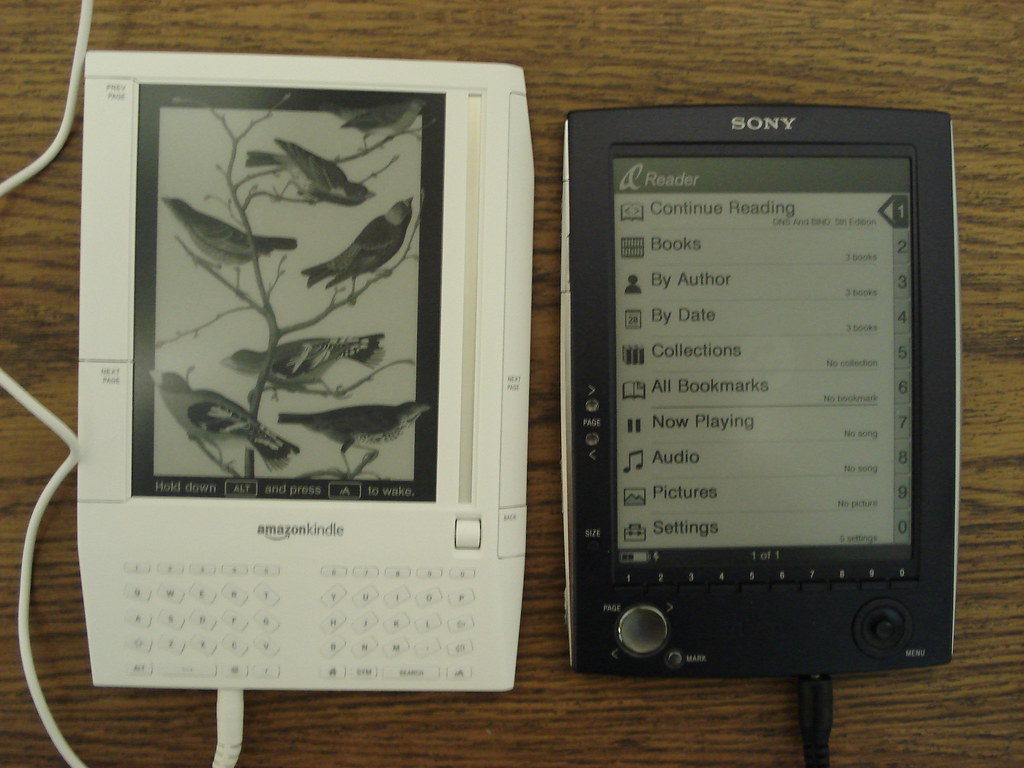
If you look at the original Kindle versus the latest model you can see how the design language moved from a ‘BlackBerry’ type product design to a smartphone type design. Along the way it benefited from improvements in e-ink display technology to provide a crisper viewing experience. Sony’s competitor might have looked more modern bit it didn’t manage to get the marketing mix and the hardware / services mix right.
Sony’s failure indicated while you could be successful in a number of media markets, it didn’t guarantee success in other media.
Ten years ago today, we launched the first-ever Kindle. Happy 10th birthday @AmazonKindle and thank you to all the Kindle readers and authors! pic.twitter.com/qelfniBSK1
Rather like Apple products Kindle is a combination of hardware, software (including content), payment infrastructure and the Whispernet global mobile virtual network.
Like Apple, Amazon came in and refined an existing business model. Companies like Sony made very nice e-readers, but they didn’t have the publisher relationships and market access that Amazon had.
Context rather than convergence
In a time where consumer electronics thinking was all about convergence, from the newly launched iPhone to the Symbian eco-system, Amazon were determined to come up with a single purpose device.
Amazon resisted the trend and created a dedicated device for reading. That is why you have a black-and-white e-ink screen and an experience exclusively focused on seamless content downloads.
Yes, they’ve rolled out tablets since, but even the latest range stick to the original Kindle playbook. Some of their decisions were quite prescient. The Kindle was deliberately designed so that it didn’t require content to be side loaded from personal computer like an iPod.
The Kindle has survived the smartphone and the tablet device as a reading experience. Even if ebooks didn’t conquer the book publishing market in quite the way Amazon had planned.
Using the U.S. legal system to clear the field
Amazon was helped out by the US government prosecuting Apple under the Sherman Act. Wikipedia has a good summary of this case. On the face of it Apple was doing a similar structured deal with publishers on book pricing to what it had done previously with record companies for iTunes music.
This case effectively stalled Apple book store momentum and lumbered Apple with overzealous US government overwatch. The consumer benefit has been minimal – more on that later. The irony of all this is the way Amazon has leveraged its monopolistic position to decimate entire sectors of the retail economy.
The interesting thing about this case, say compared to the Apple | Qualcomm dispute is that Apple still kept Audible audio book sales in iTunes throughout this dispute and didn’t look at ways to bounce the iPad Kindle app from the app store. Audible is an Amazon-owned company.
By comparison, Amazon bounced Apple’s TV from its own e-commerce platform and has taken a long time to support the AppleTV app eco-system – long after the likes of Netflix.
Piracy in China
Amazon hasn’t had it all its own way. China had a burgeoning e-book market prior to the Kindle and Chinese consumers used to read these books on their laptops. Depending which store you used; it might have more books at a cheaper price because intellectual property wasn’t ironed out. This has undermined Amazon’s slow entry into the Chinese e-book marketplace.
A cottage industry sprang up that saw Kindles acquired in the US and Japan shipped back to China and reflashed with software that made them compatible with the local app stores. These Kindles were bought at a subsidised price as Amazon looked to sell devices to sell books.
The Kindle brain phenomenon
I moved from the UK to Hong Kong to take up a role and tried to lighten my burden by moving my reading from books to the Kindle. I found that I didn’t retain the content I read. I enjoyed the process of reading less and did it less often. I wasn’t an e-book neophyte I had enjoyed reading vintage pulp fiction novels as ebooks on Palm devices and Nokia phones in the early 2000s as a way of passing them time on my commute.
Talking to friends their experience was similar. I now read on the Kindle or listen to audio books only for pleasure. I tend to buy my reference books in the dead tree format. There is something more immediate about the process of reading from a ‘real book’ rather than an e-book.
It seems that digital natives aren’t ready to give up books just yet. Studies about the use of digital technology and e-books in education are mixed and anecdotal evidence suggests that technology industry leaders liked to keep the level of digital content in their children’s lives at a low threshold.
The Kindle hasn’t replaced the bookshelf and the printing press yet.
Pricing
Disposing of the medium didn’t mean that we got cheaper e-books. On Amazon it is worth looking carefully to see what is the cheapest format on a case by case basis. Kindle competes against print books and secondhand books.
Secondhand books win hands down when you are looking at materials beyond bestsellers. A real-world book is easier to gift and Amazon Prime allows for almost instant gratification. The Kindle starts to look like Amazon covering all the bases rather than the future of publishing. This may change over time, a decade into online news was a more mixed media environment than it is now – but Kindle feels as if it has reached a balance at the moment. More related content here.
How the Chinese Government Fabricates Social Media Posts for Strategic Distraction, not Engaged Argument by King, Pan & Roberts – Chinese regime’s strategy is to avoid arguing with skeptics of the party and the government, and to not even discuss controversial issues. We show that the goal of this massive secretive operation is instead to distract the public and change the subject, as most of the these posts involve cheerleading for China, the revolutionary history of the Communist Party, or other symbols of the regime (PDF) – fascinating study, more online related content here.