Category: innovation | 革新 | 독창성 | 改変

Innovation, alongside disruption are two of the most overused words in business at the moment. Like obscenity, many people have their own idea of what innovation is.

Judy Estrin wrote one of the best books about the subject and describes it in terms of hard and soft innovation.

  • Hard innovation is companies like Intel or Qualcomm at the cutting edge of computer science, materials science and physics
  • Soft innovation would be companies like Facebook or Yahoo!. Companies that might create new software but didn’t really add to the corpus of innovation

Silicon Valley has moved from hard to soft innovation as it moved away from actually making things. Santa Clara country no longer deserves its Silicon Valley appellation any more than it deserved the previous ‘garden of delights’ as the apricot orchards turned into factories, office campus buildings and suburbs. It’s probably no coincidence that that expertise has moved east to Taiwan due to globalisation.

It can also be more process orientated shaking up an industry. Years ago I worked at an agency at the time of writing is now called WE Worldwide. At the time the client base was predominantly in business technology, consumer technology and pharmaceutical clients.

The company was looking to build a dedicated presence in consumer marketing. One of the business executives brings along a new business opportunity. The company made fancy crisps (chips in the American parlance). They did so using a virtual model. Having private label manufacturers make to the snacks to their recipe and specification. This went down badly with one of the agency’s founders saying ‘I don’t see what’s innovative about that’. She’d worked exclusively in the IT space and thought any software widget was an innovation. She couldn’t appreciate how this start-ups approach challenged the likes of P&G or Kraft Foods.

  • Patent cliff + more things

    Pharma to lose $69 billion in five years as patents expire | Pharma File – patent cliff kicks in. Pharma has been buoyed historically by a run of blockbuster drugs. These drugs are coming off patent and there is a lack of obvious replacements. Secondly, investment in research is getting more and more expensive for pharma companies to stave off this patent cliff. Expect the pharma industry to try and go for intellectual property right extensions to try and stave off the patent cliff

    Laurence Fink Says Activist Investing Can ‘Destroy Jobs’ | New York Times – not terribly surprising but interesting that Black Rock has come out and said it

    Britain’s autumn statement: Two lost decades? | The Economist – at least since there is no compelling reason for things to improve (like with North Sea oil in the 1980s)

    Intelligence: Nike’s CIO Had to Get the Hell Out of Portland | Racked – surprised that Nike hadn’t managed to build a more urbane environment in Portland. I could see this as being a great case study for Who Is Your City author Richard Florida

    Intelligence: Gucci Cleans House: CEO, Creative Director Are OUT | Racked – not surprising given poor sales performance

    WhatsApp might be working on a web client | VentureBeat – me too feature to catch up with WeChat, expect QRCode hand-off

    Yahoo shuts offices in Malaysia, Vietnam, Indonesia | Campaign Asia – Malaysia I understand: closeness to Singapore, less of an economic power machine and a marketing sector that needs to work hard to keep up with legislation and local sensibilities. Indonesia and Vietnam are surprises given the high growth and populous markets that they represent

    Sony Lawyers Warn Press to Destroy Documents from Hack | Variety – this is tough one legally Sony as journalists are largely protected by the the US constitution

    Top 10 websites in the US according to Quantcast: A few observations | Chris Dixon – some interesting data points, you can still see the power of the IE installed user base and email looking at this data

    The Cheapest Generation – Atlantic Mobile – it assumes that will have the same amount to invest

    Silk Road subsidies undermine rail link | South China Morning Post – really interesting article about the nitty gritty of rail freight including lack of international common legal standards and requirements for paper work, insurance etc

    The Customer Journey to Online Purchase – Think with Google – really handy for media planning

    Sony hack: Studio Tries to Disrupt Downloads of its Stolen Files | Re/code – ethically dubious at best

    Xiaomi’s Indian expansion could be derailed by a patent tussle with Ericsson | Quartz – this is interesting as IP could put a speed bump on the new smartphone players for the time being, though this may decline in 5G as Huawei and ZTE get a bigger proportion of the IP in comparison to Alcatel-Lucent, Qualcomm, Samsung, Broadcom, Nokia, and Ericsson

    Russia tries again, in vain, to steady its collapsing currency | Quartz – it’s a buffet that the west hasn’t been invited and will end with a stronger China – having got hold of military and strategic industry IP, industrial assets and natural resources to drive further Chinese growth and strength

    Wal-Mart is the latest company to badly overestimate China | Quartz – there is a whole blog post in this story about growth, the nature of growth, management by Excel spreadsheets and a bit about China. Maybe I will have the time to write it one day

    EDMTCC 2014 – The EDM Guide: Technology, Culture, Curation – white paper trying to defend the bastard child of the dance music scene now that the Americans discovered it including Swedish House Mafia alumni (PDF)
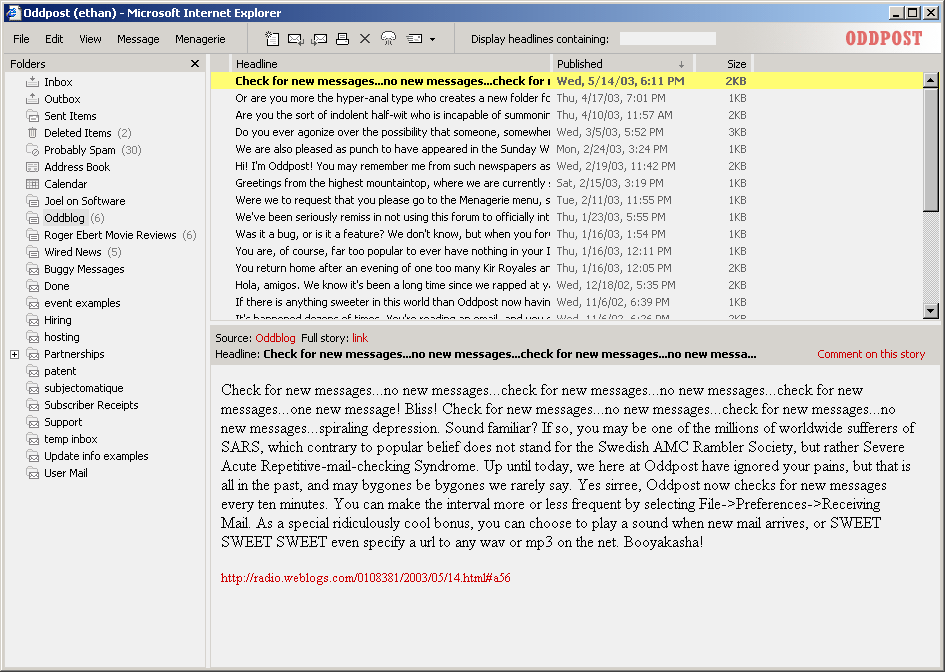

  • Oddpost webmail

    Before Oddpost

    When you think about Oddpost, you have to cast your mind back almost two decades in 2002, the web was a very different place. In order for applications to do anything they would have to refresh the whole page. You couldn’t dynamically edit a document with other colleagues like you can with Google Docs for instance.  Which made applications like time tracking, or updating the basket on an e-commerce site a bit of a pain.

    The catalyst for change for app like performance in the browser was a webmail client called Oddpost.
    Oddpost RSS aggregator

    Oddpost.com

    Oddpost was different in a number of ways to anything else at the time. At first glance, it looked like a three pane desktop mail client, there was less navigation controls than your webmail interfaces at the time. Which heralded a very different design approach in subsequent web 2.0 companies. It is hard to articulate now, Gmail wouldn’t arrive for another two years and when it did it was invite only which meant that for the average Joe it took a while to come around. There was no download or application required to make it work (like a Java applet for instance). Oddpost, instead used technologies which are now humdrum, but a decade ago were the web equivalent of a revolution. Dynamic HTML, XML, and Simple Object Access Protocol (SOAP) allowed individual elements of a page to be updated that provided a desktop app-like experience.

    Design

    Oddpost’s design approach didn’t lend itself to advertising that would slow down it’s dynamic interface and its method of updating components of a page rather than the full page adversely affected the page view metric advertisers cared about at the time. Storage was more expensive than it is now, so it made sense that Oddpost was a paid-for product.  In return for your subscription of $30/year got you a whopping 30MB of storage in your email box and an integrated RSS reader (rather like mail.app with OSX or Outlook with Windows).  In addition to the unique interface Oddpost offered support for both POP3 and IMAP standards which allowed access over an email client. IMAP allowed you to keep the files on the system providing you with a standard view using the web interface, your own computer, PDA (using Bluetooth and your cell phone as a wireless modem) or early smartphones like the Nokia 7650 and Nokia 6600 which came out in 2003. I was unusual at the time in having an IMAP email account, the entry cost for this service was purchasing an Apple computer.

    Oddpost was rough around the edges. It would be another few years before the metal lid of an Apple laptop would be as common as it is now, so it wasn’t as much of an issue that Oddpost only worked on Internet Explorer (version 5 or better) for Windows. The search functionality only did the headlines of messages not the body text. The company was eventually acquired in April 2004 by Yahoo! as it looked to bolster its position as an email provider against the then new Gmail service.

  • Shenzhen ecosystem

    It is hard to believe that the Shenzhen ecosystem was built over just a few decades. Just over 30 years ago China moved from a period of cultural isolation to gradually opening up to the commercial world beyond its borders. The place to naturally start this was in Guangdong province close to the then British colony of Hong Kong. A small fishing village grew to become the workshop of the world. The growth of Shenzhen was driven by investment from multi-nationals and overseas Chinese. One of the earliest industrial areas was called Overseas Chinese Town or OCT. OCT has changed from manufacturing to retail and offices for the creative industries in the former factory buildings.

    Hong Kong had built up capability and expertise in light manufacturing and clothing from the 1950s through the 1970s. It is still important for supply chain intermediaries. This was the ‘golden age’ of Hong Kong. This is how many of the Hong Kong oligarchs made their first fortunes; which they then invested overseas, in China and into the Hong Kong real estate market.

    Globalisation had started after the second world war. But the opening up of China threw it into overdrive. Hong Kong industrials moved manufacturing plants for clothing, shoes, toys, plastic goods and electrical appliances to China.

    They were joined by Taiwanese electronics manufacturers and then multinationals from Europe, America and Japan. Hong Kong clothing manufacturers provided China supply chain expertise to western retailers like Walmart.

    The Shenzhen ecosystem was built on manual production. The deft fingers of Chinese women workers allowed a lot more precision than Japanese pick-and-place machines. Which meant a lot more flexibility in manufacturing using the Shenzhen factories. You wouldn’t have an iPhone if you used pick-and-place robots on the production line.

    Electronics manufacturing

    At first, these companies were used to fatten the wallets of customers who took on the marketing and distribution of electronics in the West. The dirty secret about many PC and laptop designs was they were standard underneath. Then this cost saving was passed on to the customer as people like Dell went for close to lowest price operator based on a direct mail / online direct ordering and cut out the channel.

    Finally that wasn’t enough, and most of the laptop and PC resellers make no money. Instead the main people to profit from these sales were Microsoft which licensed it’s Windows operating system and Intel which provided the majority of compatible micro-processors capable of running Windows-compatiable applications. In the PC industry there is usually just two or three profitable manufacturers and one of them is Apple. Historically it was Dell, then Hewlett-Packard and now it is likely to have be Lenovo.

    Shrinking PC-esque computing power into the palm of one’s hand was inevitable with the rise of flash storage and Moore’s Law facilitating power-efficient processors. The challenge is battery technology, packaging and industrial design.  Apple pushed the envelope with suppliers. Hon Hai and other manufacturers installed hundreds of CNC machines to fabricate thousands of metal phone chassis. These radical changes in manufacturing capability were opened up to lower tier manufacturers raising the standard of fit and finish immeasurably over a few years.

    Now Xiaomi and Lenovo product handsets that have better build quality than many Samsung and HTC handsets. The performance is good enough (again thanks to Moore’s Law) and the handsets run the same applications. Sony, HTC and Samsung handsets look as marooned as Sony’s Vaio PC range in the Windows eco-system.

    Shenzhen’s ecosystem has been a great leveller of manufacturing and industrial design capabilities with Apple at the leading edge of what’s possible from an industrial design and materials technology.

    More information
    Shenzhen Government Online – this loads slow like they are phoning the pages in from 2002, but is informative
    The smartphone value system – An earlier piece I wrote about the challenges of the Android eco-system

  • FES watch + more things

    Who’s Behind the E-paper FES Watch? – Digits – WSJ – interesting the way Sony has become an internal VC operation. It makes sense since they need disruptive innovation and they still have smart people. they also need to allow their engineering talent to keep having an outlet for their creativity. The FES watch is a classic quirky Sony product that is very clever. The disappointing bit was hearing them working with an external product design agency on the FES watch. Especially given the internal industrial design capability to deliver iconic designs and a wider design language across product ranges. More design related content here.

    Tightening too frightening for UK | HSBC – interest rate increase and lower than expected economic growth

    Oh No They Didn’t: European Parliament Calls For Break Up Of Google | SearchEngineLand – inevitable but not sure it will make an impact, Google must have expected this?

    Maglev elevators are coming that can go up, down, and sideways | Quartz – I love this

    Flickr is about to sell off your Creative Commons photos | DazedTech entrepreneur Stewart Butterfield left the company in 2008, but says that Yahoo-ordained plan is “a little shortsighted”. He added: “It’s hard to imagine the revenue from selling the prints will cover the cost of lost goodwill”. It’s the equivalent of looking for pennies that may have fallen down a crack in the sofa. Flickr photos are already used in the online and offline media. They have also been used to train image recognition algorithms, both of which are allowed by the licensing. The prints seems like a cheap, low value move.

    Supermarket own-brands generate more than half of UK grocery sales | BrandRepublic – bad news for CPG brands. And bad news for brands in general, particularly when one thinks about how Amazon is building its private label lines across several sectors

  • Silicon Valley corporate raiders

    The origins of Silicon Valley are new, even by American standards. Over the space of one life time the area below San Francisco around the Santa Clara valley went from apricot farms and orchards to urban development based around hardware (the silicon in silicon valley) and then on to campus design sites preferred by software companies.

    At the time of the PC revolution was kicking in, Silicon Valley rose to prominence in the public consciousness. This gave use the consumer side of consumer technology we live with today like iPhones and the MacBook Pro this post is written on.

    Over the space of this time, it wasn’t only the landscape that changed but the way we work and how entrepreneurship was rewarded. There were decades of unparalleled economic growth driven by companies firstly in hardware, then software and finally in networking and communications – the internet.
    Reagan_et_Thatcher
    During the early 1980s, America had Ronald Reagan as president. The manufacturing industry that had driven post-war prosperity in the country was suffering from global competition and businesses were under attack. This was the golden age of the corporate raider who destroyed businesses in the name of shareholder value. For example corporate raider Carl Icahn was considered responsible for the bankruptcy of Trans-World Airlines (TWA).

    By comparison Silicon Valley was in a spate of explosive growth. Computers and software were changing the way business operated. Spreadsheet software enabled the kind of models required for corporate raids on main street. Apple, Adobe and Aldus came up with the different components required for desktop publishing revolutionising design in the process.
    The fall of the Berlin Wall - November 1989
    The cold war ended and the Berlin Wall came down, corporate raiding ran out of steam as corporate lawyers began to construct effective barriers on behalf of besieged companies. Silicon Valley started a move away from ‘hard’ innovation to the soft innovation of gadgets, software and services. But that was fine, there where other places in the world who wanted to make the hardware components because of the jobs and wealth it created. The modern internet started to be built on Sun and Silicon Graphics servers connected with Cisco routers. The web was designed on the same Apple Macs that designed brochures.  Technology companies became media companies, retailers and super-fast courier companies. Wired magazine talked about the ‘new economy’.

    The industry was also riding on a one-time offer. Older computers that now ran the modern world had a ‘millennium’ or Y2K bug, which was a bonanza for business IT companies. A dot com bust dampened enthusiasm, cleared out some of the more egregious business models.  Out of the fire sales of Aeron chairs and Cisco Catalyst series routers paired with cheaper broadband came web 2.0 – where the web became a platform rather than just a catalogue.

    For many of the previous businesses in Silicon Valley growth slowed. Most business software looked like a solution looking for a problem. High-performance hardware could be cheaply replaced with more commodity priced boxes. Eventually for many people’s needs, hardware became a service that could be rented according to need. Business models were disrupted, sales dried up, licences weren’t renewed and advertising sales dried up.

    Enterprise software companies were hoovered up by private equity firms eager to leverage their steady cashflows to service debt from further transactions.

    Businesses like IBM and Nokia look like the TWA or Goodyear Tire and Rubber Company in the 1980s. The story of Yahoo! over the past six years looks like one corporate raider greenmail scam after another. Jerry Yang who has recently started to see his reputation rehabilitated was turned out of the company he founded by shareholders influenced by Microsoft and Carl Icahn. The subsequent replacement Carol Bartz supervised over a spectacular destruction in value at the company. Current CEO Marissa Mayer, like her peers at Apple and IBM faces constant corporate raideresque behaviour to leverage up and return money to shareholders as part of a share buyback.

    Microsoft who seemed to have used corporate raiders against its foes like Yahoo! now has activist shareholders on its board and is being forced to rejig its own business.

    Just what is going on?

    I think it it down to a confluence of different factors:

    • Technology has had a spectacular growth spurt in Silicon Valley but the growth has spread beyond the valley. Huawei is arguably one of the most important companies in telecommunications and internet infrastructure now. Just over two decades ago it was a small business selling secondhand company switchboards to the new businesses springing up in Shenzhen. Zhengfei Ren moved from selling equipment he sourced in Hong Kong to manufacturing it himself. Now the company makes everything from core network switches and submarine cables to smartphones, tablets and wearables. Shenzhen is full of companies like Huawei – some more successful than others. The most powerful names in silicon are also Asian companies TSMC and Samsung Electronics play a key role in the manufacture of non-PC style computers: phones, tablets and even televisions. It is often easier to name products that aren’t becoming ‘smart’ in some way
    • There isn’t the same willingness in the US to fund start-ups looking at smart innovation, instead the focus is on areas like social applications. Technology industry veteran Judy Estrin identified this as a key problem in her 2008 book Closing the Innovation Gap: Reigniting the Spark of Creativity in a Global Economy. There are serious technology challenges available that need to be addressed: the break down of Moore’s Law in semiconductor manufacture, commercially viable nuclear power and quantum computing to name but three
    • The technology has been demystified and is yet another industry. There isn’t that much difference between LVMH and Apple or Caterpillar and Oracle. Software as a service moved the buying decision on a number of products from the IT manager to the marketing manager or department head. Cheaper smartphones saw the rise of bring your own device (BYOD) policies. I sat in an old warehouse turned conference centre last week when Will.i.am announced off the stage that ‘Designing hardware isn’t hard, filling Wembley stadium, that’s hard’. Eco-systems from OEMs to Kickstarter have democratised and demystified technology businesses. And with this familiarity has come at least some contempt

    More information
    Closing the Innovation Gap: Reigniting the Spark of Creativity in a Global Economy
    Finding Alibaba: How Jerry Yang Made The Most Lucrative Bet In Silicon Valley History | Forbes
    Yahoo Stock Crashes As Alibaba IPOs – Business Insider
    Marissa Mayer’s day of reckoning at Yahoo is rapidly approaching | Quartz
    BlockBuster: Lyme Regis Sues Icahn, Accuses Sabotage – Barrons.com
    Carl Icahn 2.0: an icon of ’80s greed is back to shake up Silicon Valley | The Verge – 2 words: TWA, Yahoo!