Materials are as important as technology and innovation. Without access to hydrocarbons you wouldn’t just lose access to the car as transport, but the foundational products of modern life.
Added to the materials list of importance would be the likes of:
Lithium – current battery technology and in some alloys
Helium – inert atmosphere for chemical reactions and lighter than air craft including blimps, airships and weather balloons
Silicon – semiconductors
Cobalt – a key material in batteries
Titanium – similar applications to steel but with a higher weight to strength ratio. Also hypoallergenic in nature
Carbon fibre – high strength light weight materials
Rare earth metals and key materials including:
Dysprosium- magnets, lasers, nuclear control rods
Erbium – lasers, particularly in telecoms fibre optics cables and optronics
Europium – interest in using it to develop memory for quantum computers
Holmium – magnets, lasers and quantum computer memory
Neodymium – high strength magnets
Praseodymium – magnets
Yttrium – catalyst in some chemical processes
Thorium – future safer nuclear fuel source
Thulium – portable x-ray devices, ceramics used in microwave equipment
Scandium – high strength lightweight alloys
Ytterbium – manufacture of stainless steel, atomic clocks
Uranium – nuclear fuel
In addition to innovation in material science and chemistry with these raw materials. There is also the benefit of recycling and reusing existing stuff once it has finished its useful life. The Tokyo olympics of 2020 saw an unprecedented peace time effort to find precious metals in e-waste and junk that could then be processed into the winners medals.
A desire to lower the carbon footprint will require ingenuity in systems, design and materials use for it to be successful
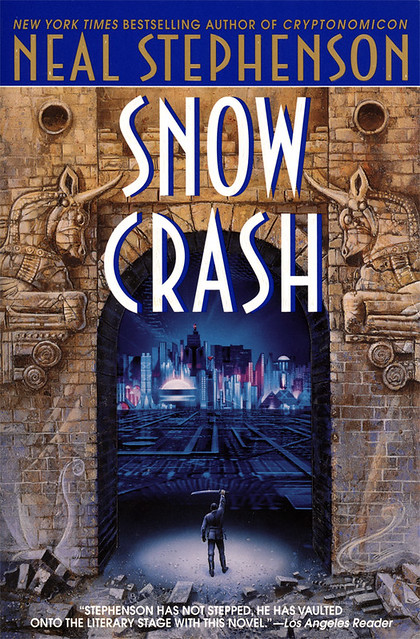
Hiro Protagonist is the main character of Neal Stephenson’s iconic novel Snow Crash. In the novel talks about the rise of the corporation to become a quasi-nation state, a winner takes all economy, a vision of a future metaverse, hacker culture and service hyper-competition with Uber-like employees.
Snow Crash by Neal Stephenson
Hiro Protagonist is a hacker who moonlights as a courier to make ends meet. The story starts with Hiro Protagonist trying to deliver a pizza at high speed. The idea is that the courier would deliver a pizza to any location, not just delivery to a building like getting pizza to work or home. Now we’re starting to see these kind of services being rolled out in real life, by building them into in-car systems and mapping applications. This will add more importance to dark kitchens over store fronts, but store fronts are important as they build brand experiences.
Quiller came out of the cold war. The Quiller series were written under the name Adam Hall by Elleston Trevor who had actually been born Trevor Dudley-Smith. Elleston Trevor like most of the other writers had either served in the second world war or in the national service afterwards. Quiller features in 19 novels written from the mid-1960s to the last one in the mid-1990s.
The books go into a lot of technical detail about spy craft. While he is a man of action, he doesn’t live the high life like James Bond, but has to worry about filing expenses and grim and grey atmosphere of London and Warsaw Pact countries. He has a nervous tick when under stress and has to deal with ‘office politics’ of difficult personalities.
Like Bond Quiller appeared on film, The Berlin Memorandum was re-made as the Quiller Memorandum. Quiller was also made into a TV series by the BBC in 1975 for one season. I knew nothing about it until YouTube.
Spy novel industry
There was a veritable industry of British spy writers. Ian Fleming had James Bond which has been continued like some bizarre literary science zombification experiment long after Fleming himself had died. Post-Fleming’s death there has been 32 new James Bond novels written.
Len Deighton had the unnamed protagonist of his first set of books (though they would be given the name Harry Palmer in the film adaptations):The IPCRESS File, Horse Under Water, Funeral in Berlin, An Expensive Place to Die, Spy Story, Yesterday’s Spy and Twinkle, Twinkle, Little Spy. As this wasn’t enough Deighton wrote ten books about the jaded intelligence protagonist Bernard Samson.
Anthony Price wrote 19 novels featuring Dr David Audley and, or Colonel Jack Butler.
All of these characters had more ‘derring do’ than John LeCarre‘s George Smiley. Deighton’s Bernard Samson’s character has the jaded aspect of Smiley. Anthony Price’s stories are best described as as somewhere between George Smiley and Robert Hannay with the past and ‘present’ woven together.
For the love of books
I picked up the bug of reading these books from my Dad. He used to go and buy these books along with Alistair McLean novels from a florid man in the local market. (Alistair McLean novels were basically the same book and same character with different names and locations).
My Dad left school at 13, he can’t spell but at that time he loved reading novels, engineering books and history. They were around the house at home, so usually after my Dad had read them, I started to read them myself. My childhood reading was a weird mix of ‘children’s books’, fantasy novels which were considered suitable for children (J.R.R. Tolkien and Ursula LeGuinn), spy novels, text books and classic science fiction. My Mum made sure that I had a smattering of Irish folklore books in the mix as well.
One person’s literature is another person’s trash
Nowadays, alongside the weighty tomes of James A. Michener, you would be hard pressed to get an Oxfam shop to take many of these books off your hands.
While Le Carre & Fleming have their dedicated followers, the Quiller books, Len Deighton and Anthony Price will be overlooked.
The war on terror didn’t fire the imagination in quite the same way, yet as we go into a new cold war we might see a renaissance in Quiller-type archetypes in escapist fiction of our current times. Mick Herron’s Slough House series ground us too much in reality sometimes.
Abbott curated this interesting discussion on sports health. In my lifetime we’ve gone from football coaches giving players Guinness to bulk them up to this detailed scientific approach which I previously would have only associated with serious bodybuilders like my college friend Carsten who looking for marginal advantages.
Hong Kong
Brain-drained HK workforce marks historic decline – Asia Times – a few things here. The Chinese visa applicants (less than 15,000) coming in won’t plug the gap: 95% of Hong Kong Talent Visa Approvals Are From China – Bloomberg. Though this might not cover mainland Chinese graduating from Hong Kong universities. Secondly, once growth takes off Hong Kong will lose its relative attractiveness for Chinese from an economic point of view. Secondly, the brain drain of teachers, medical staff, social workers and middle class professionals is starting to become significant from the Hong Kong government’s perspective; but a rounding error from Beijing’s viewpoint.
Japan
Repost: Weebs! – by Noah Smith – Noahpinion – While I was in Japan over the last two weeks, I asked some local startup founders, VCs, consultants, and random friends whether they had ever heard the word “weeb”. Not a single one had. I was pretty stunned, because Japanese cultural products have given rise to a whole worldwide subculture, and people in Japan itself are barely aware that that subculture even exists. It’s not like it’s a fringe thing, either — the latest volume of the anime Spy X Family was the bestselling book in North America this week, and soldiers at the front in Ukraine do Pikachu dances to relieve stress. Japan became a cultural superpower almost by accident – this was a new one on me. I thought otaku was still the label. NHK World on famous ‘Weeb’ Steve Jobs.
pearº – The World’s Biggest Social Experiment – Pear Ring – imagine if Match.com as well as extending into events for singles decided to allow people to have a badge that said ‘I’m single, date me’. That’s the premise of Pear, except that the badge is actually a ring that looks like fake jade…
Online bookseller Book Depository is closing down with some three weeks notice. It wasn’t a topic at work and barely made a ripple amongst British friends. The Hong Kong part of my social media bubble shared the news and were sad about it. The company had been owned by Amazon since 2011. I used it for a few reasons:
Free postage anywhere. I have friends around the world and Book Depository was a good way of sending a gift book. It made the process of international gifting so much easier. I bought a set of books there as recently as last week. Many of the upset people on social media were from Australasia, Latin America, Eastern Europe and Asia
Getting hold of English books when I lived in Hong Kong. At the time I lived in Hong Kong there were a couple of nice chains that did English language books, but if I wanted something for my professional life or esoteric interests, then online made more sense. Dymocks, Eslite and the various independent stores would only get you so far. For everything else Book Depository helped out. This was partly down to book shops being a ‘lifestyle’ in Hong Kong and other parts of Asia. They carefully curate fiction but aren’t necessarily like the university book shops I spent my teens and twenties in
Arbitrage. Despite being owned by Amazon, there were a number of items that I bought where there was a price difference between Book Depository and their parent company
You could find a particular edition or format, with Amazon it could be a bit of a lottery
It isn’t full of tat like Amazon. Amazon Marketplace has been both a blessing and a curse. Amazon hasn’t done a good enough job curating Marketplace. I found Marketplace useful at the beginning, rather like a fixed-price eBay. Now its a dystopian retail experience littered with a substantial minority of counterfeit products and sub-standard garbage
Their ask the author section provided some interesting reading.
The brand
I always had it in my mind as ‘The Book Depository’ rather than Book Depository. It’s always the way I discussed it with other people. I had to go back and edit stray ‘The’s that slipped into this post.
Book Depository home page
Diminished ambitions
Book Depository is being closed by Amazon as part of cost cutting across its book and device categories. There is a certain irony in Alexa being in full retreat just at the time when LLMs were about to turn up. Alexa skills are likely to get loss in the subsequent withdrawal and LLM expansion. Book Depository helped plug gaps on the map where Amazon didn’t have native businesses. The decline of Book Depository implies an upper limit to Amazon’s global retail expansion.
Beauty bots drive R&D at Unilever’s £68 million facility | Vogue Business – The world’s highest concentration of robots doing material chemistry can be found at Unilever’s lab in North West England. Vogue Business gets a behind-the-scenes peek at the facility, which develops innovative products for brands including Hourglass and Living Proof.
Is China’s New Rocket Really Coal Powered? Deep Space Updates – April 2nd – YouTube – yes kerosene made from the kind of coal hydrogenation process similar to what SASOL used in apartheid-era South Africa. The National Coal Board had a pilot plant doing something similar during the late 1980s at Point of Ayr under what was called a ‘coal liquefaction plant‘. I used to know a few of the guys that had worked there previously. The plant had a number of experienced oil refinery technicians on the staff when it was running. The site was subsequently taken over and was where BHP Petroleum built their sour gas facility and brought natural gas ashore from the Liverpool Bay oil and gas field in the early 1990s. It also probably tells you everything you need to know about China’s climate related decarbonisation goals.
How the new generation of weight-loss drugs work | The Economist – the potential benefits of such drugs go beyond their ability to promote weight loss in individuals. By showing that molecular mechanisms hinder people’s attempts to lose weight, they show that gluttony is not to blame when people remain obese. That should slowly help to eliminate the stigma. Both weight-loss surgery and drugs are useful tools in the fight against obesity. But by changing the conversation these new drugs may remind health-system leaders that they need to do much more to encourage healthy lifestyles.
Hong Kong
‘Fair price, fine quality’: Hong Kong fast-food chains become go-to place for mainland Chinese budget tours | South China Morning Post – Established eatery chain Café de Coral was among those capitalising on the trend as it offered advance bookings for the tour groups, which have increased after the city fully resumed cross-border travel with the mainland earlier in the year. A Post reporter at 11.45am on Monday observed two mainland tour groups of about 30 people each being guided from their coaches and taken to Grand Waterfront Plaza, a shopping centre in To Kwa Wan, where they dined at the site’s Café de Coral outlet.
Online trolls are taking a toll in China – BBC News – In collectivist cultures such as China, those perceived as going against the norm tend to be severely punished, experts say. What makes it worse, they add, is a pervasive culture of shame. “A strong sense of collectivism in China can mean that cyberbullying, when perpetrated as a symbolic act of violence or aggression towards another in a public setting, may lead to drastic measures, such as suicide, to escape that sense of humiliation,” says K Cohen Tan, a vice-provost at University of Nottingham Ningbo China
Bob Hoffman has been pointing out the problems with the way online advertising has been run for years. Bob’s book Adscam is probably one of the best critical examinations of the online media eco-system and the risks inherent in programmatic advertising.
Bob Hoffman got to speak with the European Parliament. Bear with it as audio improves through the recording.
He also spoke at the Digital Marketing is Broken event.
Interesting talk on the benefits and limitations of economic sanctions with a particular focus on Iran and Russia.
Ireland
I never realised that Sony had a factory in Ireland as early as 1960; Sony globalised production of transistor radios relatively early on in their production life. Compare this to the later US technology businesses setting up shop in Ireland over the next couple of decades. This also might go someway to explain why Sony was such a respected brand in Ireland and shows how visionary and experimental the Sony management were. These comments on Irish workers in 1963 versus their Japanese counterparts are interesting. The assembly workers don’t seem to realise the intrinsic value of (the Sony Japan-made) transistors that go into the products – this might be down to education as this was likely a soldering and screwing products together assembly line.
Suzuki-san points out what he thinks are flaws with Irish workers whilst recognising that this partly down to the different social contract between employee and business. Part of the problem was that Irish workers had the opportunity of going abroad without any government restriction compared to Japan. Suzuki-san didn’t believe that Irish workers are bad workers, but rather they require more investment to encourage them to become good workers.
Interesting perspective on the Windsor Framework from an Irish and EU perspective. Tony Connelly did one of the best podcast series on the Brexit process for RTÉ
Materials
I am a big fan of the Rose Anvil account for the way they take a deep dive into materials and shoe construction. Here’s a great example of their work which shows the design principle of what you leave out is as important as what you leave in a product.
Retailing
Olivia Moore on Temu e-commerce app. Her idea of ‘invisible AI’ is actually more prevalent than Ms Moore thinks, otherwise great conversation to listen in on.
Connie Chan does a short talk on the future of e-commerce.
Dow said it was recycling our shoes. We found them in Indonesia | Reuters – Reuters put trackers in usable secondhand shoes to see where they would end up. The main gist of the story is that Dow recycling effort was a failure, which is also embarrassing for their partner the Singapore government.
The idea was the sneakers would be made into playground surfaces. Reuters seems to have stopped investigating the story of Dow recycling shoes, but I was left with more questions about Dow recycling than answers from the Reuters report:
Were some of the shoes more distressed than others?
Do Reuters know what happens to unwearable sneakers that enter the Dow recycling process?
Is it more ethical to sell on lightly used shoes as affordable footwear to Indonesians or recycle them regardless? Reuters doesn’t have an answer to this issue
UK struggles with transition to manufacturing electric cars | Financial Times – foreign carmakers’ core concern is that Britain’s reputation as a stable and pragmatic place in which to manufacture vehicles has been shattered, initially by the 2016 Brexit vote, and more recently by last year’s political turmoil at Westminster. “They are asking whether the UK is a stable partner,” said one person close to the Japanese companies. – Brixiteer economic expert Patrick Minford openly discussed the demise of the car manufacturing industry
Women and ethnic minorities overrepresented in advertising industry, finds report – Women and ethnic minorities are now overrepresented in the UK advertising industry following a decades-long push to improve diversity, according to a new survey. A 2022 census found that an estimated 55pc of employees in the sector were women, compared to 45pc who were men. That was after the number of women increased from an estimated 11,600 to 14,400, an increase of 24pc, the Institute of Practitioners in Advertising (IPA) said. At the same time, the proportion of non-white employees increased by almost one third to 24pc, compared to 18pc a year earlier. Women made up 51pc of the population in England and Wales in 2021, according to the Office for National Statistics, while non-white ethnic groups comprised about 18pc. In London, where most of the UK’s advertising industry is concentrated, non-white ethnic groups represent roughly 46pc of the population. The IPA said there was more work to do on diversity, as women still only get just over one third of executive jobs in the ad industry, while non-white individuals only occupy 11pc of roles. – Daily Telegraph on how it feels that ‘woke’ addend risks becoming ‘out of touch’ with the British public, but doesn’t manage to make its argument very well.
Walt Disney vs Ron DeSantis: who really won the ‘Don’t Say Gay’ dust-up? | Financial Times – Instead of candidates with backgrounds in economic development or tourism, he packed the board with political allies. Two of them are leading lights in the culture wars that have helped DeSantis build a national profile ahead of a presumed run for the 2024 Republican presidential nomination. Among them is Bridget Ziegler, co-founder of the conservative Moms for Liberty group and a champion of Florida’s Parental Rights in Education law, dubbed “Don’t Say Gay” – Disneyland Florida is pretty screwed