Category: online | 線上 | 온라인으로 | オンライン

The online field has been one of the mainstays since I started writing online in 2003. My act of writing online was partly to understand online as a medium.

Online has changed in nature. It was first a destination and plane of travel. Early netizens saw it as virgin frontier territory, rather like the early American pioneers viewed the open vistas of the western United States. Or later travellers moving west into the newly developing cities and towns from San Francisco to Los Angeles.

America might now be fenced in and the land claimed, but there was a new boundless electronic frontier out there. As the frontier grew more people dialled up to log into it. Then there was the metaphor of web surfing. Surfing the internet as a phrase was popularised by computer programmer Mark McCahill. He saw it as a clear analogue to ‘channel surfing’ changing from station to station on a television set because nothing grabs your attention.

Web surfing tapped into the line of travel and 1990s cool. Surfing like all extreme sport at the time was cool. And the internet grabbed your attention.

Broadband access, wi-fi and mobile data changed the nature of things. It altered what was consumed and where it was consumed. The sitting room TV was connected to the internet to receive content from download and streaming services. Online radio, podcasts and playlists supplanted the transistor radio in the kitchen.

Multi-screening became a thing, tweeting along real time opinions to reality TV and live current affairs programmes. Online became a wrapper that at its worst envelopes us in a media miasma of shrill voices, vacuous content and disinformation.

  • Industrial Action

    The recession has brought industrial action that we haven’t seen since the 1970s as union members blame foreign workers for taking British jobs. The flashpoint has been at Lindsey refinery operated by Total. Lindsey sits at the mouth of the Humber river. The inciting incident involved an Italian subcontractor doing maintenance on the refinery who brought in Italian and Portuguese workers, which there was high unemployment in the area. The underlying nationalism is the populist dark side of the globalisation boom.

    My parents came to the UK when my Dad came over to work in the shipbuilding industry in the mid-1960s. Most of my friends have worked abroad: engineering in the Middle East, construction in Germany, web development and PR in North America and Asia Pacific.

    Newsnight highlighted two things of interest to me in the strike.

    First of all is the conflicted politics around the strike. Traditional left-wing allies of the strikers like the Socialist Workers Party  are between a rock and a hard place as they can’t allign themselves with worker solidarity and a doctrine of protectionism that smacks of racism. Secondly this gives the far right yet another opportunity to get a hook into the angry disenfranchised white working-class. There is a large amount of government money already going into community engagement programmes to try and deal with this problem and other organisations have ongoing efforts to deal with the BNP head on, however the industrial action is like putting petrol on a fire. I could see this feeding into a broader anti-globalisation right wing populist fuelled reactionary politics focused on Euro-skepticism.

    The second thing is the way worker politics has been extended and expanded via web 2.0 platforms. British Wildcats is a WordPress-based blog which seems to have far-right sympathies. It presents a professional looking face (even if the copy is hackneyed) to the movement using Google Maps integration, downloadable leaflets and blog posts to spread its message.

    British jobs for British workers Facebook group

    Over on Facebook I found 487 groups relating to British jobs for British workers. The top-ranked group: British Jobs for British Workers has 27,094 members. It used to be that the printing press and the xerox machine were tools of subversives. The CIA used to smuggle photocopiers into the Soviet Union for that very reason. Now it’s blogs and social networks.

    More related content can be found here.

  • Wired Style Guide

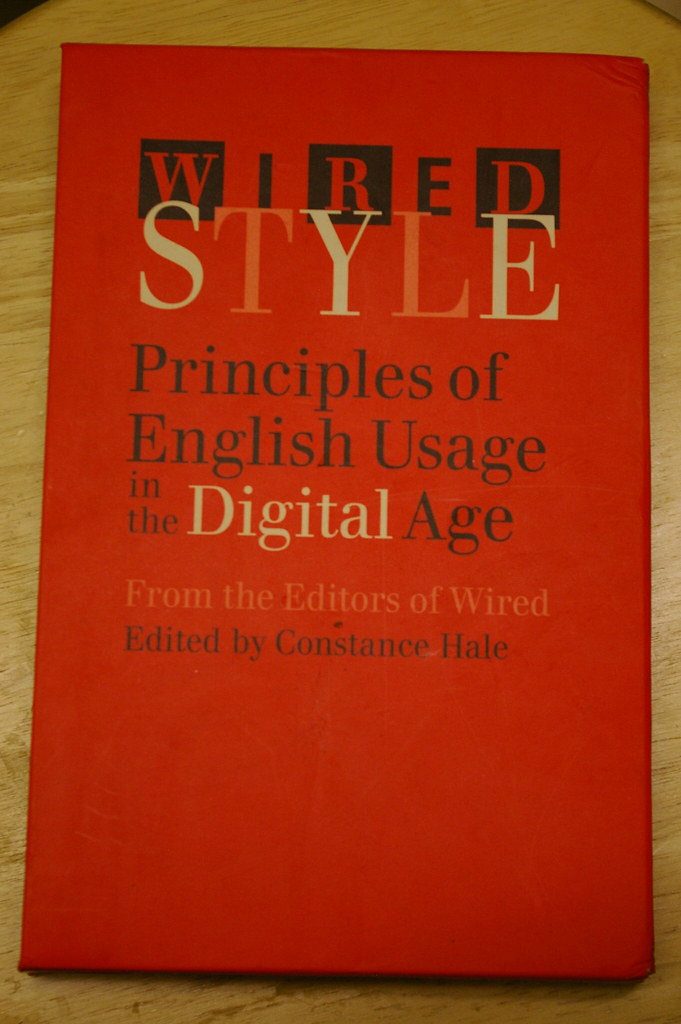
    I was looking through my first edition copy of Wired Style guide – Principles of English Usage in the Digital Age edited by Constance Hale and it struck me that many of the sections in the book were also maxims for bloggers and those involved in social media.

    Hale isn’t a technologist or a staffer at Wired. Instead she is a journalist’s writer. She has run conferences for mid-career journalists and a writing retreat. Beyond her website I am not too sure how qualified she was to prognosticate on the digital age for the Wired Style Guide. 

    Wired Style Guide sleeve

    So I decided to convert these titles from the Wired Style Guide into the maxims I had imagined:

    • Voice is paramount – a blog is a deeply personal thing and the challenge at first is finding your ‘blog voice’. This takes time to establish. It needs to be true to yourself and have enough cojones to express your opinions
    • Be elite – In the words of Wired: “Shared knowledge connects the writer and the reader. It forms the bridge from the type on the page (or the screen) to the deeper meanings and nuances for words”. This comes down to seeking knowledge, knowing your readership and the norms of the subcultures that they belong to. Even if you don’t belong to a community act like you do
    • Transcend the technical – there is so much written about the technical aspects of the web, be prepared to get beyond that at the end of the day it is people like you that social in social media
    • Capture the colloquial – So much of what makes a community is the informal lexicon that is particular to them. Think about Twitter in the course of a couple of years we now have the Fail Whale, twitterati, twitterverse, RT (re-tweet). Capturing this colloquial language in your writing helps to put your work in the midst of your readership subculture
    • Anticipate the future – Whilst we are more likely to get predictions of the future wrong, it also makes great copy. If you are going to anticipate the future, think about the things that are unchanging in life: the need for self-expression or the need to belong being two unchanging requirements for people in general
    • Screw the rules – Rules are made to be broken and knowing when to break them. Going against rules or expectations is a great way to inspire creativity – gorillas don’t really play the drums
    • Grok the media – The style guide defines grok as “A verb meaning to scan all available information regarding a stiuation, digest it and form a distilled opinion.” Being a ferocious reader of blogs, books, papers and the mainstream media makes you a better blogger. And even if it doesn’t, you’ll at least be better informed
    • Go global – Global village used to be a cliche that would be bandied around before globalisation made middle-class people think that their future is under threat, since then an international outlook has taken on a more sinister tone. However looking at international trends: from mobile marketing in South Africa to social networking in Japan allows us to better understand how technology and culture interact and increases the likelihood of being able to anticipate the future

    More on similar books to the Wired Style Guide here.

  • Harris’ Law

    I came across Harris’ Law due to Jason Calacanis. Jason Calacanis has touched on the issue of overconnectivity in a recent editon of his email newsletter. It dealt  with more certainty about the adverse social effects that connectivity brings which I first heard raised by Eric Benhamou of 3Com when he spoke about a decade ago in a keynote at Networld+InterOp in Paris.

    Key to the mail was a concept that Calacanis called Harris’ Law (after his friend Josh Harris):

    At some point, all humanity in an online community is lost, and the goal becomes to inflict as much psychological suffering as possible on another person.

    That sounds excessively harsh in most circumstances, since most social networks mirror life and society. Yes 4Chan and 8Chan can have lots of repulsive content on them. This is less about inflicting pain but more about the kind camaraderie that disgusting jokes brought in the school yard. Yes there are too many incidents involving bullying or hate speech on online communities, but it only makes up part of the content on these communities.

    Political groups aren’t motivated by ‘inflicting damage on the opponents, but by their concerns of things going on around them’. Their tribal ‘wars’ are reinforcing the community and manifesting those concerns rather than being purely about inflicting suffering.

    Even communities like Anonymous that seem to be full of pranking rally around some moral causes such as opposing Scientology or the Iranian government’s oppression of protestors.

    I wanted to end this post on a timely reminder which I have taken from Hugh MacLeod of Gaping Void fame’s twitter feed:

    “People matter, Objects don’t”. That’s all you need to know about social media.

    Harris’ Law is also a good reminder to think about mental resilience and good hygiene practices with regards online interactions.

    You can subscribe to Jason’s email list here. More related content can be found here.

  • Feedburner

    Google is incorporating the Feedburner service that it acquired a couple of years ago into the Google infrastructure. So they’ve been getting Feedburner users like this blog to move to a Google ID. On the surface this makes sense as they are the masters of cloud computing and service provision.

    I had a good experience when Yahoo! did the same with Flickr, so went into this transition in good faith. Unfortunately Google didn’t have the good sense that Yahoo! did to leave well alone the functions and features and seem to have been tampering in a ‘boot stamping on the face of users’ kind of way.

    So far my experience has been underwhelming to say the least, hell that’s being polite: it sucks and I don’t mean that in small way.

    I used Feedburner to keep track of the traffic on my feeds, to provide me with a simple (Googly) web analytics dashboard and provide the ‘flare’ on each blog post that allows you to share the post via delicious, Facebook etc.

    • My feed traffic is down, these things happen and it should pick back up as Google gets its act back in order
    • I no longer have access to my web analytics, I presume that Google did this to force users like myself to use their own Analytics offering. Now both are free but I preferred the simplier one on Feedburner for my blog. I don’t need or want Google’s industrial strength version – if for no other reason than its user experience is destinctly un-Googly
    • The ‘flare’ which provides my sharing functions seems to be broken on new posts, severely affecting the ability of my readers to  socialise or share my blog posts

    The saddest part of all this is that Google will blindly trundle on thinking that they have done the right thing and this kind of behaviour will be even more common place as it hits the rapidly approaching ceiling on its search business and moves from being a hip young growth business to a blu-chip value stock like Dow Chemical, IBM, Microsoft or GE. Is it a small sign of a larger ailment: has Google has become ‘middle-aged’ before its time? You can find similar content available here

  • Guanxi online + other news

    Guanxi

    56minus1 :: » guanxi in the Chinese web :: – the rapid rise of Chinese social media has resulted in changes in guanxi. This means more pressure on the government to take action bypassing guanxi. Influencers and experts with a following have a new form of guanxi

    Business

    Yahoo Announces Next Steps in Open Strategy

    What Yahoo Should Do « blog maverick – Yahoo! should go big and buy companies up cheap whilst it can to bulk up on places it could monetise, its open strategy could be leveraged as an advantage to make that happen

    Consumer behaviour

    Youth Marketing Statistics: Traditional Media Sparks Web Searches for 84% of Digital Influencers

    Social media more popular than ever / we are social – nice bit of research from Robin and the guys at we are social

    50 Youth Marketing Trends for 2009 (Part Two 26-50)

    10 Articles on Ethnographic Research 26 Dec 08

    Culture

    Sk8’ers find heaven in foreclosure

    Economics

    Forecasts: Get ready for a three-year recession – no compelling reasons for the economy to snap out of it

    FMCG

    ‘Ugly Betty’ Inspires Dove Campaign in China – Unilever had to go back to the drawing board as Chinese women believed that “a model on billboards is something that women do aspire to, and feel is attainable” so the real beauty concept fell on its ass.

    Germany

    Schober Group – German list broker

    Hong Kong

    Michelin rates Hong Kong, but with which yardstick?

    Black Cross – cool Hong Kong streetwear shop

    How to

    Apple – Business – Theater – Apple’s quick tips theatre

    LinkedIn: Answers: Home – very handy facility if you are on LinkedIn

    How to Hold a Digital Camera

    Phil Windley’s Technometria | Moving Jobs Between Printers in OS X

    21 Settings, Techniques and Rules All New Camera Owners Should Know

    Tweet Manager Twitter App For Complete Twitter Automation – hmm a spam marketers delight, be afraid`

    10 Articles on Working the Idea Cloud, Crowdsourcing and Product Development 30 Dec 08

    Japan

    JET SET – legendary Japanese record store, another reason why I love Japan

    Web 2.0 Asia :: Google might become the top dog in Japan – this is really disappointing, particularly as Asia was the one bright spot in the Yahoo! network

    Japanese business confidence hit hard – International Herald Tribune

    Album of Photographs of Japan – a set on Flickr – cool copyright free pictures from the New York Library

    Korea

    Top Interent News in 2008 – KoreaCrunch

    Legal 

    A Chill on ‘The Guardian’ – The New York Review of Books – interesting discussion in the Tesco Tax Avoidance case.

    Digital Design Blog » Tracking Social Influence: Razorfish Files Patent For Social Media Action Tag

    Marketing 

    South African brand trends for 09 « Underfield

    Communities Dominate Brands: From James Bond’s invisible Aston Martin to the visible non-car in Ford’s Ka Find It campaign – interesting discussion on the web of no web

    Building Relationships is More Important Than Building Links Alone – this completely closes the gap between search agencies and PR agencies if the SEO guys wake up to it

    The plight of branded apps and the future of social marketing » VentureBeat – brand apps on Facebook are a bust

    The Secrets of Marketing in a Web 2.0 World – WSJ.com – basics of web 2.0 for senior management

    Media

    Content Sites Bracing For 50% Revenue Slowdown

    Digging In To MySpace And Facebook’s (Projected) Slump In Ad Sales | paidContent.org

    Tough Love For Microsoft Search

    Online

    cmypitch.com – social network for start-ups and small businesses

    Twitblogs – Sam Sethi’s new business, not sure what the point is though.

    Beet.TV: Ning has 600,000 Networks, Gina Bianchini Writes in The New York Times

    Software

    Things – task management on the Mac

    Telecoms

    SwissCom Tries To Deflect Criticism Of Le Web Internet Failure – Arrington calls SwissCom liars.