Category: oprah time | 書評 | 서평 : 文芸批評

Welcome! I guess the first question that you have is why oprah time? Well in my last year of college I used to sit in the house that I shared with my landlord and write my essays whilst watching cable TV.

There I would be sipping tea, writing away and referencing from text books spread around me on the couch and coffee table. One of the programmes on the in the background was Oprah Winfrey. A lot of the show was just background noise. But I was fascinated by Oprah’s book club.

She’d give her take on a book, maybe interview the author. And then it would be blasted up the New York Times bestsellers list. This list appears weekly in the New York Times Book Review. Oprah’s book club was later emulated by other talk show hosts, notably the UK’s Richard Madeley and Judy Finegan.

On the high end you had Melvyn Bragg‘s South Bank Show when they profiled an author of the moment.

When I came to writing my own review of books that I’d read, I was was brought back to that time working on a sofa. Apple laptop in hand. It made sense to go with Oprah time.

You might also notice a link called bookshelf. This is a list of non-fiction books that I have kept. And the reasons why I have kept them.

If you’ve gone through my reviews and think that you’d like to send me a book to review. Feel free to contact me. Click this link, prove that you’re human and you will have my email address.

  • Free – The Future of a Radical Price by Chris Anderson

    Free owes a debt to work done by some of the early team at Wired magazine. Encyclopedia of the New Economy by John Browning and Spencer Reiss was originally published as a three-part work in Wired magazine back in 1998. Step forward a decade or so and current Wired magazine editor Chris Anderson has been explaining some of the key concepts for his readers. The Long Tail was his first effort at this missonary work and Free – The Future of a Radical Price is his latest effort.

    I may be the wrong person to review Free because I am not the target audience. Alongside  generation-Y, I am 0ne of those people who think that its perfectly natural to have a colossal photo album on steroids in flickr, a digital memory in delicious and the world’s largest library in Google all for free (or near as damn it).

    Try explaining these economic concepts to my Mum and Dad however and you will find this tougher going: Free is aimed at people like my parents and Rupert Murdoch who don’t quite get what is going on and how best to harness it. With this audience in mind Anderson takes us on a journey of Free which is part light magazine content a la Alan Whicker and part-intellectual a la Bamber Gascoigne.

    Some of the book gave me a deja vu from Anderson’s early work The Long Tail, in particular the example about the Anderson household’s preference for DIY stop-motion animation versions of Star Wars scenes on YouTube over George Lucas’ works on DVD, (I am with them on that one, the dialogue Lucas came up should put him on trial for crimes against cinema).

    Anderson spins a good yarn, but chances are that if you read this blog on a regular basis, Free is way below your ‘web-literacy’ age.

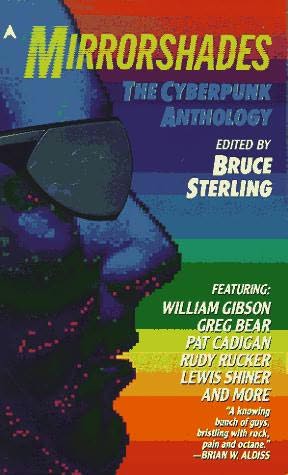
  • Mirrorshades – The Cyberpunk Anthology edited by Bruce Sterling

    Cyberpunk is a type of science fiction that has been very influential in the creation of the web as we know it. As with most predictions about the future, the now has both over-and-under achieved. Since we are at an economic inflection point, I thought I’d revisit one of the seminal publications of the cyberpunk genre Mirrorshades.

    Mirrorshades

    Mirrorshades is a collection of stories that were created by authors considered to be representative of that genre by one of their own Bruce Sterling. Mirrorshades refers to the Oakley type-lenses in sunglasses that were considered to be a cultural artifact for this genre, in the same way that chromed rocket fins graced US-made cars of the 1950s and 60s.

    In some ways the stories echoed the kind of ideas I would expect appearing in feature articles of Wired magazine: private artificial islands based on a libertarian ideal to fuel commerce, artificial-eye implants, radical Islam-inspired cyber-terrorism and gene therapy. All of this feels familiar in a post-truth era of late stage capitalism where authoritarianism vies with liberal democracy for legitimancy

    Others were exceptionally dated: depending on the the Soviet Bloc to still be a bulwark against global capitalism. The rampant artificial drug use in the stories mirrored the US decent from hippy-inspired pot heads to mainstream cocaine use and new drugs that were then coming online including crack cocaine and MDMA. There was an assumption that the leisure pharmaceutical industry would carry on this spurt of commercial innovation through product development.

    Mirrorshades is a good read, but the ideas have been so pillaged by later works that you have to keep yourself in check and remember that for much of the films and books in this area, Mirrorshades (often filtered through other authors later works) was the genesis; the source material from which they sprang. More book reviews here.

  • Barbarians Led by Bill Gates

    I started reading Barbarians Led by Bill Gates after the I’m a PC campaign tried to humanise the brand image of Microsoft. Barbarians is an unusual book: it is unspun lacking the fingerprints of public relations-led storytelling and yet fits uncomfortably between gonzo journalism and business history book. This partly explains the negative reactions that the book received on its release, in that it is a curates egg of a book.

    Its isn’t strictly a history that describes Microsoft, instead it like it reminds me of a great definition for art “art isn’t about what a thing looks like, but what a thing is.”

    It peers inside the software company and shows how chaotic happenstance, internal politics and ego rather than smarts managed to bring the company from being a lowly start-up to one of the world’s biggest and most powerful corporates which would match a reasonably sized country in earning power. The smarts came in when they realised the opportunities that they had been handed and the magicians art of promoting a new product: and a key part in this magic was my former agency WE Worldwide and in particular senior executive Pam Edstrom aka Gates’ keeper.

    If you are in PR, the descriptions of the planning that went into campaign execution and long-term relationship building alone will be very instructive. For me, the description of life on the inside of Microsoft rang true, as it resonated with my own experiences in-house at Yahoo! as projects ebbed and flowed in priority on an almost weekly basis.

    The book is also the story of how Marlin Eller gradually fell out of love with the company he had help build, how politics triumphed and expertise waned as Microsoft grew from a scrappy start-up to being part of the establishment. The portrayal of Bill Gates ultimately makes him more human because of his fallibility and indecision. Things that were polished out of his official image.

    Although the book finishes its story in 1998, it is by turns instructive and provides an interesting prism to view the company through, as the experiences described shape the legal and commercial environment that Microsoft operates in today. For instance, Google’s openness mantra is designed to be a judo move on Microsoft’s historic business model, using the corporations own strength and size against itself.

    Barbarians led by Bill Gates is also an artifact, staring back into marketing and PR before The Cluetrain Manifesto and The Naked Corporation, but comparing and contrasting with the present can provide a a useful aid to learning a number of powerful lessons. More book reviews can be found here.

  • Underground

    Murakami is best known for his book Norwegian Wood, but I chose Underground: the Tokyo gas attack and the Japanese Psyche as my first Murakami book. It is his only non-fiction work to date (at least to my knowledge).

    Murakami fled Japan after the success of Norwegian Wood and was lacking context around the Sarin attack on the Tokyo underground in 1995. It was a fantastical and terrible event that sounds like it has been plucked from the pages of a Tom Clancy or Robert Ludlum novel.

    You have a weapon of mass destruction cooked up by a cult that has echoes of the Mansion family about it.

    Underground was his way of making sense of it. He interviewed survivors and protagonists telling the stories in their own words.

    It is antithesis of Tom Wolfe’s new journalism: Murakami manages to let the people speak for themselves. Murakami removes himself completely from the work, which is the antithesis of the personal nature in a novel. Instead you get uncoloured reportage. If Wolf did new journalism, Murakami has done ‘Muji journalism’. Simple unadorned content which lets the story be the story.

    What comes out of their stories in Underground a strength, modesty and stoicism that shines through the horror of the experience that the people went through. I was reminded of that oft quoted Japanese saying ‘fall down seven times, stand up eight’.

    I was told that it was a dark book that is heavy going, but I didn’t find this to be the case at all. These people and their response to the Tokyo underground gas attack are an example to us all confronted with sudden adversity.

    The Tokyo gas attack was a shocking event and both systems and processes broke down, but what came out also was the heroism of the people involved in dealing with the tragedy and their deeply ingrained ethical system. More details of Underground here. More Japan related content here.

    Picture courtesy of NeilsPhotography

  • Nation of Rebels Why Counterculture Became Consumer Culture by Joseph Heath and Andrew Potter

    With Nation of Rebels, Heath and Potter set out to square the circle on how consumerism and counterculture aren’t mutually exclusive.  how the hippies of the 1960s and 1970s become the yuppies of the 1980s. They put together a skillful argument in the early part of the  book that counterculture is an extension of the bohemian artistic view of the world that has been around for centuries.

    In terms of class: the traditonal landed gentry whose riches are in heirlooms have been supplanted by the merchant classes and now with the knowledge economy there has been a rise of a creative class.

    Nation of Rebels

    Nation of Rebels take things further when they seek to disprove the fallacies that they see the counterculture has been built on. Many of their points are valid, however where it falls down is in its criticism is in its opposition to the ‘appropriate technology’ aspect of counterculture. This is where the Homebrew Computer Club came from, the community norms for successful web 2.0 pioneers like Flickr, the EFF, open web technologies and open source software. Their whole argument is that libertarian values on the web were responsible for the rise of spam. To me this was like saying that the laser printer and the laminating machine are responsible for underage drinking.

    The laser printer and the laminating machine can be used to make fake IDs, but they can also be used to make notices in community centres and legitimate IDs that help utility company personnel reassure vulnerable consumers that they are the real deal.

    Nation of Rebels is a fascinating well-researched read: its authors Heath and Potter are masters in the art of rhetoric, however I wouldn’t take everything at face value in the book. More book reviews here.