Category: retailing | 零售 | 소매업 | 小売業

Looking back to when I started this blog, it would have been reasonable to expect an inevitable march of retailing from offline to online. Amazon was on a tear and search advertising volumes were increasing year on year. By the time I was at Yahoo! search advertising (focused on online retailing) counted for about half of all revenue for the company.

At that time Yahoo! had a Spotify-like subscription streaming music service that was viewed as a threat to Apple’s iTunes download only offering. When I worked there Yahoo Music was the number one online music site in terms of audience reach and total time spent by consumers on the site. Also display advertising was much bigger for brands than it is today and Yahoo! was guaranteed a good share of the online marketing spend from any movie launch at the time.

The reality of online retailing, was slower than our expectations. While COVID drove an increase in online retailing there has also been corresponding innovations in retailing as well.

Amongst the pioneers in this change have been luxury brands like Burberry and Nike, who brought digital into their stores to provide a superior customer experience.

Adidas brought manufacturing into its stores with its speedfactory experiment, allowing for fast time to market and customisation.

Supreme changed the cadence of retailing with the Thursday morning ‘drop’  which saw queues outside stores. Every Thursday became a launch day as far as their customers where concerned. The queue has moved from Apple’s annual cadence, to every week.

  • Ian Jindal on retailing

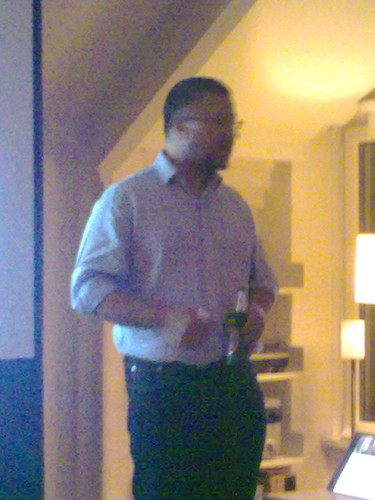
    Ian Jindal was on top form at the Sense Loft where he presented some interesting ideas about the future of retail. I know Ian from my work with Econsultancy. Ian Jindal is also the editor of Internet Retailing and consults for the great and the good of the retail sector. Some of the observations about technology made by Ian Jindal are of particular interest. I made some notes on the presentation in real time on my mobile phone and will try to elaborate around them in italics:

    The UK

    Ian Jindal addressed the overall health of retail and e-tail in the UK.

    • UK most onlne country outside Korea – we may not have 100MB/second fibre into the home broadband connections, but the way in which UK people engage with the web and engage with e-commerce in terms of the amount they spend and the frequency that they shop online means that they are more online than most other countries outside Korea. Hong Kong has a strong broadband infrastructure but e-commerce is superflous in such a compact space. Japan has become almost post-consumer in the way that they no longer splash out on fast cars and Louis Vuitton accessories. One of the things that makes the UK online is the ubiquitous nature of credit cards – still the most effective payment system infrastructure that has seen off a host of rivals
    • UK is the most sophisticated market – consumers have better knowledge in the UK, they know how to play the system. They understand where voucher programmes are and how to best game them to get benefits. UK consumers haven’t stopped spending but are very value driven. They know retailers weak spots and exploit them to get the best deal for themselves

    2008/2009 sales

    Ian Jindal commented on a retail sector struggling with the fallout of the 2008 financial crisis

    • November big growth due to fire sales – retailers dropping prices enticed consumers online: its a value crunch as much as anything else
    • Volume big but not making money – consumers are buying goods at lower prices and for a given amount of revenue far more is having to be spent on logistics
    • Winners include John Lewis because of gift voucher sales, PCWorld due to the reduced costs of modern big plasma and LCD screens, New Look – why?
    • Successful businesses need to deliver on product, price and promise (and make a profit)
    • Logistics companies screwing the small businesses to service big players like Amazon – in the run up to Christmas 89 per cent  of consumers received their purchases on time, with Amazon it was 97 per cent. Small upstarts will get screwed over on performance as delivery companies prioritise their largest accounts
    • Customers a lot cannier play voucher schemes – they abandoned the voucher sites as soon as the sales kicked in and play the system to maximise value
    • 2009 its about cash, ROI, business focus, focus on SEO and conversion – In the credit crunch the first priority is cash flow, a focus on business efficiency and effectiveness. It moves emphasis from getting traffic to getting conversion as business. Pay-per-click (PPC) buys traffic, but does not guarantee a sale. The high price of PPC means that extreme SEO (search engine optimisation) including hand-building the top 100 search pages
    • Ruthless chopping product lines – To reduce the amount of cash invested in stock and focus product lines on those that sell. A focus on the ‘head’ of the long tail

    Future

    Ian Jindal on the future focused on the problem of getting to close a sale online and the role of data to signal user intent which is still a major problem.

    • PPC is outmoded as a marketing communications vehicle as attention is the goal: PPC gets traffic to the site but is no guarantee of ‘stickiness’ or completion of a sale
    • One-page department store – This was a concept that Ian mentioned. There is no point having consumers trawl through a site the only page that matters is the page that they buy from. This page needs special attention. 
    • Context vended pages based on user intent – The example Ian gave was two consumers using Google: one looks for Levi’s 501 36 inch waist cheap. Price is obviously important so you don’t display a lot of options and put the price front and centre on the page. The second searches for smart jeans dark blue, you provide them instead with a series of large images that they can click on to buy since they don’t know what they want and reduce the emphasis of pricing information on the page
    • Google as department store of the world. Google,  niche players and brands are what will drive online shopping. Affiliates will not exist in present from in two years time. Affiliate marketing falls down for many of the same reasons as PPC, Google is the department store of the world because of the pre-eminent position of search as the front door to the web. Niche players will do well as they can meet consumers need and won’t be under so much price competition pressure
    • CPA (cost-per-acquisition) is symptomatic of an overly simplistic world that doesn’t understand a complex decision making process – Consumers may go to multiple online and offline brand touch points in order to make a purchase. Who is responsible, how do you measure assists and infer linkages?
    • Social bored him shitless, reviews not believable, people moving beyond reviews as inspiration stories – As Ian so eloquently put it social bored him shitless, it achieves very little for a lot of effort on behalf of the retailer. Current review offerings don’t provide a lot of utility to customers who often don’t trust them, whether it is an act of ‘sock puppetry’ or consumers with a very different viewpoint to our own. Reviews are also based on a viewpoint that is needs focused rather than desire focused. We live in a consumer society where most people’s needs are already met, much of current consumption is about desire and aspiration. Consequently, empowering consumers to tell their own aspirational stories is much more powerful – a kind of crowd-sourced version of the old TV ads from the 1980s
    • Co-shoppers as retailers – Ian highlighted a new US site called ThisNext, which uses individuals as retail curators. As their authority increases and consumers click through on their recommendations they get rewarded with ‘maven points’. This is a mix of the best attributes in social and affiliate marketing – tapping into consumer aspirations and their trust of people like them
    • nikeID vender management, intelligence gathering on trends and colors – Rather than nikeID being about mass-customisation and prosumption Ian thought that it was about getting information on trends, what colour ways should Nike be making products in. What combinations never sell. It is more scientific than coolhunters tracking down kids in urban setting of New York or Tokyo and helps support buying decisions. It is all about trying to understand the head of the long tail
    • Cross channelists – retail businesses who can deliver experiences through different channels are more likely to be part of consumers complex purchase decisions

    Evolution of data

    • Data – screw this and you build it on sand – the right data and the right architecture to structure the data is the lifeblood of any retail business. If you get this wrong your decison making process and business is at risk
    • Data is facts – facts works as a good definition of data
    • Meta data – data about data that the data would not know itself
    • The way we use data has changed as the number of nodes that process it change, moving from business analysis to data as a service and mash-ups – Google services and APIs are supported by thousands of servers in a given data centre
    • Social web – evolving to responsive and self configuring services – context, location all start to become important – flickr uses camera details from metadata to provide shopping recommendations
    • APML and microformats – APML is a proxy for intent and understanding the consumer. It shows where they put their time. Microformats allow for data to have more utility than plain HTML data – addresses can be readily imported into address books a la Google Maps using the hcard format
    • Rescue Time time management software allows consumers to make use of their own APML data
    • APML-powered commerce: engagd, phorm, google checkout
    • Entering network age with services such as pique and bazaarvoice  – where predictive services offered based on APML and population monitoring to spot patterns of consumer behaviour
    • location: omnifocus brightkite – includes where 2.0 techniques. From a consumer point-of-view this means a move towards apparent ESP by services as they have an emergent intelligence

    You can find Ian’s slides for this event here.
  • Optoelectronics + more news

    Optoelectronics

    H.P.’s Hunk of Burning Light – Bits Blog – NYTimes.com – interesting update on optoelectronics in computing. This is an area that has been talked about since I worked in a technology lab at Corning’s old Optical Fibre business in Deeside in the mid-90s. That site is now a greenfield inside the fence of the Toyota engine plant. Optical interconnects still haven’t filled the potential of optoelectronics in computing. Instead while optical processing has been done with optoelectronics in the laboratory; it hasn’t had commercial success yet.

    Design

    G-Shock prototype phone hides its craggy looks at CES, only fears your stares – Engadget – there is something a bit 1990s sci-fi about this design that I really like

    Economics

    Reposting the Chinese Premier’s speech at Cambridge Uni « Perspectives – interesting speech by Wen Jiabao – The Chinese Government maintains that countries should: firstand foremost, run their own affairs well and refrain from shifting troubles onto others; second, carry out cooperation with full sincerity and avoid pursuing one’s own interests at the expense of others; and third, address both the symptoms and the root cause of the problem. A palliative approach will not work. We should not treat only the head when the head aches, and the foot when the foot hurts. As I
    reiterated at the World Economic Forum Annual Meeting in Davos, necessary reform of the international monetary and financial systems should be carried out to establish a new international financial order that is fair, equitable, inclusive and well-managed. We should createan institutional environment conducive to global economic growth. Let me talk briefly about how China has been responding to the crisis. The fallout of the financial crisis on China’s real economy is
    becoming more evident. Since the third quarter of last year, our exports have declined sharply, economic growth has slowed down, and the pressure on employment has been rising. In the face of the grim situation, we have acted decisively. We have made timely adjustment to the direction of our macroeconomic policy, promptly introduced ten measures to expand domestic demand, and formulated a series of related policies.

    When Consumers Cut Back – A Lesson From Japan – NYTimes.com – the UK’s bust isn’t likely to go away any time soon

    China’s mounting pink slips

    Inconvenient truths about fixing China – FT.com – really interesting analysis of China’s economy (paywall)

    Finance

    The End of the Financial World as We Know It – NYTimes.com – Michael Lewis of Liar’s Poker fame gives his take on 2008’s financial debacle

    Ideas

    An interview with William Gibson | The Verge

    Luxury

    LVMH: daring to ditch the runway circus | FT.com – interesting move

    Second-Hand Luxury Market On The Rise In China – Forbes

    Hocked Luxury Watches Make The Good Times Roll At Beijing Pawnshops « Jing Daily

    Marketing

    U.S. military recruiters use video arcades in urban areas – International Herald Tribune – interesting idea, US Army makes recruiting experiential

    Media

    RIAA Says It Will Stop Suing Consumers for Illegal Downloading – Switched

    Online

    The Language and Branding of QQ in China – its all about the context, I just knew of QQ as the dominant IM client

    Retailing

    I, Cringely » Apple, MacWorld and Steve Jobs – the Wal-Mart Connection – interesting analysis

    Online shopping and the Harry Potter effect – science-in-society – 22 December 2008 – New Scientist

    Fashion gets a digital game-changer | FT.comTokyo Girls Collection have been there so much earlier

    Security

    Interesting privacy hardware homebrew kit

    Mega Echelon Option – Cryptome has a very politically skewed but interesting piece alleging that MegaUpload was done in with the help of the intelligence community

    Schneier on Security: Privacy in the Age of Persistence

    Technology

    My MidemNet Presentation: Trent Reznor And The Formula For Future Music Business Models | Techdirt

    Is Venture Capital Dying? – some interesting stuff here Paul Kedrosky points out that technology is a mature sector and green tech is way off prime time. This provides a disconnect that will ripple through to investors, markets and subsidiary sectors like technology integrators, resellers

    Telecoms

    Cisco Plans Big Push Into Server Market – NYTimes.com – this maybe a bridge too far for Cisco, after all what is a router but a couple of line terminators (ADSL, Ethernet, wi-fi, GSM, WCDMA), a server motherboard and a look-up table. Something that IBM, HP or Sun Microsystems could easily throw together and sell at cost just to crush the competition

    Wireless

    Digital Evangelist: Guess that Six Sigma does not work – Ian Wood writes what could be the best obituary that Motorola’s handset division may ever get.

  • Twist + other news

    Twist

    Twist – see trends in twitter – like Google Trends but for Twitter. Twist looks more like a feature than a product for me. I am surprised that Twist has managed to survive, given the volume of social listening tools available. Finally, Twitter could look at Twist’s functionality and find a way to build interest and engagement around popular topics. 

    How to

    8 SMS gateways/aggregators | E-consultancy.com

    Twitter multi account manager & brand monitor | Splitweet – managing multiple twitter accounts

    Boxee Invites – invites with really nice service

    Luxury

    Beckumer Leder-Bekleidungswerk GmbH – makers of the German pilot jacket – very cool design and virtually indestructable. The same design of jacket is worn by Germany Navy and Air Force pilots, but in different colours. It offers a tough goat skin shell and is more modernist in design than US pilot jackets

    Media

    BBC NEWS | Can Stephen Fry kill a gadget? – interesting article about influence. The central question being did a bad review by Stephen Fry kill the BlackBerry Storm device? While Stephen Fry is influential, I don’t think his influence doesn’t have the reach of someone like Walt Mossberg over the Wall Street Journal. I think that BlackBerry killed the Storm with bad product and software design. May Fry would have been one of a number of voices who reviewed the device negatively

    Not ye olde banners | The Economist – online article courtesy of Joshua March on online display advertising

    Online

    Printable Vouchers – Print Off High Street and Restaurant Discount Vouchers. The next step is likely to be in-app integration

    Technorati: State of the Blogosphere 2008

    Retailing

    Lufthansa – shopping adding points to my account – interesting how airlines incorporate e-tailing and loyalty programmes together

    Style

    Triple Aught Design Gear, Inc. – dodgy site design but some nice soft shells and jackets using really good textile material partners that seem to be ‘tactically influenced’. More related content here.

  • Karaoke + other news

    Karaoke

    How to Sing Karaoke With Confidence – wikiHow – to me karaoke is up there with water boarding, however if you want to bond with co-workers and friends in Asia karaoke is a necessary evil. My personal recommendation if you are asked to do karaoke is California Dreaming by the Mamas and the Papas

    Business

    Mark Zuckerberg: Why Facebook is still hiring – interesting analysis of the Facebook business at present

    Mary Meeker’s Entire Bummer PowerPoint on Her Internet Outlook | Kara Swisher | BoomTown | AllThingsD – more related content here

    FT.com / Home UK / UK – No space wasted in the Velcro workplace of the future – the unspoken narrative here is that integrated marketing is the way forward, the PR agency in its traditional form is moribund, which is one of the reasons why Edelman took the opportunity to change their work environment when they moved into their Victoria offices earlier this year. Will this break down practice fifedoms?

    China

    Beijing Word of Mouth City Guide China – Beijing Restaurants, Bars, Shopping & Nightlife in Beijing

    Design

    Ford F150 Raptor | Ford Vehiclesreal men drive Unimogs, but if you’re a hairstylist then Ford’s F150 Raptor maybe just the thing for you. A low centre of gravity, decent tires and a paint job that looks the customers from an Essex tanning salon. Lovely.

    How to

    High quality YouTube video hack

    Web Design Toolbox: 130+ New Tools to Make You a Better and Faster Designer

    Marketing

    Online PR – PushON blog  – PR 101 for digital agencies

    Hitwise Intelligence – In tough times, in brands we trust! – Asia Pac trends towards trusted ‘bricks and mortar’ brands over pure play online brands in Hitwise traffic, sign of economic times?

    What it means for PR – op-ed on the Russell Brand / Jonathan Ross debacle at the BBC.

    Hitwise Intelligence – Bill Tancer – US: Guest Post – Sizing Up the Long Tail of Search

    Online

    Plus Eight Star | Presentation on Mobile Internet

    Retailing

    NYLVI: Your Place For Vinyl: Buy & sell records, explore music scenes
    – like Netsoundsmusic but very cool design

    Mens Underwear and Male Underwear from Sunspel – really nice plain t-shirts.

    National Geographic Store Opens in London, Offers Self-DNA Sampling | PSFK – Trends, Ideas & Inspiration – I must go along to see this

    Plastered T-shirts, Beijing’s Original T-shirt Brand – cool kitsch t-shirts

    Welcome to Rough Trade Shops

    Software

    Handset OS market shares shifting – RCR Wireless News

    Technology

    Saving Bletchley Park | Welcome – campaign to save the UK’s contribution to modern computing

  • 87000 possible combinations

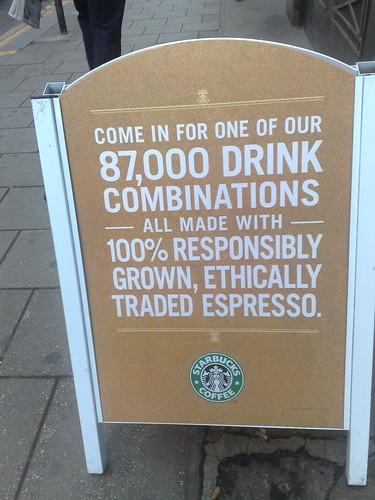
    I saw this notice talking about 87000 possible combinations and was reminded of the car industry. Back in the 1990s, I remember being told that car maker Volvo had over 30,000 combinations of vehicles available as passenger cars. This included: body shell variants, diesel and petrol engines of different sizes and power, manual or automatic transmissions, interior design options, in car entertainment options, safety features, paint jobs, body accoutrements. Since then Volvo has hinted at electric vehicles and now has at least two models of SUVs.

    87000 possible combinations, originally uploaded by renaissancechambara.

    While I don’t doubt the statistical capability of Starbucks marketing department, I was surprised to see that the coffee shop could serve up 87000 possible combinations of drinks based on relatively few options. This could be even larger in Starbucks other markets like Hong Kong or Japan, where there are more beverage varieties like Milk Tea or Matcha lattes, and more seasonal variation such as sakura season and mid-autumn festival alongside the usual Starbucks products.

    All of which brings home the impact of mass-customisation to a business. How would the Starbucks EPOS (electronic point of sales) system handle 87000 possible combinations? How does this impact the training of their baristas? Is there an operational model like a decision tree for these coffee options?

    I wonder is there a Starbucks long tail? What is the split between cold coffee drinks and hot drinks? Has this long tail altered itself over time, as the popularity of flat white drinks have taken off due to the influence of Australian coffee culture? How does the long tail affect the relative prioritisation that Starbucks might put on the different ingredients that go into their drinks? Mass customisation has gone mainstream. What does this degree of customisation mean for other service and retail businesses? How does this compare to what is seen in personalised products like NikeID or MyAdidas?

    More retailing related content can be found here.