Category: technology | 技術 | 기술 | テクノロジー

It’s hard to explain to someone who didn’t live through it how transformation technology has been. When I was a child a computer was something mysterious. My Dad has managed to work his way up from the shop floor of the shipyard where he worked and into the planning office.

One evening he broad home some computer paper. I was fascinated by the the way the paper hinged on perforations and had tear off side edges that allowed it to be pulled through the printer with plastic sprockets connecting through holes in the paper.

My Dad used to compile and print off work orders using an ICL mainframe computer that was timeshared by all the shipyards that were part of British Shipbuilders.

I used the paper for years for notes and my childhood drawings. It didn’t make me a computer whiz. I never had a computer when I was at school. My school didn’t have a computer lab. I got to use Windows machines a few times in a regional computer labs. I still use what I learned in Excel spreadsheets now.

My experience with computers started with work and eventually bought my own secondhand Mac. Cut and paste completely changed the way I wrote. I got to use internal email working for Corning and internet connectivity when I went to university. One of my friends had a CompuServe account and I was there when he first met his Mexican wife on an online chatroom, years before Tinder.

Leaving college I set up a Yahoo! email address. I only needed to check my email address once a week, which was fortunate as internet access was expensive. I used to go to Liverpool’s cyber cafe with a friend every Saturday and showed him how to use the internet. I would bring any messages that I needed to send pre-written on a floppy disk that also held my CV.

That is a world away from the technology we enjoy now, where we are enveloped by smartphones and constant connectivity. In some ways the rate of change feels as if it has slowed down compared to the last few decades.

  • Machine learning sublime influence

    Scott Galloway talks about the way brands are using AI (machine learning) and the examples are very much in the background.  Welcome to the sublime world of machine learning where the impact on the customer experience won’t be apparent. In many respects this is similar to how fuzzy logic became invisible as it was introduced in the late 1980s.

    The Japanese were particularly adept at putting an obscure form of mathematics to use. They made lifts that adapted to the traffic flows of people going in and out of a building and microwaves which knew how long to defrost whatever you put into it. Fuzzy logic compensated for blur in video camera movement in a similar manner to way smartphone manufacturers now use neural networks on images.

    The Japanese promoted fuzzy logic inside products to the home market, but generally backed off from promoting it abroad. The features just were and consumers accepted them over time. In a quote that is now eerily reminiscent of our time a spokesperson for the American Electronics Association’s Tokyo office said to the Washington Post

    “Some of the fuzzy concepts may be valid in the U.S.,”

    “The idea of better energy efficiency, or more precise heating and cooling, can be successful in the American market,”

    “But I don’t think most Americans want a vacuum cleaner that talks to you and says, ‘Hey, I sense that my dust bag will be full before we finish this room.’ “

    This was also the case with the use technology companies made of Bayes Theory. This was used by the likes of Autonomy and Microsoft Research.

    A second technique was rules, put simply IF then THAT. This kind of technology has been used to drive automated trading models and credit card approvals for decades. Pegasystems are one of the leaders in developing rules based processing. Rules based systems could even be built in an Excel macro and would still count as a form of machine learning. 

    Finally machine learning needs to think about a number of things with regards the models being used:

    • The importance of accuracy in the use case
    • The level of precision required and ways to indicate that precision means
    • The cost of generation versus other methods, this is very important in terms of computing power and energy consumption 

    More information
    The Future of Electronics Looks Fuzzy | Washington Post (December 23, 1990)

  • Narita airport + more news

    Narita Airport dumping squat toilets in restroom reform:The Asahi Shimbun – OMG makes Heathrow seem even more barbaric by comparison. Both Haneda airport and Narita airport are a pleasure to fly into. More Japan related content here

    Media

    Some thoughts on #SMWLDN – Matt Muir nails the ephemera that passes for thought leadership in social circles

    Technology

    There’s Blood In The Water In Silicon Valley | Buzzfeed – Tech is manifestly unready for this new era. They’ve been playing small-ball politics of regulation, and coasting on incredibly high approval ratings. But there are signs they feel the winds changing. You can usually detect a political figure’s problems from their overcompensation, and Zuckerberg’s Midwestern tour had all the hallmarks of a classic reaction to a specific political polling question: “Does he care about people like me?” The move was widely misinterpreted as some kind of beginning to Zuckerberg’s political career. But Zuckerberg is Facebook, and his image is his company’s. His mission was to fix the company’s image, and I’m just not sure this one is fixable.

    You can see the shape of how this plays out in a recent exchange between Mark Halperin and Rep. Adam Schiff, in which Halperin asked of Facebook: “Did they put profits ahead of patriotism in their conduct during the campaign?”

    Wall Street Journal Reports on SoftBank Offer for Uber….Yet No Other Press Outlet is Picking the Story Up | naked capitalism – at a lower than expected market value

    Web of no web

    As Amazon Pushes Forward With Robots, Workers Find New Roles – NYTimes.com – great example of what Kevin Kelly talked about in his book The Inevitable that we only preserve jobs by working with rather than against robots

    The Smart Watch Market is Headed for a Boom | Park Associates – not so sure about the rationale on this, I often forget to wear my smart watch for the same reasons that they give for fitness bands

  • The Inevitable by Kevin Kelly

    I re-read Kevin Kelly’s What Technology Wants and then decided to revisit The Inevitable: Understanding the 12 Technological Forces That Will Shape Our Future. The books make sense as ideal companions for each other, despite some overlap in terms of proof points.

    On the face of it The Inevitable is a less ambitious book than What Technology Wants. And when I started reading the book I didn’t get the kind of electrifying feeling that a big idea can bring, like when I read What Technology Wants.
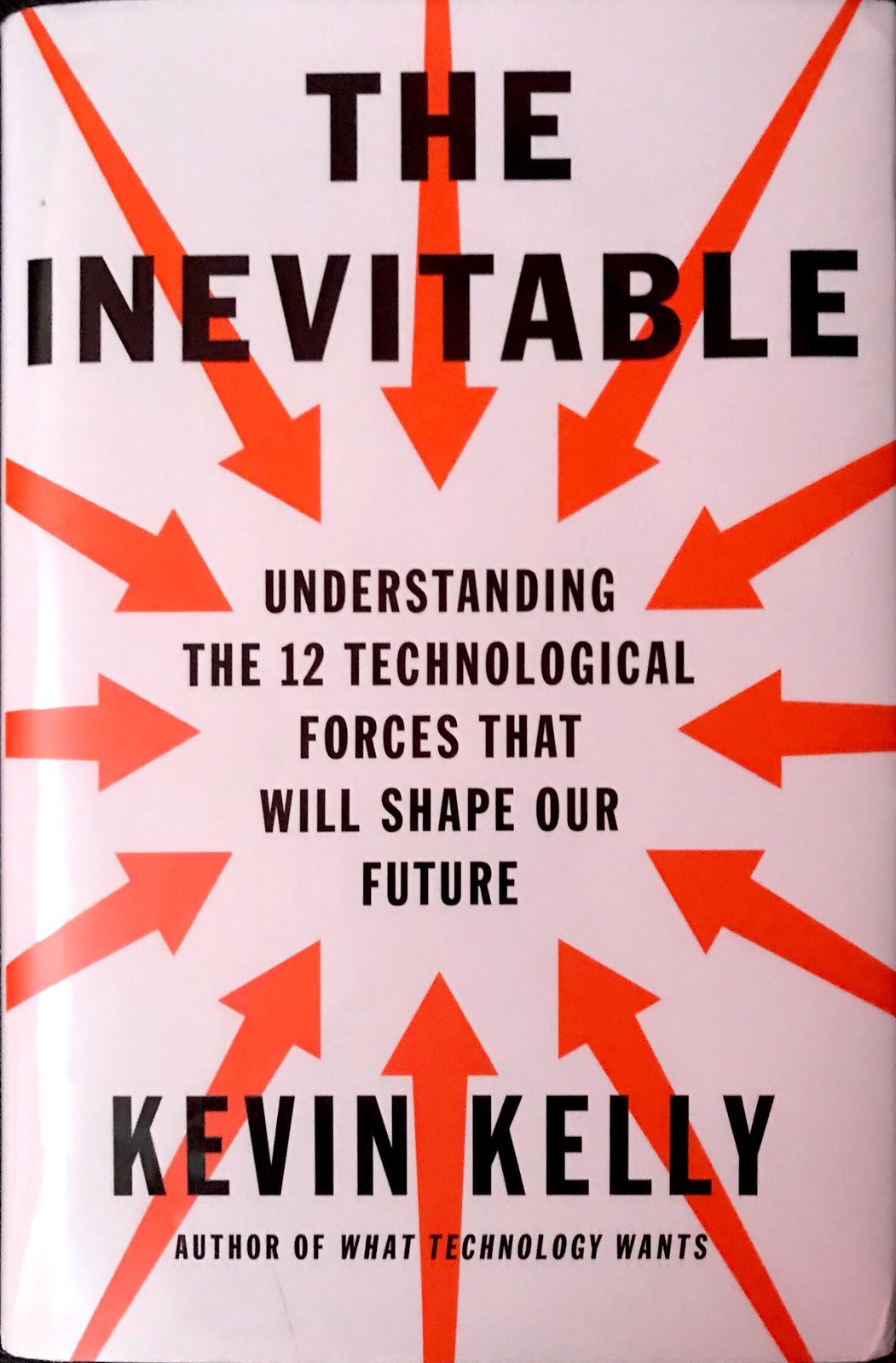

    The inevitable

    In the book Kevin Kelly touches on the kind of areas one would expect in  typical presentation given by an innovation team at an advertising agency. He is an unashamed techno-optimist, but the key difference in his thinking is two-fold:

    • Kelly pulls it together as a coherent idea rather than 12 slivers. He provides in-depth cogent arguments that bind the trends together
    • Kelly argues that transparency in governments will compensate for the erosion of privacy. While I understand where the idea has come from, I don’t agree with this particular viewpoint at least as it would manifest itself in the west. I certainly don’t think that would be the case in the East either. The Nazis use of IBM technology damn near destroyed the world as we know it. The level of trust between the government and the governed is in decline

    There is a clear line of progression in Kevin Kelly’s works from Out of Control written at the start of the modern internet age through to The Inevitable.  If you are interested in how technology is shaping our world buy What Technology Wants; if you are still hungry for more follow it up with The Inevitable: Understanding the 12 Technological Forces That Will Shape Our Future.

    More book reviews here.

  • Digital News Report + more stuff

    Digital News Report by Oxford’s Reuters Institute for the Study of Journalism latest findings discussed by Dr. Rasmus Kleiss Nielsen. This Digital News Report is based on a survey of more than 70,000 people across 36 countries.

    Economics

    The US gender wage gap is closing because women are making more and men are making less — Quartz – I wonder how this then fits into a feminist, social and larger economic agendas? Will there be a tension between all these? Is there a floor where aggregate male earnings will hit?

    FMCG

    P&G’s Pritchard Calls for Next Generation of Digital Ads | Special: Dmexco – AdAge – I kind of agree with him from a an overall sentiment point of view, but viewability is also a function of how much of the viewable area it fills? I realise that it would be hard to measure but it would be a function of ad size, scrolling speed and display size. In the real world think about the ads on the tube escalators.

    Innovation

    China May Own More Artificial Intelligence Patents Than US By Year-End – China Money Network – interesting speculation. I could understand it given that IBM is one of the largest filers of patents in the US and its machine learning efforts are overhyped

    Korea

    How Nike Sneakers Made a Billionaire of Park Yen-cha | BoF – interesting profile

    Legal

    WeWork accuses Chinese competitor UrWork of stealing its name and style: Shanghaiist – wait I thought WeWork’s style was stolen from the hipster catalogue?

    Media

    comScore Opens Global Access to Free Viewability Measurement – comScore, Inc – only for global advertisers, publishers, agencies and ad networks?

    P&G Asia brand director: ‘We were clickbaiters – and a giant duck still got more likes than we did’“I’ve been through generations of training in how to make a good Facebook ad, which has gone around 360 degrees and come back to the simple principles of marketing. We went through lots of complications in how to get clicks – we were clickbaiters. We honestly were. And yet that duck in Hong Kong Harbour got more likes than any of pure branded messaging, and we thought that’s maybe a good thing. But it’s not and it doesn’t help brands or businesses. It’s taken us time to get to where we are and the simplicity of those core marketing principles.”

    Security

    On the Equifax Data Breach – Schneier on Security – Surveillance capitalism fuels the Internet, and sometimes it seems that everyone is spying on you. You’re secretly tracked on pretty much every commercial website you visit. Facebook is the largest surveillance organization mankind has created; collecting data on you is its business model. I don’t have a Facebook account, but Facebook still keeps a surprisingly complete dossier on me and my associations — just in case I ever decide to join.

    I also don’t have a Gmail account, because I don’t want Google storing my e-mail. But my guess is that it has about half of my e-mail anyway, because so many people I correspond with have accounts. I can’t even avoid it by choosing not to write to gmail.com addresses, because I have no way of knowing if newperson@company.com is hosted at Gmail.

    Edward Snowden Interview: ‘There Is Still Hope’ – SPIEGEL ONLINE

  • iPhone X launch + more things

    iPhone X launch

    In terms of the news agenda, the iPhone X launch dominated the news. I wrote about it here and here.  This image from the Chinese internet summed everything about the iPhone X launch up for me.

    Chinese reaction to iPhone X

    We’re in a place of innovation stuckness at the moment – we’re celebrating incremental improvements in user experiences on smartphones as transformational, they aren’t. This is a category challenge, not a vendor-specific one. Even infrastructure and component vendor Qualcomm is struggling to envision ways to move things on.

    I have been mostly listening to this playlist from this years Love International Festival

    And FIP Radio

    Japanese group meforyouforme combining traditional Japanese culture and dance with modern tap dancing FTW


    Hong Kong stars Donnie Yen and Andy Lau go back to the 1970s with Chasing the Dragon – a thriller based on real characters involved in drug smuggling and organised crime in the turbulent go-go economic boom of Hong Kong – Lee Rock (Lui Lok) was a corrupt policeman nicknamed 500 million dollar Inspector, who avoided corruption charges by moving to Canada and then Hong Kong. Crippled (or Limpy) Ho was a triad called Ng Sek-ho who rivalled the 14K triad group.  It is against the backdrop of the post-1967 riots economic boom which saw Hong Kong blow up in manufacturing and financial services. This brought rich pickings in corruption which led to the formation of the ICAC – the Independent Commission Against Corruption.