Category: technology | 技術 | 기술 | テクノロジー

It’s hard to explain to someone who didn’t live through it how transformation technology has been. When I was a child a computer was something mysterious. My Dad has managed to work his way up from the shop floor of the shipyard where he worked and into the planning office.

One evening he broad home some computer paper. I was fascinated by the the way the paper hinged on perforations and had tear off side edges that allowed it to be pulled through the printer with plastic sprockets connecting through holes in the paper.

My Dad used to compile and print off work orders using an ICL mainframe computer that was timeshared by all the shipyards that were part of British Shipbuilders.

I used the paper for years for notes and my childhood drawings. It didn’t make me a computer whiz. I never had a computer when I was at school. My school didn’t have a computer lab. I got to use Windows machines a few times in a regional computer labs. I still use what I learned in Excel spreadsheets now.

My experience with computers started with work and eventually bought my own secondhand Mac. Cut and paste completely changed the way I wrote. I got to use internal email working for Corning and internet connectivity when I went to university. One of my friends had a CompuServe account and I was there when he first met his Mexican wife on an online chatroom, years before Tinder.

Leaving college I set up a Yahoo! email address. I only needed to check my email address once a week, which was fortunate as internet access was expensive. I used to go to Liverpool’s cyber cafe with a friend every Saturday and showed him how to use the internet. I would bring any messages that I needed to send pre-written on a floppy disk that also held my CV.

That is a world away from the technology we enjoy now, where we are enveloped by smartphones and constant connectivity. In some ways the rate of change feels as if it has slowed down compared to the last few decades.

  • Ruining Oxygene

    I didn’t mean to write a post about ruining Oxygene by Jean-Michel Jarre. Instead I had hoped to write a post about the joy of having got my hands on one of Sony’s legendary D-Z555 Discman. That post will have to wait for another time.

    Jean-Michel Jarre - Oxygène (1976)
    Oxygene shot by luna715

    I had a 1980s vintage CD of Oxygene. Moving to Hong Kong had seen it go along with a lot of my other belongings. I had wanted to listen to it to hear the quality of the D-Z555. I got a new copy from Amazon. The Oxygene I remembered has highs and lows. It makes use of stereo spacing to move its sweeping sound around you. I paired it with a modern pair of Sony in-ear monitors (MDR-EX800ST) with custom Snugs ear moulds.

    This is wasn’t the Oxygene that I’d previously heard. The first thing that I noticed was the that the constant peak across frequencies on the on-board display. Then it stayed loud, when it doesn’t go quiet. So loud it made the hair stand up at the back of my neck and became uncomfortable to continue listening.

    I took the CD out and played E2 – E4 by Manuel Göttsching. But this sounded glorious and the onboard display was more what I expected. The highs, the lows. The space that allows all the instruments room to shine.

    Tried a new copy of Jean Michel Jarre’s album Magnetic Fields and had a similarly uncomfortable listening experience.

    So I went back to the Oxygene CD case. In the small writing it said that the album had been digitally remastered from the original analogue tapes. The same remastering company had also done the Magnetic Fields CD as well.

    This remastering process has been what was ruining Oxygene for me. Looking at reviews around the web, it was obvious that this process had been unpopular. Looking at the prices of Oxygene and Magnetics Fields CDs on Discogs showed that there was premium price on the original CD versions. This wasn’t just about rarity. Like Dire Straits and Sade albums, these were commonplace in CD collections.

    I delved into reading about the loudness war. I was aware of the loudness war and the effect that it had on pop music. But Jean Michel Jarre isn’t really radio play material. (Although Magnetics Fields had been used as a signature track for an Egyptian numbers station* in the past. His albums whilst popular are slow steady sellers.

    A lot of the music that I listen to didn’t need high dynamic range compression. I knew that sampled instruments and digitally synthesised instruments are naturally more compressed, lacking the peak transients of live performances. My friend Joe used to record dance music before building a property empire. His uncle was a long-time musician (ex-Mission, Pulp and Artery) who then left to record electronic music in New Mexico. I vicariously got some of my studio recording knowledge from him through Joe.

    Overall I hadn’t really been exposed to large amounts of high dynamic compression in music before. This practice of making loud music. This had started in earnest in the 1990s as digital signal processing put more tools in the hands of the mastering engineers.

    Historically compression techniques had been used creatively. Motown frequently pushed the limits of vinyl recordings, particularly 7 inch singles.

    Motown was notorious for cutting some of the hottest 45s in the industry

    Nashville mastering engineer Bob Olhsson

    Digital signal processing seems to have led to a dramatic acceleration in this evolution

    There’s a 12 to 14dB apparent loudness difference between Black Sabbath, produced in 1977 or so and transferred to compact disc in the early ’80s, and the Black Eyed Peas’ ‘Let’s Get It Started.

    Bob Katz, mastering engineer

    Both quotes were from an article written in 2005 and things seem to have got only worse. The reasons for this are myriad:

    • In-car listening and iPods were considered to blame. But the level of compression is far beyond that
    • The decline of consumers actively listening to music, using it as audio background
    • Inexperienced engineers who don’t know what good sounds like
    • Inexperienced artists think that overly compressed masters sound better

    Whilst record label A&R people were considered partly responsible for loud mixes on vinyl singles. By 2005, record labels weren’t considered to be pressuring mastering engineers for louder mixes.

    Ruining Oxygene seems to have occurred a few years later as streaming services built up steam. I remember how Yahoo! Music used to master their streams when I worked for Yahoo! Europe. They were ripped straight from CD on a desktop HP computer by whoever had time in the music team.

    All of my research into the process of ruining Oxygene seems to have been a vicious circle. Various pressures on compression lowered the bar on what was good and that went through several cycles.

    The morals contained the story for music listeners are

    • Progress doesn’t mean better
    • We have lost something with the move away from actively listening to music

    *Numbers stations are a rabbit hole that you can descend into on the internet. So rather than having to go there, here’s a potted explanation. Countries would have spies embedded abroad, often for years at a time. In order to give them instructions or information, it would be preferable to do it in a manner that didn’t involve directly interacting with the agent. Shortwave radio filled this breach. The signals carry over huge distances. The messages would be concealed in numbers, often read out using speech synthesis – which gives them an other worldly feel.
  • Personal data leads + more things

    Consumers don’t believe use of personal data leads to more relevant ads, report finds | Campaign AsiaThe report also found that consumers still trust TV ads over their digital counterparts. On average, consumers are twice as likely to say TV ads provide a more positive impression of brands than common digital formats. The top concern about digital platforms amongst those polled was fake news on social media (53 percent), followed by cyberbullying, online predators, child endangerment online and children’s data privacy. “While consumers embrace the technology, there remains a multitude of concerns regarding advertising on the technology. These concerns are a significant reason why TV actually still remains the medium most likely to provide a positive impression of brands,” Juhl said. – Personal data leads to apparently less effective advertising. So why would you recommend digital for brand building activity??? Supports Gartner’s position that businesses will move away from personal data and Byron Sharp’s idea of smart mass marketing. More on how personal data leads to ineffective targeted online ads and ad blocking here.

    Street Media
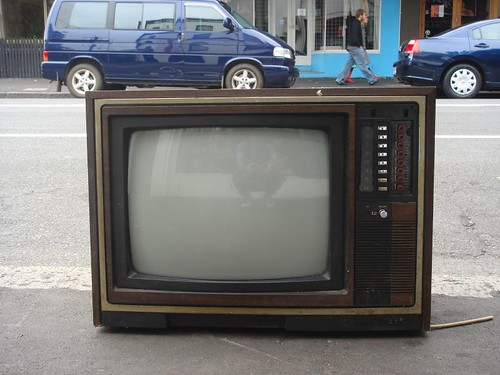
    Television via Flickr account Naked Faris

    People call for boycott of filmmaker Sam Morales after alleged catfishing of trans woman | Rappler – interesting online scandal in the Philippines at the moment with apparent complex catfishing of gay men and trans-women

    Facebook eyes multibillion-dollar stake in Reliance Jio | Financial Times – if the board game Risk was about global telecoms infrastructure instead of military conquest, the truism ‘never fight a land war in Asia’ would change to ‘never buy a carrier in India’. I can’t see how Facebook is going to do any better with its holding than Vodafone etc

    Singtel-backed OTT service Hooq enters liquidation | Advertising | Campaign Asia“Global and local content providers are increasingly going direct, the cost of content remains high, and emerging-market consumers’ willingness to pay has increased only gradually amid an increasing array of choices,” a Singtel statement said. “Because of these changes, a viable business model for an independent, OTT distribution platform has become increasingly challenged. As a result, HOOQ has not been able to grow sufficiently to provide sustainable returns nor cover escalating content costs and the continuous operating costs of an independent OTT distribution platform.” – it will be interesting to see how people like MUBI and NowTV do moving forwards

    Recession pushes Hong Kong shoppers to sell their luxury goods | Financial Times – interesting article however the speculation on mainland Chinese trading in secondhand luxury might be impeded a bit. A mix of fakes and and a desire for new things. They would need to have strong trustworthy authentication. And might want to vent that market abroad as well as Japanese players like Brand-Off have managed

    Inside China’s controversial mission to reinvent the internet | Financial Times – this sounds like a right mess. We’ll soon have a splinternet

    How to Beat Science and Influence People: Policymakers and Propaganda in Epistemic Networks | The British Journal for the Philosophy of Science | Oxford Academicweak or subtle interventions are often most effective for the would-be propagandist. In particular, outright scientific fraud—intentional publication of incorrect, fabricated, or purposely misleading results—is not only unnecessary to influence public opinion on topics of scientific inquiry, it is also riskier and often less effective than other forms of manipulation. Biased production, which does not involve fabricating results, is a successful strategy for misleading the public. And in many cases, biased production is itself less effective than selective sharing – HT Ian Wood

    What Does the Symmetry of Your Logo Say About Your Brand? – asymmetric conveys excitement. I was left with so many questions, like what about rotational symmetry in a logo?

    Madison Avenue Insights | The Next Big Thing in Media & Advertising: Simplification – great read by Michael Farmer, but will they look with a clear eye at the current digital marketing being done from a brand marketing perspective?

    “Krisenmarketing”: Warum Werbungtreibende nun ihre Etats nicht einfrieren sollten › Meedia – yes its in German but it comes out fine in Google Translate: Financial, insurance or telecommunications companies in particular should instead rely on customer-centered communication and pick people up instead. They would have to show existing customers that they are there for them during the crisis and offer solutions. For example, Deutsche Telekom is doing exemplary with its campaign “We connect Germany” and the specific services. Banks could also help with liquidity shortages.

    London has the highest productivity levels in UK PwC – without productivity improvements levelling up isn’t going to work. Interesting that London performed this high, yet was lower on females in employment with a higher female unemployment rate

  • My analogue journey & more things

    I’ve been listening to My Analogue Journey which has got an amazing selection of Japanese music as part of his videos. Check this out. My Analogue Journey pulls together some buttery smooth records; like a high class version of smooth radio.

    Streaming Up From Boston – Info on how to watch here | Dropkick Murphys – what really surprised me is that enterprise software company Pegasystems stepped up to financially support this. Its an amazing concert by the Dropkick Murphys.

    I am a big fan of SIGGRAPH demo videos. They are are an amazing amalgam. Reality and Daliesque surrealism. This video is very much in that SIGGRAPH vein. The physics of this video is amazing, but has a distinct otherworldly quality.

    Huggies candid campaign takes on parent-shaming | Canvas8 – Procter & Gamble have built a stable of expertise in mixing ads with social purpose. Some of these ads have been more effective than others, for instance the Gillette ads have fallen flat with male customers. This reminded me a bit of Brooklyn Brothers work for Water Wipes which hinged around authenticity around the parenting experience. More posts related to Procter & Gamble here.

    ICYMI: Vanilla Ice apologises for crimes against music in this campaign from Virgin to ‘Right Music… | Creative Moment  – using celebrities and getting the balance right is always a tough one. In this particular case Virgin seems to have done a better job rebuilding up the brand of Vanilla Ice than its own brand. It was an interesting insight that consumers no longer know about Virgin’s musical heritage that gave it its original cool factor. I guess its time for Mike Oldfield to release another follow on to Tubular Bells and remind gen Z of Virgin’s relevance. I do wonder if Vodafone had a similar but less extreme issue with its ads that revolved around Martin Freeman.

  • Misleading ad metric + more news

    Facebook executives ‘knew for years’ about misleading ad metric | Financial TimesThe lawsuit claims that Facebook represents the potential reach metric as a measure of how many people a given marketer could reach with an advertisement. However, it actually indicates the total number of accounts that the marketer could reach — a figure that could include fake and duplicated accounts, according to the allegations. – Facebook’s misleading ad metric isn’t news in its own right. What’s interesting is that the FT article goes on to claim that potential audience size in some states were bigger than publicly available data and seemed nonsensical in comparison to say census data

    UK lays out plans for legal e-scooters, medical drones and more transportation innovation in test cities | TechCrunch – if electric scooters is going to be anything like what I saw in Paris, it’ll be carnage

    Xenophobia amid the coronavirus pandemic is hurting Chinese immigrant neighborhoods – Voxanti-Asian xenophobia and racism have become a bigger issue around the world as a result of Covid-19. As Nylah Burton reported for Vox, in major cities like Los Angeles, Seattle, and Toronto, East Asians have been targeted — from racist comments made by TSA agents to verbal street harassment. Meanwhile, Chinese restaurants across the globe say they are struggling for business because of widespread misconceptions about the “cleanliness” of their food – exceptionally dark reading

    Time Out rebrands to Time In as coronavirus ‘social distancing’ takes effect | The Drum – circumstance encouraged Time Out to rebrand, but the strong equity they have in their brand allowed them do so successfully, like Pizza Hut’s Pasta Hut or the Google Doodle

    Madison Avenue Insights | Creative agencies: winning the battle but losing the warCreative agencies have mastered the requirements of integrated campaigns, from TV to online video, websites, Facebook, Instagram, ad banners and e-mail marketing. It’s a pity, then, that this victory is being undermined by agency price-cutting strategies that leave agencies understaffed and underpaid. Senior agency executives need to create winning business practices – they’re losing the business war. – great read by Michael Farmer. I suspect the piece that’s missing is the devastation wrought by procurement

    Russian influence operations using netizens in Ghana to target African Americans – GrapfikaThe operation used authentic activists and users, fronted by an ostensible human rights NGO, to covertly propagate an influence campaign. It is not the first time such an attempt has been made, but the tactic is of concern. The unwitting individuals co-opted into the operation bear the risk of reputational or legal jeopardy; indeed, CNN reported that the Ghanaian operation was raided by law enforcement as a result of their online activities. For the human rights community, the risk is that genuine NGOs may be misidentified as being involved in influence operations by accident or malice, and there is also the danger of tarnishing the reputation of important work and organizations across the field – its a fascinating read – a mix of information ops, subterfuge and offshoring. The west African link is interesting

    The Public Interest and Personal Privacy in a Time of Crisis (Part II) – Google Docs – part two of an essay by a Chinese academic- l linked to part one in this post

    Between Privacy and Convenience: Facial Recognition Technology in the Eyes of Citizens in China, Germany, the UK and the US by Genia Kostka, Léa Steinacker, Miriam Meckel :: SSRN 

    Lao Dongyan, “Artificial Intelligence” – Reading the China Dream – piece on biometric recognition

  • Ever more digital media + more

    Whilst the world is becoming ever more digital, the book publishing industry has remained print focused due to customer demand. This is a great segment from CNBC that goes into it in more depth.

    Dina Amin’s stop-motion assembly and disassembly video of everyday objects caught my eye. I would be surprised if this doesn’t show up in future ad agency work concepts.

    What’s inside by Dina Amin.

    Even my lack of expertise in gaming means that I have heard of Crash Bandicoot. What’s interesting in this video is how the development of Crash Bandicoot for the original PlayStation is similar to getting software to work on early PCs. Crash Bandicoot was one of a handful of titles that drove PlayStation popularity.

    How Crash Bandicoot hacked the original PlayStation from Ars Technical’s

    I did some initial work on dental health campaigns in APAC. It fell apart due to politics within my own agency, making us unable to collaborate with our colleagues at Red Fuse. Our agency was appointed for social media marketing work; but we couldn’t get anything out the door. During that time I came across some really smart people working in this space. This is why work like this: Colgate Ice Cream and Candy – The Inspiration Room made me smile. Great insight, simple execution in collaboration with confectionery companies ensuring a win-win outcome.

    Greg Girard’s street photography from Tokyo in the 1970s feels like postcards from the future – check out these previews from a forthcoming book of his work: Rare 1970s Street Photography from Tokyo Published in New Photo Book. You can see more Japan related posts here.  

    I’ll be working from home for the foreseeable future, but will be working hard to try and keep this blog as free of coronavirus-related content as I can.

    I am not a virologist, so my expertise doesn’t matter. I do know about the media and social platforms. You will see contradictory information, confusion and uncertainty. A classic example is the way hoarding toilet paper became a self-perpetuating meme.

    While I am working from home, I don’t imagine that it will be too much of a trial as the office environment itself has become ever more digital. I am going to use the time that I’d have spent commuting to improve my reading. I have a stack of unread books that won’t read themselves. I may even explore the ideas from them here with you my reader(s).