Category: telecoms | 電信 | 통신 | テレコム

I thought about telecoms as a way to talk about communications networks that were not wireless. These networks could be traditional POTS (plain old telecoms systems), packet switched networks including ethernet or some hybrid of the two.

I started my agency career working during the dot com era. What was happening in the broader technology space was one wave of technology cresting, while another one rose.

In the cresting space was:

Enterprise software (supply chain software, financial systems, database software, middleware software tools).

NIC cards (network interface cards, a way of getting your computer to be able to communicate with an ethernet network. It was a little circuit board that connected on to the mother board and allowed.

Mainframe and  mini-computers. It was around about this time that company owned data centres peaked.

In the rising wave was:

Servers –

  1. Unix servers and workstation grade computers were what hosted the first generation of websites. Names that did particularly well were Sun Microsystems (now part of Oracle) and Silicon Graphics Inc. (SGI). Sun Microsystems ran everything from investment banking models to telecoms billing systems. It’s hardware and software made great web servers. SGI was facing a crisis in its core market of 3D modelling due to Moore’s Law, but its operating systems was still very powerful. They managed to get some work as servers because people had them around in creative agencies.
  2. You also had a new range of servers on the low end. A mix of new suppliers like Cobalt Networks and VA Linux, together with existing companies like Dell who were offering Linux and Windows web servers that were really repackaged local area network file servers.

Enterprise information management software. The web posted its own problems for content management and publishing and companies like Captiva and Open Text rushed in to plug the gap.

Traditional vendors like HP and IBM rushed into provide a mix of software and hardware based solutions including e-business by IBM, which morphed into ‘Smarter Planet’

Telecoms companies – two things happened.

  1. Phone services were deregulated opening up former state owned incumbents to competition in fixed line and mobile telephony
  2. Data services really started to take off. Multinational companies like Shell looked to have a global data network for routing their calls over, so in many respects they looked like their own telecoms company. Then those data networks started to become of interest to the nascent internet providers as well. Mobile data started to gain traction around about the time of the dot com bust

So it made sense that I started to think about telecoms in a wide but wired sense, as it even impacts wireless as a backhaul infrastructure. Whether this is wi-fi into your home router or a 5G wireless network connecting to a fibre optic core network.

  • Google I/O 2016

    Google I/O 2016 happened on May, 18 – 20.  There had been a lot of pieces of coverage about the different products and services released. But I wanted to spend a bit of time reflecting on what Google I/O 2016 told us about their viewpoint on technology.

    Giving apps a second chance

    Google knows as well as anyone that the app moves towards a maturity model where consumers stick with the core apps that they want and then don’t go any further.
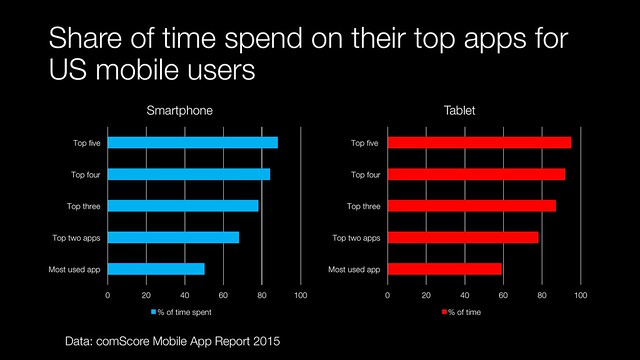
    apps
    Data shows that consumers use their top five apps 88 per cent of the time. So why would Google care when it knows that 60 percent of the top apps on the Android platform?

    The reasons for an expanded app usage include:

    • A proportion of Google’s advertising (like Facebook) is derived from the promotion of app downloads
    • Android devices are reaching market maturity in many markets, growth is likely to come from new uses – at least some of which will be derived from third party platforms
    • Google has staked its ambition in the PC sector on its Chrome operating system being able to run apps from the Android eco-system. In order for that to happen there needs to be a healthy community of developers
    • In the same way that DoubleClick’s ad network greatly expanded the inventory of Google’s advertising business, third party applications offer Google an additional source of usage for its own services. If you want to see the future of Google Apps look at the the way the likes of Baidu and Tencent allow third-party integration with their own tools

    Streaming or ‘instant’ apps is part of Google’s efforts to encourage consumer trial of new apps and enhance relationships with developers. Firebase, it’s new analytics platform for mobile developers helps them have a better relationship with their installed user base allowing them to use data to target notifications and campaigns.

    More faith in wider area networks (WANs) than personal area networks (PANs)

    Android Wear’s updates were interesting. Put simply Google has more faith in data being delivered in a timely manner over cellular or wi-fi networks than it does for inter device transfers over variants of Bluetooth. Both the Apple Watch and Android Wear products suffered from performance lags when the watch was a thin client of a phone. Having a cellular radio on board the phone presents challenges with battery life, but speeds up real world performance.

    The original design failure wasn’t down to network performance, but is likely to have implications for personal area network technology like Bluetooth in its different variants or ZigBee. These technologies are all about scale, lose a scale advantage and it poses a problem for future adoption by others. This can happen in a virtuous way. Apple’s adoption of USB benefited the standard greatly and drove interest in peripheral development for both Mac and PC. Apple’s abandonment of FireWire and the 3.5″ diskette marked their decline.

    Lots to be concerned about from a privacy point of view?

    Google Home moved yet another pair of Android powered ears into our environment. It was obvious from Google’s description of services that a paid marketing model to be the ‘car booking’ or equivalent service of Home could be very lucrative for the search giant. How this device could be used for market research, tracking brand mentions or government surveillance also poses some conundrums moving beyond smartphones to brown goods.

    Android N features file based encryption rather than treating the whole device as an encrypted disk. This raises questions around the comparative ease of access from a privacy perspective. Secondly, SafetyNet allows Google to reach into a phone to remove pre-existing applications without user permission. There is no explanation if they also have write privileges to the phone as well. If so, expect law enforcement and intellectual property owner interest. From the way it reads this would affect apps and content that have been side loaded as well as got from an app store.

    Android is giving the high ground to Apple on privacy presumably because it considers its own customers don’t care about it that much.

    Reference designs in VR to drive adoption and commoditisation 

    Google’s Daydream project looks to provide standardisation in hardware. By going down this route, Google hopes to spur on the sensor market required for improved AR experience and drive uptake. These will likely be a very different experience to the computer workstation powered Occulus Rift. Driving this technology into the smartphone market may combat the current stagnation in phone sales growth.

    More information
    Google I/O 2016 event page
    A16hz on Google I/O 2016
    Everything Google just announced at its I/O conference
    Palm, Apple, Google and the whole mobile device thing
    The Limits of Google
    If Google’s right about AI, that’s a problem for Apple – Marco.org
    ISIS’s Mobile App Developers Are in Crisis Mode | Motherboard
  • 2016 Mary Meeker presentation

    2016 Mary Meeker’s annual presentation on internet trends is a tradition within the technology sector that goes back more than two decades. Meeker used to be a sell side analyst during the dot com boom and was known as a cheerleader for the sector. Unlike Harry Blodget she didn’t come unstuck with the subsequent bust.

    More recently Meeker moved to Silicon Valley and took a job with a VC firm. Hence the reason why the 2016 Mary Meeker presentation is done in conjunction with KPCB (Kleiner Perkins Caufield Byers).

    The key themes explored in the presentation this year include:

    • Mobile – a favourite for a number of years, but with over half of all internet sessions being done on a smartphone or similar it was inevitable that it would take up a substantial amount of the presentation. Mobile is maturing which is shown in the decline in growth rate of the sector this year. Android is picking up market share due to its cheaper handsets but still lagging behind in share of profit
    • Declining global economic growth. Global debt has risen higher and faster than global GDP. Population growth is also slowing and ageing. Meeker thought that India may be the bright spot due to its demographics, but this assumes that it can get over its structural issues and take advantage of its young population. That is probably overly-optimistic because of rising hindu nationalism
    • Online advertising – efficacy still a serious issue to be dealt with. Consumers hate it hence ad blocking.
    • Social: Meeker saw the big factors being video, images and messaging
    • Voice: the rise of voice driven assistants in the home and on mobile devices. The decoupling of China versus the rest of the world is apparent in this new category.

    Here is the latest iteration for 2016

    More on Mary Meeker here.
  • June 2016 research slides

    Here is a copy of the slides that I pull together (when I have the time) of publicly available data that would be of use. This is the June 2016 research slides.

    Google search volumes

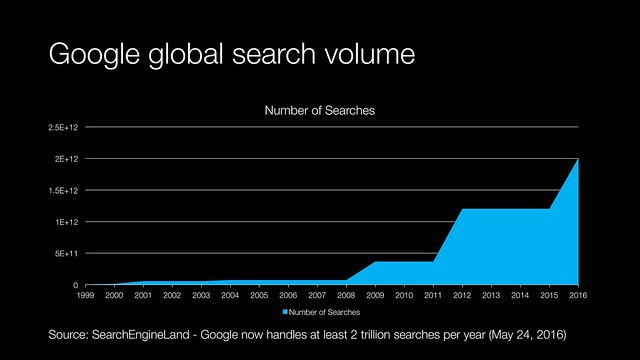
    This month I have some new data around search which came from disclosures at Google I/O in terms of search volumes. We talk about social as if search has gone out of style but its growth is still staggering. This is now driven by mobile device penetration and adoption as computing devices on the go. It also speaks to the wider number of questions that search now answers. It used to be that search answered with ‘facts’ found online. It then became more contextual with shortcuts that gave you the weather forecast or a foreign exchange rate. Mobile moved this on further to items like local recommendations.

    Partly through the search box, but also by more meta detail about the device doing the searching and its location to within a few metres due to GPS and cell tower triangulation. Voice interaction has also started to impact search volume. Image driven search still seems to be an area that could drive much more potential search volume, that would be valuable for commerce.
    Google global search volume
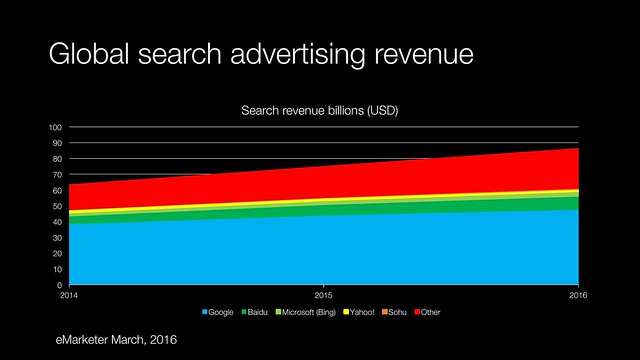
    Looking at global search revenue over time, Google’s monopoly position becomes immediately apparent. It is amazing how Bing and Yahoo! haven’t managed to grow market share but just transfer value from one to the other. In the Chinese market, Sohu has been obliterated with Baidu search. But one does have to wonder about the value of web search, when so much internet usage now happens in the WeChat eco-system.
    Global Search Revenues
    More details about me here.
    Slide20

    Full presentation

    Full presentation available for download as a PDF on Slideshare and you can find more research related posts here.

  • The New Nokia

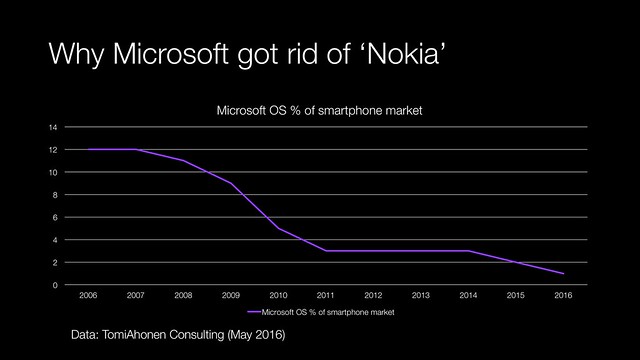
    The New Nokia can rise from the ashes of the old. Microsoft finally let go of its licence for the Nokia brand license on May 19, 2016.
    Slide03
    There is a lot of logic to this move:

    • Microsoft has already written down the full value of the business acquisition
    • It has got the most valuable technical savvy out of the team and moved it into the Surface business
    • It removes problematic factories and legacy products

    For the businesses that have acquired the rights to use the Nokia name and the factories the upsides are harder to see.

    The factories may be of use, however there is over supply in the Shenzhen eco-system and bottlenecks aren’t usually at final manufacture, but in the component supply chain.

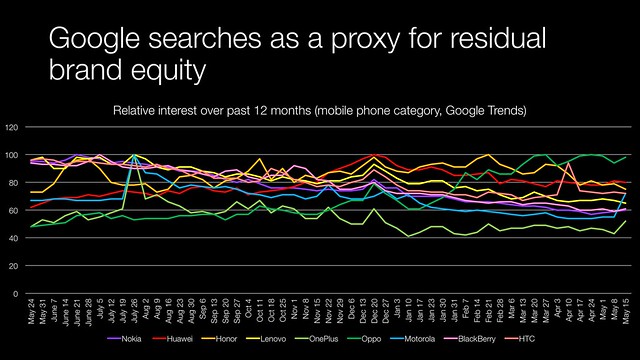
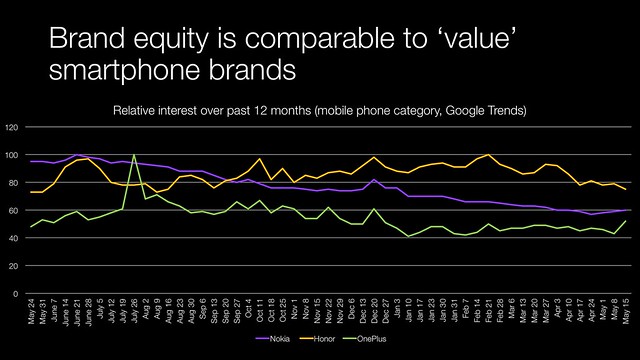
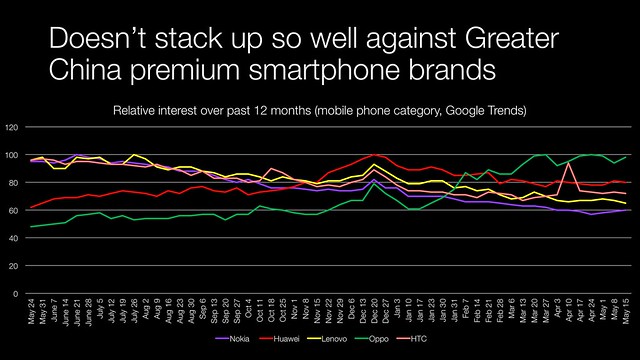
    There is still some brand equity left in the Nokia phone brand. I analysed Nokia along with a number of other international Greater China smartphone eco-system brands using Google Trend data.
    Slide06
    There has been a decline in brand interest over the past 12 months for Nokia of 37%
    Slide07
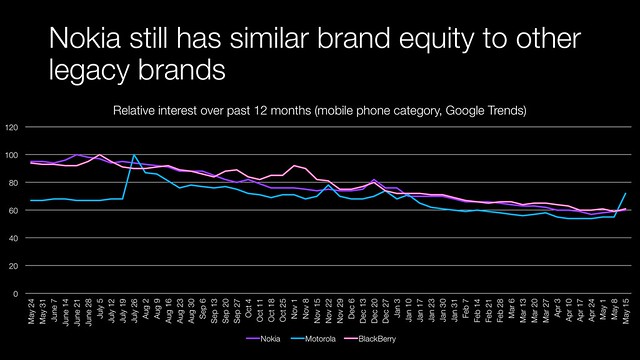
    Nokia still has comparable brand equity to other legacy mobile brands such as BlackBerry and Motorola
    Slide08
    The brand equity is comparable to other value mobile brands. Honor; Huawei’s value brand has had a lot of money and effort pumped into it to achieve its current position.
    Slide09
    But it’s brand equity doesn’t stack up well against premium handset brands from Greater China. The reason for this is that smartphone marketing and fast moving consumer goods marketing now have similar dynamics – both are in mature little differentiated markets. Brands need to have deep pockets  and invest in regular advertising to remain top-of-mind across as large an audience as possible. Reach and frequency are more important than social media metrics like engagement.

    In addition to advertising spend needs to be put into training and incentivising channel partners including carriers.

    They are entering a hyper-competitive market and it isn’t clear what their point of advantage will be. Given the lock down that Google puts on Android and commoditised version of handset manufacture, the best option would be to look for manufacturing and supply chain efficiencies  – like Dell did in the PC industry. But that’s easier said than done.

    Garnering the kind of investment required to seriously support an international phone brand is a hard sell to the finance director or potential external investors.

    Slide13
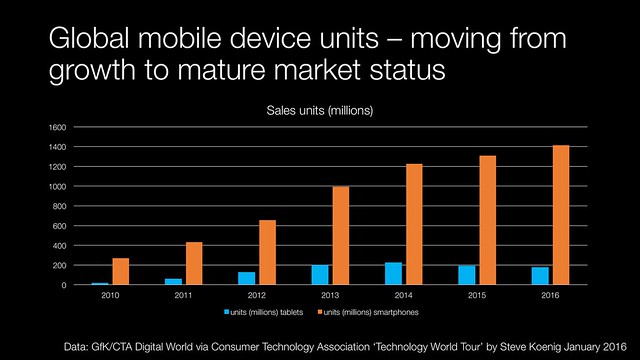
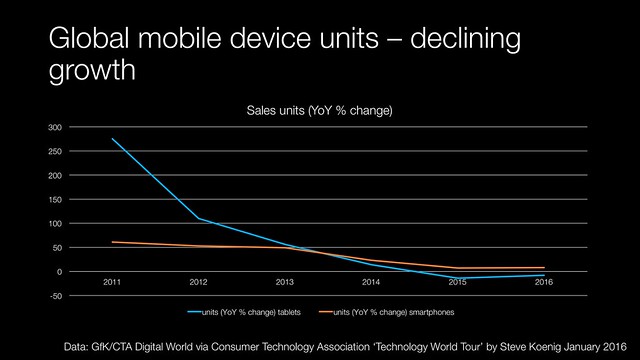
    Growth is tapering out.
    Slide14
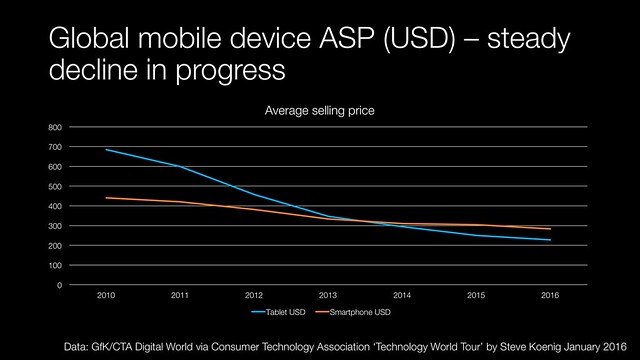
    The average selling price is in steady decline
    Slide16
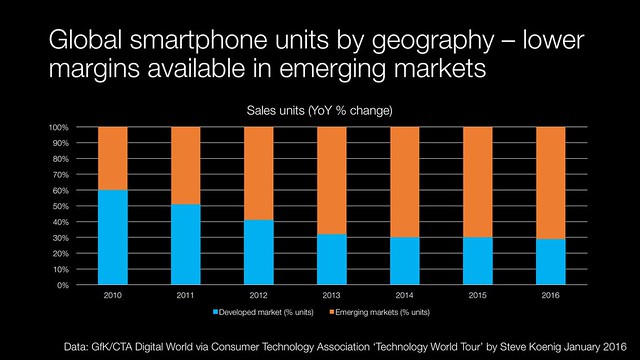
    This is partly because the emerging markets are making the majority new phone purchases.
    Slide15
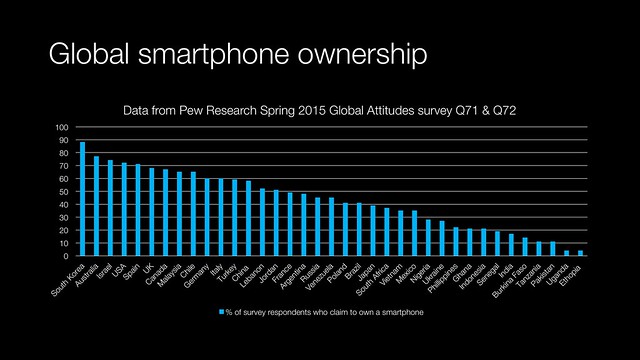
    Consumers in developed markets are likely holding on to the their phones for longer due to a mix economic conditions and a lack of compelling reason to upgrade.
    Slide12
    All of the consumers that likely want and can afford a phone in developed markets have one. Sales are likely to be on a replacement cycle as they wear out. Manufacturers have done a lot to improve quality and reliability of devices.

    Even the old household insurance fraud standby of dropping a phone that the consumer was bored with down the toilet doesn’t work on the latest premium Android handsets due to water-proofing.
    Slide20

    More information

    The answer to the question you’ve all been asking | Nokia – Nokia’s official announcement
    Gartner highlights a more challenging smartphone sector for Nokia than when it “quit” in 2013 | TelecomTV
    Nokia is coming back to phones and tablets | The Verge
    So the Nokia brand returns.. with a Vengeance | Communities Dominate Brands

    Supporting data slides in full

  • What about the work desk phone?

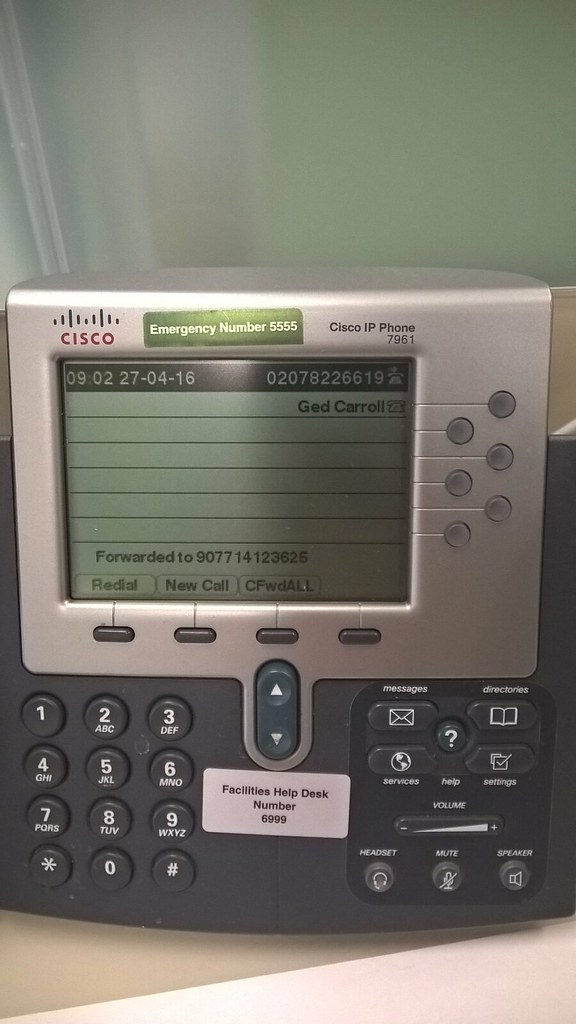
    I was in touch with a former colleague of mine the other day and they sent me a picture of my old work desk phone. It was still logged into my account and with a divert through to my mobile phone.
    Untitled
    The office had hot desking because there wasn’t enough space for everyone to be in at the same time.  We had email account size restrictions and people walked around with secondary hard drives plugged into their laptops as local and network storage wasn’t adequate enough to schlep all the documents on to a file server. There wasn’t a cloud-based equivalent of a file server in use 3either.

    Yet my former work desk phone remained logged in because no one was bothering to use it. So they have a surplus of desk telephones, when there was a shortage of pretty much every other resource the knowledge worker needed.

    Often times, people still used the land line number which followed them due to the Cisco VoIP PBX, but they diverted it to their mobile handset. The culture was very much based around conference calls, international teams would dial into a bridge number and be connected. You would see people pacing the common spaces such as corridors or reception and participating in conference calls on headsets wired into their smartphone.

    At the point of my project finishing they were just starting to roll out Skype for business. I suspect that this wasn’t going to change dramatically the use of mobile handsets, just the nature of how the call got to the recipient.

    Mobile infrastructure manufacturers have been expecting this for years, they rolled out pico-cell products aimed at enterprises to deal with reception dead spots in metal framed office buildings. What really seemed to have spurred things into action is the rise of all-you-can-eat voice tariffs.