Category: web of no web | 無處不在的技術 | 보급 기술 | 普及したテクノロジー

The web of no web came out of a course that I taught at the La Salle School of Business at the University Ramon Llull in Barcelona on interactive media to a bunch of Spanish executive MBA students. The university wanted an expert from industry and they happened to find me by happenstance. I remember contact was made via LinkedIn.

I spent a couple of weeks putting together a course. But I didn’t find material that covered many of things that I thought were important and happening around us. They had been percolating around the back of my mind at the time as I saw connections between a number of technologies that were fostering a new direction. Terms like web 2.0 and where 2.0 covered contributing factors, but were too silo-ed

So far people’s online experience had been mediated through a web browser or an email client. But that was changing, VR wasn’t successful at the time but it was interesting. More importantly the real world and the online world were coming together. We had:

  • Mobile connectivity and wi-fi
  • QRcodes
  • SMS to Twitter publishing at the time
  • You could phone up Google to do searches (in the US)
  • Digital integration in geocaching as a hobby
  • The Nintendo Wii controller allowed us to interact with media in new ways
  • Shazam would listen to music and tell you what song it was
  • Where 2.0: Flickr maps, Nokia maps, Yahoo!’s Fireeagle and Dopplr – integrated location with online
  • Smartphones seemed to have moved beyond business users

Charlene Li described the future of social networks as ‘being like air’, being all around us. So I wrapped up all in an idea called web of no web. I was heavily influenced by Bruce Lee’s description of jeet kune do – ‘using way as no way’ and ‘having no limitation as limitation’. That’s where the terminology that I used came from. This seemed to chime with the ideas that I was seeing and tried to capture.

  • Apple and Jaguar Land Rover in China

    Apple and Jaguar Land Rover blamed the Chinese economy for their recent financial results. The truth is probably more complex. What factors are affecting affecting Apple and Jaguar Land Rover that aren’t directly related to the Chinese economy?

    The reality is that Apple and Jaguar Land Rover are being buffeted by very different forces, some of which are their own making.

    Apple

    China is a unique mobile environment and in some ways it mirrors the hopes (and fears) for the internet in the late 1990s. Oracle and Sun Microsystems spent a lot of time during the dot com boom developing technologies that would allow applications to run on the web. Enterprise software sudden had a user experience that could be accessed via a web browser. Java allowed applications to be downloaded and run as needed. Netscape had a vision of the internet replicating the operating system as a layer that would run applications. Microsoft also realised this which was why they developed Internet Explorer, integrated it into Windows and killed off Netscape. The Judge Jackson trial happened and that was the start of the modern tech sector allowing Google and Apple to rise.

    Move forwards two decades and most computing is now done on mobile devices. In China, WeChat have managed to achieve what Netscape envisioned. Their app as a gateway to as many services as a consumer would need including a plethora of mini applications. It doesn’t suffer the problems that native web apps have had in terms of sluggish user experiences. In addition, WeChat has invested in a range of high-performing start-ups to built a keiretsu of businesses from cab services, e-commerce, property companies and even robotics. In the meanwhile Tencent who own WeChat have a range of consumer and business services as well.

    What this means for Apple is that many of its advantages in other markets are negated in China. The OS or even performance of a smartphone doesn’t matter that much, so long as it can run WeChat and a couple of other apps. The look and feel of the app is pretty much the same regardless of the phone OS. Continuity: where the iPhone and a Mac hand-off seamlessly to each other doesn’t matter that much if many consumers use their smartphone for all their personal computing needs.

    This has been the case for a few years now in China – but Apple haven’t found a way around it.

    As for phone industrial design – Apple lifted the game in manufacturing capability by introducing new machines and new ideas. To make the iPhone 5, Apple helped its suppliers buy thousands of CNC machines. This grew the manufacturers capability to supply and the amount of pre-owned machines that eventually came on the marketplace. It meant that other manufacturers have managed to make much better phone designs much faster.

    That meant Chinese consumers can buy phones that are indistinguishable from an iPhone if you ignore the logo and function the same because of China’s app eco-system. Again this has been the same for a few years and has accelerated due to the nature of the dominant smartphone form factor. The second iteration of the iPhone X form factor is what really changed things. The phones were different to what has come before, but they weren’t demonstrably better. They were also more expensive.

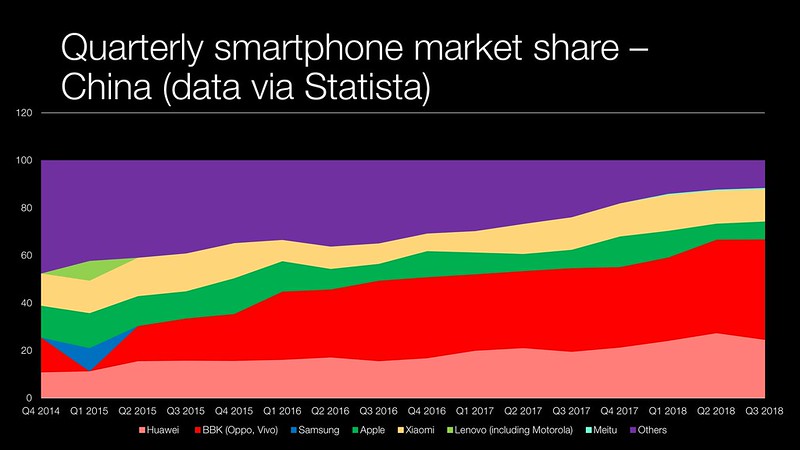
    In the mean time Huawei and others have continued to make progress, particularly in product design and camera technology – the two areas where Apple led year-on-year. Huawei devices can be expensive for what they are, but they gave domestic manufacturers ‘brand permission’ in the eyes of many Chinese consumers to be as good as the foreigners.

    This wasn’t helped by Samsung’s missteps in the Chinese market that started with the global recall of the Samsung Galaxy Note7 battery recall. Samsung hasn’t managed to make that gap back up and seems to make marketing missteps regularly such as its recent tie-in with the ‘fake’ Supreme brand holder China. If you’re a Chinese consumer the additional value or status that you used to see in foreign handset brands is now diminished. This seems to be a wider theme as domestic brands are also making similar gains in market share compared to foreign FMCG brands. Although there are also exceptions like baby formula.

    Domestic brands have done a good job marketing themselves. BBK in particular are very interesting. Whilst Huawei makes lots of noise and bluster at how big they are, BBK creeps up. It has a number of brands in China and abroad OnePlus, Oppo, Vivo and RealMe going after particular segments. The brands are focused but run separately like companies in their own right. Apple’s marketing riffs on its global marketing (though it did a great Chinese New Year themed ad last year). This reinforces the perceived common view that foreign businesses are full of hubris and don’t sufficiently localise for China. Apple’s recent pricing strategy in a market where this is so little to show in value provided looks like the epitome of hubris.

    180120 - China smartphone market

    Finally, there has been a massive amount of consolidation of brands in the China smartphone market over the past four years. That provides for scale in terms of logistics, supply chain, design, component sourcing and marketing.

    Jaguar Land Rover

    If we move to the automotive sector and look at Jaguar Land Rover – their problems in China look self inflicted. China’s car market has declined for the first time in 20 years. But it seems to have mostly affected brands like Hyundai rather than prestige brands like Mercedes Benz or BMW. The reasons why aren’t immediately apparent. Yes diesel cars are less popular, but BMW, Audi and Mercedes make diesel cars.

    Jaguar Land Rover aren’t the only foreign brand suffering: Toyota has had problems in China since the last round of strong anti-Japanese sentiment exploded in 2012.

    More information

    Why Does WeChat Block Competitors, While Facebook Doesn’t? | Walk The Chat

    Apple’s China Problem | Stratechery

    Samsung recalls Galaxy Note 7 worldwide due to exploding battery fears | The Verge

    Samsung angers hypebeasts by partnering with fake Supreme brand in China | The Verge

    Fake News: Samsung China’s Deal With Supreme “Knock-off” Spurs Drama | Jing Daily

    Chinese car sales fall for first time in more than 20 years | World news | The Guardian

  • Aston Martin classics + more things

    Aston Martin Will Make Old Cars Electric So They Don’t Get Banned From Cities – Slashdot – surprised more companies like Porsche aren’t doing this. This upgrade process reminded me of the service that Bristol Cars have provided for years. Like Aston Martin has planned, Bristol Cars has steadily upgraded cars with better brakes, handling, electronic fuel injection and more emissions friendly engines. Their purchase by Fraser Nash is now looking at an Aston Martin like electric upgrade service. More luxury related content here.

    Exclusive: Amazon’s Alexa begins crowdsourcing answers to common quest – reminds me of the original thinking behind Yahoo! Knowledge Search (what begat Yahoo! Answers) when I first heard Jeff Weiner articulate it

    Mark Ritson: The story of digital media disruption has run its course – Marketing WeekIt’s hard to get emotional or feel any of the romance of news media from a home page, but the paper edition carries with it the great cultural power of journalism. Print editions will become the ‘couture’ offering of the news brands – loss-making but important assets for building and retaining authority and influence over the market

    WSJ City | Britain’s stock link to China falls flat – many larger foreign institutions can already access mainland-listed Chinese stocks via trading accounts in Hong Kong. – Not terribly surprising. The big problem is how much hope had been pinned on it from a Brexit point of view

    Unilever’s rules for influencer marketing | WARCthat its influencer efforts focus not just on a product, but on attempts to covey a brand’s purpose – as shown by Dove, the personal care line, focusing on “real beauty”. “We are using influencer marketing for Dove across the whole spectrum. In some cases, we use influencers to talk about the features and benefits of the products,” Di Como said. “But, more and more, we are using them to talk about the idea to buy into – to talk about the brand value, of why the brand exists, and the purpose of the brand.” “There is an obsession that the only KPIs out there are ‘reach’ or ‘number of followers’,” said Di Como. “We need to talk about what the real impact is on brand equity – the real impact on the values of the brand.” – which is interesting as I heard that there were efforts to move away from brand tracking surveys and instead interpolate the equivalent data from social listening

    Apple Offers New iPhone Promo Deals, Trade-Ins to Boost Sales – Bloomberg – I think the market in general for smartphones is over-baked

    Bose Global Press Room – Bose Announces Frames — A Revolutionary New Wearable – this looks interesting, if they get it to work and you have enough connectivity to the cloud

    46 insurgent brands shake up China’s FMCG market – Kantarthe redefinition of consumers, merchandise and stores known collectively as“New Retail.” China’s consumers have growing expectations for tailored and specific offerings, which creates many niche opportunities for insurgent brands to capture. The traditional scale advantages of incumbents, such as large sales forces and large retail shelf space, have in some ways turned into disadvantages by digital disruption. For example, the e-commerce channel can reach millions of consumers without a single sales rep, and online platform advertising can reach millions of consumers with much lower budgets than traditional brands typically spend

    Volvo & Ericsson – Scroogled? – Radio Free Mobile – interesting article looking at Google’s move into automotive systems

  • Meng Wenzhou & things from last week

    Meng Wanzhou and China

    I’ve made a conscious decision to ignore Sabrina Meng Wanzhou and her forthcoming extradition to the US. I had met Meng Wenzhou when she was called Cathy. I also decided to ignore Starwood’s database of really private data allegedly being pwnd by Chinese intelligence. Unsurprisingly Brexit – which at the moment looks like an Austin Allegro hitting a brick wall at a moderate speed, collapsing like a crisp packet and killing its union jack clad occupants

    On to things that made up my week:

    Back in the day, consumer products brands used to do a lot of advertising to build brand equity. It is interesting that marketing thinking is starting to sway back to that being a good idea again. Reality check, it never was a bad idea, but marketers focused too much on short term effectiveness in isolation. Agencies were fine with this due to the profits available on digital media sales.

    An example of the power in brand advertising was work by McCann Worldgroup in Hong Kong for Nescafe Black. Which paid homage to a well known hair dye advert from the 1980s. Bigen hair dye went big on reach and repetition during the 1980s; its recall and memorability helps Nescafe’s ad work 30 years later. Actor Kenneth Tsang is probably not disappointed by the ongoing work either.

    This video on Amazon sponsored brands ad format reminds me a lot of the arbitrage opportunities that used to be common in early search advertising. It goes to underscore how much Amazon has taken away from Google et al in terms of product and shopping related searches.

    MIT released a video on how self driving cars can work on country roads (without the complex prebuilt LIDAR maps associated with current driverless cars efforts)

    Neopets was one of them child oriented social environments with games of a similar vintage to Habbo Hotel and Disney’s Club Penguin. It also has an odd startup story behind it. Watch the video and be amazed. More online related stories here.

    Wu-Tang Clan celebrate the 25th anniversary of their break out album 36 Chambers  with an appearance on NPR’s Tiny Desk concert.

  • Cringely Red Hat analysis + more

    I, Cringely Red Hat takes over IBM – I, Cringely – interesting Cringely Red Hat analysis. The IBM buyout of Red Hat is about cultural rejuvenation. In return, Red Hat gets scale. More related content by Cringely on IBM here. Red Hat is one of a few businesses that have managed to build themselves on open source and have a success exit. Open Source Software is a difficult category to build a successful enterprise of business of the ilk of Red Hat.

    iOS vs. Windows – Input and Office – Radio Free Mobile – no real surprise here. One only has to go back to the late 1970s / early 1980s experience of the HP 150 mini computer with a touch screen to see the productivity issue that the Microsoft Surface represents. Keyboards work, and they work better now that more people are reasonable touch typists. When you pair them with a GUI, you want the cursor to be controlled from close to the keyboard. You’re more likely to have touchpads rather than touching the screen. Tablets are still interesting as consumption devices, the question is what the market is?

    Oath will soon be rebranded as Verizon Media Group – The Verge – what is more interesting is how Verizon changes management approach (presumably after losing Tim Armstrong). It no longer feels ‘media industry’. It is interesting that Verizon has put its own name on the business. If it fails it will adversely affect the corporate brand. Oath gave them a bit of brand space. More related content here.

    Snapchat Lenses are coming to the desktop and Twitch streams | TechRadar – integration with Twitch will fuel further speculation on an imminent Amazon buy-out, even though it doesn’t make that much sense on paper. Twitch does start to look as if it has similar capabilities to Chinese live streaming social selling platforms.

  • Pegatron + more things

    Apple reportedly shifting more iPhone XR orders to Foxconn from Pegatron, says paper  – Pegatron’s production has been affected by a lower-than-expected yield rate and shortages of workers at its plants in China – the manpower issue at Pegatron is very interesting and implies a possible rift between the factories and local government. Historically local governments have gone out of their way to facilitate large Taiwanese employers China has just begun to see a decline in worker numbers overall in its population. Pegatron used to be part of ASUSTek. When that business reorganised its OEM manufacturing business became what we now know as Pegatron.

    Brands throwing cash at sponsorship with little idea of return, report finds – Mumbrella Asia – not terribly surprising

    Deepfakes web α | Generate your own Deepfakes – Japanese currency denominated service to create your own deep fakes. This service looks as if its designed for the curious, rather than virtual revenge porn creators, the accessibility of this capability brings with it a variety of issues

    Smart cities — too clever by half? | Financial Times – hell is other people’s technology. Smart cities don’t have the attendant ethical considerations because that would dull their ‘smartness’. In addition law enforcement would prefer to have maximum choices on data. It was interesting that China Mobile’s key use case for 5G was urban crime fighting in the first adverts that they ran.

    Life insurance company John Hancock wants to track your Fitbit data – Vox – very sinister. What demands will the insurance company put on the insured? How will it be using the data?

    Software disenchantment @ tonsky.me – innovation entropy

    Adobe Changes Its Marketing Cloud Trajectory With Marketo Acquisition – this going to be a very different marketing / sale model for Adobe

    Alexa, Blow My Mind | Gartner L2 – Apple’s recent iPhone and Apple Watch launch lacked buzz in comparison to previous launches.