Blog

  • Designing the Internet

    David D Clark was involved in the designing the internet as it moved into the commercial sphere. He rose to prominence in the 1980s through to the mid-1990s. In the talk at Google’s Mountain View campus he goes over much of the process. The things he says about network economics and security is particularly interesting.

    Outtakes

    In the 1970s it was about getting the protocols right, they needed to debug both the code and the specification that went alongside.

    1980s made hierarchies to make things scale as everything got bigger.

    1990s brought in the commercial internet, the specific goal of specifications was to shape industry structure. Protocol boundaries define industry structures.

    Quality of service development was compromised because it didn’t work economically for network providers. Specifically by concern about internet telephony. Standards adaptation was affected the internet service providers efforts to get value out of applications that run over the top (like Google).

    His discussions on designing the internet with politicians are particularly intriguing. There are still unanswered questions about societal and political accountability. There is a space for anonymous actions and an accountable internet would fall back to sovereign states including authoritarian regimes.

    Availability as well as integrity and cryptography (disclosure control) are important for security. The internet is insecure by design. Conscious decisions were taken to put risky actions into the internet. This gave us Flash, Acrobat and the Chrome browser.

    Embedding risky actions to provide attractive features for users, versus ensuring that these are only between people who you know. Trustworthiness is key.

    Protocol features affect industry power, adding more features may give power to the wrong people. The prime example of this is the work that the Chinese government have been doing with Huawei to try and define real ID, censorship and cyber sovereignty into next generation standards. More related content here.

  • Vein verification + more things

    Hackers Make a Fake Hand to Beat Vein Verification | Motherboard – another biometric standard weakens. The big question is the cost of the hand versus the benefit gained fooling vein verification. I am quite impressed by the vein verification hack. More on biometric authentication here.

    9 Chinese Fashion Labels to Watch in 2019 | RADII Media – there are also legion of domestic streetwear brands to keep an eye on due to the popularity of hip-hop culture in China

    Apple’s “Color Flood”: like Picasso said | Ken Segall – interesting analysis on the influences on Apple’s iPhone X/XR/XS advertising. All I can say is thank goodness Qualcomm aren’t in the ad business or Apple would be screwed

    Can Luxury Brands Tap Into China’s ‘Virtual Avatar’ Fever? | Jing Daily – reminds me of the Adidas promotion Yahoo! did as a tie into to the 2006 World Cup in Germany. Yahoo! was a FIFA sponsor (for online sports content, part of the bigger Terry Semel – ‘lets build a media company’ ethos along with ‘Kevin Sites in The Hot Zone’ – a proto-Vice TV documentary series. Often ideas have to come around a number of times before they have their day…

    Geoffrey Hinton and Demis Hassabis: AGI is nowhere close to being a reality | VentureBeat – general AI is nowhere near reality, but the amount of people who talk as if it is are legion

    Chinese regime ‘intimidates critics in intellectual war against Britain’ | News | The Times – you can feel a Cold War brewing – the key difference in Chinese and western influence operations is that they lack subtlety and go harder. Which makes sense when they are used to getting their way at home

    China restarts video game approvals after months-long freeze | Reuters – what’s more interesting is the degree of flexing going on by the Chinese government against Tencent. No Tencent games were in the batch of 80 approved titles

    Japan’s Prisons Are a Haven for Elderly Women – Bloomberg – prisons are taking up the slack of community care

    QR Codes are dead — long live Bluetooth beacons! – YNAP Tech – Medium – not convinced:

    • QRcodes are now supposed in the core OS of iOS
    • Support and familiarity in Asian apps (WeChat, LINE etc) and even the hand off between WhatsApp mobile and desktop clients
    • Bluetooth beacons size and broadcasting nature vs print materials and European privacy regulations
  • ICE-ing

    ICE-ing – a method of protest using vehicles with internal combustible engines

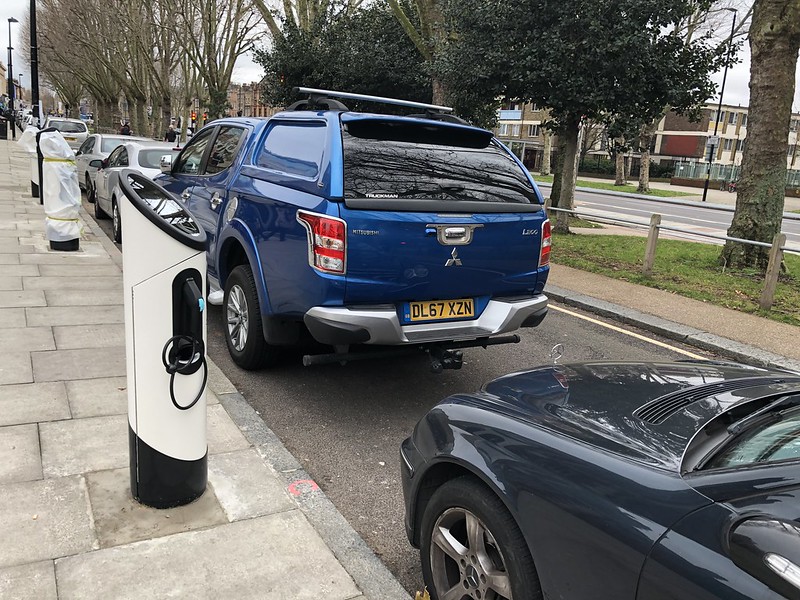
    Sometimes writing posts are a matter of serendipity. I was out walking in Stepney Green and came across a series of electric vehicle charging points. I hadn’t paid any attention to them before.

    Right about the time that I noticed them; I saw that the parking bays in front of the charging points were all taken up by petrol or diesel engined vehicles. This being London were parking spaces tend to be a premium, I took a picture of the dissonant scene and quickly moved on.

    Untitled

    I came in and then read a piece of how truck owners in the US were trolling Tesla supercharging points. Car culture is still huge and overwhelmingly celebrating petrol engined vehicles. But in the US there is a definite sub-text to the protests; one of class war. Metropolitan elite Democrats versus middle America truck-owning Republicans hence ice-ing.

    I revisited the photo that I took earlier in Stepney Green. All the vehicles in the photo were mid-range Mercedes cars with the exception of the Nissan pick-up truck. What would the odds have been of a super-mini in the row of parked vehicles if this was just about parking spaces? Was it British ice-ing

    It didn’t seem organised; but more of an organic system. Some first ‘person like me’ committed the transgressive act of parking in a charging bay. This then gave ‘permission’ for others to do it as well and the spaces filled up.

    There are a number of reasons for a consumer to not want to purchase an electric car when looking for a vehicle:

    • Cost
    • Energy density / range
    • Speed of recharging
    • Charging point network
    • Vehicle choice

    A bigger and harder to crack issue for vehicle manufacturers is one of values. Electric cars don’t have a culture behind them. They may have good road performance but they are the wholemeal bread of the automotive world. Something you should so, rather than something you are passionate about driving. Internal combustion engines won’t go quietly into the night.

    BMW going into formula E and launching the i8 using the design language from the M1 was a nod towards making electric sexy. But on its own its like spitting in a hurricane. One Japanese vehicle manufacturer knew how to make electric (and petrol) vehicles exciting through

    • Customisation
    • Tinkering
    • Community
    • Noise
    • Spectacle

    Unfortunately for the automotive industry that vehicle manufacturer is Tamiya. Tamiya is a Shizuoka based manufacturer of remote control cars for hobbyists.

    Maybe the answer isn’t about marketing but about engineering?

    You can change the fuel without changing the excitement, noise or spectacle.

    Hydrogen powered combustion engines offer similar energy density and performance to petrol cars, but with water as the waste product rather than carbon monoxide. Battery technology currently relies on a lithium and most of the world’s supply comes out of a high desert in Chile – we’ve replaced one finite resource (oil) with another (lithium and rare earth metals).

    Toyota is already experimenting with hydrogen in Japan. BMW have done pilot programmes in the past and hydrogen as been trialled in heavy goods vehicles.

    More consumer behaviour related posts here.

  • Facebook secret rulebook + more things

    Inside Facebook Secret Rulebook for Global Political Speech – The New York TimesModerators express frustration at rules they say don’t always make sense and sometimes require them to leave up posts they fear could lead to violence. “You feel like you killed someone by not acting,” one said, speaking on the condition of anonymity because he had signed a nondisclosure agreement. – the Facebook secret rulebook for global free speech raises as much questions as it provides answers and gives Facebook dangerous extra governmental powers. More Facebook related content here.

    Amazon Alexa crashes after Christmas Day overload | The Irish TimesThe crash, at about 10am Irish time, prompted Amazon customers to complain about not being able to play festive songs, turn on their living room lights or get cooking instructions for Christmas dinner. – reminds me of working on the Cellnet / O2 Genie WAP portal that did a similar thing on Christmas day. And the technicians from Logica (now part of CGI) who supported it all having to roll back the Oracle database underpinning many of the systems including email.

    Silence has been golden for Jardine Matheson | Financial Timestoday’s Jardines is primarily Sir Henry’s creation. It is an intensely conservative institution that does not give a fig for modernity or the views of outside shareholders, and is overseen by an all-male, family infused board of directors. It is equally a daring merchant adventurer with plenty of grit. – Jardines were more averse to the risk that the 1997 handover of Hong Kong represented and have built up businesses in other countries unlike their peer Swire

    Amazon Alexa Shopping Tripled as Bose, Nerf Topped Holiday Sales | FortuneAmazon on Wednesday said that the number of voice-activated orders placed via its virtual personal assistant Alexa were three times greater during the 2018 holiday season than they were in the last year – is this proportionate to the increase in Alexa powered devices, this comparison is important in order to understand the ramifications of the growth pattern

    Huawei Veterans Selling AI to Banks Shape China’s Newest Unicorn – Bloomberg – 4Paradigm looks as if it could get crushed by Huawei’s wolf culture. The only thing holding it back is the lack of trust in the associatedHuawei name abroad and concerns about letting Chinese software manage the most sensitive data

  • T-WOG $ & things that made last week

    Things that made my day this week, apart from spending time with family, introducing my Mum to T-WOG $. T-WOG $ is the Terry Wogan secret pirate radio shows. We also ended up eating surprisingly little Christmas food; none of us really wanted the heaviness of seasonal fare that introduces food coma.

    For those who haven’t heard it, T-WOG $ is Peter Serfinowicz channels Terry Wogan; IF he hosted a show on rinse.fm. He gets the light, deft responses that Wogan perfected for his fan base during his heyday on BBC Radio 2 or TOGs as they were called. TOGs stood for Terry’s Old Geezers and Gals. Serfinowicz then marries this with the call out culture from pirate radio since the late 1980s.

    Terry was unfortunately taken from us going on for two years ago, but his cultural impact lives on.

    To complete the illusion; I just need to find an impressionist who can do a passable impression of Daniel O’Donnell spitting lyrics over drill tracks.

    RuPaul’s tic-tac diet from circa 1993… RuPaul had refined her persona by this time. This was done about the same time that RuPaul had her first album and mainstream success with Tommy Boy Records.

    A more serious interview with RuPaul Charles courtesy of Houston PBS

    Ireland, Brexit and the future of Transatlantic Relations

    An Irish perspective on Brexit. Daithi O’Ceallaigh is a former Irish Ambassador to the United Kingdom, so is likely to have an informed opinion with regards how the Irish government views Brexit.

    Three stories on video game addiction told in I Was A Winner. Its a great bit of film making about an issue that could be the tobacco industry of our time.

    And one last thing as a seasonal bonus