Blog

  • LINE tries to crack US + more things

    LINE Tries to Crack US Messaging… With a Times Square Store for Plush Toys? – this isn’t about LINE trying to crack the US market its about reaching an international audience for Brown and Co. Think of LINE as a ‘Sanrio’ analogue with a technology company attached when it comes to markets like the US. LINE is unique in this regard, combining both media assets and technology and that why LINE tries to crack US isn’t as crazy  Think about the amount of Asian tourist footfall…

    China’s newest trend: mini karaoke booths at shopping malls | South China Morning Post – Li said that at traditional karaoke bars, users have to reserve rooms in advance and there were usually extra charges such as service charge and for beverages and fruit served. – interesting because it moves KTV into a more family orientated area with no room for the ‘added services’ including drink and company at the shadier end of the sector

    Ad Tech Firm Criteo to Launch Data Cooperative to Help Retailers Take On Amazon – WSJ – a combination of actors here. Criteo’s business is threatened by the all encompassing ad tech stacks of Google and Facebook – who between account for 85% of online advertising growth. The main insurgent online adverting provider is Amazon… E-tailers in many product categories are now dealing with Amazon as the number one product search engine and e-tailer. This won’t address the challenge of breaking consumer habit of ‘let’s hit Amazon and eBay first to see if I can get it’

    Under Armour’s sneaker business has cratered | Quartz – not terribly surprised – when you think about how their basketball business relied on Curry, their football boots have entered a hyper competitive market and the brands historic relationships with college sports

    WeChat Vs. LINE Battle Of the Merchadise Stores | China Channel – really interesting battle LINE sometimes looks as much like Sanrio as a technology firm, its character Brown is popular merchandise

    The UK home secretary is wrong: ‘real people’ need end-to-end encryption | TheNextWeb – probably won’t help digital start-ups either

    UK home secretary Amber Rudd says ‘real people’ don’t need end-to-end encryption | BusinessInsider – what would Amber Rudd know about ‘real’ people

    Shanghai to build ‘brand economy’ | Shanghai Daily – really interesting. In general China isn’t the most marketing orientated business culture so having them talk about brand rejuvenation and brand building is a step change. Shanghai makes the most sense as historically it was the commercial centre of China. In the longer term this is a big move against global brands currently there. There has already been a move towards local FMCG despite past security scares, this seems to consolidate that move further

    Fox Will Bring 6-Second Ads To TV During Teen Choice Awards | Media – AdAge – it will be interesting to see the efficacy of these ads as will have implications for online brand advertising moving forwards (paywall)

    Google’s Push for Dominance Brings Big Change to YouTube | Digital – AdAge – working on media partnerships (paywall)

    Tesla Model 3 Buzz Belies Tiny Electric Vehicle Market | CMO Strategy – AdAge – (paywall)

    Fendi taps Hong Kong millennial consumers by featuring Taeyang and Asian hip-hop acts | Style Magazine | South China Morning Post – interesting that Fendi is further blurring the lines between streetwear and luxury

    LVMH Tests the Notion That Brand Trumps Traffic in China – Bloomberg – going it alone in e-commerce in China rather than being on Jd.com or Alibaba
  • BBC Reith font, Johnston & San Francisco

    Whilst looking for the new BBC ‘Reith’ font – which they’ve done in-house to update Gills Sans and not pay licence fees, I came across this interesting specification on global web page design by the BBC.

    Mark Ovenden talks about the new font as part of a wider appreciation of Gill Sans and Johnston (the London Underground font) in a BBC 4 documentary. It was interesting to hear how Neville Brody used it in City Limits magazine and the challenges these fonts faced in the move to digital – first of all for graphic design and then for online consumption.

    Finally, from a font perspective, I found this video from Apple WWDC 2015 that Apple used to introduce its San Francisco family of typefaces as its system font (they also use it as their corporate font now). This was the first font designed in-house at Apple in 20 years. Apple keeps it tightly controlled and restricts access to it.

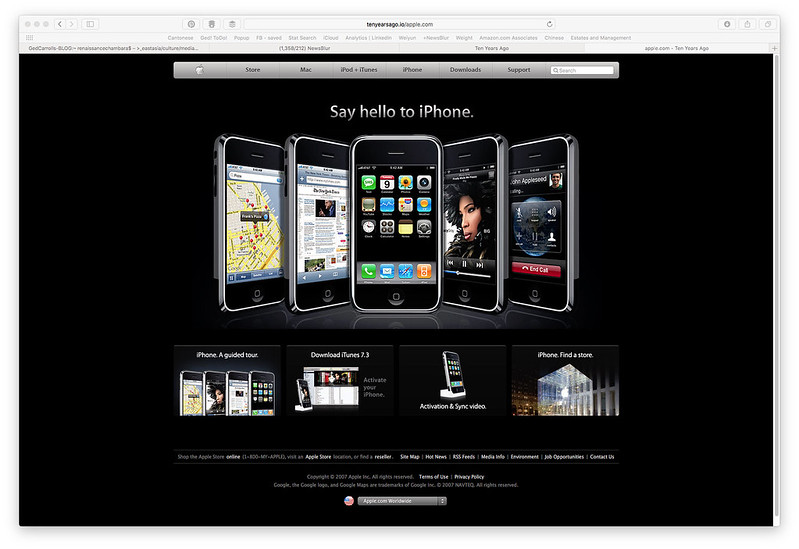
    I looked back on Apple’s website from 10 years ago following the launch of the iPhone I realised how fad driven web design could be.

    Apple's website circa 2007

    In particular notice the reflection was very now at the time. Javascript had taken off with web 2.0 and someone came up with a block of code that did reflections on images a la the image effect you can get in PowerPoint. This then drove a wider trend to do this in code or in InDesign. You can blame the font gradient on a similar ‘cool Javascript hack’ to design trend meme as well.

    SaveSave

  • Vic Gundotra + more things

    Vic Gundotra – The end of the DSLR for most people has already… – ex Googler Vic Gundotra endorses the iPhone as a camera phone for structural reasons in the Android community, of course you could always use a third party camera software instead. What’s more interesting is the implications around system-level innovation and hardware support

    Summer of Samsung: A Corruption Scandal, a Political Firestorm—and a Record Profit – Bloomberg – interesting profile of Samsung. Interesting that they don’t realise Huawei is the big bad wolf yet

    The myths of the digital native and the multitasker – ScienceDirect – fits in with what I’ve seen in terms of empirical evidence, millennials are just as bad at technology as the rest of us (paywall)

    Russia Bans’Uncensored’ VPNs, Proxies and TOR | Torrent Freak – interesting implications for China. I wonder how they would achieve all this?

    Announcing Ghost 1.0 – possible WordPress replacement or niche player?

    The ‘real’ reasons manufacturing returning to US – Yahoo! Finance – it depends how you measure costs. Automation requires more capital, upfront costs and benefits big production runs in certain industries. Automation more limited in batch contract manufacturing. Still barriers: ecosystems of suppliers, expertise, skills and access to critical raw materials (rare earth metals, cobalt and coltran). A crisis in shipping (such as the collapse of Hanjin Shipping) will hit both international long supply chains and Chinese finished products equally hard

    Chinese Fintechs Use Big Data To Give Credit Scores To The ‘Unscorable’ – I wonder how this intersects with the PRC govt social scores?

    Turn Off, Drop Out: Why Young Chinese Are Abandoning Ambition – interesting for the subtle differences between this and gen-x style slackers

    Google Adds Autoplay Video to Search Results Page | The SEM Post – this will be terribly annoying

    eBay Powers Searching and Shopping with Images on Mobile Devices – eBay Inc – interesting move turning every shop into a potential showroom for the eBay marketplace

    P&G cuts more than $100 million in largely ineffective digital advertising | WSJ – (paywall)

    Trending posts — Steemit – paid social network. Apparently digital payments of some sort are given per post. They are held in a blockchain database. I won’t lie, I’m sceptical to say the least

    Hong Kong’s Lee Kum Kee Group to buy London’s ‘Walkie Talkie’ building in historic £1.3b deal | South China Morning Post – interesting that Hong Kong investors think that central London office property is cheap enough to make big deals like this. I think they might be disappointed at least from the short to medium term. It could be a play to gain a UK foothold well in advance of Hong Kong’s final assimilation by the motherland

    Inside LeEco’s spectacular fall from grace | Engadget – I was reminded of an old client Enron, when I started reading about LeEco. Like Enron, LeEco started off in one business (video streaming) and then exploded into several other sectors at once before collapsing under the weight of its ambition. Like Enron, I was left feeling that LeEco just didn’t make sense, except in the mind of a megalomaniac with wicked Excel skills

  • What does a great email look like?

    I often end up with my head in the data and need to check myself to ensure that the basics are happening. This was a deck that I pulled together on what does a great email look like?

    Why email marketing? Because it still works and provides relatively good value in terms of marketing spend. We might be getting ever lower open rates over time in aggregate, but that means as marketers we need to be more focused on what makes a great email.

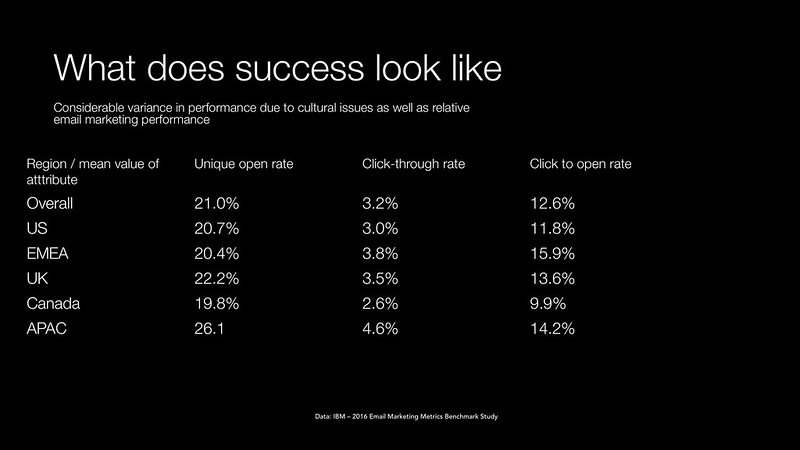
    So what does success look like, what constitutes great? If you work in digital marketing you probably have heuristics in the back of your mind based on an article you’ve read or how previous projects have turned out.  The reality is that it changes by country and by industrial sector.

    What does success look like

    There are some interesting variations, such as the US / Canada or UK / Canada click to open rates for email.

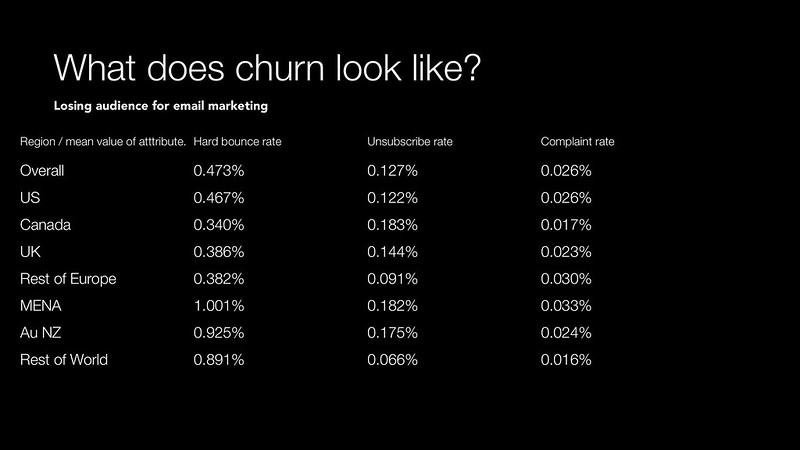
    What does churn look like

    Or the comparatively high of churn rate in the UK vis-a-vis the US and Canada.

    Getting to open

    There are a number of factors that can aid getting to open. Some of them will be hygiene when the General Data Protection Regulations kick in across the EU next year.

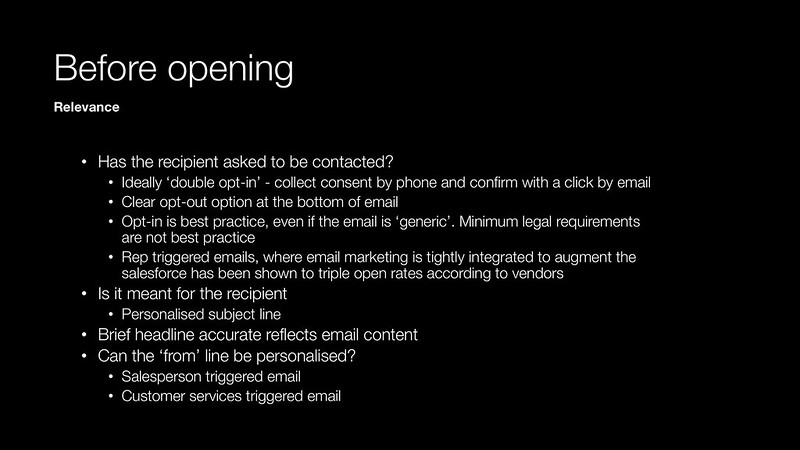
    Before opening

    A lot of the basics seem obvious, yet there is a lot of unpersonalised, unrequested, irrelevant mail is still sent out. For business-to-business relationships in particular having a phone and online double opt-in is desirable. For consumer marketing an online opt-in followed by a confirmation email and opt-in link.

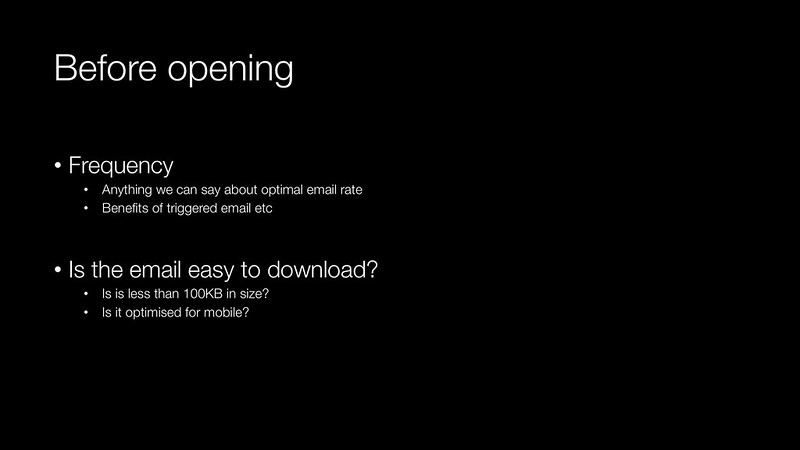
    Before opening

    In some ways we have gone back to the early web. Lean download sizes for email are really important. There have been so many times I have been deleting marketing email on the tube, as the mobile device and spotty wifi can’t download the image heavy communication in a timely manner. For some reason clothing and shoe e-tailers are really bad on this.

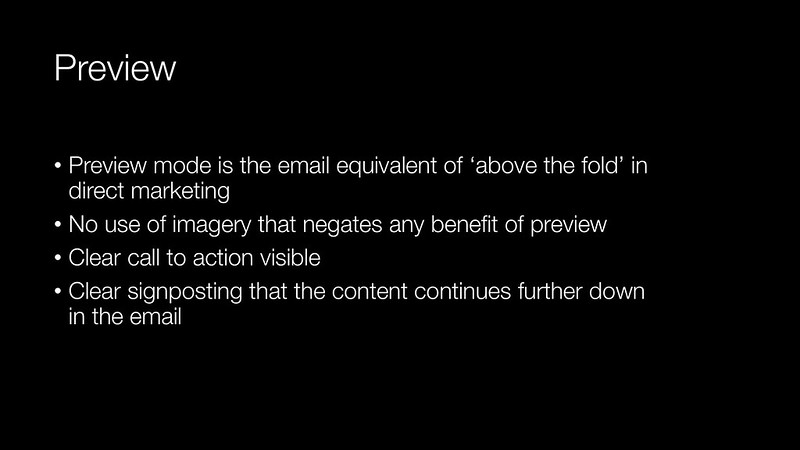
    Preview

    Back when I started in digital marketing, people laboured long-and-hard over crafting highly clickable message subject lines, but preview is as important now; especially in ‘three pane’ email clients like Outlook or Mail.app on Mac and iPad.

    Design

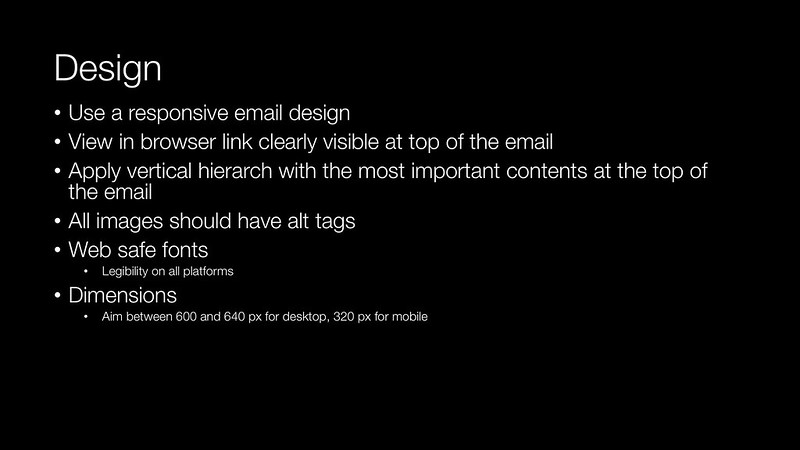
    Design is a key part of getting an email viewed. The design needs to be responsive because of the variation in possible device display sizes and the foibles between email clients, web email clients, web browsers and mail providers. Previously one would have worried about not being black listed (still important), plain text and HTML options. Business to business marketers used to get stressed over will the email work on Lotus Notes (historically no, unless it was in plain text).

    Inverted pyramid approach

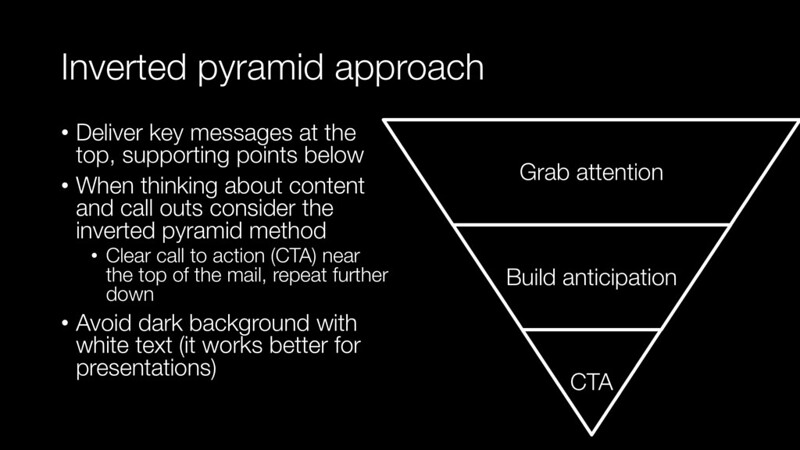
    When you are thinking about content and design layout the inverted pyramid approach is a good place to start from. With the call to action what kind of behavioural cues would work best? This is where A/B testing can be employed. Marketers aren’t great at intuitively picking these.

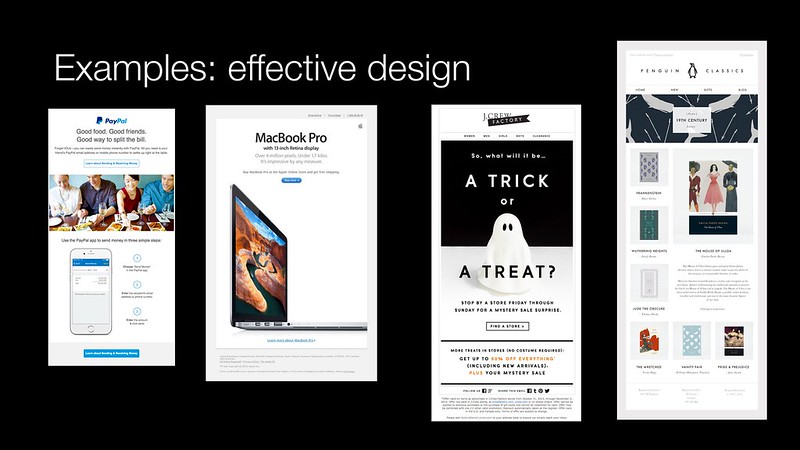
    Here are some examples of effective email design, notice the vertical alignment that makes them mobile friendly

    Effective design examples

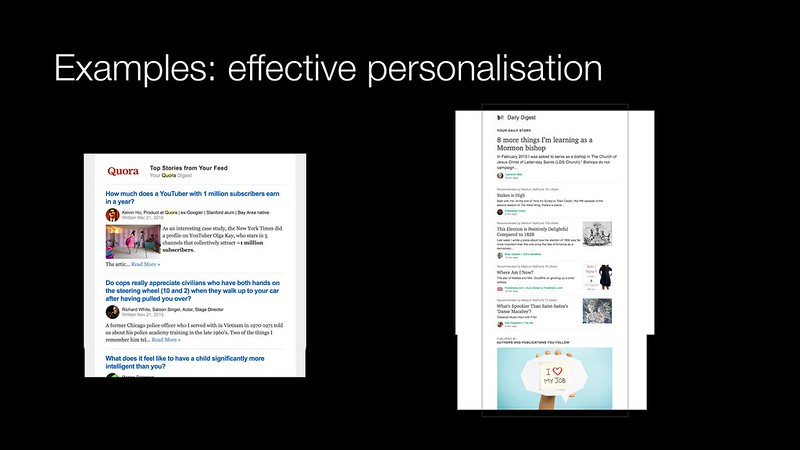
    And here are some examples of effective personalisation (in both these cases based on previous behaviour on-site).

    Effective personalisation examples

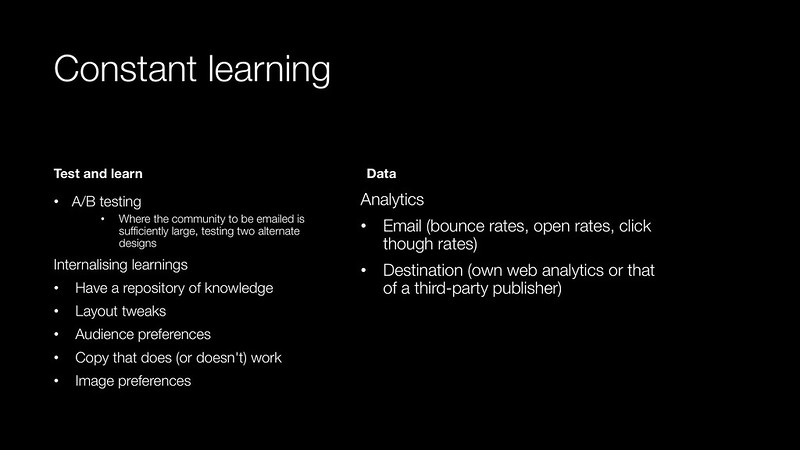
    The biggest mistake that organisations fail to do is internalise learnings from previous campaigns. This isn’t just about improving numbers over time but learning what has, and hasn’t worked. Often this knowledge will disappear when the marketer responsible moves on, or when the agency responsible has a similar change on their side.

    Constant learning

    Thanks for making this far, here are my details if you want to find out more.

    About me

    You can find this presentation on Slideshare.

  • Audrey Li + more things

    My friend and former colleague Audrey Li wrote a great rambling essay. Audrey’s family live in a small town / village in Sichuan province. Sichuan is in the west of China. The essay covers WeChat, payments, crime and the party’s fight against pollution. WeChat scams are surprisingly common for an authoritarian regime that surveils everything. Although Audrey’s Mum seems to have a similar level of technology literacy to my Mum and Dad, I am surprised she uses mobile payments. The battle against pollution has hard costs, which Audrey Li goes into – Smart Phone, No-cash Society, and Jobless — A Short Conversation with My Mother

    Line loses users in 3 of its most important countries – interesting changes in Taiwan, Indonesia and Thailand. I wonder what has eaten into LINE’s market share outside Japan? Maybe LINE has to provide a more fully featured experience like LINE Japan

    Dissecting the Jimmy Choo Michael Kors Deal | News & Analysis | BoF – The Jimmy Choo deal was part of a wider Michael Kors strategy. Michael Kors appears to be focusing on creating a collection of ‘affordable luxury’ brands, a strategy that mirrors Coach’s approach. This differs from companies like LVMH and Kering, which concentrate on high-end luxury brands. Additionally, LVMH and Kering are more established, possessing numerous brands and centralized systems to leverage their combined strengths. I find it interesting that Jimmy Choo is now ‘accessible luxury’. The comparison with Coach is very interesting, it does make one wonder two things:

    • Do American luxury brands have ‘brand permission’ to do high end luxury?
    • Given that accessible luxury and the ‘high-end luxury’ of Kering, LVMH etc. both actually rely on middle class customers for the bulk of their sales – who will win out in a downturn?

    More luxury orientated content here.

    Is Beijing getting serious about selling off state firms? | SCMP – Tencent and Alibaba buying into Unicom could be an interesting dynamic. The big would be around the extra power these groups would get. I could see China going the other way greater state enterprises rather than market liberalisation

    Kaspersky’s stellar antivirus finally goes free | PCWorld – feature limited but powerful