Blog

  • Optimising for platforms

    Optimising for platforms rather than clients and audiences. Three years ago I taught an interactive marketing module at the business school of a private university in Barcelona. It was a great experience presenting to a number of senior executives and up-and-coming talent from various parts of Spanish industry including advertising and interactive agencies. I ended up learning from them as much as they learned from me.

    One of the attendees talked about listening to what his clients wanted, but that he really focused on building sites that Google wanted him to build; when the client wishes and Google were in conflict, Google won out. At the time the phrase struck me as it illustrated the pinnacle of Google’s power on the internet.

    The internet maybe open, it may be based on standards which means that you can see broadly the same experience across different platforms and browser software; but that’s no good if no one ever sees you site, modern-day equivalent of the classic philosophical question:

    If a tree falls in a forest and no one is around to hear it, does it make a sound?

    However even if you don’t rank highly in Google, it can still be promoted in other ways. The other week I was at a conference when I heard one of the audience as a question about the wisdom of:

    Buiding a business in Mark’s house

    That is building a business on the Facebook eco-system. I was reminded of the earlier discussions I had in Barcelona around the power of Google.

    Facebook wasn’t a new idea, there have been social networks for as long as there has been the commercial internet.

    • The Well
    • AOL in some of its earliest incarnations as a BBS (bulletin board system) for Macintosh computers provided some of the functionality that Facebook pages and groups do now. AOL gave users 2MB to create their own personal presence on the web through a tool called Personal Publisher (it could be found with the keyword PP2 – it wasn’t called search back then) a kind of pre-Geocities.com page that does what your profile on Facebook does now
    • And if you enjoy Zynga’s Farmville or Cityville, these owe a huge debt to Lucasfilm’s Habitat developed by former Yahoo Randy Farmer and sat on the AOL platform some 25 years ago

    Many of the innovations that Facebook has since come out with like email and instant messaging, are features that AOL and others had since the internet first became popular. The contrast between the two is more about scale, whilst AOL was phenomenally popular with 30 million subscribers at its peak (who also paid for line access), and still reaches 112 million unique users on a monthly basis; but it was never omnipotent in the way that Facebook became.

    Facebook has an unsurpassed reach, kind of like a telephone directory for large swathes of the world – a de-facto real identity check. This powerful position is one that Clay Shirky says won’t be changed for the foreseeable future.

    You have to be on Facebook, even if you don’t engage with it (and engagement is something that Facebook seems having issues with for a good while).

    So businesses have gone to the logical step of building their web presence on a platform that they think is most consumers online homebase (as I read it described in Larry Weber’s Everywhere).

    So whilst Facebook may not control as much advertising budget as it likes; it wields a huge amount of consumer power and power over businesses that decide to use the social network as a platform – and that’s not likely to change any time soon.

    There are a number of factors to consider around Facebook:

    • Facebook abuses its position with consumers and I don’t need to discuss it here as it’s been well documented elsewhere already
    • Then there is the impermanence of web APIs, Nick Bradbury wrote a great post about this where he name-checked Facebook’s depreciated FBML, but to be fair, Google and Yahoo! have either changed the terms of APIs to make them less viable or got rid of them completely. So your platform may be here today gone tomorrow. From my experience, at the very least you are subject to browser compatibility problems and relatively high unpredictable down-times
    • It has become a crutch for marketing agencies in the way that the the answer to all consumer marketing used to be the 90-second television advertisement – I am surprised that so many brands are surrendering their reputation to Facebook given the concerns that had been voiced by marketers about Google’s power in recent times

    Marketers would be well advised to take a more pragmatic approach, think about where they are sending their traffic – who ‘owns’ the customer experience and take a portfolio or multi-channel approach to a campaign. More related content here.

    More information:

    Is it possible to replace Facebook? – interesting article by the research and development team at Norwegian state broadcaster NRK

    How Ford Blew It On Facebook | Advertising Age – why drive people via advertising to your Facebook page when you can drive them to your own property?
    The long-term failure of web APIs | Nick Bradbury

  • Extreme couponing

    Extreme couponing – is a phrase that I came across in the Knowledge@Wharton newsletter to describe the way hard-pressed value conscious consumers in North America are using offline vouchers and online resources including comparison shopping and coupon websites to make their grocery spend to go further. Having worked on FMCG programs rolled out in North America, the continued power of local newspaper and electronic coupons are famous.

    Coupons and extreme couponing were historically associated with thrifty older consumers who carried on family traditions developed during and post the great depression.

    Some US supermarket retailers built up a reputation for being ‘coupon friendly’ stores. But that might present its own problems. The average basket value might be much lower. Also the productivity of cashiers might be lower as they have to process all the coupons submitted. If the coupons aren’t valid for that supermarket that might result in a customer stand-off that needs to be resolved with the help of store management.

    The more astute of you may remember seeing coupon clipping and usage in historic episodes of Roseanne (what then become The Conners).

    Which begs the question what’s new that’s driving extreme couponing now? The answer seems to be a combination of food price inflation, low-to-no wage growth and an uncertain economy with high unemployment has led consumers to change their shopping. Pharmacy chains like Walgreens have benefited from business previously done as a one-stop shop in the supermarket since they will accept coupons for personal hygiene and cleaning products. The big issue is for the major brand companies like General Mills, Unilever and Procter & Gamble who are seeing brand loyalty eroded.

    Alongside an increase in coupon adoptions you are seeing bulk buying to hedge against inflation, rather than consumers trying to save the money itself in bank account. More retailing related content can be found here.

    More information

    Brand Disloyalty: Recession-weary Consumers Take Discounts to the Extreme

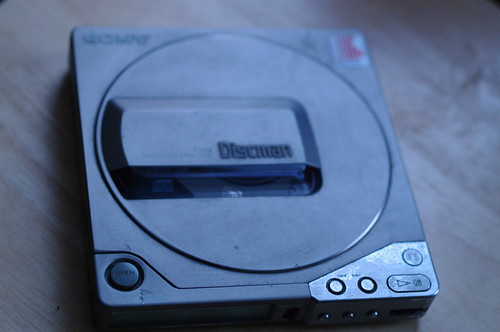
  • Sony Discman D-250

    When you think about the likes of the Sony Discman D-250 you need to realise what it was like growing up in the 1980s. It meant that personal music on the move was a ghetto-blaster perched on your shoulder annoying the neighbourhood or a Sony Walkman personal stereo. I was really fortunate in that I had a half decent Walkman WM-24 which whilst bulky gave half decent sound. It was more expensive looking than it actually was but the Dolby noise reduction made a big difference. This eventually died on me and I ended up with a more modern, but poorer quality Walkman WM-36.

    But a CD player was what you really wanted, for decent sound.
    Sony D-250 Discman
    I poured over the Sony catalogues working out which one I wanted (the Sony D-Z555) versus the best that I could afford (the Sony D-250). The Sony D-250 Discman was in Sony’s premium Discman range, featuring a pressed metal chassis and a NiCD rechargeable battery the size of a packet of Dentyne gum. Eventually the battery dying and my not being able to buy a replacement battery would see it do hi-fi duty. Portable music would have me use a Sony DCS901 Sports Discman. This also played CD-Rs full of MP3 files – it was my pre-iPod and had a battery life of almost 40 hours, but more of that another time.

    The Discman D-250 came with line-out connection for a hi-fi and you could attach a wired remote control. It could be programmed to random play, play tracks in a specific order and access CD ‘index marks’. These index marks put you to predefined points in a specific recording and at the time were only used in some classical recordings. As a standard it wasn’t widely supported but would have leant itself well to the mix CDs that started to come along a few years later from Mixmag Live.

    The CD has served me well as a player for my hi-fi system because of its rugged mechanicals and decent electronics long after I started using an iPod for portable music and its more sophisticated brother the D-Z555 is highly prized by hi-fi enthusiasts for the same reason, particularly as it featured a digital output as well.

  • London conference on cyberspace

    The Foreign and Commonwealth Office of the British Government has always had the best online presence of all the different government departments, but I still find it interesting that it is they rather than the department of media and culture who are looking to lead a discussion on the future of the web and associated technologies. The FCO are hosting a conference on cyberspace in London on November 1-2, 2011 and are extending it online through social media platforms. I can’t help but feel the dialogue is aimed as much within the UK as internationally.

    Of course, the ironic thing is that the UK isn’t at all progressive in terms of all things internet related compared to the likes of South Korea, Singapore, Hong Kong, Australia, Iceland or Finland to name but a few countries. The Digital Economy Bill and actions done by the likes of Ed Vaizey have shown resistance rather than working out how it can benefit from the change. The music industry tried to fight the change and has torn itself apart so it will be interesting to see how that stance will work out. I look forward to following the conference on cyberspace; in cyberspace.

    Find out more here. More online related topics here.

  • Think Outside Stowaway

    I first got hold of a Think Outside Stowaway portable keyboard at the start of my agency career. It was 2000, the over-enthusiasm for internet-based businesses, alternative telecoms providers and Linux eco-system businesses was in full-swing and I was building my agency career helping further fuel the economic bubble.

    Broadband wasn’t a word in common parlance, streaming video windows were about the size of a postage stamp; that didn’t stop sites like UK business technology site Silicon.com from trying to develop and promote video content for the web.

    We weren’t living in the real-time always-on world of now. At this time wi-fi devices were online starting to be launched on to the market and was some way from adoption. Wireless meant using IrDA infra-red connections between devices (like a TV remote control having a long conversation) and wireless data meant the then new digital mobile phone networks with SMS and patchy voice services.

    You could could get some Nokia and Ericsson phones to talk to other devices to connect to the internet but it wasn’t cheap. The only people I knew who used it were news photographers getting pictures over to picture desks at photo agencies and newspapers.

    My biggest client at the time was Palm who were spun out of 3Com with Carl Yankowski at the head of the company and Bill Maggs as CTO.

    I had gone out and bought a Palm Vx PDA three weeks before being put on the account (where I would have got one for free).  The Vx became my primary computing device, as I was away from home much of them working in the office, at client meetings or traveling. I started to write on it, but the stylus would only get you so far.

    I had looked at devices like the AlphaSmart 3000, which was cheap, ran on three AA batteries for weeks at a time, and could transfer text via USB. It had proper keys with decent travel on them and was sturdily made, but it had a similar footprint to a modern-day 13-inch MacBook Pro.

    I eventually ordered a Think Outside Stowaway portable keyboard from Amazon in the US. The keyboard used the Palm Vx as its ‘computer’ and and PDA became a compact word processor that would fit into two jacket pockets and was more productive than even the current iPad.

    I managed to draft emails to colleagues, positioning documents, media tour briefing documents and press releases on it. You could type away quite happily on the train or an airplane, which I frequently did when I went back home to see the parents.

    How on earth did a they get the Think Outside Stowaway keyboard to fit in a jacket pocket?

    This came down to a bit of product design genius by a Silicon Valley-based start-up called Think Outside Inc. who came up with a Jacob’s Ladder-type keyboard design which gave you 19mm keys and then folded into four sections – connected together with a flat ribbon cable. The pieces were locked together by sliding in two handles (the red bits in the picture above) to provide a stable flat keyboard. The design was so successful that Palm sold their own-branded version to be sold to people like me and Targus-branded versions did a similar thing for Handspring, Compaq and HP PDAs. But none of them had the elegant design solution collapsing the keyboard like the Think Outside Stowaway unit.

    A flip-up connector plugged into the serial port of the device and held the screen at an optimum position for viewing. Later versions of the keyboard used Bluetooth wireless connectivity, unfortunately the electronics were less tolerant of being folded up so the keyboards became less elegant and bulkier. Eventually Think Outside was acquired by cellphone charger company Mobility Electronics (iGo) and eventually touch devices pretty much killed the mainstream demand for a portable keyboard all together.

    You can still get keyboards that embody the ideas of the Think Outside Stowaway. Unfortunately, they aren’t any more compact or robust than their predecessor. Which is a shame given the prevalence of iPhone users is many businesses. More throwback gadget related content here.